
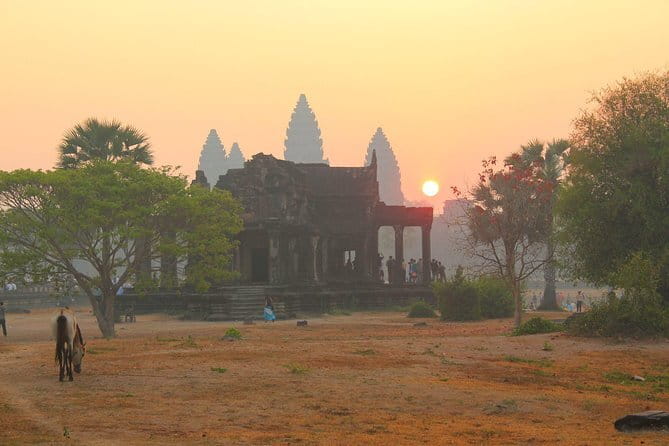
Reviewed · ANGKOR TEMPLE TOURS
Two Day Angkor Temples Tours
Banteay Srei’s pink sandstone carvings and Ta Prohm’s tree-covered ruins give this two-day tour a fine balance: one day reaches the quieter outer temples, while the other brings you to Angkor Wat and the great city of Angkor Thom. The private format lets your guide adjust the pace and explain the carvings instead of rushing you from gate to gate.
I especially like the mix of major sights and smaller temples, including Neak Pean and Ta Som, which many short Angkor tours skip. I also like the emphasis on flexible guiding and photography. Guides named in the feedback, including Borey, Kim, Bunleat, and Kimhoeun, are praised for clear English, cultural context, and help finding good picture spots. The main drawback is cost: at $102.57 per person, this is not the cheapest way to see Angkor, and temple admission and GST are extra.
In This Review
- Key points to know before you book
- Why this two-day route works so well
- Day 1: From Banteay Srei’s carvings to Pre Rup’s stone pyramid
- Banteay Srei, the artistic highlight
- Banteay Samre, a quieter Vishnu temple
- Preah Khan, a maze of corridors and carvings
- Neak Pean, a small temple on an artificial island
- Ta Som, a quick stop with a memorable gate
- Eastern Mebon, once surrounded by water
- Pre Rup, a strong final stop
- Day 2: Angkor Wat, Angkor Thom, and Ta Prohm
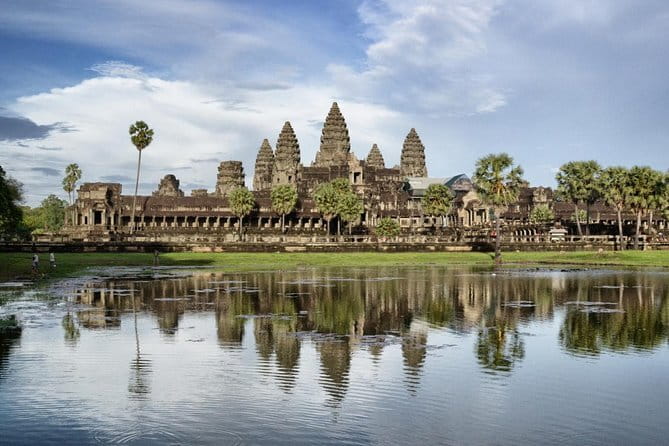
- Angkor Wat, the essential two-hour visit
- Phnom Bakheng, listed as a very brief stop
- Angkor Thom, the great walled city
- Ta Prohm, the atmospheric finale
- What the guides add to the stonework
- Private transport, pace, and physical demands
- Who should book this two-day Angkor tour?
- Should you book it?
- FAQ
- How long does the Angkor temples tour last?
- Is this a private tour?
- Is transportation included?
- Are Angkor temple admission tickets included?
- Which guides may lead the tour?
- Can I cancel for a full refund?
Key points to know before you book
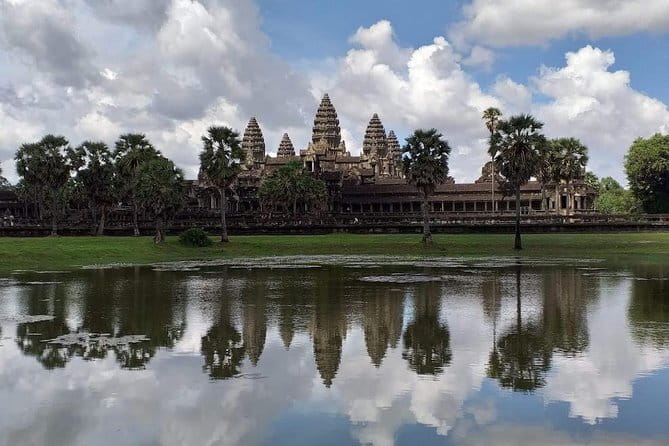
- Banteay Srei gives Day 1 a spectacular start: Its pinkish stone and fine carvings are unlike the larger temples closer to Siem Reap.
- The route includes seven temples on Day 1: Expect a full sightseeing day with stops ranging from 30 minutes to one hour.
- Day 2 covers the essential icons: Angkor Wat, Angkor Thom, and Ta Prohm form the core of the Angkor experience.
- You get a private vehicle and guide: Only your own group takes part, and the air-conditioned car matters in Cambodia’s heat.
- Guide quality is a central part of the experience: Borey, Kim, Bunleat, and Kimhoeun are named as guides who provide history, cultural explanation, flexibility, and photography help.
- Admission is not included: You redeem the tour at Angkor Enterprise, and you must budget separately for temple tickets and GST.
Why this two-day route works so well
Angkor is not one temple. It is a huge collection of monuments spread around Siem Reap, built by different kings and shaped by both Hindu and Buddhist beliefs. A good route should give you scale, variety, and enough explanation to make the stones meaningful.
This tour does that in two different ways. Day 1 moves through a long sequence of temples, from the delicate carvings of Banteay Srei to the broad temple-mountains of Eastern Mebon and Pre Rup. Day 2 focuses on the three names most people hope to see: Angkor Wat, Angkor Thom, and Ta Prohm.
I like this division because it saves the best-known monuments for a day when you can give them more attention. Angkor Wat receives two hours, Angkor Thom two hours, and Ta Prohm one hour. Those time estimates are not a guarantee, but they suggest a useful pace rather than a quick photo stop at every site.
The private format also matters. You are not tied to the interests or energy of a large group. If you want more time with a particular carving, or if your family prefers photography to a long lecture, the guide can respond. The strongest feedback focuses on this flexibility, especially from people who had a particular interest in Ta Prohm or wanted detailed explanations.
More Angkor temple itineraries:
- Angkor Wat Sunrise or Sunset Tour with Guide from Siem Reap
5.0 · 12,109 reviews - Siem Reap: Angkor Wat: Small-Group Sunrise or Sunset Tour
5.0 · 9,444 reviews - Siem Reap: Angkor Wat 2-Day Tour with Sunrise and Sunset
4.9 · 4,429 reviews
Day 1: From Banteay Srei’s carvings to Pre Rup’s stone pyramid
Banteay Srei, the artistic highlight
Banteay Srei is often called the jewel of Angkorian art, and the reason is easy to understand. Built in the 10th century as a Hindu temple dedicated to Shiva, it is cut from pinkish stone and covered with unusually fine carvings.
You have about one hour here. That is a sensible amount of time for a first visit, since the temple is smaller than Angkor Wat but rewards close looking. Pay attention to the detail in the lintels, doorways, and figures. This is a place where a guide can add real value by pointing out what you might otherwise walk past.
Banteay Srei is also a useful introduction to the range of Angkorian architecture. It feels more intimate than the huge royal complexes, and its delicate stonework makes a strong contrast with the massive structures later in the tour.
Banteay Samre, a quieter Vishnu temple
The next stop is Banteay Samre, built in the 12th century under Suryavarman II, the same king associated with Angkor Wat. It was dedicated to Vishnu and remains in fairly good condition.
You get about an hour here. The temple offers another chance to see the design language of the Angkor period without the scale of Angkor Wat. Its connection to Suryavarman II also helps set up the next day, when you visit the king’s great monument.
I would ask your guide to compare Banteay Samre with Banteay Srei. The contrast is useful: one is prized for delicate 10th-century carving, while the other belongs to a later period and feels more like a compact temple complex.
Other Siem Reap experiences to weigh up
- Angkor 2-Day Sunset & Sunrise Small-Group Tour
5.0 · 2,567 reviews - 2 Days Exclusive Temple Highlights with Sunset and Sunrise Tour
5.0 · 1,157 reviews - Siem Reap: Angkor Sunrise 1- or 2-Day Guided Temples Tour
4.9 · 1,132 reviews - 2 Days Guided Historical Tour in Angkor
5.0 · 855 reviews
Preah Khan, a maze of corridors and carvings
Preah Khan means Sacred Sword, and it is one of the largest complexes at Angkor. The planned stop is one hour, though detailed explanation or photography can easily tempt you to linger.
The appeal here is movement through the structure. You pass vaulted corridors, carved walls, and stonework marked by age. Preah Khan is often treated as a companion to Ta Prohm, but it offers a different mood. Its corridors and layers make it feel like a place to explore rather than simply admire from the outside.
The route gives you a good reason to visit Preah Khan before Ta Prohm. You see one large complex with a somewhat quieter atmosphere, then encounter Ta Prohm on Day 2 as the more famous tree-covered ruin.
Neak Pean, a small temple on an artificial island
Neak Pean is a short stop of about 40 minutes. Built by Jayavarman VII, this Buddhist temple sits on an artificial island in the middle of the man-made lake known as Jayatataka, or the North Baray.
Its small size gives your day a change of rhythm after Preah Khan. Rather than wandering through a vast complex, you focus on a compact temple with a distinctive setting. The intertwined-snake name refers to the temple’s design and symbolism.
This is one of the stops where a guide’s explanation can make the visit more rewarding. The waterworks and island setting are part of the story, not just background scenery.
Ta Som, a quick stop with a memorable gate
Ta Som is another temple built by Jayavarman VII in the late 12th century. It is small, and the planned visit lasts about 30 minutes, but it earns its place because of the large carved head at the eastern gate.
Do not expect a long exploration here. Think of Ta Som as a focused stop where you see a memorable feature, hear how it relates to nearby Preah Khan, and take a few photographs. The short time can be a welcome break during a day with seven temples.
Eastern Mebon, once surrounded by water
Eastern Mebon was built by Rajendravarman II between 944 and 968. It was originally located on an island in the Eastern Baray, a large reservoir, although the water is gone and the temple now sits on dry land.
The scheduled visit lasts about 50 minutes. This stop helps you understand how Angkor’s temples were connected to major water projects. The change from island temple to dry-land monument also shows how much the setting of Angkor has changed over time.
Eastern Mebon is a Hindu temple, so it adds another period and religious layer to the day. After the later Buddhist temples of Jayavarman VII, the shift back to an earlier Hindu monument gives the route welcome variety.
Pre Rup, a strong final stop
Pre Rup was built by Rajendravarman II in the 10th century, about one kilometre south of Eastern Mebon. Like Eastern Mebon, it is a Hindu temple. Its pyramid form rises through three tiers, creating the powerful temple-mountain shape associated with Angkorian architecture.
You have about 40 minutes here. That is enough to understand the basic plan and see how the upper levels relate to the lower terraces, though the climb may require moderate physical effort. The day ends with a monument that feels bold and geometric after the smaller carvings and corridors earlier on.
Day 1 covers a lot. Seven stops, even with short visits, can leave you tired. The upside is range: you see fine carving, water architecture, Buddhist temples, Hindu sanctuaries, corridors, gates, and pyramid temples in a single day.
Day 2: Angkor Wat, Angkor Thom, and Ta Prohm
Angkor Wat, the essential two-hour visit
Angkor Wat was built by Suryavarman II in the 12th century as a Hindu temple dedicated to Vishnu, the deity with whom the king identified. It is the largest and most famous monument in the Angkor complex, and the tour allows about two hours.
That time gives you a chance to look beyond the first grand view. Ask your guide to explain the temple’s religious purpose, its connection to Suryavarman II, and the carvings you encounter. Angkor Wat can feel overwhelming because of its scale, so a clear route through the complex helps you use your time well.
This is also where the guide’s photography experience may help. The feedback places special emphasis on finding good picture spots and helping with phone photography. You should still expect to do your own looking, but practical advice can make a difference when the temple is crowded or the light is changing.
Admission is not included, so confirm the current Angkor ticket requirements before the visit. The redemption point given for the experience is Angkor Enterprise on Apsara Road in Siem Reap.
Phnom Bakheng, listed as a very brief stop
Phnom Bakheng was built by Yasovarman I in the early 10th century and is described as the first temple-mountain built near Angkor. It has five tiers and seven levels.
The schedule lists only one minute here. That is unusually brief, so you should clarify with the guide how this stop will work. It may function as a quick orientation or passing point rather than a full temple visit. Do not build your expectations around a long climb or extended exploration unless the operator confirms a change.
Even with limited time, Phnom Bakheng matters as architectural context. It helps you see how the temple-mountain idea developed before the later monuments became larger and more complex.
Angkor Thom, the great walled city
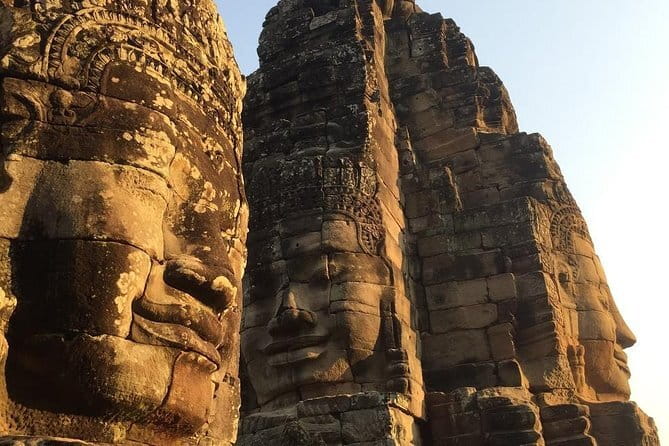
Angkor Thom means Great City and was the last city of Angkor. It was built by Jayavarman VII and may have supported a population of one million people in the surrounding region at its height. The city is centered on the Bayon.
The two-hour stop is one of the most useful parts of Day 2 because Angkor Thom is not a single monument. It is a city area with a broader story about power, religion, and urban life. Your guide can help you understand how the Bayon fits into the city rather than treating it as an isolated pile of carved stone.
This is also a good point to ask questions about the shift from Hindu worship to Buddhist monuments under Jayavarman VII. The tour includes both traditions, and that comparison is one of the best reasons to hire a private guide instead of relying only on signs.
Ta Prohm, the atmospheric finale
Ta Prohm is the final listed stop and receives about one hour. It is famous for the way trees have grown through and over the ruins, giving the temple a strong sense of age and drama.
The appeal is not just the trees. Ta Prohm was built by Jayavarman VII, the same king connected with Preah Khan, Neak Pean, and Ta Som. Seeing several of his projects across the two days lets you compare a large complex, a water-centered temple, a small satellite temple, and this heavily overgrown ruin.
The private setup is especially useful here. One family described enjoying Ta Prohm so much that the guide adjusted the plan for them. That is the sort of flexibility you should ask about before booking: if one site captures your imagination, can you spend longer there or alter another stop?
What the guides add to the stonework
The experience provider presents the guides as flexible and focused on history, photography, and your interests. The named guides include Borey, Kim, Bunleat, and Kimhoeun, but you should confirm who will lead your tour.
Borey receives repeated praise for clear English, responsiveness before the trip, family knowledge of Siem Reap, and strong explanations of Angkor’s history. Kim is praised for connecting the temples with Cambodia’s more recent past. Bunleat is described as willing to give very detailed explanations, which may suit you if you want a slower, more intellectual visit.
Kimhoeun is also named as a guide who helped provide a caring and informed two-day experience. The important point is that the quality of the tour depends heavily on the person assigned to your group. If you have a preference, request a specific guide early, but do not assume that person is guaranteed to be available.
Good guiding here means more than listing dates and kings. Hindu and Buddhist symbols can be difficult to read without context, and the same architectural form can serve different religious purposes. A guide who can explain those links will make the temples easier to remember.
Private transport, pace, and physical demands
The tour uses an air-conditioned vehicle, a welcome feature in Siem Reap’s heat. Pickup is offered, but the stated ticket redemption point is Angkor Enterprise on Apsara Road. Confirm the exact pickup arrangement when you book, especially if you want hotel collection.
This is a private activity, so only your group participates. That gives you more control than a large coach tour, though private does not mean relaxed every minute. Day 1 includes seven stops, and Day 2 includes four major areas. You should be ready for walking, standing, uneven surfaces, and temple steps. The required fitness level is moderate.
Group discounts are offered. Since the price is listed at $102.57 per person, the value improves when shared among a small private party, particularly if you care about personal attention. The cost is less attractive if you only want transportation and quick photographs, since temple admission and GST are not included.
You receive confirmation when booking. Free cancellation is available up to 24 hours before the start time. Cancellations within 24 hours are not refunded, and poor weather may lead to a new date or a full refund.
Who should book this two-day Angkor tour?
I would choose this for a first visit to Angkor when I wanted the major monuments plus a wider sense of the complex. It suits families, couples, and small groups who prefer asking questions and setting their own pace.
It is also a good match for photographers. The route includes strong visual variety, from pink sandstone and fine carvings to tree-covered ruins and pyramid temples. The guides’ interest in photography, including phone photography, is a useful bonus.
I would think twice if your priority is the lowest possible price, or if you want a very slow visit to only two or three temples. Day 1 is packed, and the short Ta Som and Phnom Bakheng stops may feel too quick for someone who wants extensive exploration at every site.
Should you book it?
Book this tour if you want a private, two-day introduction that combines Angkor Wat and Ta Prohm with less familiar places such as Banteay Srei, Neak Pean, and Eastern Mebon. Its strongest feature is the guide-led flexibility, especially if you are matched with someone such as Borey, Kim, Bunleat, or Kimhoeun and communicate your interests in advance.
Before paying, ask who your guide will be, how pickup works, what the Phnom Bakheng stop includes, and what you will pay separately for admission and GST. If those details suit you, the price is reasonable for a private vehicle, personal guiding, and a route that goes well beyond the usual headline temples.
FAQ
How long does the Angkor temples tour last?
The experience lasts approximately two days. Day 1 includes seven temple stops, while Day 2 includes Angkor Wat, Phnom Bakheng, Angkor Thom, and Ta Prohm.
Is this a private tour?
Yes. Only your own group participates in the activity.
Is transportation included?
An air-conditioned vehicle is included. Pickup is offered, but you should confirm the exact pickup details when booking.
Are Angkor temple admission tickets included?
No. Admission tickets are not included. The stated ticket redemption point is Angkor Enterprise on Apsara Road in Siem Reap.
Which guides may lead the tour?
The named guides associated with the experience include Borey, Kim, Bunleat, and Kimhoeun. Guide availability can vary, so request your preferred guide when booking.
Can I cancel for a full refund?
Yes, if you cancel at least 24 hours before the experience start time. Cancellations or changes made within 24 hours are not refunded, and poor weather may result in a different date or a full refund.
Fresh reviews from around Siem Reap
- Full-Day Tour Preah Vihea & Koh Ker Temple 3.7 · 3 reviews
- Savor the Countryside: Tours with Authentic Cooking Classes” 5.0 · 3 reviews
- Angkor Wat Sunrise TukTuk Tour 5.0 · 3 reviews
- Angkor Grand Circuit Tour & Banteay Srei 5.0 · 3 reviews
- Guided Private Tuk Tuk Tour Angkor Wat and Small Circle and Five Extras 5.0 · 3 reviews
- Siem Reap Temple Tour 2-Day with Sunrise/Sunset 3.7 · 3 reviews
- Bangkok to Angkor Wat 2 Days 1 Night by Flight 4.5 · 3 reviews
- Kompong Pluk Tour 5.0 · 3 reviews
Angkor Temple Tours, compared.

Angkor Wat Sunrise or Sunset Tour with Guide from Siem Reap
Read our review →



Angkor Wat Sunrise tour with Small – Group and Guide tours
Read our review →
Angkor Wat Highlights and Sunrise Guided Tour from Siem Reap
Read our review →

Full-Day Angkor Wat Sunrise Private Tour with Guide from Siem Reap
Read our review →Browse the lists this tour appears in