
Reviewed · ANGKOR WAT SUNRISE TOURS
Siem Reap: Angkor Sunrise 1- or 2-Day Guided Temples Tour
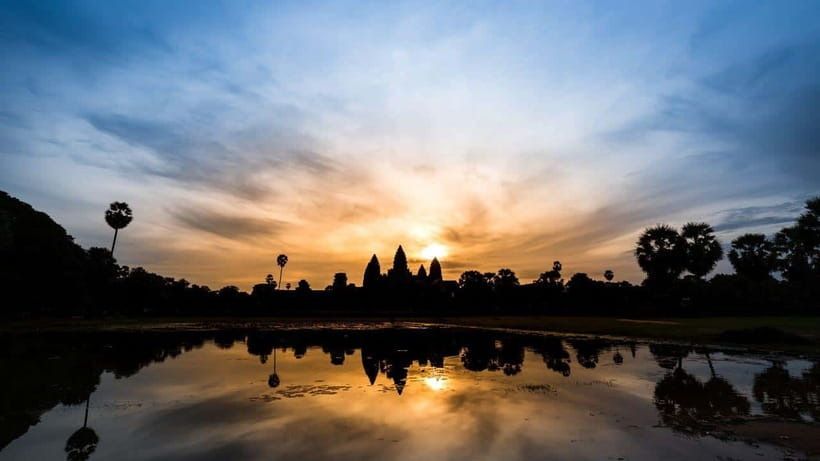
Angkor Wat at sunrise is the main event here, but the clever part is what comes after: you keep exploring while the day is still young, then return for a string of temples that show how varied the Khmer Empire could be. I like the two-day route’s mix of famous and quieter sites, especially Banteay Srei and Preah Khan, which feel quite different from Angkor Wat.
I also like the practical care built into the day. The air-conditioned vehicle, regular bottled water, and cold towels matter in Cambodia’s heat, and guides such as Sak, Pal Saruon, and Sokpee are praised for adding local stories, finding good photo spots, and allowing time to look around on your own. The drawback is the schedule: Day 2 begins around 4:20 AM, and Day 1 may run late because sunset is part of the plan.
In This Review
- Key points at a glance
- Why the two-day plan makes sense
- Day 1: Banteay Srei and the Grand Circuit
- Neak Pean and Preah Khan
- Day 2: Angkor Wat before breakfast
- Angkor Thom and Bayon’s stone faces
- Ta Prohm and the jungle setting
- Guides, drivers, and the small-group setup
- Price, temple pass, and overall value
- What to bring and how to pace yourself
- Who should book this tour?
- Should you book it?
- FAQ
- Is the temple pass included in the tour price?
- What time does the sunrise day begin?
- What temples are included in the two-day tour?
- Is food included?
- What does the tour provide during the day?
- What should I wear at the temples?
- Is the tour suitable for children or wheelchair users?
Key points at a glance
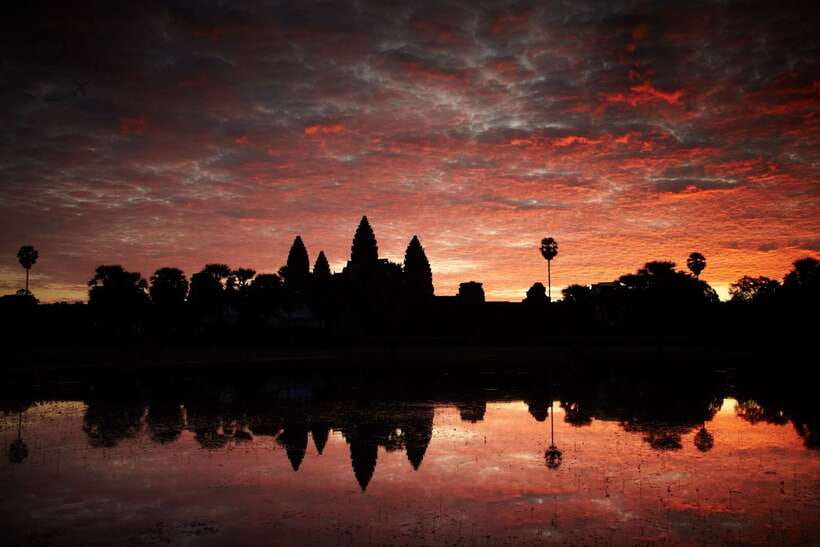
- Sunrise at Angkor Wat: Leave Siem Reap before dawn and spend about two hours inside the temple after sunrise.
- A strong two-day temple mix: See Angkor Wat, Bayon, Angkor Thom, Ta Prohm, Banteay Srei, Preah Khan, Neak Pean, and Pre Rup.
- Good guide support: English-speaking guides including Sak, Pal Saruon, Sokpee, Pi, Bun, and others explain carvings, religion, royal history, and Cambodian life.
- Useful relief from the heat: The vehicle has air conditioning, while the driver supplies bottled water and cool towels.
- Small-group format: Groups are limited to 15, though some departures have been much smaller.
- Budget price, extra ticket cost: The advertised $19 covers transport and guiding, but the Angkor temple pass costs $62 per person for two or three days.
Why the two-day plan makes sense
Angkor is not one temple. It is a huge archaeological area spread around Siem Reap, with royal cities, Hindu sanctuaries, Buddhist monuments, terraces, reservoirs, and smaller shrines. You can hire transport and visit the main sights alone, but a guide helps turn a wall of carved stone into something you can understand.
The one-day version is the faster choice. It gives you the dawn visit to Angkor Wat, followed by Angkor Thom, Bayon, and Ta Prohm. That covers the sights most people place at the top of their list, and it fits well if you have only one full day in Siem Reap.
I would choose the two-day option if you can spare the time. Day 1 moves beyond the central complex to Banteay Srei and the Grand Circuit temples, then ends with sunset. Day 2 focuses on Angkor Wat and Angkor Thom. The result is less like ticking off one famous monument and more like seeing the scale and changing styles of Angkor.
There is still a lot of walking. Expect uneven ground, stairs, broken stone, and exposed paths. The tour is not suitable for wheelchair users or children under eight, and you must cover your knees and shoulders inside the temple areas.
More sunrise departures to Angkor Wat:
- Angkor Wat Sunrise or Sunset Tour with Guide from Siem Reap
5.0 · 12,109 reviews - Siem Reap: Angkor Wat: Small-Group Sunrise or Sunset Tour
5.0 · 9,444 reviews - Siem Reap: Angkor Wat 2-Day Tour with Sunrise and Sunset
4.9 · 4,429 reviews
Day 1: Banteay Srei and the Grand Circuit
The first day usually begins with hotel pickup around 7:40 to 8:10 AM. The exact time is sent the day before, so keep your phone available and do not arrange an early activity that morning.
Your first major stop is Pre Rup, a Hindu temple built in 961 or 962. Its laterite and sandstone construction gives it a sturdy, formal appearance, and it offers an early lesson in the older temple style you will see across the region. It is a good opening stop because you can begin with the broad shape of Khmer temple design before moving on to finer carving.
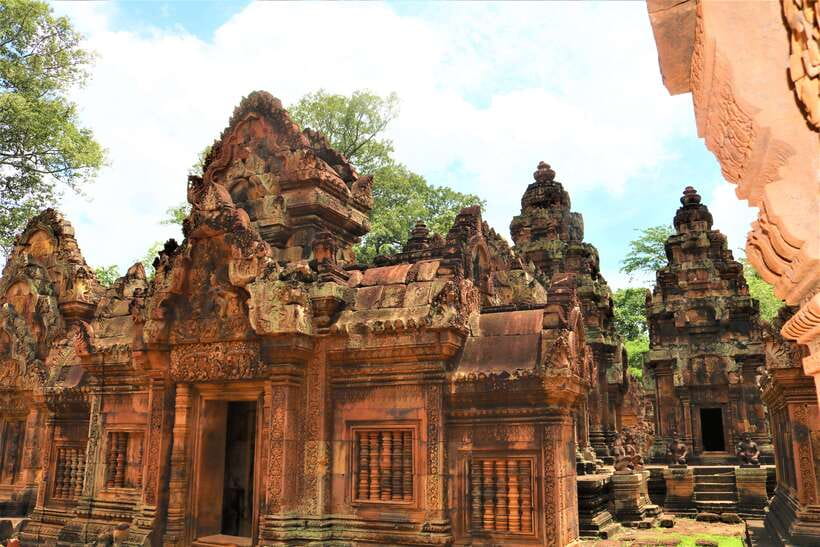
Banteay Srei is the star of Day 1. It is smaller than Angkor Wat, but its pinkish sandstone walls carry unusually precise reliefs. The carvings are the reason for the detour, with carefully cut figures and decorative details that reward a close look.
The distance from the main Angkor sites is part of the tradeoff. Banteay Srei takes more driving time than another temple inside Angkor Thom, but it gives you a different scale and texture. If you want only the headline monuments, this may feel like a long outing. If you care about craftsmanship, it is one of the best additions to the two-day schedule.
Your guide can help you read the Hindu scenes and explain why this small temple has such a strong reputation. Guides such as Sak and Pal Saruon have also been praised for knowing where to stand for photographs, which is useful at a site where the detailed carvings can get lost in a wide shot.
Neak Pean and Preah Khan
On the return toward Siem Reap, the route reaches Neak Pean. This Buddhist temple sits on a circular artificial island in Jayatataka Baray, an ancient reservoir. The approach across the water gives it a setting unlike the enclosed courtyards of Angkor Wat or Bayon.
Neak Pean is not a place to spend hours wandering through a huge complex. Its appeal comes from the arrangement of the island, water, and central shrine. Your guide’s explanation is particularly helpful here because the layout and religious purpose are not always obvious at first glance.
Preah Khan follows, and it is one of the most atmospheric stops on this route. It was commissioned by Jayavarman VII in honor of his father, and the site combines long corridors, crumbling stone, tree roots, and partially restored structures.
I like Preah Khan because it provides a useful contrast with Angkor Wat. It feels less monumental and more exposed, with the remains showing how the jungle and time have affected the buildings. Restoration work has helped preserve important sections, but you should still expect rough surfaces and a less polished visit.
Day 1 ends with sunset. The exact location and timing can vary, and the day may finish around 6:00 to 7:30 PM rather than the shorter eight-hour estimate shown in some tour details. That is worth knowing before you book dinner or evening transport. The sunset stop is a fine bonus, but it makes this a long day.
Day 2: Angkor Wat before breakfast
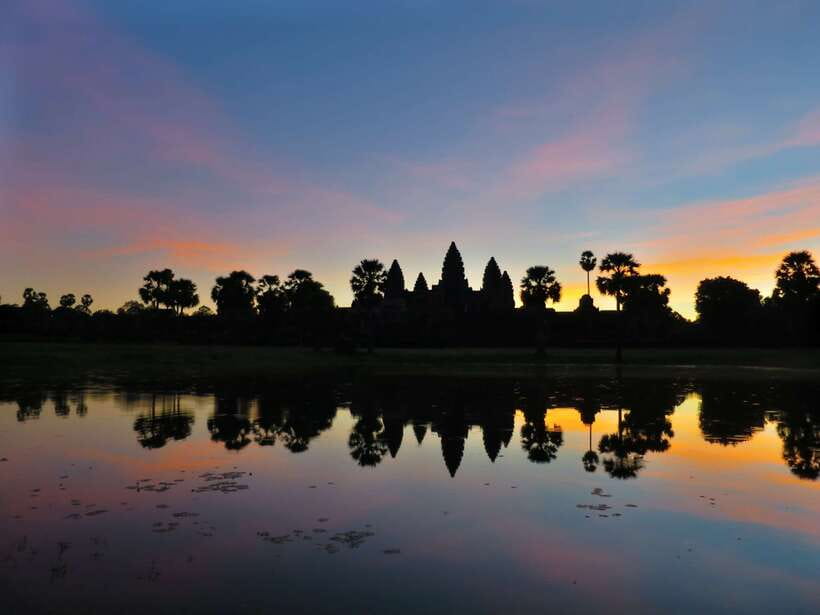
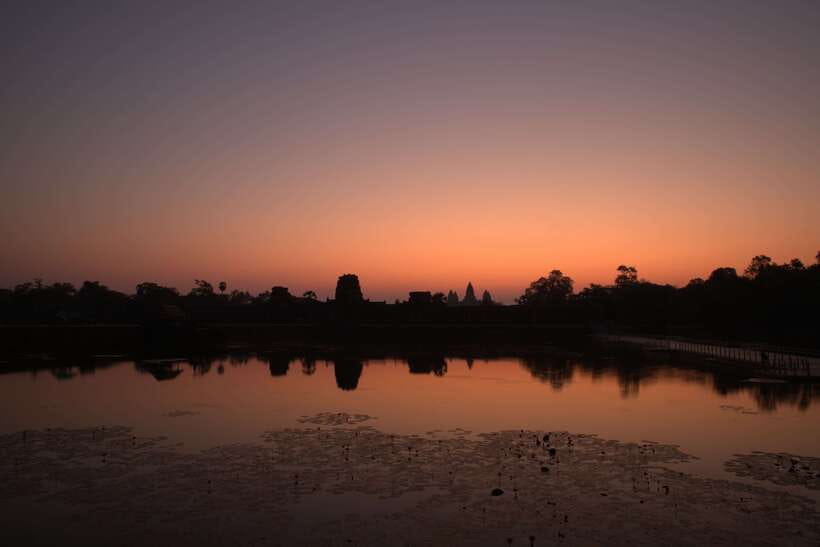
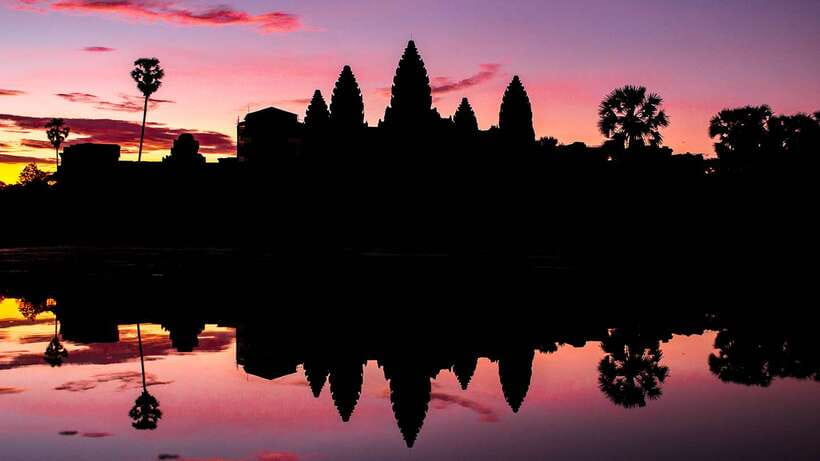
Day 2 begins between 4:20 and 4:35 AM. This is not a gentle start. You will be leaving your hotel while it is still dark, but the early departure is necessary if you want a good position near Angkor Wat’s reflecting pools and outer walls.
The sunrise itself depends on clouds and weather. You may get a clear reflection, a soft sky, or a muted dawn. Do not treat the famous postcard view as guaranteed. The larger benefit of arriving early is having time and space before the site becomes busier.
Some guides choose a seated position along the outer wall instead of pushing directly toward the most crowded point by the moat. That can be a smart call. You may still get the reflection photographs, while avoiding a long period of standing shoulder to shoulder.
After sunrise, the group goes inside Angkor Wat for about two hours. This is not just a quick photo stop. You have time to see the galleries, central chambers, upper terraces, and long bas-reliefs.
Angkor Wat was built as a Hindu temple and later used as a Buddhist sanctuary. The carvings show scenes from Hindu epics and royal life, while the scale of the building reflects the power and ambition of the Khmer Empire. A strong guide will point out details you would likely pass without noticing, then give you time to walk and look independently.
This balance is one of the tour’s best features. Guides including Pi, Sokpee, Sak, and Pal Saruon are often praised for explaining the meaning of the carvings without filling every minute with talk. Solo visitors also benefit from guides who take photographs at useful angles.
Breakfast is taken at a local restaurant near the temple and is not included. Bring cash or plan to buy food locally. The stop breaks up the morning and gives you a chance to sit down after the early start.
More Angkor temple itineraries:
- Siem Reap: Full-Day Angkor Wat Guided Tour with Sunset
4.9 · 3,803 reviews - Angkor Wat Sunrise tour with Small – Group and Guide tours
5.0 · 3,655 reviews - Angkor Wat Highlights and Sunrise Guided Tour from Siem Reap
5.0 · 3,213 reviews - Angkor Wat Sunset Small Group Tour with Lunch Included
5.0 · 3,059 reviews
Angkor Thom and Bayon’s stone faces
The route then moves to the Southern Gate of Angkor Thom. A row of 54 stone figures lines each side of the approach, with gods on one side and demons on the other. The figures help establish the religious and royal symbolism before you enter the fortified city.
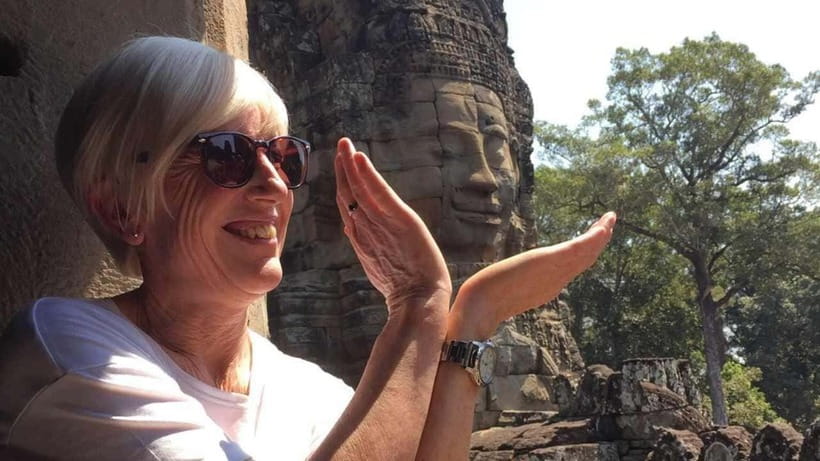
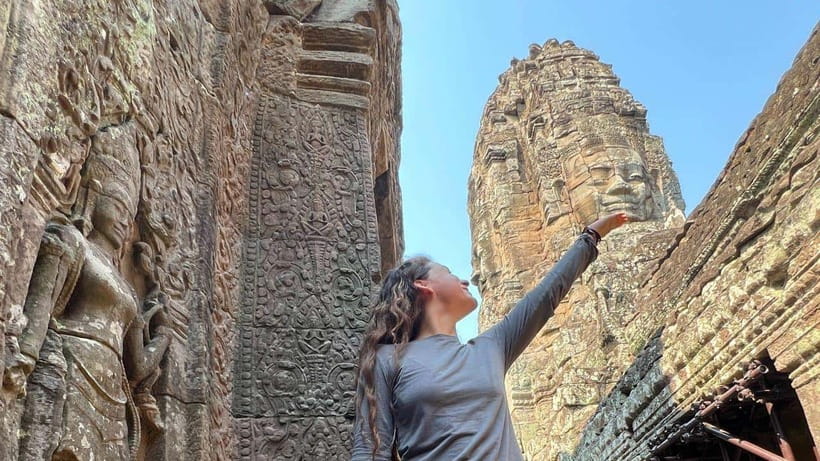
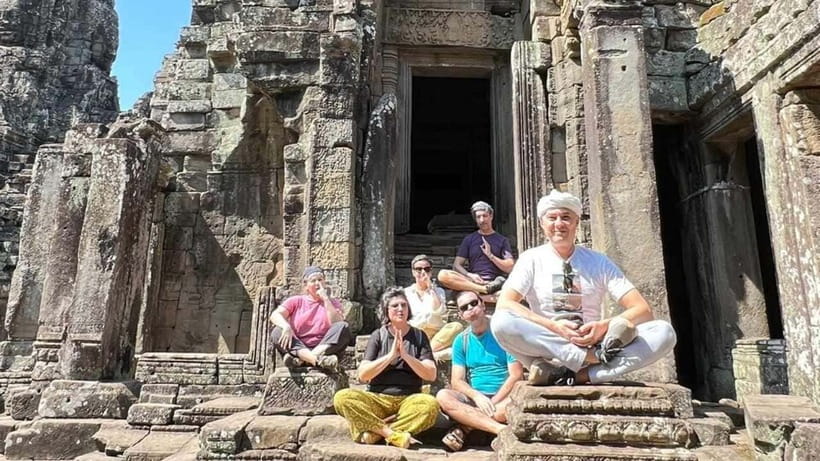
Angkor Thom was a major royal center, not merely a collection of temples. Inside, you visit Bayon, the central temple famous for its enormous carved faces. More than 200 faces cover its towers, creating one of the most memorable scenes in the entire complex.
Bayon can be confusing without guidance. Its passages are tight, the towers overlap, and the faces appear from different heights and angles. Your guide can connect the architecture to Jayavarman VII and explain the mixture of Buddhist imagery and royal authority.
The route also includes the Terrace of the Elephants and the Terrace of the Leper King. These are open, horizontal monuments rather than enclosed sanctuaries, so they help you understand how Angkor Thom functioned as a city of ceremonies and royal display.
You will walk between several areas, often on uneven stone. The morning is cooler than the afternoon, but the sun can still become intense. Keep the supplied water with you and use the vehicle’s air conditioning during transfers.
Ta Prohm and the jungle setting
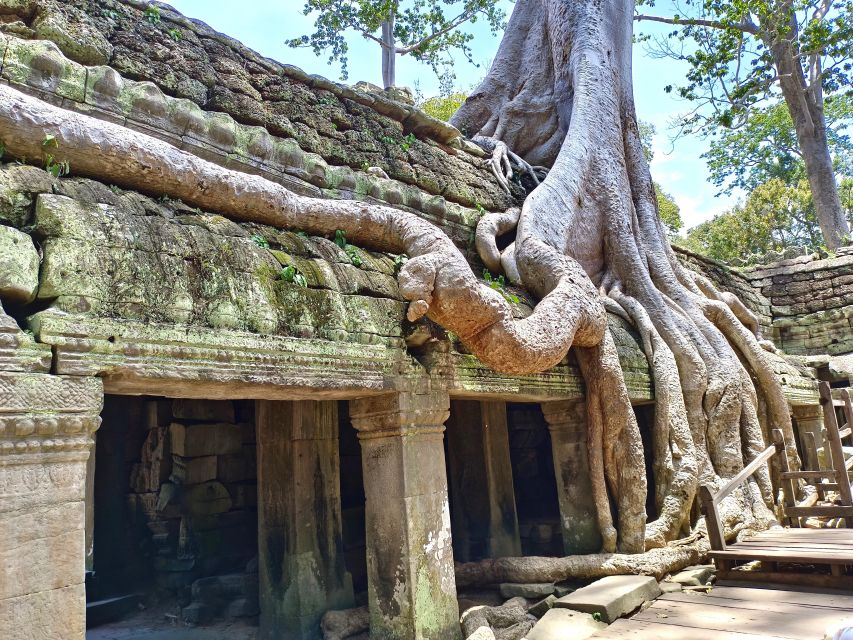
Ta Prohm is the final major stop on Day 2 and one of the most visually distinctive. Tree roots press into walls and doorways, while broken galleries create a sense of a temple being reclaimed by the forest.
The site was once home to almost 3,000 monks. That fact changes how you see it. Ta Prohm was not built as a small woodland shrine. It was part of a large religious and social system, and the remaining corridors hint at a much bigger institution.
Ta Prohm is also one of the most popular stops, so patience helps. The famous root-covered sections can be crowded, and your guide may take you to less congested corners for photographs. Guides such as Pal Saruon and Pi are repeatedly praised for finding better angles and helping solo visitors get decent pictures.
The tour returns to Siem Reap around 12:30 to 1:30 PM. That early finish is useful. You can eat, rest, or schedule a quieter afternoon after the pre-dawn start.
Guides, drivers, and the small-group setup
The guide can make or break a temple tour. The most frequently praised guides in the supplied experience details include Sak, Pal Saruon, Sokpee, Pi, Bun, and Saruon Pal. Names are not guaranteed when you book, but the pattern is clear: the guide is expected to do more than recite dates.
You can expect explanations of Hinduism, Buddhism, temple construction, Khmer rulers, carved stories, and Cambodian daily life. Several guides also share personal knowledge of the area and local culture. That human context gives the stone monuments a stronger connection to present-day Cambodia.
Photography help is another useful touch. Guides often know less crowded viewpoints and will take pictures for people traveling alone. Do not expect a dedicated photographer, but this service can make a real difference if you want more than selfies.
The driver matters just as much during a hot, long day. The vehicle is air-conditioned, and drivers such as Vichet, Naro, Mao, Ro, Keal, and Mr. Water are praised for safe driving and for meeting the group with cold bottles and cool, sometimes scented towels. These small comforts are not decoration. After walking across hot stone, a chilled towel can reset your energy.
Groups are limited to 15 people, and some departures have had only five or six. A smaller group makes it easier to hear the guide and keep moving, though group size can vary by date.
Price, temple pass, and overall value
At $19 per person, the tour price looks unusually low for two days of transport and guiding. The important catch is the temple pass. A two or three-day pass costs $62 per person and is not included, so your basic total is about $81 before meals.
That remains a good value if you want to see many sites without arranging separate transport, negotiating prices, or working out the temple roads yourself. The price includes hotel pickup and drop-off, an English-speaking guide, an air-conditioned vehicle, bottled water, and cool towels.
Meals are extra. Breakfast and other food can be bought at local restaurants near the temples. You should also budget for the ticket before the tour begins. The pass can be purchased online and arranged to be sent the day before the start date.
The strongest value comes from the two-day option. The one-day trip is sensible for a short visit, but the additional day gives you Banteay Srei, Pre Rup, Neak Pean, Preah Khan, and sunset. You see more architectural variety and spend less time trying to compress everything into one punishing day.
What to bring and how to pace yourself
Wear comfortable shoes with a secure sole. This is a walking tour over rough surfaces, stairs, and old stone. Sandals may be fine for some people, but practical footwear is safer.
Pack sunglasses, a sun hat, a camera, and insect repellent. Choose clothing that covers your knees and shoulders. Shorts are not allowed under the stated rules, and temple dress requirements are enforced as part of respectful site access.
Bring a light layer for the pre-dawn departure if you feel cold easily, but expect heat later. Keep your camera ready for sunrise, relief details, faces at Bayon, and the root-covered galleries at Ta Prohm.
The schedule is tight. One person described the two days as covering many sites with strict timing, and that is fair. You have free time at many stops, but the vehicle cannot wait indefinitely. Listen to the meeting instructions and return on time, especially on Day 2 when the group is trying to fit Angkor Wat, Angkor Thom, Bayon, the terraces, and Ta Prohm into one morning.
Free cancellation is available up to 24 hours before departure, and general last-minute date changes can be made up to seven hours before the start without an extra cost. Reconfirm if you will arrive in Siem Reap outside the normal reconfirmation period.
Who should book this tour?
I would recommend the two-day option to first-time visitors who want context, reliable transport, and a good spread of temples without planning every transfer. It is also a strong fit for solo visitors, since the guide may help with photographs and the small group gives you company without the feel of a large coach excursion.
Choose the one-day version if Angkor Wat, Bayon, and Ta Prohm are your main goals or if your Siem Reap stay is short. You will miss some of the outlying sites, but you will still see the core sights.
I would think twice if you dislike early mornings, long walking days, or fixed schedules. The 4:20 AM pickup is demanding, and Day 1 can stretch into the evening. This is not a relaxed temple stroll.
Should you book it?
Book the two-day tour if you want the best balance of famous monuments, smaller temples, practical comfort, and guide commentary. The extra $62 temple pass is a real cost, but the $19 operating price is strong value once you consider the vehicle, driver, guide, hotel transfers, water, and towels.
The main reason to choose this tour is not simply the number of temples. It is the structure: Banteay Srei and Preah Khan give Day 1 variety, while sunrise Angkor Wat and Bayon anchor Day 2. If you accept the early alarm, the heat, and the need to keep time, this is an efficient and well-supported way to see Angkor.
FAQ
Is the temple pass included in the tour price?
No. The two or three-day temples pass costs $62 per person and must be purchased separately. It can be bought online and arranged to be sent one day before the tour starts.
What time does the sunrise day begin?
Hotel pickup for Day 2 is usually between 4:20 and 4:35 AM. The exact time is provided one day before the tour.
What temples are included in the two-day tour?
Day 1 includes Pre Rup, Banteay Srei, Neak Pean, Preah Khan, and a sunset visit. Day 2 includes Angkor Wat at sunrise, Angkor Thom, Bayon, the Terrace of the Elephants, the Terrace of the Leper King, and Ta Prohm.
Is food included?
No. Meals are not included, but you can buy breakfast and other food at local restaurants near the temples.
What does the tour provide during the day?
The tour includes hotel pickup and drop-off, an English-speaking guide, an air-conditioned vehicle, bottled water, and cool towels.
What should I wear at the temples?
You must cover your knees and shoulders. Comfortable shoes are important because the tour includes substantial walking over uneven surfaces and stairs.
Is the tour suitable for children or wheelchair users?
The tour is not suitable for children under eight or wheelchair users. The route includes rough ground, stairs, and uneven temple areas.
More 2-Day Experiences in Siem Reap
- 2 Days Exclusive Temple Highlights with Sunset and Sunrise Tour
5.0 · 1,157 reviews - 2 Days Guided Historical Tour in Angkor
5.0 · 855 reviews - 2-Day Angkor Wat With Small, Big Circuit and Banteay Srei Tour
5.0 · 545 reviews - Siem Reap: 2-Day Temple Highlights Sunrise and Sunset Option
4.9 · 445 reviews
More Morning in Siem Reap
- Full-Day Angkor Wat Sunrise Private Tour with Guide from Siem Reap
5.0 · 2,920 reviews - Angkor Wat Sunrise & 3 Main Temples with Breakfast – Small Group
5.0 · 2,857 reviews - Siem Reap: Angkor Wat Sunrise and Full-Day Sightseeing Tour
4.9 · 2,828 reviews - Angkor 2-Day Sunset & Sunrise Small-Group Tour
5.0 · 2,567 reviews
Fresh reviews from around Siem Reap
- Full-Day Tour Preah Vihea & Koh Ker Temple 3.7 · 3 reviews
- Savor the Countryside: Tours with Authentic Cooking Classes” 5.0 · 3 reviews
- Angkor Wat Sunrise TukTuk Tour 5.0 · 3 reviews
- Angkor Grand Circuit Tour & Banteay Srei 5.0 · 3 reviews
- Guided Private Tuk Tuk Tour Angkor Wat and Small Circle and Five Extras 5.0 · 3 reviews
- Siem Reap Temple Tour 2-Day with Sunrise/Sunset 3.7 · 3 reviews
- Bangkok to Angkor Wat 2 Days 1 Night by Flight 4.5 · 3 reviews
- Kompong Pluk Tour 5.0 · 3 reviews
Angkor Wat Sunrise Tours, compared.

Angkor Wat Sunrise or Sunset Tour with Guide from Siem Reap
Read our review →


Angkor Wat Sunrise tour with Small – Group and Guide tours
Read our review →
Angkor Wat Highlights and Sunrise Guided Tour from Siem Reap
Read our review →
Full-Day Angkor Wat Sunrise Private Tour with Guide from Siem Reap
Read our review →
Angkor Wat Sunrise & 3 Main Temples with Breakfast – Small Group
Read our review →
Browse the lists this tour appears in