
Reviewed · ANGKOR TEMPLE TOURS
Private Tour: (Avoid Crowds & Heat) 2-Day Angkor Temples
The smartest part of this private Angkor tour is its two-day rhythm. You begin with quieter, more distant temples such as Banteay Srei and Banteay Samre, then save Angkor Wat, Angkor Thom, Bayon, and Ta Prohm for the second day. I like that pacing because it lets you learn the setting before tackling the famous monuments.
I also like the private air-conditioned transport, hotel pickup, snacks, and cold refreshments. Guides including Tay, Sopheara, Viet, Kim, and Tai have been praised for clear English, strong temple knowledge, and adjusting the route to reduce crowds. The drawback is cost: the listed $62 tour price does not include the Angkor entrance pass, which adds $62 per person for a two or three-day visit. You should also be ready for stairs and climbing.
In This Review
- Key points to know before booking
- Why the two-day plan works so well
- Day one: pink sandstone and quiet ruins
- Banteay Srei, the Citadel of Beauty
- Banteay Samre and its peaceful setting
- Pre Rup, where brick and laterite meet sandstone
- Preah Khan, part temple and part city
- Neak Pean and the healing pond
- Day two: Angkor Wat, the royal city, and jungle ruins
- Angkor Wat deserves its full two hours
- Angkor Thom, a walled capital with several major sights
- Ta Prohm and the trees among the stones
- Ta Nei, the small temple that changes the pace
- What the private format adds
- The real cost and what you receive
- Timing, effort, and practical preparation
- Who should book this Angkor tour?
- FAQ
- Is the Angkor entrance ticket included?
- How much does the tour cost?
- How long does the experience last?
- What time does the tour start?
- Is hotel pickup included?
- Is this a private activity?
- What transportation is provided?
- Can I request sunrise or sunset?
- Is the tour suitable for most people?
- Should you book it?
Key points to know before booking
- Two distinct days: Day one covers Banteay Srei, Banteay Samre, Pre Rup, Preah Khan, and Neak Pean. Day two focuses on Angkor Wat, Angkor Thom, Ta Prohm, and Ta Nei.
- Private means flexible: Only your group joins the activity, so your guide can adjust stops and time within the planned route.
- The park pass costs extra: Budget $62 per person for the two or three-day Angkor Archaeological Park ticket.
- Crowd control is part of the plan: The route includes less visited temples and offers a complimentary sunrise or sunset option if you tell your guide on day one.
- Comfort comes built in: Hotel pickup and drop-off in Siem Reap, an air-conditioned private vehicle, snacks, and refreshments are included.
- This is an active sightseeing trip: Expect temple steps, uneven surfaces, and plenty of walking, especially at Angkor Wat, Angkor Thom, and Ta Prohm.
Why the two-day plan works so well
Angkor can feel like too much if you try to see every famous monument in one long outing. This tour spreads the experience across two days and gives each group of temples a different mood.
Day one moves through the outer and northern parts of the park. You see fine pink sandstone carving, an isolated temple with few distractions, a 10th-century mountain temple, and two atmospheric sites connected with King Jayavarman VII.
Day two is the grand sequence. Angkor Wat provides the scale, Angkor Thom provides the city, Bayon provides the faces, and Ta Prohm provides the tree-covered ruins that many people picture when they think of Angkor.
You should expect a full sightseeing schedule, but the private format helps. You do not have to match another group’s pace or spend time waiting for strangers. Guides have also adjusted routes to find better views and fewer people, though no guide can promise empty temples at the main sites.
More Angkor temple itineraries:
- Angkor Wat Sunrise or Sunset Tour with Guide from Siem Reap
5.0 · 12,109 reviews - Siem Reap: Angkor Wat: Small-Group Sunrise or Sunset Tour
5.0 · 9,444 reviews - Siem Reap: Angkor Wat 2-Day Tour with Sunrise and Sunset
4.9 · 4,429 reviews
Day one: pink sandstone and quiet ruins
Banteay Srei, the Citadel of Beauty
Banteay Srei is more than 20 kilometers north of Angkor, so reaching it takes you away from the busiest central cluster. The temple dates from the second half of the 10th century and is known for delicate carving in pink sandstone.
You get about an hour here, which is a useful amount of time for studying the small-scale details. The carvings are unusually fine, and the warm stone gives the temple a softer appearance than the larger gray and laterite monuments elsewhere in the park.
This is a good first stop because it rewards close looking. At Angkor Wat, size can dominate your attention. At Banteay Srei, I would slow down and look at door frames, decorative figures, and the repeated patterns around the towers.
The listing shows no separate admission charge at each stop, but that does not mean the park is free. Your Angkor pass is not included in the tour price and must be purchased separately.
Banteay Samre and its peaceful setting
Banteay Samre takes about 45 minutes. It is an isolated temple built in the first half of the 12th century, with tower forms that recall Angkor Wat.
The appeal here is the quieter setting. You are still looking at a major Khmer monument, but the experience can feel less hurried than at the headline sites. That makes Banteay Samre a sensible counterpoint to the busy second day.
I would use this stop to ask your guide about the way temple styles changed over time. The guide can connect Banteay Samre’s design with what you will see later at Angkor Wat, making the next day easier to understand.
Other Siem Reap experiences to weigh up
- Angkor 2-Day Sunset & Sunrise Small-Group Tour
5.0 · 2,567 reviews - 2 Days Exclusive Temple Highlights with Sunset and Sunrise Tour
5.0 · 1,157 reviews - Siem Reap: Angkor Sunrise 1- or 2-Day Guided Temples Tour
4.9 · 1,132 reviews - 2 Days Guided Historical Tour in Angkor
5.0 · 855 reviews
Pre Rup, where brick and laterite meet sandstone
Pre Rup is a 10th-century temple visited for about 30 minutes. Its name refers to turning the body, and its appearance comes from the mix of laterite, brick, and sandstone.
The stop is brief, so you should not expect a long lesson or a slow exploration of every corner. Instead, focus on the structure and its materials. The different colors and textures make Pre Rup a useful place to see how Khmer builders combined stone types rather than relying on one uniform surface.
There are stairs and climbing around the temples on this tour. Pre Rup is one of the places where you should take care, especially if you are already feeling the heat or tiredness from the morning.
Preah Khan, part temple and part city
Preah Khan receives about an hour and was built by Jayavarman VII in the late 12th century as a Buddhist university and city. Its atmosphere recalls Ta Prohm, but its details are different.
The most unusual feature listed here is a round-columned, two-story building. That detail gives you something specific to look for instead of simply walking through another set of corridors and towers.
Preah Khan is a strong stop for anyone who likes ruins with a sense of space and age. You can see how the site was more than a single shrine. It had the scale of an organized settlement, which helps explain the power and reach of the Khmer Empire.
Neak Pean and the healing pond
Neak Pean takes about 30 minutes. Jayavarman VII built it in the late 12th century for miraculous healing, and its central monument appears in the middle of a pond.
This is a very different experience from climbing a tall temple. The symbolism and water setting matter more than sheer size. You may find the stop restful after Preah Khan, although the visit is shorter and the central monument is viewed from a more limited route.
Day one therefore has a useful variety: detailed carving, a quiet temple, a material study at Pre Rup, a large Buddhist complex, and a symbolic water monument. It is not simply a warm-up for Angkor Wat. It gives you several ways to understand Khmer architecture.
Day two: Angkor Wat, the royal city, and jungle ruins
Angkor Wat deserves its full two hours
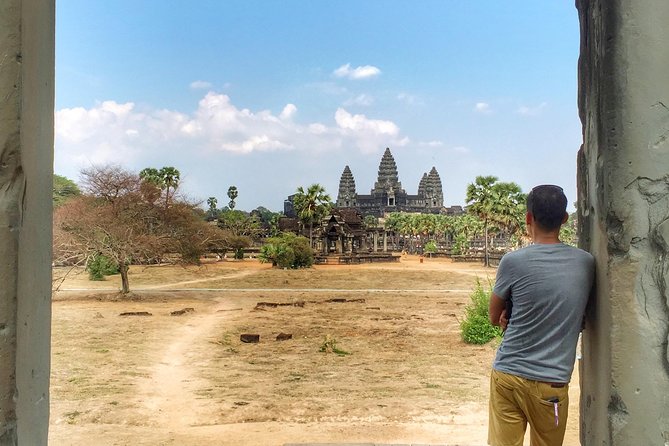
Angkor Wat is described as the world’s largest religious monument, and two hours gives you enough time to grasp its scale without treating the visit as a quick photo stop.
Your guide can help you read the site as more than a famous silhouette. Look at the broad layout, the towers, the galleries, and the carved stone surfaces. The monument’s size can make it hard to know where to focus, so a private guide is particularly useful here.
You can also request a sunrise or sunset outing at no extra charge, but you must tell your guide on day one if you want to arrange it for the following day. The supplied details do not promise a particular sunrise or sunset schedule, so treat it as an added option rather than the central feature of the tour.
Angkor Thom, a walled capital with several major sights
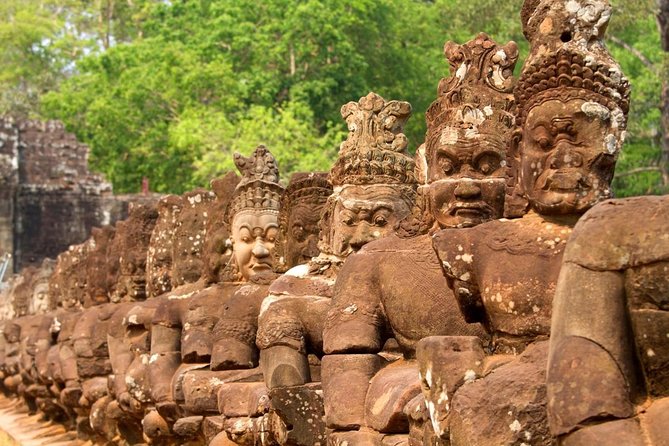
Angkor Thom takes about two hours. It was one of the Khmer Empire’s great capital cities and contains several important monuments inside its walls, including Bayon, Phimeanakas, Baphuon, the Terrace of the Elephants, and the Terrace of the Leper King.
This stop is really a group of connected sights, not one building. Two hours goes quickly, especially if you want to listen to explanations and take photographs.
Angkor Thom helps you picture the city around the temples. At Angkor Wat, the focus is a monumental religious center. Here, the walls and internal sites show a capital built for ceremony, power, and daily activity.
The ground can be uneven, and Baphuon and other structures involve steps. If you have limited mobility, ask your guide what parts of the area are practical for you. The official details say most people can participate, but the tour is not a flat, easy walk.
Ta Prohm and the trees among the stones
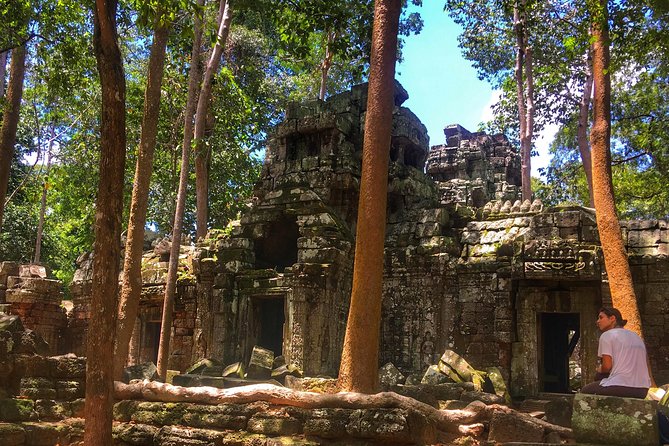
Ta Prohm gets about an hour and is known for its strangler figs and silk-cotton trees growing through the ruins. It is also associated with the film Tomb Raider.
The trees are the obvious attraction, but the site is not only a backdrop for photographs. The roots and walls show the tension between the living forest and the built monument. You can expect a romantic, enclosed atmosphere, though the fame of the site means it may feel busier than Ta Nei.
This is one place where the guide’s crowd strategy matters. A guide such as Tay or another member of the team can adjust the order or route where possible, helping you find better moments for photographs. Still, Ta Prohm is a major Angkor stop, so you should not expect complete quiet.
Ta Nei, the small temple that changes the pace
Ta Nei is a Buddhist temple built during the reign of Jayavarman VII in the late 12th century. You spend about 30 minutes here, and its main value is the chance to get away from the crowds.
After Angkor Wat, Angkor Thom, and Ta Prohm, Ta Nei can feel like a reset. The visit is short, but that is part of the point. You get a smaller, less polished ruin instead of another grand complex.
This stop suits you if atmosphere matters as much as famous names. If you only want the biggest monuments, you might consider Ta Nei less essential. For me, its role in the day is important because it gives the itinerary a quiet final note.
What the private format adds
A private tour is more than a smaller vehicle. You share the day only with your own group, which gives you room to ask questions and decide how long to look at a carving or courtyard.
The strongest part of the guiding service is the human element. Tay is praised for managing temple visits and shaping the route around views and crowds. Sopheara is described as especially strong on history and education. Viet is praised for turning the visit into a carefully shaped experience, while Kim is noted for explaining Khmer architecture and civilization with patience. Tai and driver Mr. Long are also singled out for a comfortable, well-run two-day outing.
Those names do not guarantee that one particular guide will be assigned to you. They do show what to value when you meet your guide: clear English, an ability to explain the temples, patience with questions, and practical judgment about timing.
The air-conditioned private vehicle matters in Cambodia’s heat. You also receive snacks and refreshments, and one detailed account mentions cold water and lemongrass-scented cool towels. Those small comforts become useful after a hot walk over stone and steps.
The real cost and what you receive
The tour price is $62, but the Angkor entrance ticket costs another $62 per person for a two or three-day visit. For one person, that makes the listed cost $124 before considering any other personal spending. For a private group, the value depends heavily on how many people share the tour and whether you prefer private guiding to a larger group.
The $62 tour portion covers a licensed professional guide, hotel pickup and drop-off in Siem Reap, private air-conditioned transport, snacks, and refreshments. It also includes the possibility of a complimentary sunrise or sunset outing if you request it on day one.
I see the price as reasonable for someone who wants transport, a guide, and a carefully arranged two-day route without organizing several separate trips. It is less attractive if you already have transport and only want a basic driver.
Group discounts are available, and only your group participates. Before booking, compare the total price for your party, not just the headline figure. The park pass is a major part of the final cost.
Timing, effort, and practical preparation
The stated start time is 7:30 a.m., with pickup in Siem Reap. Hotel pickup and drop-off remove one common hassle, especially when you are trying to reach distant temples such as Banteay Srei.
Wear practical shoes. The route includes temple steps, climbing, uneven ground, and long periods on your feet. One detailed account specifically warns about lots of stairs and climbing, so I would not choose this plan if you want a gentle, low-effort sightseeing day.
Carry water even though refreshments are included. Use the planned breaks, listen to your guide about footing, and do not rush up steps for a photograph. The private format gives you more control, but it cannot remove the heat or the physical demands of Angkor.
You should also tell your guide on day one if you want the complimentary sunrise or sunset option on the following day. That request needs to be made early, not at the last minute.
Who should book this Angkor tour?
I would choose this tour if you are visiting Cambodia for the first time and want both the famous monuments and less visited sites. The schedule gives you the major Angkor landmarks while avoiding a single day devoted only to the most crowded temples.
It is especially well suited to history buffs, photographers who want help with timing, and couples or families who value a private pace. The guides’ ability to answer questions and explain architecture is central to the experience.
I would think twice if your main goal is a relaxed holiday with little walking. The itinerary is full, the entrance pass adds a large extra cost, and the temples require climbing. You may also prefer a shorter tour if you only want Angkor Wat and Ta Prohm.
FAQ
Is the Angkor entrance ticket included?
No. The Angkor Archaeological Park entrance pass is separate and costs $62 per person for a two or three-day visit.
How much does the tour cost?
The listed tour price is $62. You must add the separate $62-per-person Angkor entrance pass.
How long does the experience last?
The experience lasts approximately two days, with temple visits spread across two sightseeing days.
What time does the tour start?
The stated start time is 7:30 a.m.
Is hotel pickup included?
Yes. Hotel pickup and drop-off in Siem Reap are included.
Is this a private activity?
Yes. Only your own group participates in the activity.
What transportation is provided?
Transport is provided in a private air-conditioned vehicle.
Can I request sunrise or sunset?
Yes. Sunrise or sunset on the following day is complimentary, but you must tell your guide on day one.
Is the tour suitable for most people?
Most people can participate, but the route includes stairs, climbing, and uneven temple surfaces. You should consider your physical ability before booking.
Should you book it?
Book this two-day tour if you want a private guide, air-conditioned transport, and a thoughtful mix of major and quieter Angkor sites. The strongest reasons are the well-paced division between the two days, the inclusion of Banteay Srei and Ta Nei, and the chance to shape the route with a guide such as Tay, Sopheara, Viet, Kim, or Tai if available.
Skip it if the extra $62 park ticket makes the total too high or if you want minimal walking. For most first visits, though, the plan offers a sensible way to see Angkor Wat without letting that one monument crowd out the smaller temples that give the area its character.
Fresh reviews from around Siem Reap
- Full-Day Tour Preah Vihea & Koh Ker Temple 3.7 · 3 reviews
- Savor the Countryside: Tours with Authentic Cooking Classes” 5.0 · 3 reviews
- Angkor Grand Circuit Tour & Banteay Srei 5.0 · 3 reviews
- Guided Private Tuk Tuk Tour Angkor Wat and Small Circle and Five Extras 5.0 · 3 reviews
- Angkor Wat Sunrise TukTuk Tour 5.0 · 3 reviews
- Siem Reap Temple Tour 2-Day with Sunrise/Sunset 3.7 · 3 reviews
- Bangkok to Angkor Wat 2 Days 1 Night by Flight 4.5 · 3 reviews
- Kompong Pluk Tour 5.0 · 3 reviews
Angkor Temple Tours, compared.

Angkor Wat Sunrise or Sunset Tour with Guide from Siem Reap
Read our review →



Angkor Wat Sunrise tour with Small – Group and Guide tours
Read our review →
Angkor Wat Highlights and Sunrise Guided Tour from Siem Reap
Read our review →

Full-Day Angkor Wat Sunrise Private Tour with Guide from Siem Reap
Read our review →Browse the lists this tour appears in