
Reviewed · ANGKOR WAT SUNRISE TOURS
Private 2 Days Angkor Wat Sunrise and Discover all Major Temples
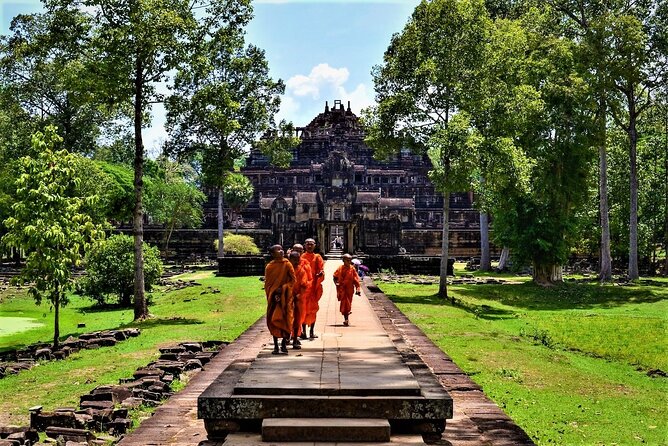
Angkor Wat at sunrise is the headline, but the real strength of this tour is its reach. Over two long days, you move from the famous five-towered temple to quiet Ta Nei, delicate Banteay Srei, and the grand ruins of Preah Khan. Private transport means your group can move at a sensible pace rather than follow a bus timetable.
I like the combination of major temples and less-visited sites, and I like having a guide explain how the Khmer kings built and used this enormous religious city. The main consideration is stamina: day one begins at 4:30 a.m., and both days pack in many stops. The Angkor Pass and meals also cost extra.
In This Review
- Key points at a glance
- Two days that make sense for a first visit
- Day one begins before dawn at Angkor Wat
- Angkor Thom and the stone faces of Bayon
- Baphuon, Phimeanakas, and the royal terraces
- Ta Nei and Banteay Kdei add welcome quiet
- Day two reaches the outer temples
- Preah Khan and Neak Pean show Khmer ambition
- Ta Som, East Mebon, and Pre Rup finish the circuit
- Private transport is useful here
- What you pay for, and what you still need to budget
- Who should book this experience
- Should you book it?
- FAQ
- What time does the tour begin?
- Is the Angkor Pass included?
- Are meals included?
- Is hotel pickup and drop-off provided?
- Is this a private tour?
- Is transportation air-conditioned?
- Is a tour guide included?
- What is the cancellation policy?
Key points at a glance
- Sunrise begins at 4:30 a.m. at Angkor Wat, with time afterward to explore the temple itself.
- Private touring keeps the schedule flexible, useful for families and groups with different energy levels.
- The route mixes famous monuments with quieter stops, including Ta Nei, Banteay Kdei, and Ta Som.
- Banteay Srei brings finely carved pink sandstone, while Bayon supplies the park’s famous stone faces.
- Air-conditioning, bottled water, and cool towels matter during two full days in Cambodia’s heat.
- The Angkor Pass is not included, and lunch at local restaurants costs about $3 to $10 per dish.
Two days that make sense for a first visit
At $149.46 per person, this is not the cheapest way to see Angkor. A tuk-tuk and self-guided visit can cost less, especially for a small group. But the price buys a private vehicle, hotel pickup and drop-off, an English-speaking licensed guide, bottled water, cool towels, and a route that covers an impressive amount of ground.
For a first visit, that coverage has real value. Angkor is not one temple beside a town. The archaeological park spreads across roughly 390 square miles, or 1,000 square kilometers, and the monuments sit far apart. A good guide also helps you understand why a temple matters instead of leaving you with a series of photogenic stone walls.
The exact guide is not guaranteed. Past bookings have included guides named Sara and Leap, with drivers such as La, Ry, Pheap, Sophal, and Paul. The strongest service pattern is clear English, careful driving, friendly help, and useful explanations. If a particular guide is important to you, ask the operator when booking.
More sunrise departures to Angkor Wat:
- Angkor Wat Sunrise or Sunset Tour with Guide from Siem Reap
5.0 · 12,109 reviews - Siem Reap: Angkor Wat: Small-Group Sunrise or Sunset Tour
5.0 · 9,444 reviews - Siem Reap: Angkor Wat 2-Day Tour with Sunrise and Sunset
4.9 · 4,429 reviews
Day one begins before dawn at Angkor Wat
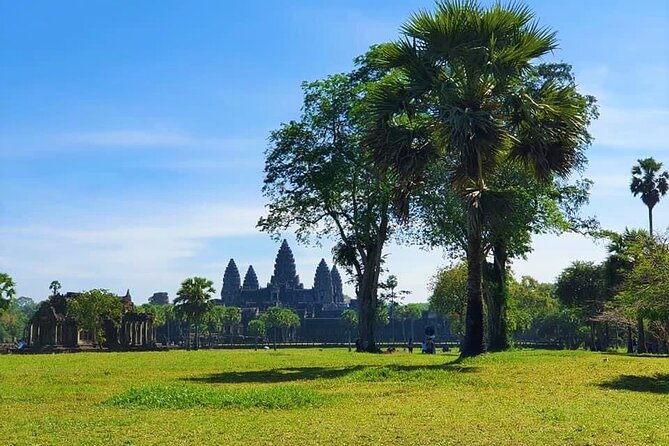
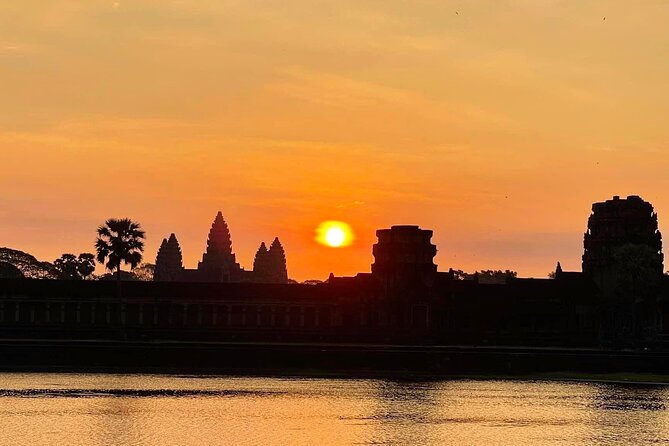
Pickup starts around 4:30 a.m. for the sunrise visit. You will need to be ready at your hotel before that time, and the early start is a serious one. It does, however, put you at Angkor Wat for the most atmospheric part of the morning, when the towers are reflected in the pools in front of the temple.
Sunrise conditions are never guaranteed. Clouds, haze, or crowds can change the view, so treat the early start as a chance to see Angkor Wat in changing light rather than a promise of a perfect photograph.
The temple itself deserves more than a quick sunrise stop. Angkor Wat was built as a Hindu temple and later used as a Buddhist shrine. Its galleries, towers, bas-reliefs, and long causeway show the ambition of the Khmer Empire, while the scale helps explain why this site became Cambodia’s national emblem.
Two hours is enough for a guided introduction, but not for every corner. If you are especially interested in carvings or architecture, tell your guide early so the visit does not become only a race for the next stop.
Angkor Thom and the stone faces of Bayon
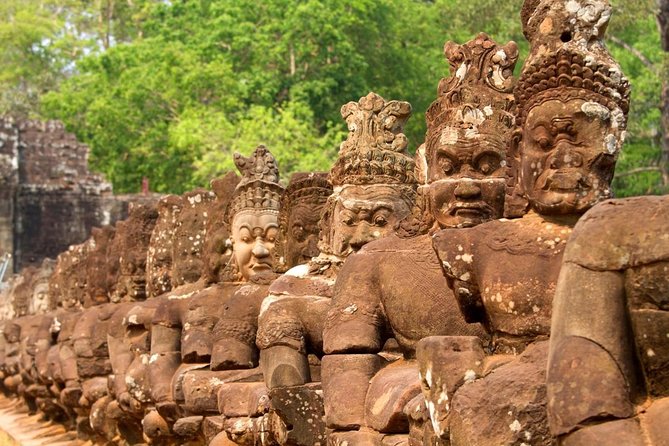
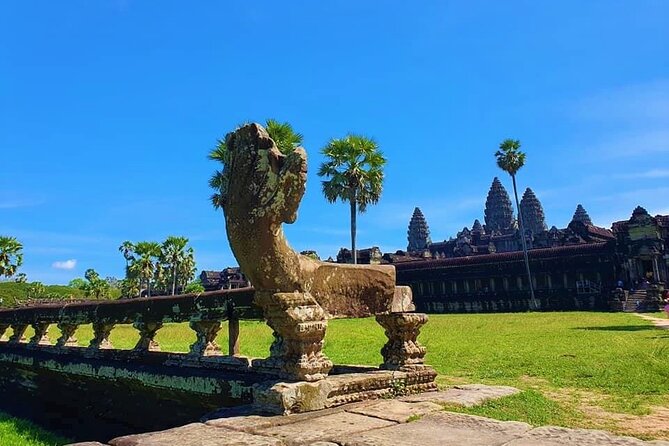
The South Gate of Angkor Thom makes a dramatic second stop. A broad moat and a causeway lined with giant figures lead toward the gate, giving you a clear sense that Angkor Thom was a fortified royal city rather than just another temple compound.
The sculptures represent a famous Khmer creation story, with rows of figures pulling at a serpent. Your guide can help you read the scene and point out details that are easy to miss from the vehicle.
Angkor Thom means Great City, and the name fits. The city once held the political center of the Khmer Empire. The tour allows about 40 minutes here before moving to Bayon, though the two sites feel closely connected because Bayon sits at the center of Angkor Thom.
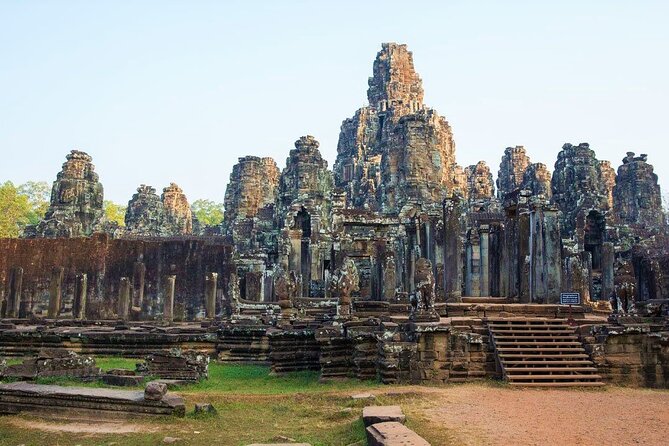
Bayon is one of the park’s essential stops. Built around 1200 during the reign of Jayavarman VII, it is filled with towers carved with large, calm faces. The faces appear from different angles as you walk through the crowded upper levels, and the effect is more intimate than the massive geometry of Angkor Wat.
Allow 90 minutes for Bayon. That sounds generous, but the temple is confusing at first glance. Corridors, stairways, towers, and carvings overlap. A guide can show you the best-known face towers and explain the shift from earlier Hindu worship toward the king’s Buddhist vision.
Baphuon, Phimeanakas, and the royal terraces
Baphuon sits only a short distance from Bayon, yet it feels different. Once the largest Khmer temple before Angkor Wat, it rises on a long elevated base and rewards a slow look at its structure. Reconstruction has been a major part of the monument’s modern story, which gives your guide a useful chance to explain how difficult it is to preserve a site built from thousands of carefully fitted stones.
Phimeanakas is a shorter visit of about 20 minutes. Its name means Aerial Palace or Celestial Temple, and it once formed part of the royal enclosure. You should not expect the same visual punch as Bayon, but its position helps complete the picture of Angkor Thom as a working capital with temples, palaces, terraces, and formal public spaces.
The Terrace of the Elephants runs along the western edge of Angkor Thom’s Royal Square. Carved elephants and other figures decorate the platform, which was used for royal ceremonies and public display. The 30-minute stop is mostly about details and setting, so listen closely rather than expecting a traditional enclosed temple.
Next comes the Terrace of the Leper King. It is smaller, but its carved walls are worth studying because some of the best details are tucked into the inner surfaces. Another 30 minutes gives you time to examine the figures without turning the stop into a hurried photograph.
More Angkor temple itineraries:
- Siem Reap: Full-Day Angkor Wat Guided Tour with Sunset
4.9 · 3,803 reviews - Angkor Wat Sunrise tour with Small – Group and Guide tours
5.0 · 3,655 reviews - Angkor Wat Highlights and Sunrise Guided Tour from Siem Reap
5.0 · 3,213 reviews - Angkor Wat Sunset Small Group Tour with Lunch Included
5.0 · 3,059 reviews
Ta Nei and Banteay Kdei add welcome quiet

Ta Nei is one of the most appealing stops for anyone who wants a calmer temple visit. This late 12th-century temple was built under Jayavarman VII and dedicated to the Buddha. Its less polished, forested setting gives you a different sense of Angkor than the carefully managed paths around Angkor Wat and Bayon.
The 50-minute visit is short enough to keep the day moving, but long enough to look at the carved stone and layout. Conditions at smaller temples can feel rougher underfoot, so sturdy shoes are sensible.
Banteay Kdei is another late-period Buddhist temple, close to Srah Srang reservoir. Its name means Citadel of Chambers, and the building’s many passageways and galleries make the name easy to understand. The temple has a worn, open quality that suits the end of a busy day.
The itinerary gives Banteay Kdei about 50 minutes. That is useful time, though you may be ready for dinner by then. A private vehicle helps here because you return directly to your hotel rather than waiting for a large group to gather.
The tour also advertises a sunset viewpoint. The listed temple sequence does not identify the exact sunset stop, so confirm the timing and location before the day begins. Sunset plans can affect which temple you visit last and how much time you have to rest.
Day two reaches the outer temples
Day two moves farther from the central Angkor cluster. That means more driving, but also a better sense of how broad the old Khmer capital was. You begin with Banteay Srei, about 25 kilometers from Angkor Wat, and the early departure is worthwhile.
Banteay Srei is famous for its small scale and exceptionally fine carving. Built from pinkish sandstone in the 10th century, it is dedicated to Shiva and looks quite different from the giant royal monuments. The detailed lintels, pediments, and figures reward close viewing.
Two hours is a sensible amount of time here. The temple is not large, but its carvings deserve attention. This is one of the places where a guide adds real value, since the most important details are often above eye level or packed into narrow panels.
Banteay Samre follows, with about 50 minutes on site. Built in the early 12th century, it is a Hindu temple associated with the reigns of Suryavarman II and Yasovarman II. Its compact design and enclosed feel make it a good contrast to Banteay Srei.
The stop at Preah Dak village adds a small local pause for souvenirs, objects, and arts. Keep expectations modest. This is not a major monument, but it offers a change from temple corridors and a chance to see a local commercial side of the Siem Reap area.
Preah Khan and Neak Pean show Khmer ambition

Preah Khan is one of day two’s major rewards. Jayavarman VII dedicated it in 1191 to his father, and the central image honored him as Jayavarmeshvara. The complex also served functions beyond worship, which helps explain its broad plan and many chambers.
Give yourself the full hour. Preah Khan can feel like a maze, with long corridors, courtyards, carved doorways, and sections where trees and stone meet. It is large enough to reward a guide who can explain what you are seeing without burying you in dates.
Neak Pean is unlike the other temples on this route. It was built on an artificial island in a large reservoir, and its arrangement centers on water. The name refers to entwined serpents, and the design reflects the Khmer interest in sacred pools and healing water.
The itinerary allows an hour here. Depending on water levels, access and views may vary, so listen to the guide’s explanation of the original layout rather than judging the site only from the walkway. Neak Pean is a good reminder that Angkor was an engineered city, not simply a collection of stone shrines.
Ta Som, East Mebon, and Pre Rup finish the circuit
Ta Som is a smaller late 12th-century temple built under Jayavarman VII. Its purpose is not fully clear, though it may have honored the king’s father or a teacher. The 40-minute visit works well after the larger Preah Khan and Neak Pean because it gives you a more contained site to explore.
East Mebon takes about 30 minutes. Built in the 10th century by Rajendravarman II and dedicated to Shiva, it was once located on an island in the East Baray reservoir. Today, its elevated position and stone elephants help you understand how water shaped both the religious design and the practical planning of Angkor.
Pre Rup is the final listed stop, with about an hour to explore. Founded in 961, it is one of the major works linked to Rajendravarman II. Its stepped, mountain-like form makes it especially good for understanding the Khmer temple-mountain idea.
The final stop can be tiring after two early mornings and many hours in the heat. Still, Pre Rup provides a strong ending because it gathers many of the tour’s themes in one place: royal power, Hindu symbolism, carefully planned terraces, and a commanding view over the surrounding countryside.
Private transport is useful here
The private air-conditioned vehicle is more than a comfort perk. It gives you a cool place to sit between temples, which matters when the schedule includes more than a dozen stops. Bottled water and fresh cool towels are also provided, small details that become valuable after walking on stone in the sun.
Hotel pickup and drop-off are included, but you need to provide the hotel name. Since the tour covers both central and more distant sites, the vehicle saves time compared with arranging separate rides for each section.
The private format also lets your group adjust the pace. You can ask for more time at Banteay Srei, shorten a stop if the heat is wearing you down, or discuss a different order when practical. The tour is still ambitious, so flexibility does not mean every stop can be extended without affecting the rest of the day.
What you pay for, and what you still need to budget
The $149.46 per-person price includes transport, hotel transfers, a licensed English-speaking guide, bottled water, cool towels, service charges, and government VAT. For a private two-day service with this much driving, I see the price as reasonable for families, couples, or small groups who want guidance without joining strangers.
The Angkor Pass is extra. It covers the temples in the itinerary, and the guide assists with buying it at the Angkor Park entrance before the tour starts. Since the pass is not included, add that cost to your budget before comparing this tour with cheaper transport-only options.
Lunch is also extra. Local restaurants offer vegetarian and non-vegetarian choices, with dishes generally priced from $3 to $10. That gives you control over spending, but you should plan for meal breaks and carry the provided water through the temple walks.
Tips for the guide and driver are not included. They are optional, but you may want to budget for them if the service is helpful, especially when the guide handles long explanations and the driver manages the two-day route.
Who should book this experience
I would choose this tour for a first visit to Angkor, especially if you want the major temples but do not want to plan every turn yourself. It also suits families: the private setup means you are not holding up a large group if children need a break, and past bookings have included young children who felt safe and well looked after.
It is a good match for couples and small groups who value a dedicated guide. English ability and guide quality matter greatly at Angkor, and the operator has used guides such as Sara and Leap, who are noted for clear explanations and friendly help.
I would think twice if you dislike early mornings, long walks, or tightly packed sightseeing days. You can see less with a slower two-day plan, but this particular route is designed to cover a great deal.
Free cancellation is available up to 24 hours before the local start time. Changes or cancellations made inside that window are not accepted for a refund.
Should you book it?
Book this tour if your priority is seeing Angkor’s essential monuments plus several smaller temples in only two days, with a private car and an English-speaking guide. The mix of Angkor Wat, Bayon, Banteay Srei, Preah Khan, Ta Nei, Ta Som, and Pre Rup gives you both the famous images and a broader understanding of the site.
Before paying, confirm the sunset plan, ask which guide is assigned, and add the Angkor Pass, lunches, and tips to your total. If you are willing to start at 4:30 a.m. and accept a busy schedule, this is a practical, well-rounded way to meet Angkor on a first trip.
FAQ
What time does the tour begin?
Day one begins with hotel pickup at about 4:30 a.m. for the sunrise at Angkor Wat.
Is the Angkor Pass included?
No. The Angkor Pass is not included. The guide will assist you in purchasing it at the entrance to Angkor Park.
Are meals included?
No. Lunch is at your own expense. Local restaurants offer vegetarian and non-vegetarian dishes, generally priced from $3 to $10 per dish.
Is hotel pickup and drop-off provided?
Yes. Pickup and drop-off at your hotel are included. You need to provide the hotel name for pickup arrangements.
Is this a private tour?
Yes. Only your group participates in the activity.
Is transportation air-conditioned?
Yes. Transfers are provided in a private air-conditioned vehicle. Bottled water and cool towels are also included.
Is a tour guide included?
Yes. A licensed professional guide with excellent English-speaking skills is included for the destinations on the tour.
What is the cancellation policy?
You can cancel up to 24 hours before the experience start time for a full refund. Cancellations or changes made less than 24 hours before the start time are not accepted for a refund.
More 2-Day Experiences in Siem Reap
- 2 Days Exclusive Temple Highlights with Sunset and Sunrise Tour
5.0 · 1,157 reviews - Siem Reap: Angkor Sunrise 1- or 2-Day Guided Temples Tour
4.9 · 1,132 reviews - 2 Days Guided Historical Tour in Angkor
5.0 · 855 reviews - 2-Day Angkor Wat With Small, Big Circuit and Banteay Srei Tour
5.0 · 545 reviews
More Morning in Siem Reap
- Full-Day Angkor Wat Sunrise Private Tour with Guide from Siem Reap
5.0 · 2,920 reviews - Angkor Wat Sunrise & 3 Main Temples with Breakfast – Small Group
5.0 · 2,857 reviews - Siem Reap: Angkor Wat Sunrise and Full-Day Sightseeing Tour
4.9 · 2,828 reviews - Angkor 2-Day Sunset & Sunrise Small-Group Tour
5.0 · 2,567 reviews
Fresh reviews from around Siem Reap
- Full-Day Tour Preah Vihea & Koh Ker Temple 3.7 · 3 reviews
- Savor the Countryside: Tours with Authentic Cooking Classes” 5.0 · 3 reviews
- Angkor Wat Sunrise TukTuk Tour 5.0 · 3 reviews
- Angkor Grand Circuit Tour & Banteay Srei 5.0 · 3 reviews
- Guided Private Tuk Tuk Tour Angkor Wat and Small Circle and Five Extras 5.0 · 3 reviews
- Siem Reap Temple Tour 2-Day with Sunrise/Sunset 3.7 · 3 reviews
- Bangkok to Angkor Wat 2 Days 1 Night by Flight 4.5 · 3 reviews
- Kompong Pluk Tour 5.0 · 3 reviews
Angkor Wat Sunrise Tours, compared.

Angkor Wat Sunrise or Sunset Tour with Guide from Siem Reap
Read our review →


Angkor Wat Sunrise tour with Small – Group and Guide tours
Read our review →
Angkor Wat Highlights and Sunrise Guided Tour from Siem Reap
Read our review →
Full-Day Angkor Wat Sunrise Private Tour with Guide from Siem Reap
Read our review →
Angkor Wat Sunrise & 3 Main Temples with Breakfast – Small Group
Read our review →
Browse the lists this tour appears in