
Reviewed · ANGKOR TEMPLE TOURS
Highlight of Angkor Complex 2 Days Private Tour
Angkor is best understood in layers, and this private two-day tour gives you plenty of them: giant royal temples, tree-covered ruins, quiet jungle shrines, and finely carved pink sandstone. You move from the smiling faces of Bayon to the maze-like corridors of Angkor Wat, then out to smaller sites where the crowds thin.
I like the private format, since your own group can keep a sensible pace and ask for changes. I also like the mix of major monuments and lesser-known stops such as Ta Nei and Banteay Prei. The main drawback is the sheer amount packed into two days. Day one is especially full, so this suits you best if you are ready for long hours on foot and plenty of temple steps.
In This Review
- Key points to know
- Why this two-day Angkor plan works
- Day one: royal power, smiling faces, and jungle ruins
- Baphuon and the terraces of Angkor Thom
- Ta Prohm, the kingdom of trees
- Angkor Wat needs real time
- Ta Nei adds a quieter finish
- Day two: fine carvings and the Grand Circuit
- Water, corridors, and Preah Khan
- Two small temples and a local stop
- What the private setup really gives you
- Who should book this tour?
- Should you book the Highlight of Angkor Complex tour?
- FAQ
- Is hotel pickup included?
- Is the Angkor Pass included in the tour price?
- Are meals included?
- Is this a private tour?
- What language does the guide speak?
- What clothing should I wear?
Key points to know
- A strong first day: Angkor Thom, Bayon, Ta Prohm, Angkor Wat, and Ta Nei make for a memorable but demanding schedule.
- Private transport: Hotel pickup, a private vehicle, an English-speaking licensed guide, drinking water, and cool fresh tissues are included.
- Good variety on day two: Banteay Srei adds delicate carvings, while Preah Khan, Neak Pean, and Banteay Samre show different sides of Khmer architecture.
- The Angkor Pass costs extra: Your guide helps you buy it at the Angkor Park entrance before the temple visits.
- Meals are not included: Local restaurant meals cost extra, with dishes listed at about $3 to $10.
- A proven guide-and-driver team: Mr. Sara is specifically named in the feedback as a guide who kept the day organized, explained Khmer history clearly, and stayed attentive to comfort.
Why this two-day Angkor plan works
At $149.46 per person, this is not the cheapest way to see Angkor, but it includes the parts that can make a major difference in Cambodia: a private vehicle, hotel transfers, a dedicated guide, and a carefully arranged route through many temples.
You are paying for more than transport. Angkor covers a wide area, and walking between the main sites is not practical. A private vehicle lets you leave one temple, cool down, and continue to another without finding a taxi each time. Your guide also gives shape to what can otherwise feel like a long procession of stone galleries and stairways.
The tour is booked about 45 days ahead on average, so reserving early is sensible if your dates are fixed. Confirmation arrives at booking, and free cancellation is available until 24 hours before the start time.
The price does not include the Angkor Pass, tips, or meals. That matters when you compare the total cost with other tours. Lunch is available at local restaurants, with vegetarian and non-vegetarian choices and menu prices of roughly $3 to $10 per dish.
More Angkor temple itineraries:
- Angkor Wat Sunrise or Sunset Tour with Guide from Siem Reap
5.0 · 12,109 reviews - Siem Reap: Angkor Wat: Small-Group Sunrise or Sunset Tour
5.0 · 9,444 reviews - Siem Reap: Angkor Wat 2-Day Tour with Sunrise and Sunset
4.9 · 4,429 reviews
Day one: royal power, smiling faces, and jungle ruins
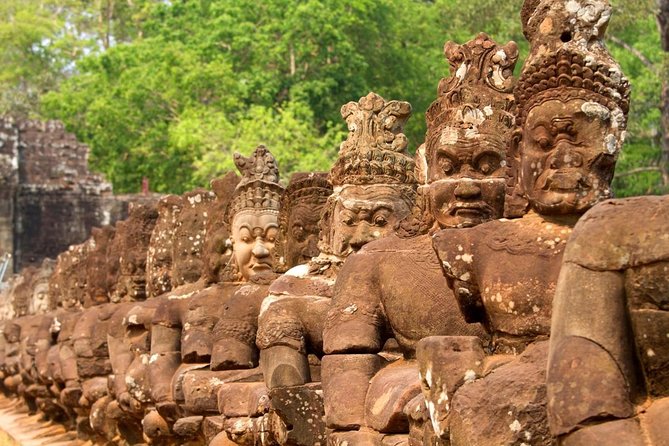
The first day begins at Angkor Thom South Gate, the grand entrance to the last capital city of the Khmer Empire. The gate has been restored, and many of its carved heads remain in place. The bridge and gate make a strong opening image, but 25 minutes is enough for photographs and a short explanation rather than a full study.
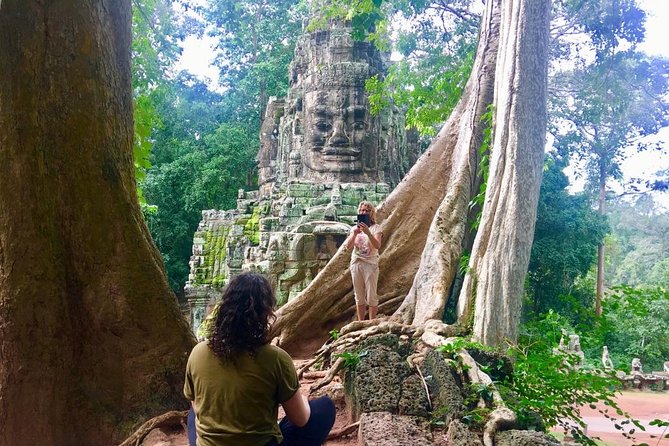
From there, you reach Bayon, the temple at the heart of Angkor Thom. Its famous towers carry enormous carved faces, with expressions that can look calm, watchful, or faintly amused depending on the light. Bayon is not as orderly as Angkor Wat, and that is part of its charm. You move through tight passages, corner galleries, and layers of carved stone.
Allow about an hour here. A guide is especially useful because the temple’s plan can be confusing, and the earliest form of the building is not fully known. Your guide can help you read the structure instead of treating each face as a separate photo stop.
The wider Angkor Thom area gets about 30 minutes. This gives you a sense of the scale of the royal city, though the schedule does not allow time to wander every path. The site is less a single temple than a large urban and ceremonial center, so keep expectations clear: you are getting an overview of its main monuments.
Baphuon and the terraces of Angkor Thom
Baphuon follows, with about 45 minutes. This temple rises on a long sandstone base and has broad, stacked levels rather than the sharply narrowing pyramid shape found elsewhere. The approach gives you a strong sense of height and proportion.
Some steps can be steep, and the stone surfaces may feel uneven. Wear shoes with a firm sole and take your time. The view from higher sections can reward the climb, but you do not need to reach every level to appreciate the design.
Phimeanakas receives about 30 minutes. It sits near the center of the former Royal Palace enclosure and is more restrained than Bayon or Baphuon. Its importance comes from its position within the royal complex and its connection to the palace area, not from a large collection of intact carvings.
The Terrace of the Elephants then stretches along the edge of the royal center. Give it about 45 minutes to examine the long procession of elephant carvings and ceremonial reliefs. This is a good place for your guide to explain how royal displays, processions, and public ritual shaped the design of Angkor Thom.
The nearby Terrace of the Leper King takes another 30 minutes. Its interior and exterior walls carry dramatic bas-reliefs, with figures arranged in crowded, detailed scenes. It is easy to glance at the outer wall and move on, but I would ask your guide to point out the carved figures in the inner passage. The terrace rewards close looking more than quick photography.
Ta Prohm, the kingdom of trees
Ta Prohm is the day’s atmospheric change of pace. About 90 minutes lets you explore more than the most photographed corner, though the temple can still feel rushed if you stop at every gallery.
The site is famous for trees growing over walls and through courtyards. Archaeologists have cleared visitor paths and strengthened weak sections, while leaving much of the temple in its ruined state. That balance gives Ta Prohm its special mood, but it also means you should watch your footing and follow the marked route.
I like this stop because the damage is part of the experience, not simply something to overlook. Roots, collapsed galleries, and carved doorways show how the temple has changed over time. The tradeoff is that its fame makes it one of the busier stops on the route, so your private guide can help you focus on the sections that fit your pace.
Other Siem Reap experiences to weigh up
- Angkor 2-Day Sunset & Sunrise Small-Group Tour
5.0 · 2,567 reviews - 2 Days Exclusive Temple Highlights with Sunset and Sunrise Tour
5.0 · 1,157 reviews - Siem Reap: Angkor Sunrise 1- or 2-Day Guided Temples Tour
4.9 · 1,132 reviews - 2 Days Guided Historical Tour in Angkor
5.0 · 855 reviews
Angkor Wat needs real time
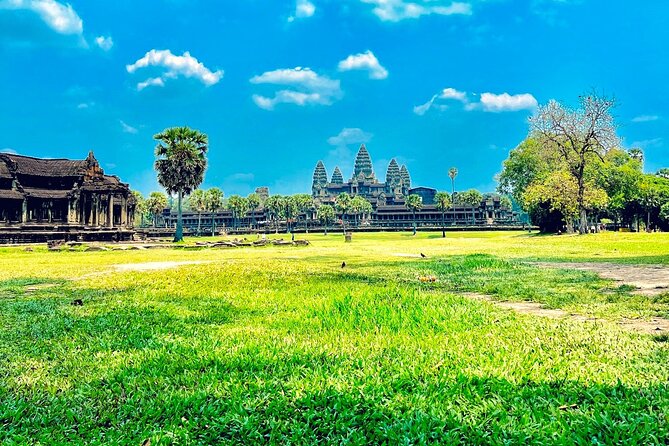
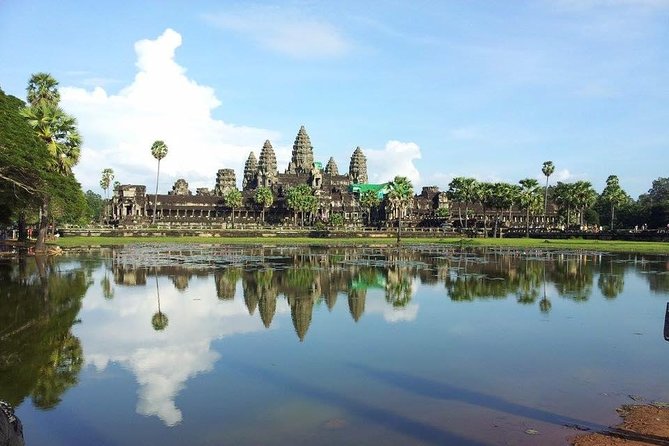
Three hours are set aside for Angkor Wat, and that is appropriate. This is not a monument you can understand from the front causeway alone. Its galleries, towers, courtyards, bas-reliefs, and long approaches need time.
Angkor Wat is the largest and best-preserved monument in the Angkor complex. Its balance is the first thing you notice: repeated galleries, rising towers, long pools, and carefully controlled sight lines. Then the details begin to appear in the reliefs and sculpture.
A guide helps you make sense of the building’s religious purpose and royal ambition. Without some explanation, the scale can become tiring rather than meaningful. With three hours, you can move at a steadier pace, pause in the galleries, and still have time for photographs.
The schedule places Angkor Wat after Ta Prohm, which makes for a long day. The listed stops alone add up to more than eight hours, before driving, parking, meals, and temple entry. If you want to watch the light change or linger at every gallery, tell your guide early. A private tour offers flexibility, but it cannot create extra daylight.
Ta Nei adds a quieter finish
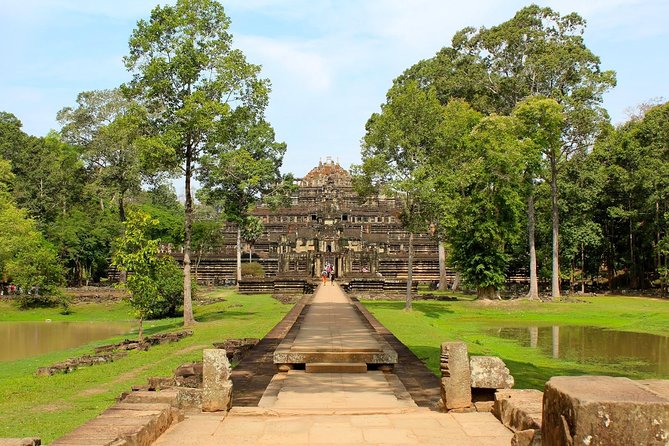
Ta Nei is a small temple hidden deep in the Cambodian forest, about 200 meters west of the East Baray. It can be hard to find and receives far fewer visitors than Angkor Wat or Ta Prohm.
The visit lasts about 45 minutes. Do not expect the scale or polish of the major temples. Ta Nei is valuable because it feels less staged and more remote. Its obscurity gives you room to think about Angkor as a large network of temples rather than a short list of famous names.
This is one of the best reasons to choose a private tour. A guide and driver who know the route can get you to a place that is not obvious from the main road. Still, access and conditions may affect how long you spend there, so treat the timing as an approximate guide.
Day two: fine carvings and the Grand Circuit
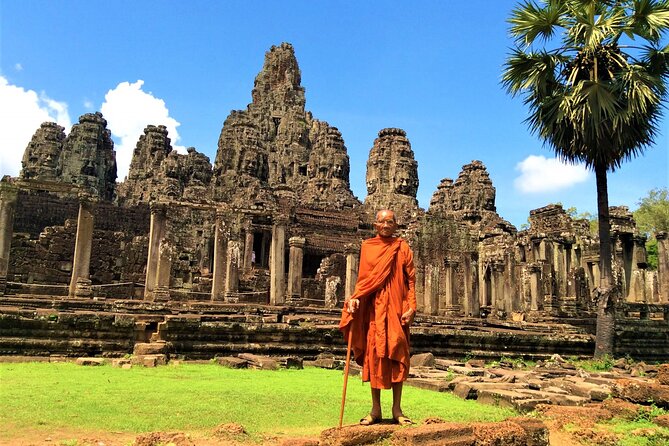
Day two begins with Banteay Srei, about 37 kilometers from Angkor Wat. The temple is smaller than the main complex, but its pink sandstone carvings are unusually fine. Allow about 80 minutes to examine the detailed lintels, pediments, and figures.
Banteay Srei is often called a precious jewel of Khmer art, but the useful point for you is simple: this is a close-looking temple. Its scale makes the carving easier to study than the vast walls of Angkor Wat. The drive takes you farther from the central complex, so this stop gives the day a different rhythm.
Banteay Samre follows for about 45 minutes. It is one of the more complete temple complexes at Angkor, restored through anastylosis, a method that reassembles original architectural pieces. The buildings have a strong, enclosed shape and can feel calmer than the main sites.
Maintenance has been uneven in recent years, so do not expect every surface to look freshly cared for. That is a practical limitation, but the temple remains worthwhile for its layout and relative completeness.
Pre Rup takes about 50 minutes. Built in a style similar to East Mebon, it uses bold tiers and a strong central arrangement. The upper levels give the temple a clear sense of height, though the stairways can be demanding.
East Mebon receives 30 minutes. Look for the free-standing stone elephants at the corners of the first and second tiers. These sculptures help you see how animal figures were used as guardians and decoration, rather than treating them as small details in a much larger monument.
Water, corridors, and Preah Khan
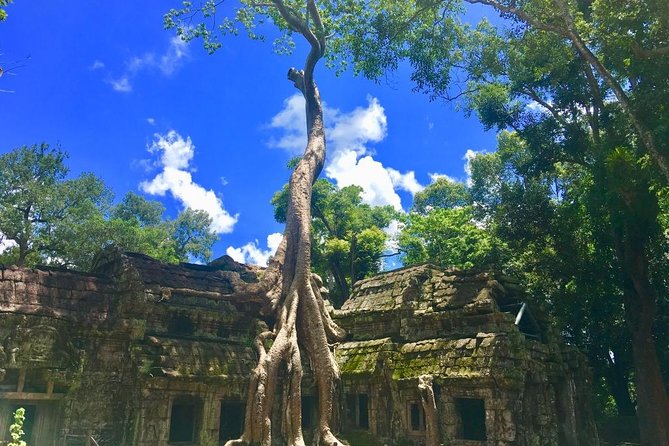
Neak Pean is a different kind of stop. Its central shrine sits within a large square man-made pond, about 70 meters on each side, with smaller pools around it. The water-centered plan gives the site a more open feeling after several pyramid temples.
You will spend about 45 minutes here. Depending on conditions, you may view the temple from a walkway rather than wander through a large interior. The appeal is the design and setting, so listen closely as your guide explains how the pools shaped the monument.
Preah Khan allows about an hour. Built in the late twelfth century by King Jayavarman VII and dedicated to his father, it is a large complex with long corridors, courtyards, carved doorways, and a mixture of religious forms.
Preah Khan rewards patience. It is easy to get turned around, and the layered plan can blur together without a guide. Ask for time to look at the details instead of rushing from entrance to exit. I consider this one of the most useful stops for understanding how a large Khmer temple functioned as more than a single tower.
Two small temples and a local stop
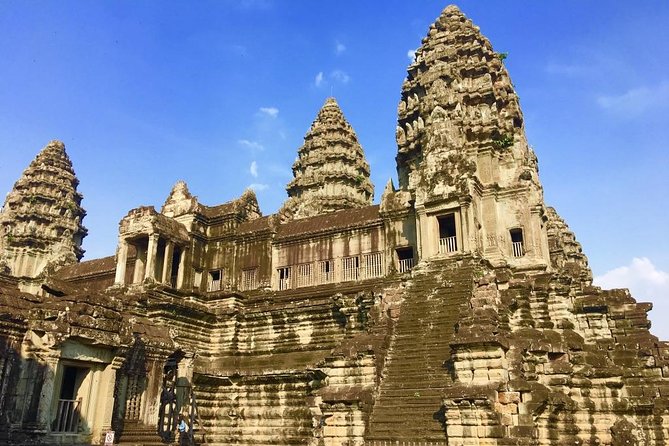
Banteay Prei is rarely visited and receives about 45 minutes. It is a minor temple, so its value depends on your interest in Angkor archaeology and quiet places. If you have already reached your limit for ruins, this may feel like a slow stop. If you want a fuller picture of the temple network, it adds a useful contrast to the grand monuments.
The final stop is in Prashdak Village, at the Om Pich steamed toddy palm cake area and Preah Dak Market. The visit lasts about 30 minutes and provides a change from stonework. You can see local market goods, souvenirs, objects, and arts.
Because the tour information does not promise a formal cooking class or tasting menu, keep your expectations modest. This is a short local stop, not a major food experience. It can still be a pleasant way to finish after two days of temples.
What the private setup really gives you
The group is limited to your own party. That is useful at Angkor, where different people in a group may want very different things. You can ask for more time at Bayon, fewer minutes at a minor temple, or a requested detour if the guide agrees.
One previous booking specifically included a stop at the land mine museum on request. That does not mean the museum is part of the standard route, but it shows why you should raise special interests early rather than waiting until the day begins.
The service includes hotel pickup and drop-off, private transfers in a comfortable vehicle, an English-speaking licensed guide, drinking water, and cool fresh tissues. Other languages are available for the experience, but the included guide is identified as English-speaking, so confirm your preferred language before booking.
You need suitable clothing for religious sites. Wear a shirt covering your shoulders and trousers, knee-length pants, or a knee-length skirt. The tour is near public transportation, and most people can participate, but the temples involve walking, uneven surfaces, and stairs.
Who should book this tour?
I would choose this tour if you want broad coverage in two days and prefer your own guide to a large group. It is a particularly good match for first-time Angkor visitors who want the famous sites but also want Ta Nei, Banteay Prei, and other quieter temples included.
It also suits people who value context. The itinerary moves through different periods, royal centers, religious buildings, terraces, water temples, and forest ruins. A good guide can connect those pieces into a story instead of leaving you with a stack of impressive photographs.
I would hesitate if you want slow mornings, long lunches, or time to sit quietly at each temple. Day one is packed, and day two includes several outlying sites. The private format gives you some control, but the tour is still designed for coverage.
Should you book the Highlight of Angkor Complex tour?
Book it if you want a serious two-day introduction to Angkor with private transport and a guide who can adjust the experience to your group. The strongest features are the wide temple selection, the mix of major and minor sites, and the chance to ask for practical changes along the way.
Before paying, budget separately for the Angkor Pass, meals, and tips. Also confirm pickup details with your hotel name and be ready for long, warm days. If that sounds manageable, $149.46 per person is a reasonable price for private service across such a wide complex, especially when you value organized transport and clear explanations.
FAQ
Is hotel pickup included?
Yes. Hotel pickup and drop-off are included, and you need to provide your hotel name for pickup arrangements.
Is the Angkor Pass included in the tour price?
No. The Angkor Pass is extra. Your guide will assist you in buying it at the entrance to Angkor Park before the temple visits.
Are meals included?
No. Lunches are at your own expense. Local restaurants offer vegetarian and non-vegetarian dishes, with menu prices listed at about $3 to $10 per dish.
Is this a private tour?
Yes. Only your own group participates, and private transfers by vehicle are included.
What language does the guide speak?
The included professional licensed guide is English-speaking. The experience is offered in a range of languages, so confirm your preferred language when booking.
What clothing should I wear?
Wear a shirt that covers your shoulders and trousers, knee-length pants, or a knee-length skirt. This clothing is required for respectful visits to the ancient religious sites.
Fresh reviews from around Siem Reap
- Full-Day Tour Preah Vihea & Koh Ker Temple 3.7 · 3 reviews
- Savor the Countryside: Tours with Authentic Cooking Classes” 5.0 · 3 reviews
- Angkor Grand Circuit Tour & Banteay Srei 5.0 · 3 reviews
- Guided Private Tuk Tuk Tour Angkor Wat and Small Circle and Five Extras 5.0 · 3 reviews
- Angkor Wat Sunrise TukTuk Tour 5.0 · 3 reviews
- Siem Reap Temple Tour 2-Day with Sunrise/Sunset 3.7 · 3 reviews
- Bangkok to Angkor Wat 2 Days 1 Night by Flight 4.5 · 3 reviews
- Kompong Pluk Tour 5.0 · 3 reviews
Angkor Temple Tours, compared.

Angkor Wat Sunrise or Sunset Tour with Guide from Siem Reap
Read our review →



Angkor Wat Sunrise tour with Small – Group and Guide tours
Read our review →
Angkor Wat Highlights and Sunrise Guided Tour from Siem Reap
Read our review →

Full-Day Angkor Wat Sunrise Private Tour with Guide from Siem Reap
Read our review →Browse the lists this tour appears in