
Reviewed · ANGKOR WAT SUNRISE TOURS
2-Day Eight Temple Tour with Optional Sunrise
Angkor’s best temples come in very different moods. Pre Rup gives you a steep climb and open countryside views, while Ta Prohm feels like a ruin being slowly reclaimed by trees. Over two private days, you also reach Angkor Wat, Bayon, Banteay Srei, Banteay Samre, Banteay Kdei, and Preah Khan.
I like the freedom of private transport and a private guide, especially when the heat makes a fixed group schedule less appealing. I also like the range: delicate pink carvings at Banteay Srei, giant stone faces at Bayon, and jungle-grown walls at Ta Prohm. The main drawback is the extra temple-pass cost, which adds $62 per person to the $98 tour price.
In This Review
- Key points at a glance
- Why this two-day Angkor route works
- Day one: Pre Rup and the eastern temples
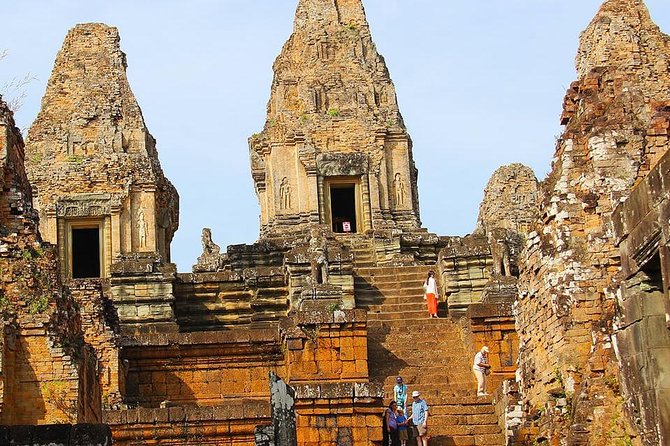
- Pre Rup, a steep start with open views
- Banteay Samre, a smaller-scale architectural lesson
- Banteay Srei, the day’s finest carving
- Ta Prohm, where jungle and stone meet
- Banteay Kdei, a quieter companion to Ta Prohm
- Day two: Angkor Wat, Preah Khan, and Bayon
- Angkor Wat, the essential centerpiece
- Preah Khan, a large ruin with less restoration
- Bayon, the temple of many faces
- A private guide can shape the whole experience
- What the $98 price really covers
- Clothing, pace, and practical planning
- Who should book this temple tour
- Should you book the two-day Angkor tour?
- FAQ
- How long is the tour?
- Which temples are included?
- Is the tour private?
- Is hotel pickup included?
- What is included in the tour price?
- Is the temple pass included?
- Are food and drinks included?
- What should I wear to the temples?
- Can I cancel for a full refund?
Key points at a glance
- Eight major temples over two days: The route covers Angkor Wat, Bayon, Ta Prohm, Banteay Srei, Banteay Samre, Banteay Kdei, Preah Khan, and Pre Rup.
- Private touring: Your group has its own guide and suitable transport, so you are not tied to another group’s pace.
- Sam is a memorable guide option: One detailed account praises Sam’s storytelling and photography skills. Guide assignment should be confirmed when booking.
- The three-day temple pass costs extra: Budget $62 per person in addition to the $98 tour price.
- A useful mix of famous and quieter-feeling sites: Ta Prohm and Angkor Wat are major draws, while Banteay Samre and Banteay Kdei add variety.
- Temple clothing rules are strict: You must cover your shoulders and knees at the temples.
Why this two-day Angkor route works
Siem Reap’s temple zone is too spread out for casual hopping between sites. This tour solves the transport problem and gives you a clear two-day plan, with hotel pickup in Siem Reap and cold water included.
The route also makes sense because it does not treat Angkor as one giant attraction. Each temple offers a different lesson in Khmer architecture, religion, or royal power. You move from mountain-temple geometry at Pre Rup to fine sandstone carving at Banteay Srei, then from jungle-covered Ta Prohm to the enormous ceremonial scale of Angkor Wat.
A private tour matters here. You can ask your guide to explain a carving, pause when a site catches your eye, or move on when you have had enough. The freedom is useful, but private does not mean empty. Angkor Wat, Ta Prohm, Bayon, and other popular sites can still have plenty of people.
The tour costs $98, not including the required three-day temple pass at $62 per person. For one person, that makes the basic outlay $160 before food, drinks, or personal expenses. For two people, the tour price becomes more attractive because transport and guiding are shared within your group. Group discounts are advertised, so larger private groups may find the per-person value better.
More sunrise departures to Angkor Wat:
- Angkor Wat Sunrise or Sunset Tour with Guide from Siem Reap
5.0 · 12,109 reviews - Siem Reap: Angkor Wat: Small-Group Sunrise or Sunset Tour
5.0 · 9,444 reviews - Siem Reap: Angkor Wat 2-Day Tour with Sunrise and Sunset
4.9 · 4,429 reviews
Day one: Pre Rup and the eastern temples
Pre Rup, a steep start with open views
Pre Rup is one of the earlier temples built by the Khmer kings. It is known as a mountain temple because the main towers rise above a steep set of steps.
The climb is part of the appeal, though it is not a casual stroll. At the top, you get a broad view of the countryside around Siem Reap. The reward is less about a single perfect photograph and more about seeing how the temple sits in the wider setting.
Take care on the stone steps. The description specifically calls out the steep climb, so anyone uneasy with heights or uneven surfaces should treat this as a real physical feature, not a minor detail. Most people can take part in the tour, but the day involves walking, steps, heat, and outdoor ruins.
Banteay Samre, a smaller-scale architectural lesson
Banteay Samre is built in a style similar to Angkor Wat. It gives you a chance to study Khmer design on a more manageable scale before the huge centerpiece arrives on day two.
Plan to spend about an hour here, according to the stated program. Look closely at the towers and carvings rather than rushing through for a quick photograph. This is the kind of stop where a private guide can add real value by pointing out details you might otherwise pass.
Banteay Samre is also a useful counterpoint to the more famous temples. You get the same broad architectural language, but without the sheer size of Angkor Wat. That makes it easier to focus on structure, decoration, and the way the temple was planned.
Other Siem Reap experiences to weigh up
- Angkor Wat Sunrise tour with Small – Group and Guide tours
5.0 · 3,655 reviews - Angkor Wat Highlights and Sunrise Guided Tour from Siem Reap
5.0 · 3,213 reviews - Full-Day Angkor Wat Sunrise Private Tour with Guide from Siem Reap
5.0 · 2,920 reviews - Angkor Wat Sunrise & 3 Main Temples with Breakfast – Small Group
5.0 · 2,857 reviews
Banteay Srei, the day’s finest carving
Banteay Srei is often the artistic highlight of the first day. Its pink sandstone came from quarries in the Kulen Mountain range, and the color gives the temple a warmer, more delicate appearance than many of the larger gray stone monuments.
The carvings are unusually fine. The walls and doorways are covered with detailed figures and patterns, and the smaller scale lets you appreciate the work at close range. A local legend says the carving was too beautiful to have been made by men, so women must have created it. Treat that as legend, but enjoy the charm of the story.
Banteay Srei rewards patience. Look around the entrances, lintels, and carved panels instead of only walking the outer path. This is one of the strongest reasons to have a guide: the visual details are easy to miss when you do not know where to look.
Ta Prohm, where jungle and stone meet
Ta Prohm is the tour’s famous movie temple, known to many people as the Tomb Raider temple after it appeared in the Angelina Jolie film. Its fame brings crowds, but the temple still has a powerful atmosphere.
Unlike a fully restored monument, Ta Prohm has been left partly to the elements. Trees push through the buildings, roots grip the walls, and corridors open into shadowy courtyards. The result is not a polished historical display. It feels like a ruin still in the process of changing.
That is also the drawback. Some areas may be restricted for safety, and popular viewpoints can slow your progress. A private group gives you more control than a large shared group, but it cannot remove other people from one of Angkor’s best-known stops.
Banteay Kdei, a quieter companion to Ta Prohm
Banteay Kdei sits near Ta Prohm and is known as the Citadel of Chambers or the Citadel of Monks’ Cells. It is a Buddhist temple with a more intimate feel, and it makes a sensible final stop after the drama of Ta Prohm.
The two temples work well together. Ta Prohm shows nature pressing into the ruins, while Banteay Kdei gives you another chance to examine corridors, chambers, and Buddhist details without relying on one famous movie image.
By the end of day one, you will have seen five temples. That is a full schedule, and the heat can make the second half feel longer than the first. Cold water is included, but meals and drinks are not, so plan to pay for those separately.
Day two: Angkor Wat, Preah Khan, and Bayon
Angkor Wat, the essential centerpiece
Day two begins with Angkor Wat, the site most people associate with Siem Reap. It is the largest temple built during the Khmer Empire and the central attraction of the Angkor Archaeological Park, a UNESCO World Heritage site.
The scale is the first thing you notice. Angkor Wat is not just a single tower or shrine. It is a vast complex with galleries, courtyards, towers, and long approaches that make the temple feel almost like a city of stone.
You should give this stop plenty of attention. The plan allows you to explore the massive temple before moving on, and the private format lets you ask about the carvings, religious changes, and royal purpose of the site. Angkor Wat contains Hindu elements, but the park also includes major Buddhist monuments, so your guide can help connect the different periods and traditions.
An optional sunrise is part of the tour title, but the supplied details do not state its meeting time, extra cost, or exact arrangements. Confirm those points before booking if sunrise is important to you. The regular program begins with Angkor Wat, but sunrise access should not be assumed to include anything beyond what the operator confirms.
Angkor Wat is also the place where crowd control matters most. The private tour gives you your own guide and transport, but you are still visiting one of Cambodia’s most popular monuments. Keep your expectations realistic: private means personal pacing, not a private temple.
Preah Khan, a large ruin with less restoration
After Angkor Wat, the route heads to Preah Khan, a 12th-century temple built by King Jayavarman VII. It has been made safe for visitors, but little restoration work has taken place compared with more repaired sites.
That limited restoration is the main attraction. You can see how walls, galleries, and vegetation interact when a monument is protected but not fully rebuilt. The temple rewards slow walking because the sense of discovery comes from passing through its spaces and noticing what remains.
Preah Khan is a good stop for anyone who prefers atmospheric ruins to perfect symmetry. It can also feel more confusing than Angkor Wat, which makes a guide useful. A private guide can help you understand the site instead of leaving you to guess what each damaged corridor once did.
Bayon, the temple of many faces
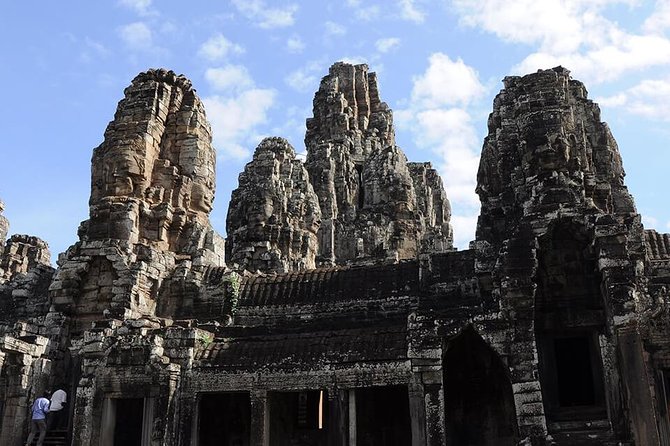
The final major stop is Bayon, often the favorite temple for people who enjoy puzzles and close-up details. Its most famous feature is the collection of huge stone faces looking out from the towers.
Bayon is not only a photo stop. The temple also contains remnants of Hindu inscriptions and both Mahayana and Theravada Buddhist inscriptions. Those layers make it a fascinating place to study how religious life changed over time.
The program allows a few hours here, which is sensible. Bayon has many corners, passageways, carvings, and faces packed into a relatively complex structure. Walk slowly and keep looking up, around corners, and along the galleries. The first face you see is only the beginning.
Bayon can be physically tiring after Angkor Wat and Preah Khan. That is one reason the private setup helps. You can set a practical pace, stop for water, and spend more time at the parts that interest you instead of following a large group through every section.
A private guide can shape the whole experience
The strongest personal praise connected with this tour goes to a guide named Sam. He is described as a master storyteller with strong photography skills, which points to two useful guide qualities at Angkor.
First, storytelling can give shape to a very large archaeological park. Without context, you may see towers, walls, and carvings but struggle to understand why one temple feels different from another. A guide who can explain the kings, beliefs, and changes in construction helps turn separate stops into a connected visit.
Second, photography help matters at temples. The most famous angle is not always the best one, and the stone faces, doorways, and tree roots can be hard to frame. Sam’s photography ability is a specific strength to ask about, though you should confirm whether he will be your assigned guide.
Another detailed account praises the guide as personable and well informed. I would treat that as a sign that the guide is a major part of the tour’s value, not as a guarantee about every guide on every departure. If a particular guide matters to you, request the name when booking.
What the $98 price really covers
The $98 price includes the tour guide, cold water, and transport suited to the group size. Hotel pickup in Siem Reap is included, which saves you the trouble of arranging a separate vehicle for a two-day route spread across the temple zone.
The price does not include food, drinks, accommodation, personal expenses, or the three-day temple pass. The pass costs $62 per person, so build that into your budget from the start. The pass is not a small add-on, and overlooking it can make the advertised tour price look lower than your actual cost.
The value improves if you are traveling with another person or a small private group. You share the guiding and transport cost while keeping control of the pace. For a solo visitor, the total is harder to justify, although the convenience of private pickup and a two-day plan may still be worth it.
Group discounts may help larger parties. Since the exact discount is not provided, ask for the total price before booking rather than relying on a general promise of savings.
Clothing, pace, and practical planning
You must cover your shoulders and knees to enter the temples. Choose clothing that meets that rule for both days, and remember that temple visits include walking and climbing, especially at Pre Rup.
Cold water is included, but food and drinks are not. The program covers several major sites across long days, so you should plan for your own meals and any personal purchases. Accommodation is also outside the tour price.
The tour is private, and only your group participates. That gives you a more personal format than a shared coach tour. It does not guarantee empty courtyards or instant access at the busiest monuments.
Confirmation is received when you book, and the activity offers mobile ticketing. Most people can participate, but the information does not promise special accessibility arrangements. If steps, uneven ground, or long walks are a concern, ask the operator before you commit.
Free cancellation is available if you cancel at least 24 hours before the local start time. Cancellations or changes made less than 24 hours ahead are not refunded or accepted.
Who should book this temple tour
I would choose this tour if you want to see a broad range of Angkor sites without arranging transport yourself. It suits a couple, family, or small group that values a private guide and wants more flexibility than a large shared tour usually allows.
It is especially good for first-time visitors who want the famous temples but do not want to spend both days only at Angkor Wat and Ta Prohm. Banteay Srei adds fine carving, Pre Rup adds views and a climb, Preah Khan adds unrestored character, and Bayon brings the memorable stone faces.
You should think twice if you want a slow, unhurried visit to only a few temples. Eight major sites in two days is ambitious. It gives you range, but each stop receives less time than it would on a custom trip with a shorter list.
The extra $62 pass fee also matters. Add it before comparing this with other tours. For a private two-day service with transport, water, and a guide, the package can be good value for two or more people, but the total cost is not $98 per person once the pass is included.
Should you book the two-day Angkor tour?
Book it if your priority is coverage, private transport, and guide-led context. The route includes the essential Angkor Wat and Bayon, famous Ta Prohm, and several sites that show a different side of Khmer architecture. The detailed praise for Sam’s storytelling and photography makes the guide worth discussing when you reserve.
Skip it if you want a very slow schedule, dislike steep steps and long temple days, or are not prepared for the separate $62 temple pass. Also confirm the optional sunrise details rather than assuming they are included in the standard plan.
For most first visits to Siem Reap, this is a practical way to see the park’s biggest sights and several excellent supporting temples in two days, as long as you budget honestly and accept a busy schedule.
FAQ
How long is the tour?
The experience lasts approximately two days.
Which temples are included?
The tour includes Pre Rup, Banteay Samre, Banteay Srei, Ta Prohm, Banteay Kdei, Angkor Wat, Preah Khan, and Bayon.
Is the tour private?
Yes. Only your group participates in the private tour or activity.
Is hotel pickup included?
Yes. Private transport includes convenient pickup from your Siem Reap hotel.
What is included in the tour price?
The price includes a tour guide, cold water, and transport suitable for the group size.
Is the temple pass included?
No. A three-day temple pass costs $62 per person and must be paid separately.
Are food and drinks included?
No. Food and drinks are not included.
What should I wear to the temples?
You must cover your shoulders and knees to enter the temples.
Can I cancel for a full refund?
Yes, if you cancel at least 24 hours before the experience start time. Cancellations made less than 24 hours in advance are not refunded.
More 2-Day Experiences in Siem Reap
- Angkor 2-Day Sunset & Sunrise Small-Group Tour
5.0 · 2,567 reviews - 2 Days Exclusive Temple Highlights with Sunset and Sunrise Tour
5.0 · 1,157 reviews - Siem Reap: Angkor Sunrise 1- or 2-Day Guided Temples Tour
4.9 · 1,132 reviews - 2 Days Guided Historical Tour in Angkor
5.0 · 855 reviews
Fresh reviews from around Siem Reap
- Full-Day Tour Preah Vihea & Koh Ker Temple 3.7 · 3 reviews
- Savor the Countryside: Tours with Authentic Cooking Classes” 5.0 · 3 reviews
- Guided Private Tuk Tuk Tour Angkor Wat and Small Circle and Five Extras 5.0 · 3 reviews
- Angkor Wat Sunrise TukTuk Tour 5.0 · 3 reviews
- Angkor Grand Circuit Tour & Banteay Srei 5.0 · 3 reviews
- Siem Reap Temple Tour 2-Day with Sunrise/Sunset 3.7 · 3 reviews
- Bangkok to Angkor Wat 2 Days 1 Night by Flight 4.5 · 3 reviews
- Kompong Pluk Tour 5.0 · 3 reviews
Angkor Wat Sunrise Tours, compared.

Angkor Wat Sunrise or Sunset Tour with Guide from Siem Reap
Read our review →


Angkor Wat Sunrise tour with Small – Group and Guide tours
Read our review →
Angkor Wat Highlights and Sunrise Guided Tour from Siem Reap
Read our review →
Full-Day Angkor Wat Sunrise Private Tour with Guide from Siem Reap
Read our review →
Angkor Wat Sunrise & 3 Main Temples with Breakfast – Small Group
Read our review →
Browse the lists this tour appears in