Reviewed · TUK-TUKS
Full Day Angkor Park with Sunset by Tuk Tuk
The best part of this day is the way you move between Cambodia’s great temples: seated in an open-sided traditional tuk-tuk, with the road, villages, and tropical air forming part of the experience. You get Angkor Thom, Bayon, Ta Prohm, Angkor Wat, and a sunset stop at Pre Rup in one long circuit.
I like the local village visit near Angkor Thom, which gives the ancient stones a human setting, and I like having an English-speaking guide explain the temples instead of simply dropping you at the gates. Guides named Samnang, Sak, Sok Chea, Phal, and Chhay have all been associated with especially strong guiding, clear explanations, and good humor.
The main drawback is cost and stamina. The advertised tour price is $41, but the required temple pass adds $37, bringing the known total to $78 per person before lunch. Nine hours of walking, heat, and temple steps can also make this a demanding day.
In This Review
- Key points at a glance
- Why the tuk-tuk makes this Angkor day different
- Starting near Angkor Thom with a village visit
- Angkor Thom and the Bayon’s stone faces
- Ta Prohm, where the forest takes over
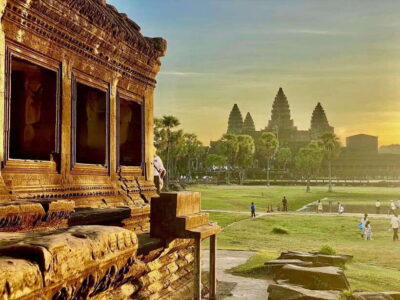
- Angkor Wat from the quieter eastern side
- Pre Rup at sunset
- What the $41 price really covers
- Practical preparation for nine hours in the park
- Who should book this Angkor tuk-tuk tour?
- Final verdict: a strong one-day Angkor introduction
- FAQ
- How long does the Angkor tuk-tuk tour last?
- What time does the tour start?
- Is the Angkor temple pass included?
- Is lunch included?
- What transportation is provided?
- Is this a private tour?
- What clothing should I wear?
Key points at a glance
- A full Angkor circuit by tuk-tuk: The open vehicle makes transfers more pleasant than spending the entire day in a sealed car.
- A village near Angkor Thom: You get a glimpse of present-day Cambodian life before entering the old Khmer capital.
- The temple sequence has variety: Bayon’s carved faces, Ta Prohm’s tree-covered ruins, and Angkor Wat’s grand architecture each offer a different mood.
- Sunset at Pre Rup: The day finishes at a temple known for its high brick terraces and broad evening views.
- Guiding is a major strength: Samnang, Sak, Sok Chea, Phal, and Chhay are names connected with careful explanations and friendly service.
- Budget for the temple ticket: The $37 Angkor pass is not included and must be paid directly at the site.
Why the tuk-tuk makes this Angkor day different
Angkor is too large to understand as one isolated temple. The ruins spread across a wide area, and the journeys between them help you see how the old capital fitted into its setting. A tuk-tuk keeps those transfers informal and open to the sights and sounds around you.
You ride in a motorised trolley pulled through the park by a local driver. It is not silent, and it is not luxurious, but that is part of its appeal. You can watch roadside life pass by, feel the breeze, and pause more naturally than you might in a larger vehicle.
The booking describes the outing as private to your group, which is useful if you want control over the pace. At the same time, some of the associated tour arrangements have included group participation, including one day with 11 people. Confirm the group format when booking if privacy matters to you.
The service includes hotel pickup and drop-off, mineral water, the tuk-tuk, and a licensed English-speaking guide. That removes much of the day’s basic planning. You still need to pay for lunch and the temple pass yourself.
More Angkor temple itineraries:
- Angkor Wat Sunrise or Sunset Tour with Guide from Siem Reap
5.0 · 12,109 reviews - Siem Reap: Angkor Wat: Small-Group Sunrise or Sunset Tour
5.0 · 9,444 reviews - Siem Reap: Angkor Wat 2-Day Tour with Sunrise and Sunset
4.9 · 4,429 reviews
Starting near Angkor Thom with a village visit
The day begins at about 9 am after breakfast. That is later than a sunrise departure, so you avoid the darkest early start, though you also miss the chance to see Angkor Wat at dawn.
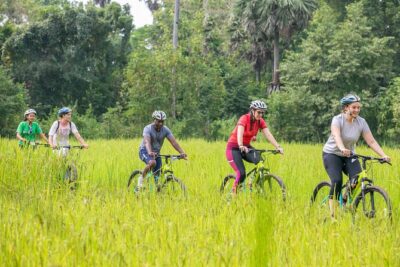
Your first stage takes you toward an untouched village near Angkor Thom. The stated aim is to learn about day-to-day local life before turning to the ancient city. This is a useful change of pace. You are not spending the entire morning moving from one stone monument to the next.
The village stop is also one reason this tour feels broader than a simple Angkor Wat transfer. You get a little context for modern Cambodia before entering the remains of the Khmer capital. The exact village activities and length of the stop are not specified, so expect an introduction rather than a full rural cultural program.
Allow yourself to settle into the heat here. Keep water close, wear good walking shoes, and use insect repellent. The included mineral water helps, but one bottle is not a substitute for preparing properly for a full day outdoors.
Angkor Thom and the Bayon’s stone faces
Angkor Thom was once the capital of the Khmer Empire, and the approach gives the first real sense of scale. The city was not just a temple. It was a major royal center enclosed within monumental walls and gates.
The itinerary gives about two hours to Angkor Thom. That is enough time to walk through the main areas with a guide, though you should not expect to inspect every corner of the great city. Your guide can help you focus on the layout, the royal setting, and the meaning behind the major carvings.
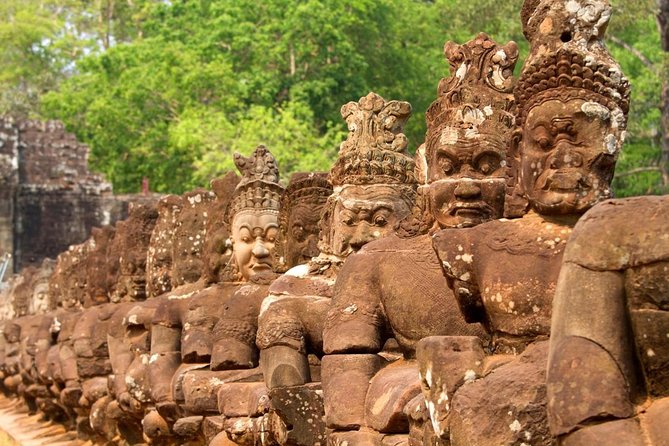
The route also passes the Terrace of the Elephants. This long ceremonial platform is known for its carved elephants and other figures. It is easy to hurry past it on the way to the larger temples, but stop and look closely at the stonework. It helps explain how royal processions and public ceremonies once shaped this space.
Bayon comes next, with another stated two-hour block. This is one of Angkor’s most memorable temples, thanks to its huge carved faces looking out from the towers. The faces appear from different angles as you walk through the narrow passages, so the temple rewards a slow pace.
Bayon can feel confusing without help. Towers, galleries, stairs, and shaded corridors overlap in a compact space. A good guide makes the visit much more useful by pointing out what you are seeing and explaining the religious and royal ideas behind it.
Several guide names connected with this experience deserve attention. Samnang, also called Lucky in the tour information, is noted for welcoming conversation and strong explanations. Sak is associated with clear English instruction at Angkor Wat. Sok Chea has been praised for teaching the history of the temples in a way that makes the day easier to follow. Phal is described as covering Cambodian history as well as the monuments, while Chhay is known for attentive detail and humor.
Guides vary, so these names should not be treated as a guarantee of your assigned person. You can ask who will lead your departure. The guide matters here because Angkor’s carvings are easy to admire but harder to interpret on your own.
Ta Prohm, where the forest takes over
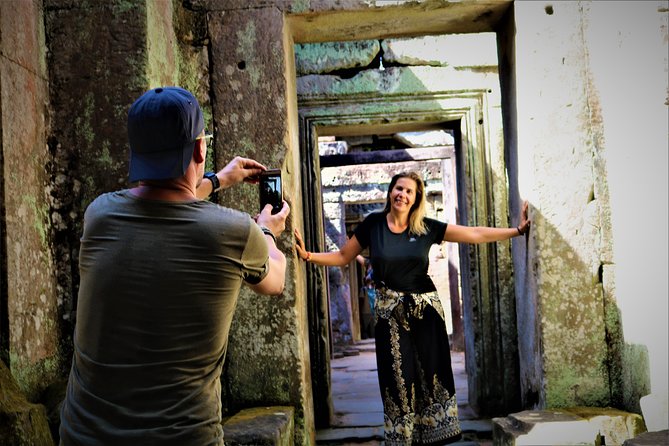
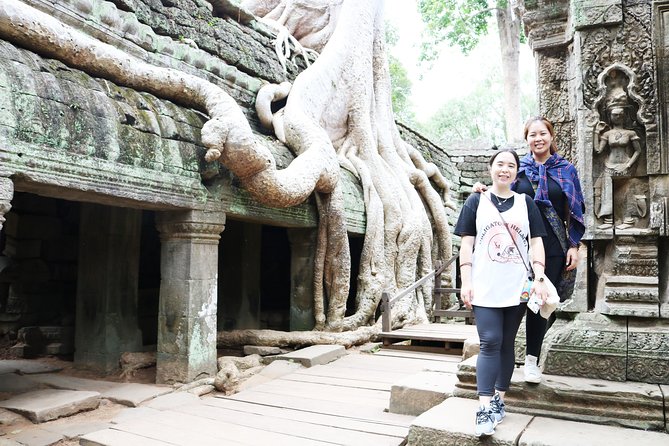
Ta Prohm changes the mood completely. After Angkor Thom and Bayon’s formal stonework, you enter a temple surrounded by jungle and known for trees growing over the ruins.
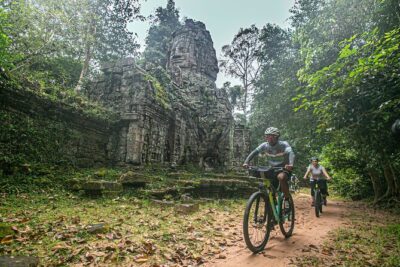
The tour allows about two hours. That gives you time to walk through the maze-like remains and see the fig trees pressing against walls and galleries. The trees are not just decoration. They show the long contest between the built temple and the forest around it.
Ta Prohm’s appeal comes from that tension. You can see carved doorways, collapsed sections, and roots wrapping around masonry in the same view. It is an atmospheric stop, but the uneven ground and broken stone demand attention.
The plan places lunch around the Ta Prohm portion, with the meal at your own expense. No restaurant is specified, so do not assume lunch is included or that a particular menu is part of the package. Ask your guide about timing, then use the break to rest rather than rushing straight into another major temple.
This is also a sensible point to check your clothing. Angkor requires respectful dress, with shoulders and knees covered. A scarf used only to cover the shoulders is not accepted according to the stated dress rules, so wear a shirt or top that already covers them. Comfortable walking shoes are more useful than fashionable footwear here.
Other Siem Reap experiences to weigh up
- Siem Reap: Angkor Wat Private Tuk-Tuk Tour
4.9 · 2,222 reviews - Siem Reap Countryside Bike Tour / E-Bike or Tuk Tuk
5.0 · 935 reviews - Angkor Sunrise Bike Tour / E-Bike or Tuk Tuk
5.0 · 615 reviews - Angkor Wat Private Tuk-Tuk Tour (sunrise Option) & more
5.0 · 439 reviews
Angkor Wat from the quieter eastern side
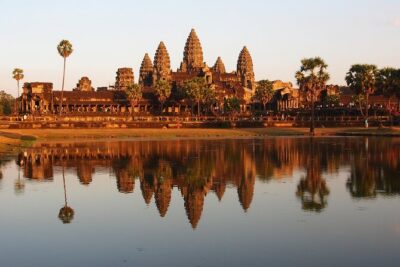
After lunch, you continue to Angkor Wat, the best-known temple in the complex and the largest sacred building in the world according to the tour description. Built in the 12th century, it took about 30 years to complete.
The approach is from the less-visited eastern side. That can make the arrival feel less predictable than coming straight through the most famous entrance. You will still encounter the scale of Angkor Wat, but the eastern approach offers a different way to understand its design.
Set aside about two hours. That is enough for a guided introduction to the outer areas, galleries, towers, and major architectural ideas. It is not an unlimited visit, especially after a full morning and lunch break.
Angkor Wat rewards patience. Look beyond the central towers and allow time for the long galleries and carved scenes. The building was planned with layers of meaning, and your guide can explain how the structure worked as both a religious center and a statement of royal power.
This is the point where a strong guide has the greatest practical value. Sak, Sok Chea, and the other named guides associated with the tour have been singled out for clear English and detailed temple explanations. Ask questions as you go, especially if you want more than a list of dates and names.
The temple pass is not included. You must buy the $37 ticket directly at the site. That fee is a major part of your actual budget, so compare the full $78 known cost, plus lunch, with other Angkor options before booking.
Pre Rup at sunset
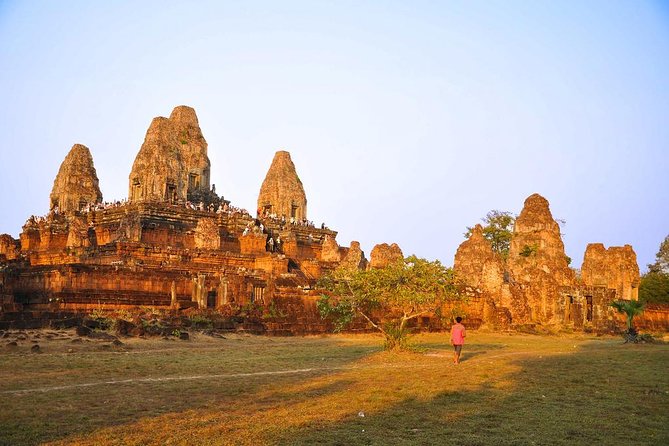
The advertised finale is sunset at Pre Rup. This brick temple rises in stepped terraces and is well suited to an evening stop because its upper levels provide open views across the surrounding area.
Sunset timing depends on the season, weather, and how long the earlier visits take. The itinerary does not give a precise sunset schedule, so the guide and driver will need to manage the day carefully. The later stops listed in the route are described as pass-bys, and the exact timing at Pre Rup is not stated.
That uncertainty is worth noting. The tour promises the sunset finish, but no weather-dependent temple visit can guarantee a dramatic sky. If poor weather cancels the experience, the policy offers another date or a full refund.
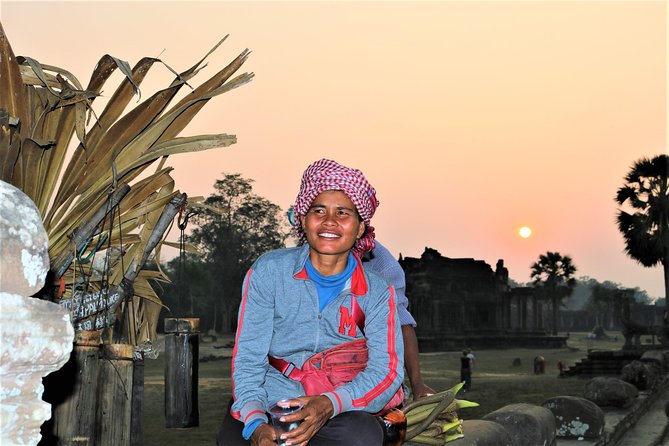
Even without a spectacular sunset, Pre Rup gives the day a quieter ending. You can sit or walk near the upper levels, review the temples you have seen, and watch the light change over the trees. After several hours of walking, that pause is welcome.
Bring a hat and sunglasses for the daytime, but keep your expectations practical for the evening. The sunset stop is one part of a long circuit, not a separate, leisurely photography session.
What the $41 price really covers
At $41 per person, the base price looks modest for about nine hours. It includes the guide, tuk-tuk transportation, water, and hotel transfers. Those inclusions cover the services you are most likely to need during a full day at Angkor.
The required $37 temple pass changes the calculation. Your known pre-lunch total becomes $78 per person, and lunch remains extra. That is still reasonable if you want a guide, transport, and a full day of temple visits without arranging each part yourself, but it is not a $41 all-in experience.
The value is strongest for people who want interpretation and convenience. A licensed English-speaking guide can explain the Khmer capital, religious symbolism, and architectural details while the driver handles the route. You are paying for a structured day, not simply a ride to Angkor Wat.
Group discounts are offered, though the details are not provided. Ask how the discount applies and confirm whether the departure remains private to your group. A private arrangement may be worth more to you if you want to linger at Bayon, shorten a temple stop, or manage the day around your walking pace.
Practical preparation for nine hours in the park
Start with breakfast because the departure is around 9 am and the day runs for roughly nine hours. Since lunch is not included, carry enough money and ask about the planned meal break.
Wear clothing that covers your shoulders and knees from the start. Do not rely on a scarf as a substitute for a proper shoulder-covering garment. Choose shoes with good support because the stops involve walking over uneven temple surfaces.
Pack the simple items that make hot temple days easier:
- Sunglasses and a hat
- Camera or phone
- Comfortable walking shoes
- Mosquito or insect repellent
- Extra water beyond the mineral water supplied
Hotel pickup and drop-off are included, and the meeting time is listed as 9 am. Confirmation is provided at booking. The experience is near public transportation, and most people can take part, but anyone with difficulty walking should consider the length of the day and the uneven temple ground.
The tour requires good weather. You can cancel for a full refund up to 24 hours before the start time. Cancellations or changes made within 24 hours are not refunded or accepted.
Who should book this Angkor tuk-tuk tour?
I would choose this outing if you want the major Angkor sites in one organized day and prefer a local tuk-tuk to a private car. It suits first-time visitors who want history explained in English, hotel transport arranged, and a route that includes more than Angkor Wat.
It also suits you if you like variety. The village, royal city, face towers, jungle temple, grand sanctuary, and sunset terrace each offer something different. You do not spend the entire day looking at similar ruins.
I would think twice if you want a slow photographic study of each temple. Two hours per major stop sounds generous, but Angkor Thom and Bayon together can absorb far more time. The nine-hour schedule is full, and sunset timing may make the final part feel less flexible.
I would also confirm the private arrangement before paying. The experience is described as restricted to your group, while some associated bookings have operated with larger groups. That detail can affect both comfort and pace.
Final verdict: a strong one-day Angkor introduction
Book this tour if you want a practical first day at Angkor with a guide, local transport, and a clear list of major stops. The strongest reasons are the tuk-tuk travel, the useful village stop, the range from Bayon to Ta Prohm and Angkor Wat, and the chance to finish at Pre Rup.
Do not book it expecting every cost to be included. Add the $37 temple ticket and lunch to the advertised $41, prepare for heat and long walks, and confirm the group size and assigned guide.
For many people, that tradeoff is fair. A guide such as Samnang, Sak, Sok Chea, Phal, or Chhay can turn impressive stones into a story you can follow. If you want a well-organized introduction to Cambodia’s Khmer monuments in one day, this is a sensible choice.
FAQ
How long does the Angkor tuk-tuk tour last?
The experience lasts approximately nine hours.
What time does the tour start?
The listed start time is 9 am, with hotel pickup offered.
Is the Angkor temple pass included?
No. The temple pass is paid directly at the site and costs $37 per person.
Is lunch included?
No. Lunch is not included in the tour price.
What transportation is provided?
You travel by traditional motorised trolley tuk-tuk. Hotel pickup and drop-off are included.
Is this a private tour?
The experience is described as private and restricted to your group. Because some associated arrangements have included group participation, confirm the group format when booking.
What clothing should I wear?
You must cover your shoulders and knees. A scarf used to cover the shoulders is not accepted, so wear clothing that provides proper coverage. Comfortable walking shoes are also recommended.
More Full-Day in Siem Reap
- Full-Day Angkor Wat Sunrise Private Tour with Guide from Siem Reap
5.0 · 2,920 reviews - Siem Reap: Angkor Wat Sunrise and Full-Day Sightseeing Tour
4.9 · 2,828 reviews - Full-Day Guided Sunset Tour of Angkor Wat
5.0 · 1,507 reviews - Siem Reap: Full Day Angkor Wat Temple Experience with Sunset
4.9 · 1,490 reviews
More Evening Experiences in Siem Reap
- Sunset tour of Kampong Phluk stilts home village on the Tonle Sap
5.0 · 4,865 reviews - Siem Reap: Full-Day Angkor Wat Guided Tour with Sunset
4.9 · 3,803 reviews - Angkor Wat Sunset Small Group Tour with Lunch Included
5.0 · 3,059 reviews - Angkor 2-Day Sunset & Sunrise Small-Group Tour
5.0 · 2,567 reviews
Fresh reviews from around Siem Reap
- Full-Day Tour Preah Vihea & Koh Ker Temple 3.7 · 3 reviews
- Savor the Countryside: Tours with Authentic Cooking Classes” 5.0 · 3 reviews
- Angkor Wat Sunrise TukTuk Tour 5.0 · 3 reviews
- Angkor Grand Circuit Tour & Banteay Srei 5.0 · 3 reviews
- Guided Private Tuk Tuk Tour Angkor Wat and Small Circle and Five Extras 5.0 · 3 reviews
- Siem Reap Temple Tour 2-Day with Sunrise/Sunset 3.7 · 3 reviews
- Bangkok to Angkor Wat 2 Days 1 Night by Flight 4.5 · 3 reviews
- Kompong Pluk Tour 5.0 · 3 reviews