
Reviewed · 3-DAY EXPERIENCES
3 Days Siem Reap Explorer – Small Group
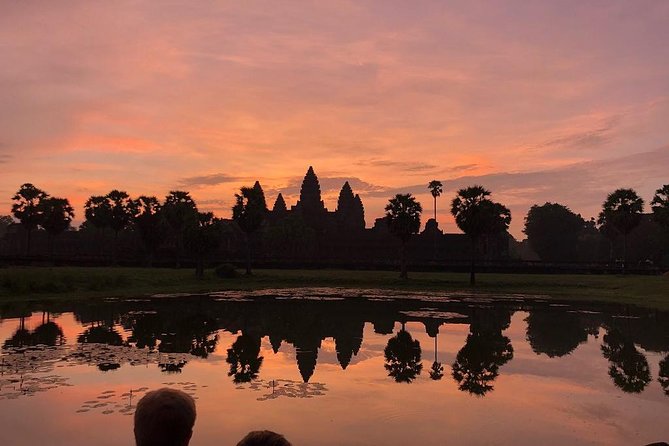
Angkor Wat before sunrise is the star here, but the real strength of this tour is its range. In three days, you move from a floating village and early Khmer temples to the grand circuit of Angkor, with time for Ta Prohm, Banteay Srei, and Pre Rup. The small group keeps the pace more personal, and guide Sok is specifically named as a standout guide. I like the mix of temples and living culture, plus the air-conditioned vehicle and hotel pickup. The main drawback is cost clarity: the advertised $129 becomes $191 once you add the required three-day temple pass, and meals remain your responsibility.
I also like that the plan gives you Angkor in stages instead of trying to cram every major ruin into one exhausting day. You get the famous sights, but also quieter places such as Neak Pean and Preah Khan. The schedule is demanding, especially with a 4:00 to 4:30 a.m. start on day two, and the Tonlé Sap or Phare Circus choice depends on the season.
In This Review
- Key points to know before booking
- Why three days works well in Siem Reap
- Day one: Tonlé Sap and the oldest Khmer temples
- Phare Circus or the lake, depending on the calendar
- Day two: Angkor Wat before dawn
- Angkor Thom and Bayon, a capital in stone
- Ta Prohm, where trees share the ruins
- Day three: quieter temples and fine carving
- Pre Rup closes the temple circuit
- What the small group and transport add
- Who should book this three-day route
- Should you book it?
- FAQ
- Is the three-day temple pass included in the $129 price?
- Is hotel pickup included?
- What happens at Tonlé Sap Lake?
- Is Phare Circus included?
- How large is the tour group?
- What should I wear and bring?
Key points to know before booking
- Angkor Wat at sunrise: Enter from the less-used eastern side before dawn, then explore the temple as daylight arrives.
- Maximum 15 people: A small group allows more room for questions and easier movement than a large coach tour.
- A full three-day temple route: Angkor Wat, Angkor Thom, Bayon, Ta Prohm, Preah Khan, Neak Pean, Banteay Srei, and Pre Rup are all included in the plan.
- Tonlé Sap or Phare Circus: The program changes from March 1 through August 31, when the group visits Phare Circus instead of the lake.
- Budget for the temple pass: The three-day Angkor pass costs an additional $62 per person and is paid directly at the site.
- Practical dress rules: Shoulders and knees must be covered inside the temples, and comfortable walking shoes are essential.
Why three days works well in Siem Reap
You can see Angkor Wat in a day, but you will understand it better if you give the temple complex time. This tour spreads the major sites over two temple days, with Tonlé Sap or Phare Circus on the first day. That leaves room for a guide to explain how the monuments differ, rather than treating every pile of carved stone as the same.
The small-group limit of 15 matters here. Angkor involves narrow galleries, steep steps, shaded courtyards, and busy photo spots. A smaller vehicle and group should make hotel pickup, temple stops, and guide explanations easier to manage than a large bus outing.
The advertised price is $129 per person. Add the required $62 three-day temple pass, and your fixed tour cost is $191 per person before meals. That is not a bargain-basement outing, but it covers three days of guiding, transport, hotel pickup and drop-off, mineral water, and either a Tonlé Sap boat cruise or a Phare Circus seat. If you were already planning to hire transport and a guide for three days, the package can be good value.
Meals are not included, so you should plan to buy food along the way or at your own choice. The schedule is active, and you will want regular meals and water rather than relying only on the included bottles.
Other Siem Reap experiences to weigh up
Day one: Tonlé Sap and the oldest Khmer temples
The first morning begins with a 7:30 pickup from your hotel and a drive through the countryside to Kampong Phluk Floating Village. The destination sits on Tonlé Sap, a huge freshwater lake that changes dramatically with the seasons. During the wet half of the year, the water expands to about 12,000 square kilometers.
The boat cruise is the point of this stop. You see traditional Khmer stilt houses and a community shaped by the lake’s rising and falling water. It is a useful counterpoint to Angkor’s royal temples. Instead of looking at the remains of an empire, you see how people still adapt daily life to Tonlé Sap.
Allow about three hours here. The boat ride is included, as is the lake entrance fee. The seasonal nature of the lake is important: what you see at Kampong Phluk depends on the water level and time of year. You should approach this as a living community and working fishing area, not simply as a photo stop.
The afternoon moves to Bakong, one of the major ruins at Roluos. These temples date to the ninth-century reign of King Indravarman I, placing them among the earliest Khmer monuments near Siem Reap. Bakong helps you see the development of Khmer temple design before the enormous Angkor Wat period.
The planned visit lasts about three hours, though the temple admission is not included in the tour price. Your $62 three-day pass covers the temples, but it is paid separately at the site. This is one reason to keep the extra charge in mind when comparing prices.
Bakong is less famous than Angkor Wat, and that is part of its appeal. The scale is more manageable, and the early date gives your guide a chance to explain how Khmer builders moved toward the temple-mountain style later seen on a grander scale.
Phare Circus or the lake, depending on the calendar
The first day includes an important seasonal switch. From March 1 through August 31, the group visits Phare, the Cambodian Circus instead of Tonlé Sap Lake. The provided schedule describes the lake as a morning stop, but also lists Phare as the alternative during this dry-season period. Check the exact plan for your dates before you book, since you should not assume both experiences are included.
Phare is more than an evening acrobatics show. It grew from post-Khmer Rouge efforts to help young Cambodians through arts training, and its performances combine physical theater, music, acrobatics, and Cambodian stories. The included ticket is for seat C, and the show lasts about two hours.
I like this option because it adds a modern Cambodian voice to a temple-focused trip. You are not only looking backward at stone monuments. You are also seeing a performance connected to Cambodia’s recovery and creative life.
If the lake is central to your plans, pay close attention to the seasonal arrangement. If Phare is offered instead, you still receive a distinctive cultural experience, but it is not a substitute for seeing Tonlé Sap. That difference may matter if this is your only visit to Siem Reap.
Day two: Angkor Wat before dawn
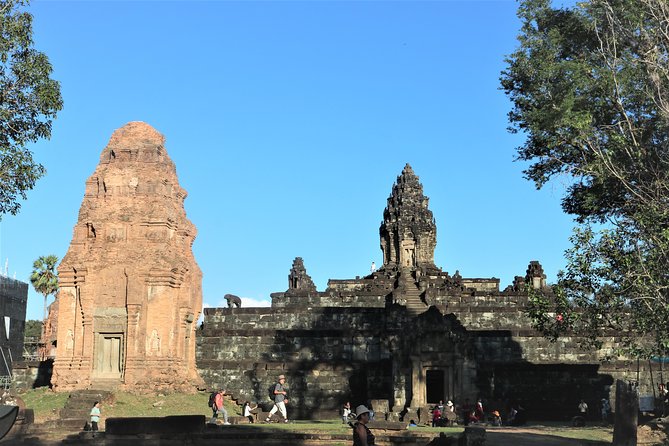
Day two begins early, with pickup around 4:00 to 4:30 a.m., depending on the season. This is not a gentle start, but sunrise at Angkor Wat is the reason many people accept the lost sleep.
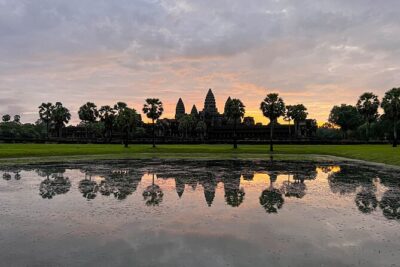
The group enters in darkness from the eastern side, described as a less-visited approach. That gives you a different first view of the temple than simply arriving at the main western entrance with the crowds. As the light grows, you can make out the towers, galleries, and long pools associated with the classic Angkor Wat view.
Plan on about three hours at Angkor Wat. The temple is large, and you will walk over uneven ground and through corridors. Comfortable shoes are not optional advice here. You should also dress for the temple rules, with shoulders and knees covered inside the monument.
Sunrise conditions are never guaranteed to look like a postcard. Clouds, haze, and crowd levels can change the mood. Even so, the early departure has practical value. You get cooler temperatures and more time inside the temple before the day becomes hot.
A guide is especially useful at Angkor Wat because the carvings and spaces can blur together without a clear route. A good explanation connects the architecture, religious purpose, and Khmer kings who commissioned it. Sok is the guide name associated with this experience, so if he is leading your departure, you can expect a particularly personal guiding style based on the available details.
A different pace for your next Siem Reap morning:
- Angkor Wat Sunrise or Sunset Tour with Guide from Siem Reap
5.0 · 12,109 reviews - Siem Reap: Angkor Wat: Small-Group Sunrise or Sunset Tour
5.0 · 9,444 reviews - From Siem Reap: Kampong Phluk Floating Village Tour by Boat
4.9 · 6,979 reviews - Sunset tour of Kampong Phluk stilts home village on the Tonle Sap
5.0 · 4,865 reviews
Angkor Thom and Bayon, a capital in stone

After Angkor Wat, the route continues to Angkor Thom’s South Gate. The stop is brief, about 30 minutes, but it gives you a dramatic entrance into the former Khmer capital. The gateway and approach help you grasp the scale of the walled city before you reach its central temples.
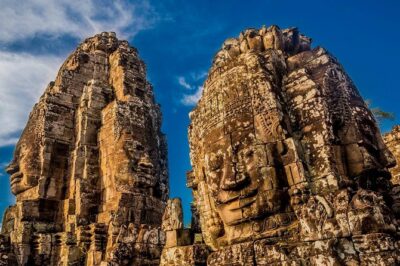
Inside Angkor Thom, the itinerary allows about an hour and a half, including Bayon. Bayon is known for its large carved faces and maze of galleries. It feels different from Angkor Wat: less symmetrical, more enclosed, and full of close-up details.
The route also passes the Terrace of the Leper King and the Terrace of the Elephants. These are not listed as long walking stops, so do not expect the same time here as at Bayon or Ta Prohm. Still, the pass-by adds useful context. The terraces once formed part of the public and ceremonial heart of Angkor Thom.
This section can be tiring because it follows the pre-dawn start. The advantage of a guided plan is that you do not have to decide which gates and terraces matter while running on little sleep. The disadvantage is that the schedule gives you set time at each place, so independent explorers may want longer at Bayon.
Ta Prohm, where trees share the ruins
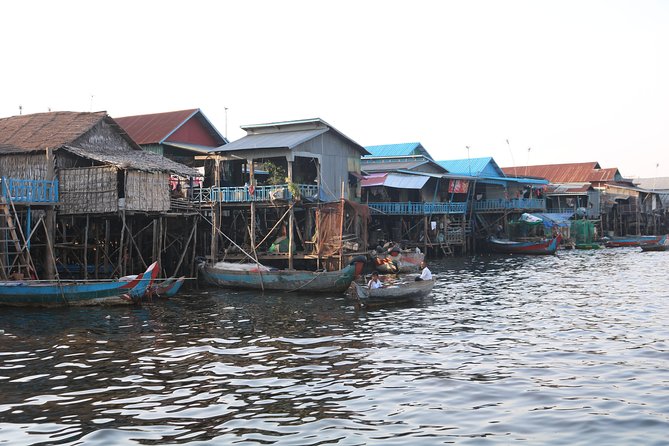
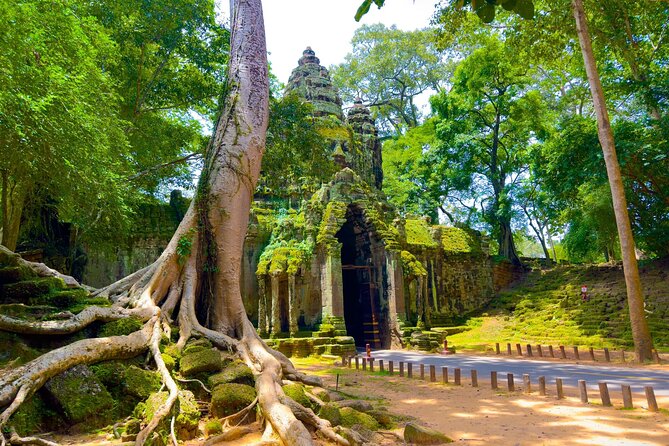
Ta Prohm is the temple most closely linked with the film Tomb Raider, but its appeal goes beyond movie fame. The site was once home to 2,740 monks, and its crumbling stonework remains tangled with tree roots. You get a strong sense of how the ruins looked when French explorer Henri Mouhot encountered them in the early 1850s.
The visit lasts about one hour. That is enough to walk through the most atmospheric sections, though not enough for every corner. Narrow passages and popular photo points can slow the group, so stay close to your guide and keep the meeting time in mind.
I like Ta Prohm as the final major stop of this day because it changes the mood. Angkor Wat presents order and grand design. Ta Prohm shows time, vegetation, collapse, and conservation in a more dramatic way.
By the end of day two, you will have covered a lot of ground. The early wake-up and several hours of walking are the tour’s biggest physical challenge. If you want to add sunrise photographs, major royal gates, Bayon, terraces, and Ta Prohm to one day, this is a sensible arrangement. If you dislike early mornings, it will feel demanding.
Day three: quieter temples and fine carving
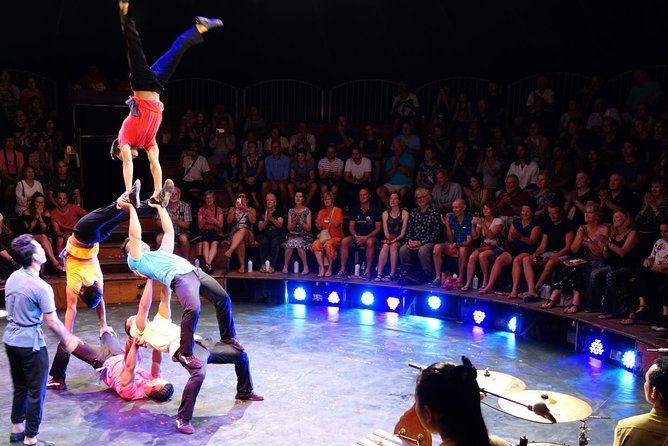
The final temple day starts at Preah Khan. This ruined complex has tree roots and crumbling stone structures, but it tends to feel less instantly familiar than Ta Prohm. The one-hour stop gives you time to see the long corridors and mixed religious elements without the same pressure to recreate a famous film scene.
Next comes Neak Pean, an artificial island with a Buddhist temple on a circular island in Jayatataka Baray. The visit lasts about 40 minutes. The setting is unusual, and the stop breaks up the long sequence of temple courtyards with water and open space.
The route then travels farther to Banteay Srei, one of the most finely carved temples in Cambodia. Its smaller sandstone structures are covered with detailed reliefs, and the workmanship is the main reason to make the trip beyond the central Angkor area.
Allow about an hour and a half at Banteay Srei. The temple is smaller than Angkor Wat, but its decoration rewards a slower look. This is a place where a guide can point out details you might otherwise walk past.
The distance from the central temples is part of the tradeoff. Banteay Srei takes time to reach, and the third day remains full. Still, it gives you a different scale and style of Khmer art. If you care about carving and construction details, it is one of the most worthwhile stops on the route.
Pre Rup closes the temple circuit
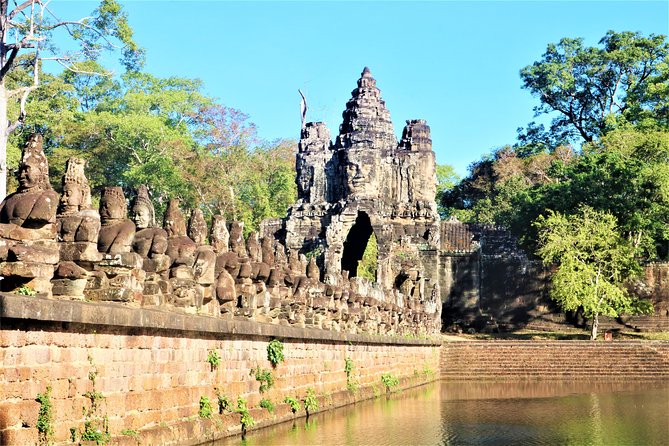
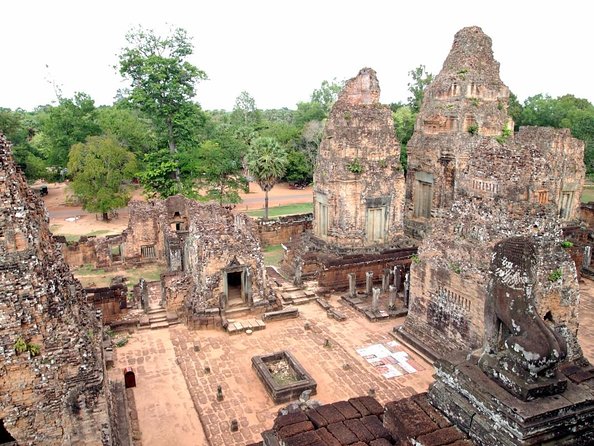
The last stop is Pre Rup, a Hindu temple mountain built as the state temple of King Rajendravarman and dedicated in 961 or early 962. Its brick, laterite, and sandstone construction gives it a different look from the more famous sandstone monuments.
The planned visit lasts about an hour and a half. Pre Rup is a strong final stop because it lets you reflect on how Khmer temple design changed across time. By this point, you have seen early Roluos architecture, Angkor Wat’s grand proportions, Bayon’s faces, Ta Prohm’s roots, Banteay Srei’s delicate carving, and Pre Rup’s brick-heavy form.
The schedule lists a late-afternoon timing for Pre Rup, but exact conditions can vary. Do not treat this as a guaranteed sunset event unless the operator confirms it. The value is the temple itself and the chance to finish the three-day route without adding another major site.
What the small group and transport add
The tour includes an air-conditioned vehicle, hotel pickup and drop-off, an English-speaking licensed guide, local tax, and mineral water. In Siem Reap’s heat, air conditioning is a practical benefit, especially after walking across exposed temple grounds.
Pickup details need a little attention. The general meeting information lists an 8:00 a.m. start, while day one begins at 7:30 and day two starts around 4:00 to 4:30. Use the actual pickup time supplied for your hotel and date, not the general start time.
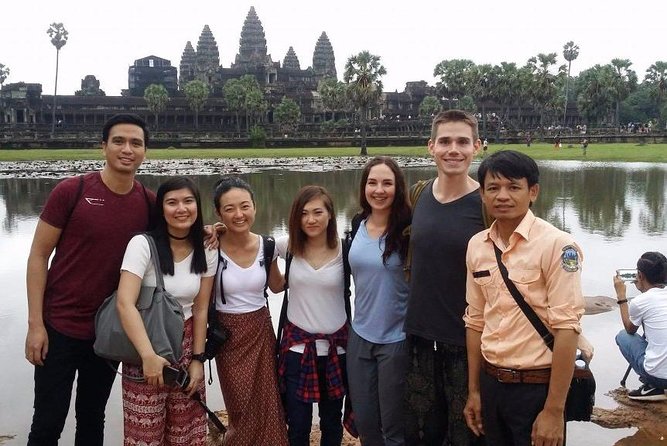
A maximum of 15 people is a useful middle ground. You still have company during long drives, but the group is small enough for questions and easier coordination. It is not a private tour, so you should expect to follow a shared schedule.
Children must be accompanied by an adult, and children younger than five are not allowed. Most people can participate, but you need comfortable walking shoes and enough stamina for uneven temple paths, multiple stops, and the early morning on day two.
Who should book this three-day route
I would choose this tour if you want the main Angkor temples handled in a logical order and also want one cultural experience beyond the ruins. It suits first-time visitors who prefer a guide, included transport, and a clear plan.
It is also a good fit if you want more than Angkor Wat alone. Preah Khan, Neak Pean, Banteay Srei, Bakong, and Pre Rup add variety, while Tonlé Sap or Phare gives the trip a connection to present-day Cambodia.
You may want another option if you need a slow holiday pace, dislike pre-dawn departures, or want to choose every temple yourself. The program is full, and the third day involves enough driving and walking to feel like a working sightseeing day.
Book only after checking whether your dates include Tonlé Sap or Phare Circus. Also budget the $62 temple pass and meals. Free cancellation is available if you cancel at least 24 hours before the local start time, but changes or cancellations inside that window are not accepted.
Should you book it?
Book this tour if you want a well-rounded Siem Reap introduction with Angkor Wat at sunrise, the major temple highlights, a small group, and practical transport. The best parts are the careful three-day spread, the atmospheric Ta Prohm and Preah Khan stops, and the chance to add either Tonlé Sap or Phare Circus.
Skip it if you want a private guide, long unscheduled time at each temple, or a lower total cost after the temple pass is added. For most first-time visitors who value structure and context, the $191 combined tour and pass cost is reasonable, provided the seasonal cultural option matches what you hope to see.
FAQ
Is the three-day temple pass included in the $129 price?
No. The three-day temple pass costs an additional $62 per person and must be paid directly at the site.
Is hotel pickup included?
Yes. Hotel pickup and drop-off are included. The listed departure times vary by day, with a 7:30 a.m. start on day one and a 4:00 to 4:30 a.m. pickup on day two.
What happens at Tonlé Sap Lake?
You travel to Kampong Phluk Floating Village, see traditional Khmer stilt houses, and take an included boat cruise on Tonlé Sap Lake. The lake entrance fee is also included.
Is Phare Circus included?
Phare Circus is included as the seasonal alternative to Tonlé Sap Lake from March 1 through August 31. The ticket is for seat C, and the show lasts about two hours.
How large is the tour group?
The tour has a maximum of 15 travelers. A minimum of two people is required per booking.
What should I wear and bring?
Wear comfortable walking shoes. Shoulders and knees must be covered inside the temples, and children must be accompanied by an adult. Children younger than five are not allowed.
Fresh reviews from around Siem Reap
- Full-Day Tour Preah Vihea & Koh Ker Temple 3.7 · 3 reviews
- Savor the Countryside: Tours with Authentic Cooking Classes” 5.0 · 3 reviews
- Angkor Grand Circuit Tour & Banteay Srei 5.0 · 3 reviews
- Guided Private Tuk Tuk Tour Angkor Wat and Small Circle and Five Extras 5.0 · 3 reviews
- Angkor Wat Sunrise TukTuk Tour 5.0 · 3 reviews
- Siem Reap Temple Tour 2-Day with Sunrise/Sunset 3.7 · 3 reviews
- Bangkok to Angkor Wat 2 Days 1 Night by Flight 4.5 · 3 reviews
- Kompong Pluk Tour 5.0 · 3 reviews
3-Day Experiences, compared.
3-Day Angkor Wat with All Interesting Major Temples, Banteay Srei & Beng Mealea
Read our review →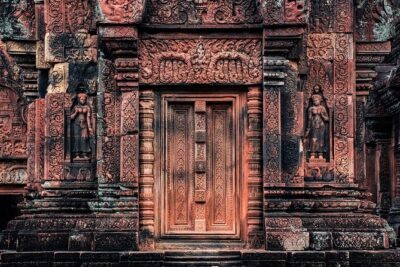
3-Day Angkor Wat & All Interesting Major Temples & Kulen Mount Waterfall
Read our review →
Best of Siem Reap 3-Day Private Tour to Angkor Wat & Tonle Sap
Read our review →
Private Siem Reap 3 Day Tour Discover All Highlight Angkor Temple
Read our review →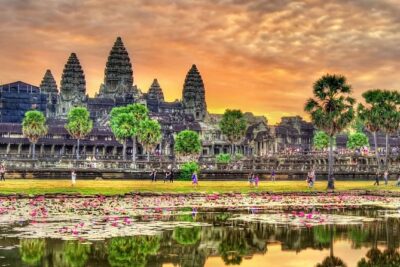
3-Day Tour(Unforgettable Angkor Temple Complex, Banteay Srei& Floating Village)
Read our review →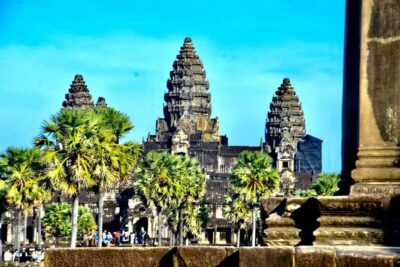
Browse the lists this tour appears in