
Reviewed · ANGKOR TEMPLE TOURS
Private Siem Reap 3 Day Tour Discover All Highlight Angkor Temple
Angkor Wat at sunrise is only the opening act here. This three-day private tour links the famous temples with Roluos, Tonle Sap, a floating village, Wat Bo, and Cambodian craft workshops, giving you a broader view of Siem Reap than a temple-only outing.
I like the cool, clean air-conditioned vehicle and the thoughtful supply of bottled water and cold towels. I also like the freedom of a private group, since you can spend longer at a favorite temple instead of following a large bus. The main drawback is the packed schedule, with several listed timings that look overly long or inconsistent, so you should confirm the daily plan with your guide.
In This Review
- Key points to know before booking
- A three-day route that gives Angkor room to breathe
- Day one: Roluos temples and life on Tonle Sap
- Day two: Angkor Wat, Angkor Thom, and the jungle temples
- Day three: Banteay Srei and the Grand Circuit
- Transport, guide service, and daily comfort
- What the $253.65 price really buys
- Who should book this private Siem Reap tour?
- Should you book it?
- FAQ
- Is hotel pickup included?
- Is this a private tour?
- Is an English-speaking guide included?
- Is transportation air-conditioned?
- Is the Angkor Pass included in the price?
- Is the Tonle Sap boat trip included?
- Are meals included?
- Can I cancel for a full refund?
Key points to know before booking
- Sunrise at Angkor Wat: Start early, see the temple in the first light, then return to your hotel for breakfast before continuing.
- A wide spread of Siem Reap: The route covers Angkor Wat, Angkor Thom, Ta Prohm, Banteay Srei, Roluos, Tonle Sap, and several lesser-known temples.
- Private transport with practical comforts: Expect hotel pickup, an air-conditioned vehicle, cold drinking water, and fresh towels throughout the trip.
- Tonle Sap by private boat: The floating-village visit adds a look at lake-based Cambodian life beyond the stone monuments.
- Local culture is part of the plan: Wat Bo, Satcha Cambodian Handicraft Center, and a palm-sugar producer break up the temple hours.
- Budget for the Angkor Pass and meals: The temple admission pass is separate, and lunches generally cost about $3 to $10 per dish.
A three-day route that gives Angkor room to breathe
At $253.65 per person, this tour is priced as a private, guided package rather than a basic ride between temples. Your price includes hotel transfers, an English-speaking licensed guide, private air-conditioned transport, a private Tonle Sap cruise, water, and towels. It does not include the Angkor Pass, tips, or meals.
That price makes better sense for two or more people sharing the private service. A solo visitor pays more for the same vehicle and guide, while a small group can spread the cost. Group discounts are available, but the exact saving is not provided, so check the final price before booking.
The private format matters most at Angkor. You can ask your guide to explain a carving, slow down at a quiet corner, or move on when the heat and crowds become tiring. You also avoid spending three days waiting for people from other hotels.
The schedule is ambitious. Day two includes sunrise, Angkor Wat, Angkor Thom, Ta Prohm, Banteay Kdei, and Ta Nei. Day three combines distant temples with Banteay Srei, local producers, and the Grand Circuit. You should be comfortable with early starts, long walks, stone steps, and warm weather.
More Angkor temple itineraries:
- Angkor Wat Sunrise or Sunset Tour with Guide from Siem Reap
5.0 · 12,109 reviews - Siem Reap: Angkor Wat: Small-Group Sunrise or Sunset Tour
5.0 · 9,444 reviews - Siem Reap: Angkor Wat 2-Day Tour with Sunrise and Sunset
4.9 · 4,429 reviews
Day one: Roluos temples and life on Tonle Sap
The first temple stop is Preah Ko, the Sacred Bull. It belongs to the old capital of Hariharalaya, now known as the Roluos group, and gives you an early look at Khmer temple design before the better-known Angkor monuments. Thirty minutes is enough for a first visit, though the stop is more useful if your guide explains how the early structure relates to later temple pyramids.
Bakong follows, with about an hour scheduled. Built in 881 under King Indravarman I, it helped establish the temple-mountain form that became a major feature of Khmer architecture. Its rising central structure gives you a clear sense of the design idea: a human-made mountain leading toward the sacred center.
Lolei is the smallest and youngest of the main Roluos temples. It is less visually dramatic than Bakong, but it completes the historical sequence. I like having these three sites together because they show development over time rather than presenting Angkor as one enormous collection of unrelated ruins.
The route then shifts from stone to water at Kampong Phluk Floating Village. The visit lasts about three hours and includes a private cruise on Tonle Sap Lake. The community has lived around the lake for several generations, and the setting gives you a chance to see a traditional way of life shaped by the lake’s changing water levels and fishing economy.
The schedule also lists Tonle Sap Lake as a separate thirty-minute stop. Since the floating-village visit already includes a boat trip, ask your guide how these two portions are arranged. You may be seeing a wider section of the lake, or the second entry may simply be part of the same water excursion.
Kampong Phluk is valuable because it adds human context to the temple circuit. Still, keep your expectations grounded. This is a working community, not a staged cultural show, and the exact sights can depend on local conditions and the route of the boat.
Back in town, Wat Bo offers a change of pace. It is one of Siem Reap’s older temples and is known for well-preserved late nineteenth-century wall paintings. The one-hour stop is a good counterpoint to Angkor’s large stone monuments, especially if you want to see a living religious setting rather than only archaeological ruins.
The day ends at Satcha, a Cambodian Handicraft Center. Its purpose is to give local artisans space to work with traditional techniques while adding modern design. This is a useful place to browse if you want a locally made souvenir, but you are not required to buy anything. The value is in seeing craft production treated as a working trade, not just a display for visitors.
Day two: Angkor Wat, Angkor Thom, and the jungle temples
Day two begins before breakfast with sunrise at Angkor Wat. You watch the light change over the temple, then explore the grounds for about three hours before returning to your hotel for breakfast. That split is practical: you get the famous early morning sight, then a chance to eat and rest before the hotter part of the day.
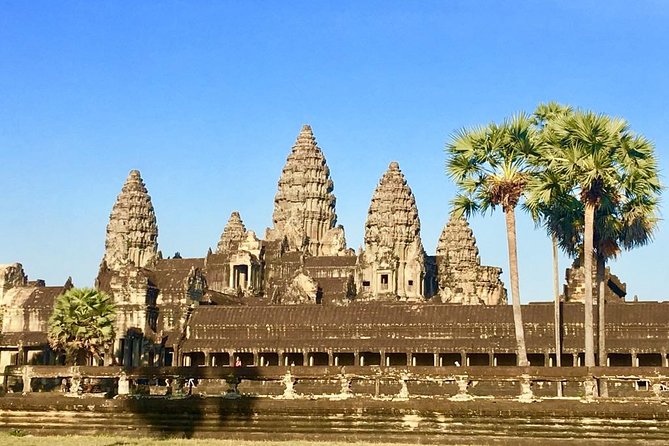
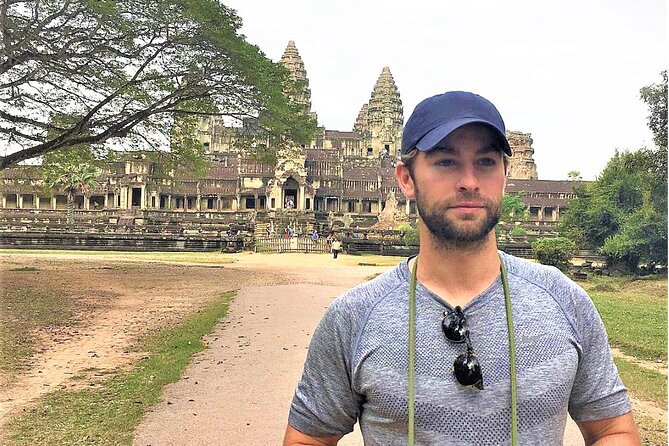
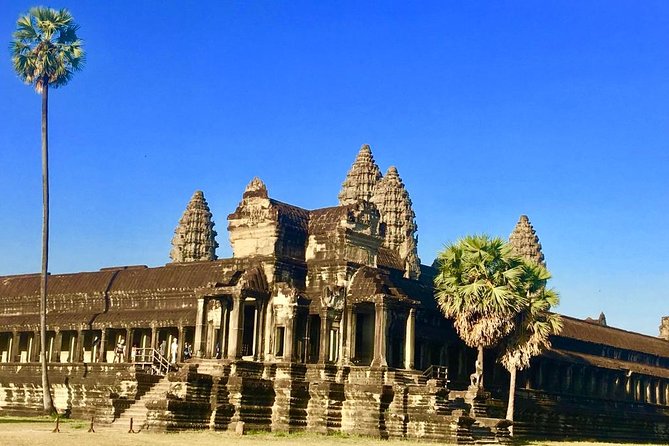
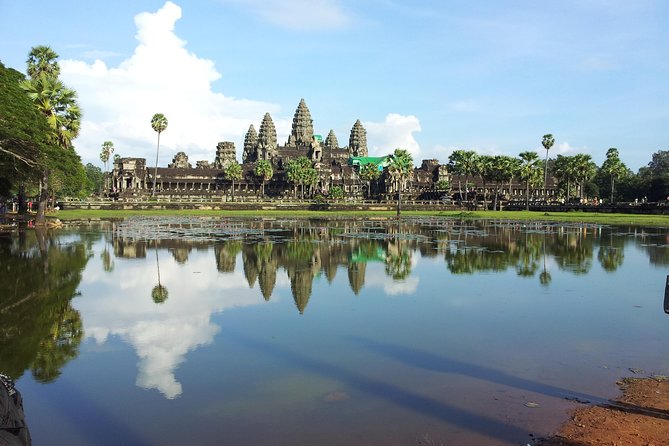
Angkor Wat is vast, and a guide earns their keep here by helping you read the design rather than simply pointing out the towers. The temple is Cambodia’s national emblem and the best-known monument on the route, but it can also feel overwhelming. Wear comfortable shoes, carry minimal gear, and use the early start to avoid doing all your walking in the strongest heat.
The South Gate of Angkor Thom is a short but memorable stop. Its causeway and monumental gate provide the familiar entrance view, with large sculptural figures lining the approach. Since this is the main road from Angkor Wat toward Bayon, it can be busy, so your half-hour visit may feel more like a focused photo and explanation stop than a quiet pause.
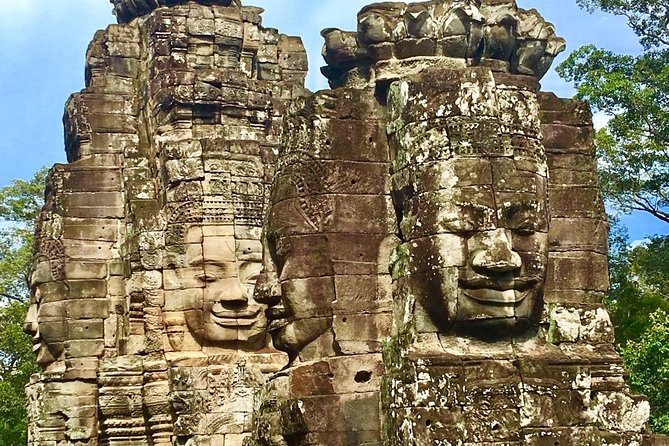
Inside Angkor Thom, Bayon is the main event. The temple was built around 1200 and is known for its many large stone faces. Give yourself time to look up and around, since the faces appear at different levels and angles. One hour is enough for a guided overview, though you may want longer if you enjoy architectural details.
Baphuon, built around 1060 as a state temple dedicated to Shiva, offers another kind of experience. Its tall form and long approach make the scale clear, while the later history of the structure helps explain why restoration at Angkor has been such a major task. Phimeanakas is quieter and more understated, with laterite construction and a long building history shaped by several kings.
The Terraces of the Elephants and the Leper King sit along the former Royal Square. They are not enclosed temple interiors, so they are easy to underestimate. Look closely at the carved details on the walls, especially on the Leper King terrace, where the reliefs reward careful attention.
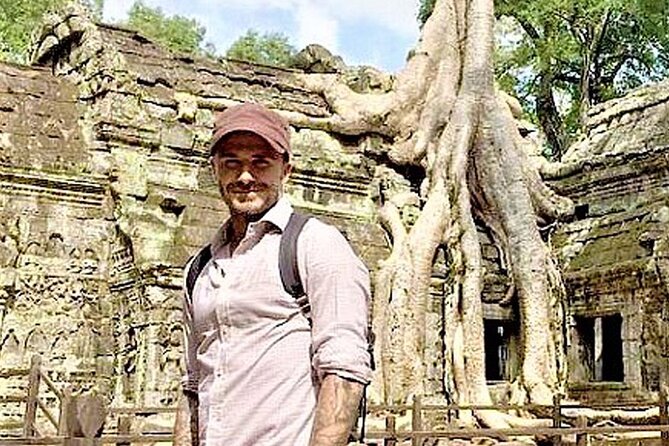
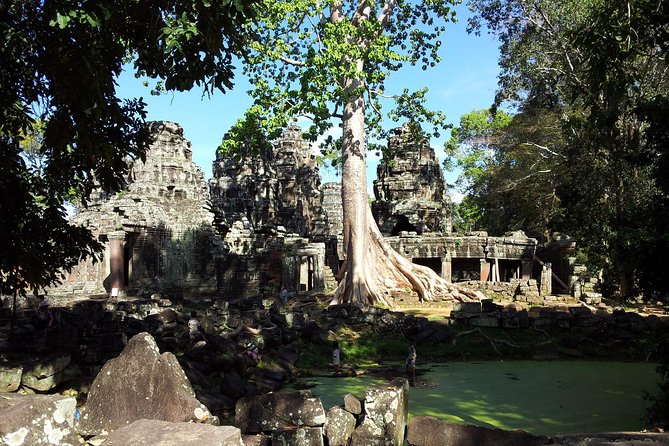
Ta Prohm is likely to be one of your most anticipated stops. It is famous for trees growing through and around the stone, giving it the familiar jungle-temple appearance. The setting is striking, but it is also one of the busiest places in Angkor. Your guide can help you see more than the best-known tree and frame the ruins as a functioning temple complex rather than a film backdrop.
The schedule then includes Banteay Kdei and Ta Nei. Banteay Kdei was a major Buddhist temple built under Jayavarman VII, and its worn corridors feel less polished than Angkor Wat. That weathered quality is part of its appeal, though uneven surfaces demand attention.
Ta Nei is a smaller late twelfth-century Buddhist temple near the East Baray. It is a worthwhile contrast to the major monuments, with a quieter setting and a more modest scale. The published timing for Banteay Kdei is listed as seven and a half hours, which cannot sensibly describe only that stop alongside the rest of the day. Confirm the actual timing, route, and whether any portion is a break.
This is the longest and most demanding day. You will see a remarkable number of major sites, but you will not study every monument at equal length. If you prefer a slower visit, tell your guide which two or three temples matter most to you.
Day three: Banteay Srei and the Grand Circuit
Banteay Srei is the star of the third day. The temple is smaller than Angkor Wat, but its detailed carvings and pinkish sandstone make it especially rewarding. Allow two hours, and take time to study the fine figures and decorative patterns rather than rushing through for photographs.
Its distance from the central Angkor group is part of the point. The ride takes you farther into the countryside and shows that the Angkor area is not limited to the monuments clustered around Angkor Wat. Banteay Srei also gives the day a different rhythm after the heavy program of day two.
Banteay Samre follows for about an hour. Built in the early twelfth century under Suryavarman II and Yasovarman II, it is a Hindu temple with a more enclosed, fortress-like feel. It is less famous than the headline sites, which can make it a calmer place to focus on structure and carving.
The palm-sugar producer group adds a local food stop. You can see the production process around the stove and learn how the sugar is made and priced. This is the kind of short cultural visit that helps connect the countryside to everyday work, though the schedule shows an extreme duration of one day and six hours. That is clearly not a realistic stop within a single tour day, so ask your guide how much time is actually planned.
Preah Khan is listed next, but only two minutes are shown. Treat that figure as a scheduling error, not as a meaningful visit. Preah Khan is a large temple linked to King Jayavarman VII and dedicated to his father. It deserves more than a quick glance, so confirm whether you will receive a proper stop there.
Neak Pean is more unusual than most Angkor temples. It was built on an artificial island in a large reservoir, and its layout differs from the typical temple mountain. The approach and water setting make it a welcome change from long galleries and steep pyramids.
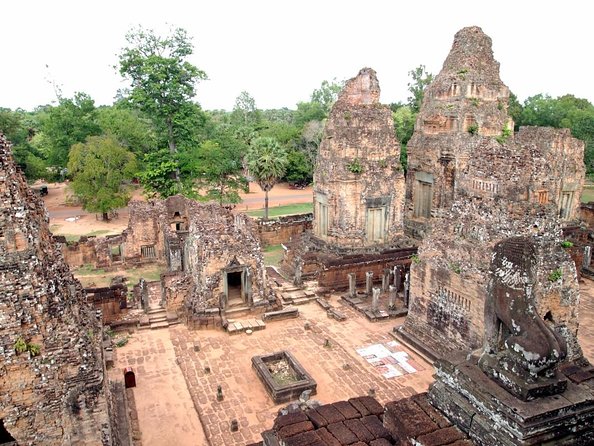
Pre Rup is a strong late-afternoon stop, with a substantial brick-and-stone structure founded in 961 under Rajendravarman II. The one-hour visit lets you compare it with the earlier Roluos temples and see how temple design changed across the centuries.
East Mebon completes the day. It once stood on an island in the now-dry East Baray reservoir, a fact that makes the surrounding setting easier to understand. Allow about fifty minutes, and ask your guide to explain how the reservoir supported the temple complex.
Other Siem Reap experiences to weigh up
- From Siem Reap: Angkor Wat and Floating Village 3-Day Trip
5.0 · 100 reviews - 3-Day Angkor Wat with All Interesting Major Temples, Banteay Srei & Beng Mealea
5.0 · 70 reviews - 3-Day Angkor Wat & All Interesting Major Temples & Kulen Mount Waterfall
5.0 · 63 reviews - 3 Days Siem Reap Explorer – Small Group
5.0 · 50 reviews
Transport, guide service, and daily comfort
Private hotel pickup and drop-off are included, provided your hotel is in Siem Reap. The vehicle is air-conditioned, which is more than a small luxury on long temple days. The route covers substantial distances, particularly to Banteay Srei and Tonle Sap, so a cool vehicle gives you a useful break between walks.
Cold bottled water and fresh towels are supplied throughout the tour. One specific account praises a driver named Ree, who used a clean Toyota Highlander and provided iced towels and cold water. Your own driver may differ, but the included comforts are clearly part of the service standard to expect.
A professional English-speaking licensed guide is included. Since the itinerary contains temples from several eras, ask for help connecting the sites instead of accepting only names and dates. The private setup also makes it easier to request a different pace, though the number of scheduled stops limits how much you can change without dropping something.
Lunch is not included. Local restaurants offer vegetarian and non-vegetarian dishes, generally priced from $3 to $10 per dish. Carry enough cash for meals and small purchases, but the tour information does not specify a payment method, so ask your provider if you need exact advice.
What the $253.65 price really buys
The strongest value is convenience. You are paying for three days of private transport, a guide, hotel transfers, a private lake cruise, and a route that would be difficult to organize efficiently on your own.
The price does not include the Angkor Pass, which covers the temples in the itinerary. Your guide assists with buying it at the Angkor Park entrance before the temple visits begin. Add that cost to your budget, along with three lunches and tips for the guide and driver.
This is a good fit for couples, families, and small groups who value time and flexibility. A solo visitor may find the cost harder to justify. Since group discounts are offered, ask for the total price for your party rather than judging the per-person figure alone.
Who should book this private Siem Reap tour?
Book it if you want the major Angkor temples but also care about local life, early Cambodian history, Tonle Sap, craft work, and rural Cambodia. The mix is much broader than a two-day temple shuttle.
It suits people who prefer private service, air-conditioning, and an English-speaking guide. It also works well if you want the main sights covered without planning each transfer yourself.
Think twice if you dislike early mornings, long temple walks, repeated stairs, or tightly packed sightseeing. The published timings contain obvious inconsistencies, and you should settle the real schedule before paying. You might also prefer a shorter private tour if your main goal is a slow, detailed study of Angkor Wat and Bayon.
Cancellation is flexible up to 24 hours before the start time for a full refund. Changes or cancellations made within 24 hours are not accepted for a refund.
Should you book it?
I would book this tour if you have three days in Siem Reap and want a broad, practical introduction to both Angkor and the surrounding communities. The private car, cold towels, sunrise plan, Tonle Sap cruise, and inclusion of Banteay Srei give it real value.
Before booking, confirm the actual stop lengths for Banteay Kdei, the palm-sugar visit, and Preah Khan. If the guide can reshape the overloaded days around your priorities, this is a strong choice. If you want a slow archaeological visit, ask for fewer stops and more time at the temples that matter most to you.
FAQ
Is hotel pickup included?
Yes. Private hotel pickup and drop-off in Siem Reap are included. You need to provide your hotel name for pickup arrangements.
Is this a private tour?
Yes. Only your group participates, and the tour uses private transport.
Is an English-speaking guide included?
Yes. A professional English-speaking licensed tour guide is included.
Is transportation air-conditioned?
Yes. Transfers are provided in a private air-conditioned vehicle.
Is the Angkor Pass included in the price?
No. The Angkor Pass is separate and covers the temples in the itinerary. Your guide assists with purchasing it at the Angkor Park entrance.
Is the Tonle Sap boat trip included?
Yes. A private cruise to visit the floating village on Tonle Sap Lake is included.
Are meals included?
No. Lunches are at your own expense. Local restaurant dishes are listed at about $3 to $10, with vegetarian and non-vegetarian choices.
Can I cancel for a full refund?
Yes, if you cancel at least 24 hours before the experience start time. Cancellations or changes made less than 24 hours in advance are not accepted for a refund.
Fresh reviews from around Siem Reap
- Full-Day Tour Preah Vihea & Koh Ker Temple 3.7 · 3 reviews
- Savor the Countryside: Tours with Authentic Cooking Classes” 5.0 · 3 reviews
- Angkor Wat Sunrise TukTuk Tour 5.0 · 3 reviews
- Angkor Grand Circuit Tour & Banteay Srei 5.0 · 3 reviews
- Guided Private Tuk Tuk Tour Angkor Wat and Small Circle and Five Extras 5.0 · 3 reviews
- Siem Reap Temple Tour 2-Day with Sunrise/Sunset 3.7 · 3 reviews
- Bangkok to Angkor Wat 2 Days 1 Night by Flight 4.5 · 3 reviews
- Kompong Pluk Tour 5.0 · 3 reviews
Angkor Temple Tours, compared.

Angkor Wat Sunrise or Sunset Tour with Guide from Siem Reap
Read our review →



Angkor Wat Sunrise tour with Small – Group and Guide tours
Read our review →
Angkor Wat Highlights and Sunrise Guided Tour from Siem Reap
Read our review →

Full-Day Angkor Wat Sunrise Private Tour with Guide from Siem Reap
Read our review →Browse the lists this tour appears in