
Reviewed · BANTEAY SREI TOURS
Private Day Angkor Wat Temple and Banteay Srei Temple Tour
Angkor is too large for a quick look, and this private tour tackles the big names in one long, carefully packed day. You move from jungle-covered Ta Prohm to the delicate carvings of Banteay Srei, then through Angkor Thom before finishing with three hours at Angkor Wat. Guide Chanra has also helped shape the day around what each group most wants to see.
I like the private format, since your group can ask for explanations, adjust the pace, and avoid being tied to strangers. I also like the practical transport: an air-conditioned vehicle, cool water, towels, parking, and road tolls are included. The drawback is simple: ten stops in 8 hours and 30 minutes means a busy day, with plenty of walking and little room for lingering at every temple.
In This Review
- Key points to know before booking
- Why this route works for a first day at Angkor
- Ta Prohm begins with jungle and stone
- Pre Rup offers a short look at a 10th-century state temple
- Banteay Srei rewards close attention
- Angkor Thom starts at the South Gate
- Bayon’s stone faces change the mood
- Baphuon and Phimeanakas reveal the royal center
- The Royal Terraces put Angkor’s public life in view
- Angkor Wat deserves the final three hours
- The $43 price needs one important addition
- Comfort, timing, and mobility matter
- Who should book this private Angkor day
- Should you book it?
- FAQ
- How long does the private Angkor tour last?
- What temples and sites are included in the route?
- Is the Angkor temple pass included?
- Is this a private tour?
- What is included in the tour price?
- Can I cancel for a full refund?
Key points to know before booking
- Ten major stops in one day: The route includes Ta Prohm, Banteay Srei, Angkor Thom, Bayon, and Angkor Wat, with shorter visits at several smaller sites.
- Private touring with an English-speaking guide: Only your group participates, and Chanra has helped customize visits through WhatsApp.
- Banteay Srei adds a different style: Its small scale and fine pink sandstone carving make it a useful contrast to the giant monuments.
- The temple pass costs extra: Add the one-day Angkor pass at $37 per person to the $43 tour price.
- Useful comfort is included: You receive air-conditioned transport, cool water, towels, parking fees, and road tolls.
- Mobility help may be possible: A guide arranged closer vehicle access, a moped, and a tuk-tuk for a guest using crutches, though you should discuss your needs before booking.
Why this route works for a first day at Angkor
The best feature here is variety. You are not spending eight hours looking at versions of the same temple. Instead, the route moves through Buddhist monasteries, Hindu shrines, royal terraces, carved faces, jungle ruins, and Angkor Wat itself.
The order also gives the day a useful rhythm. Ta Prohm supplies the atmospheric opening, Banteay Srei brings intricate detail, Angkor Thom shows the scale of the old capital, and Angkor Wat gets the longest visit at the end. That final three-hour block matters because Angkor Wat is not a monument you can understand from one quick walk to the central towers.
Still, this is an ambitious plan. The listed temple time adds up to nearly the entire tour, before you count driving, parking, and transitions. I would treat the schedule as a strong outline rather than a promise that every stop will receive exactly its listed minutes. Your guide may need to adjust the order or shorten a minor stop depending on road conditions, heat, and your energy.
The private setup helps here. You can ask for more time at Bayon or Angkor Wat, for example, or move on from a site that does not hold your attention. A shared group would give you less control.
More Banteay Srei visits:
- Full-Day Banteay Srei & 4 Temples – Grand Tours Join-in Tour
5.0 · 1,155 reviews - Siem Reap Tour: Angkor Wat Sunrise, Bayon, Ta Prohm, Banteay Srei
5.0 · 931 reviews - 2-Day Angkor Wat With Small, Big Circuit and Banteay Srei Tour
5.0 · 545 reviews
Ta Prohm begins with jungle and stone
Your first stop is Ta Prohm, the former Rajavihara, or monastery of the King. Built in 1186 as a Mahayana Buddhist monastery and university, it is known for its narrow passages, fallen stone, and huge roots spreading across the ruins.
Ta Prohm works well at the start because it feels different from the formal sight you may expect at Angkor Wat. The ruins are tangled and enclosed, with walls and doorways appearing through the trees. The roots are not just decoration. They help explain why the temple became such a memorable symbol of Angkor’s battle between stone architecture and the Cambodian jungle.
You have about an hour here. Use it to look beyond the most famous root-covered walls. The carved doorways, galleries, and broken corridors reward a slower eye, while the uneven ground calls for sensible shoes. Since admission is not included, your one-day temple pass is required for this and every other Angkor site on the route.
Pre Rup offers a short look at a 10th-century state temple
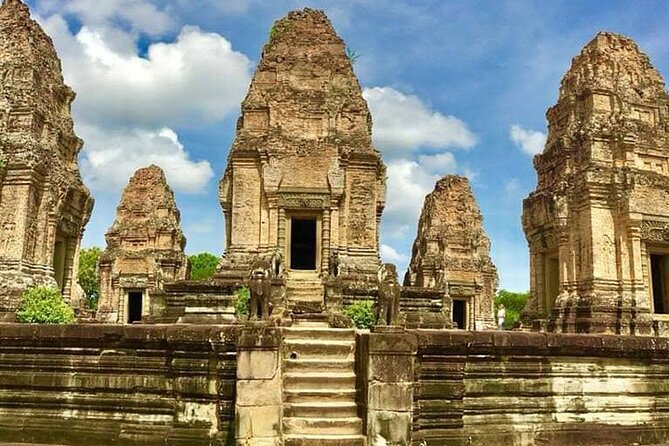
The visit to Pre Rup lasts about 20 minutes, so this is a quick architectural stop rather than a full exploration. King Rajendravarman built it as a state temple in 961 or 962, only nine years after East Mebon, located 1.3 kilometers to the north.
Pre Rup has a more open, tiered appearance than Ta Prohm. Its brick and laterite construction gives it a warm, weathered character, and its raised form helps you read the basic idea of a Khmer temple mountain. You can use this stop to compare an earlier royal temple with the later monuments ahead.
Twenty minutes will not allow for a long inspection. That is not a serious flaw if you see Pre Rup as a compact history lesson between larger stops. If you prefer a slower pace, this is one place you could discuss shortening with your guide.
Banteay Srei rewards close attention
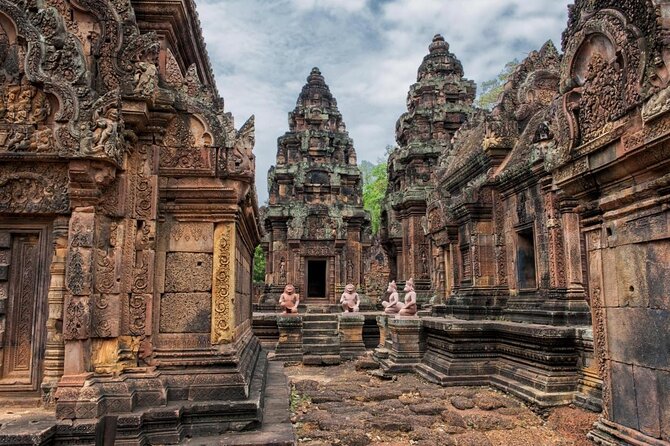
Banteay Srei is about 25 kilometers northeast of the main Angkor area, so reaching it adds driving time. The payoff is a temple famous for precise carving and its smaller scale. Built in the 10th century and dedicated to Shiva, it is often called the Pink Ladies Temple or Temple of Women.
I especially like this stop because it changes your sense of size. Angkor Wat and Angkor Thom can feel monumental and almost overwhelming. Banteay Srei asks you to look closely at the motifs, divine figures, and delicate stonework instead.
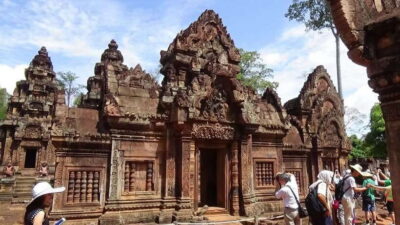
The temple is made from pinkish sandstone, and the carvings are the main event. You have about an hour, enough to examine the doorways and decorative panels without treating the place as a simple photo stop. The tradeoff is the distance from the central temples. On a short visit to Siem Reap, you spend part of the day on the road, but Banteay Srei gives the route an artistic range that the larger monuments alone cannot provide.
More Angkor temple itineraries:
- Angkor Wat Sunrise or Sunset Tour with Guide from Siem Reap
5.0 · 12,109 reviews - Siem Reap: Angkor Wat: Small-Group Sunrise or Sunset Tour
5.0 · 9,444 reviews - Siem Reap: Angkor Wat 2-Day Tour with Sunrise and Sunset
4.9 · 4,429 reviews - Siem Reap: Full-Day Angkor Wat Guided Tour with Sunset
4.9 · 3,803 reviews
Angkor Thom starts at the South Gate
After Banteay Srei, the route returns to Angkor Thom, the great royal city. At the South Gate, a causeway crosses a 100-meter-wide moat. A naga balustrade lines the approach, with massive stone figures marking the entrance.
Give yourself a moment here before rushing toward the temple. The gate is a lesson in Khmer design: a broad ceremonial approach, symbolic guardian figures, and a carefully framed entry into the old capital. Even a 20-minute stop can help you understand that Angkor was not just a collection of isolated shrines. It was an organized royal center with roads, moats, walls, and public spaces.
The South Gate can be a busy place, and vehicles need to move through it. Your guide can explain the carvings and help you make good use of the short stop, but you should not expect a long, quiet examination of every figure.
Bayon’s stone faces change the mood
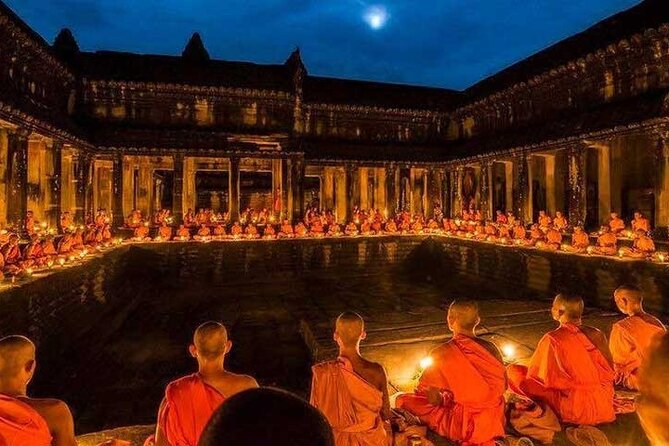
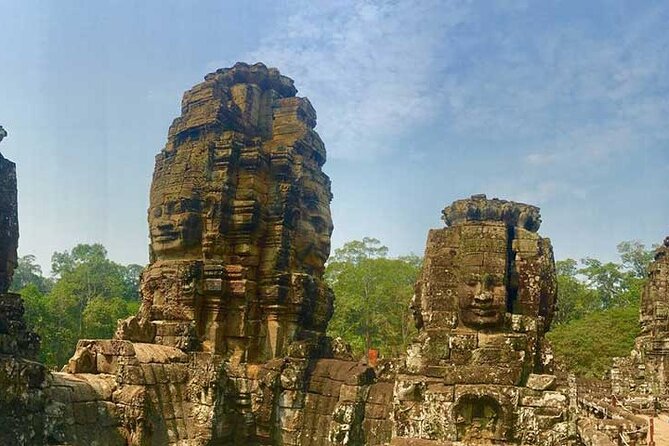
Bayon receives about 50 minutes, which is a sensible amount of time for a first look. The temple is famous for its gigantic carved faces, with 173 faces remaining on its towers. Their identity remains debated, while local Khmer belief connects them with the Four Faces of Prohm.
Bayon feels more inward and puzzling than Angkor Wat. Its towers crowd together, and the faces appear from different angles as you walk through the temple. I like the way the monument makes you slow down without needing a huge open view. One face may seem calm, another distant, and a third can appear suddenly between stone passages.
Your guide’s explanations are valuable here because the temple’s design can be confusing at first. The private setting also gives you room to ask about the competing ideas behind the faces rather than simply taking a quick photograph and leaving.
Baphuon and Phimeanakas reveal the royal center
Baphuon gets about 40 minutes. King Udayadityavarman II built it as a state temple within Angkor Thom, between the Royal Palace and Bayon. The sandstone monument has a strong tiered form and gives you another example of how Khmer rulers used temples to express power and religious ideas.
Next comes Phimeanakas, with about 30 minutes. It belongs to the royal enclosure, an area you may pass through as you move around Angkor Thom. The temple is tied to a story, and that narrative quality gives the stop a different appeal from the more famous monuments.
These two visits are useful for connecting the grand temples with the machinery of the royal city. They are not as visually famous as Angkor Wat or Ta Prohm, so some people may find the schedule tiring by this point. If your group is running low on energy, ask your guide to explain the key features rather than trying to inspect every corner.
The Royal Terraces put Angkor’s public life in view
The Terrace of the Elephants stretches more than 300 meters from Baphuon toward the Terrace of the Leper King. King Jayavarman VII built it at the end of the 12th century. Its name comes from the elephant carvings that decorate the long terrace.
You have 30 minutes here, enough to appreciate the scale and the relationship between the terrace and the parade grounds. Unlike the enclosed temples, this is a broad ceremonial space. It helps you picture royal processions and public gatherings, even though the original activity is long gone.
The Terrace of the Leper King follows with a shorter 15-minute visit. Together, the two terraces form the eastern boundary of the Royal Palace grounds. This is a quick stop, but it rounds out your understanding of Angkor Thom as a city and royal compound, not merely a set of religious buildings.
Angkor Wat deserves the final three hours
The tour saves three hours for Angkor Wat, the right call for most first-time visitors. Its five concentric rectangular walls and moats symbolize a cosmic chain of mountains and ocean. The central tower represents Mount Meru, the center of the Hindu and Buddhist universe.
That symbolism becomes easier to grasp when you approach the temple as a complete plan rather than a single tower. The moat, causeway, galleries, courtyards, bas-reliefs, and central sanctuary build toward the middle. Your guide can help you read this progression, along with the religious shift from Hindu worship to Buddhist use.
Three hours sounds generous, but Angkor Wat is enormous. You can spend part of the time on the approach, part inside the galleries, and part studying the carved scenes and towers. The exact pace will depend on your group and the conditions during the visit. If you want a very slow examination of every relief, this packed tour may feel too broad. If you want a strong first overview of the Angkor complex, the time allocation is one of the tour’s best choices.
The $43 price needs one important addition
The advertised tour price is $43 per person, but the one-day temple pass costs another $37 per person. Your real total is therefore $80 per person before any other personal spending.
That is not a bargain in the narrowest sense, but the private value is easier to see when you compare what is bundled in. You receive an English-speaking guide, a private air-conditioned vehicle, parking fees, road tolls, cool water, towels, and pickup and drop-off at the airport. The guide is also available to help shape the visit, rather than simply delivering a fixed group script.
For two people, the tour and pass together come to $160. For a larger private group, the experience may feel more cost-effective if the $43 rate is truly charged per person as stated and the group discount applies. Confirm the exact group pricing before paying, since the available information only notes that group discounts are offered.
Comfort, timing, and mobility matter
Eight and a half hours in the Cambodian heat can wear you down. The air-conditioned vehicle is more than a minor extra, especially with Banteay Srei set away from the main Angkor cluster. Cool water and towels are small touches, but they are useful after dusty paths and temple stairs.
The tour is listed as available from 8:00 AM to 4:00 PM, while the advertised duration is about 8 hours and 30 minutes. Because pickup and drop-off details can affect the day, confirm the exact start point and timing when you book. Airport pickup and drop-off are included, which can be handy if this tour is connected to your arrival or departure.
Most people can take part, but this is a walking tour through old temple sites. A particularly helpful detail is that the guide has arranged closer vehicle access, a moped, and a tuk-tuk for a guest using crutches after a foot injury. I would contact Angkor Guide Tour before booking if anyone in your group has limited mobility, since the route and available assistance should be agreed in advance.
The tour has free cancellation up to 24 hours before the start time. Changes or cancellations inside that window are not accepted for a refund.
Who should book this private Angkor day
I would choose this tour if you want the major Angkor sights in one day and value having your own guide. It fits first-time visitors who want context at Bayon, Angkor Thom, and Angkor Wat, plus the very different experience of Banteay Srei.
It also suits couples, families, and small groups that may need to adjust the pace. Chanra has communicated through WhatsApp and helped tailor the route, so ask for that kind of planning if you have a short list of priorities.
I would hesitate if your main goal is slow photography, extended time at every ruin, or a quiet temple experience. Ten stops create a full day, and the distance to Banteay Srei makes the schedule more demanding. You may prefer a shorter private visit focused on Angkor Wat, Bayon, and Ta Prohm, then reserve another day for the outer temples.
Should you book it?
Book this tour if you want a well-rounded first day with private transport, an English-speaking guide, and the freedom to ask for adjustments. The combination of Ta Prohm’s roots, Banteay Srei’s fine carving, Bayon’s faces, Angkor Thom’s royal spaces, and three hours at Angkor Wat gives you a strong overview.
Skip it if you dislike full schedules or want to linger at each site. Remember to budget the extra $37 temple pass, and contact the provider ahead of time about mobility needs or any must-see temple. For a first visit with limited time in Siem Reap, the route offers solid value once you count the guide, vehicle, and practical extras.
FAQ
How long does the private Angkor tour last?
The tour lasts approximately 8 hours and 30 minutes.
What temples and sites are included in the route?
The route visits Ta Prohm, Pre Rup, Banteay Srei, Angkor Thom South Gate, Bayon, Baphuon, Phimeanakas, the Terrace of the Elephants, the Terrace of the Leper King, and Angkor Wat.
Is the Angkor temple pass included?
No. The one-day temple pass costs $37 per person and is paid separately from the $43 tour price.
Is this a private tour?
Yes. Only your group participates in the activity.
What is included in the tour price?
The price includes an air-conditioned vehicle, an English-speaking guide, parking fees, road tolls, cool water, towels, and airport pickup and drop-off.
Can I cancel for a full refund?
Yes, if you cancel at least 24 hours before the experience start time. Cancellations or changes made less than 24 hours before the start time are not accepted for a refund.
Fresh reviews from around Siem Reap
- Full-Day Tour Preah Vihea & Koh Ker Temple 3.7 · 3 reviews
- Savor the Countryside: Tours with Authentic Cooking Classes” 5.0 · 3 reviews
- Angkor Wat Sunrise TukTuk Tour 5.0 · 3 reviews
- Angkor Grand Circuit Tour & Banteay Srei 5.0 · 3 reviews
- Guided Private Tuk Tuk Tour Angkor Wat and Small Circle and Five Extras 5.0 · 3 reviews
- Siem Reap Temple Tour 2-Day with Sunrise/Sunset 3.7 · 3 reviews
- Bangkok to Angkor Wat 2 Days 1 Night by Flight 4.5 · 3 reviews
- Kompong Pluk Tour 5.0 · 3 reviews
Banteay Srei Tours, compared.
Full-Day Banteay Srei & 4 Temples – Grand Tours Join-in Tour
Read our review →
2-Day Angkor Wat With Small, Big Circuit and Banteay Srei Tour
Read our review →

3-Days Discovery Of Angkor: Waterfalls,Floating Village and Banteay Srei temple
Read our review →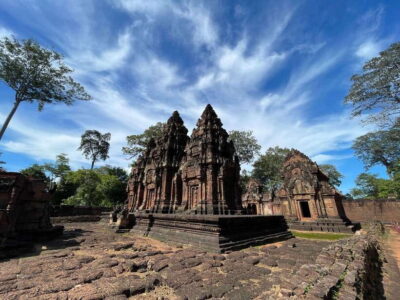
Browse the lists this tour appears in