
Reviewed · BANTEAY SREI TOURS
From Siem Reap: Banteay Srei Temple & Grand 5 Temple Tour
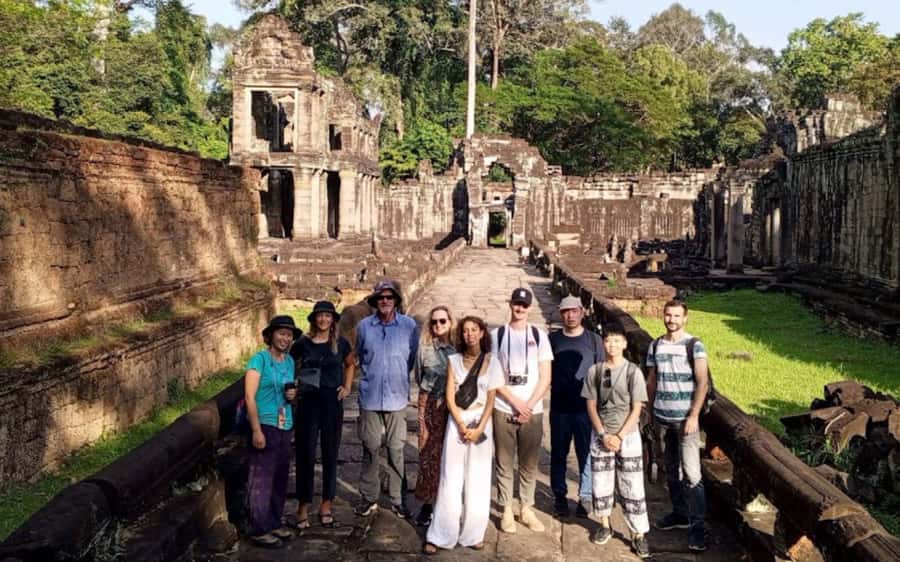
Banteay Srei is the star here. Its small size, pink sandstone, and astonishingly fine carvings feel very different from the grand scale of Angkor Wat. I like that this tour pairs it with five less-famous temple sites, giving you a fuller sense of the ancient Khmer capital instead of stopping at only the headline monuments. I also like the steady supply of bottled water and cold towels, a small comfort that matters in Cambodia’s heat.
The main drawback is the pace. You visit six temple sites in one day, and several require a fair amount of walking over uneven ground. Lunch and the Angkor Temple Pass cost extra, and this shared tour is not suitable for children under 12, wheelchair users, or people with walking difficulties.
In This Review
- Key points to know before booking
- Why Banteay Srei deserves the long drive
- Pre Rup offers a strong opening
- The road to Banteay Srei and Preah Dak Village
- Lunch is simple, flexible, and extra
- East Mebon explains the vanished reservoir
- Neak Poan turns the temple visit into a water story
- Ta Som has the memorable tree-covered gate
- Preah Khan closes the day on a grand scale
- The guides are the real value
- What the $20 price really includes
- Heat, clothing, and walking matter
- Who should book this tour?
- Should you book the Banteay Srei Grand Circuit tour?
- FAQ
- Is the Angkor Temple Pass included?
- Is lunch included?
- What temples does the tour visit?
- What time is hotel pickup?
- What should I wear?
- Is the tour suitable for children or people with limited mobility?
Key points to know before booking
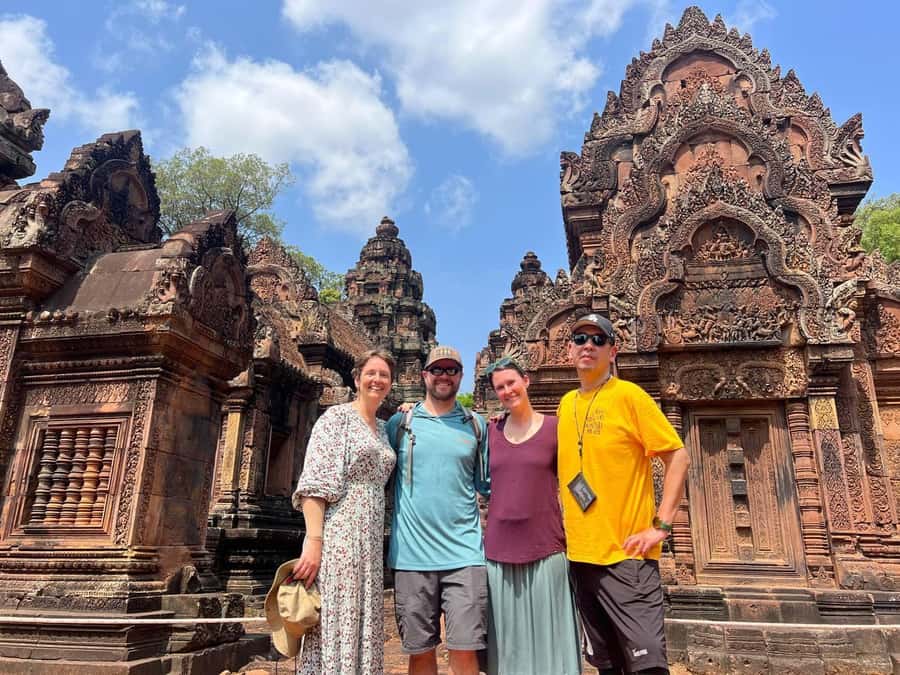
- Banteay Srei brings the finest stonework: Look closely at the pink sandstone carvings, not just the overall temple shape.
- Six temple stops create a varied day: Pre Rup, Banteay Srei, East Mebon, Neak Poan, Ta Som, and Preah Khan each offer a different setting and design.
- The guide makes a major difference: Guides including Ry, Phyrom, Nara, Narath, Tola, Lok, and Dara Try have been praised for clear explanations, humor, history, and good photo spots.
- The $20 price covers the day’s basics: Hotel transfers, air-conditioned transport, an English-speaking guide, water, cold towels, and local taxes are included.
- The Angkor Pass is separate: You stop at the Apsara Authority ticket office to buy your temple pass before entering the complex.
- Dress for sacred sites: Cover your knees and shoulders. Shorts and sleeveless tops can lead to refused entry.
Why Banteay Srei deserves the long drive
Banteay Srei sits outside the central Angkor cluster, so reaching it takes extra road time. That distance is worthwhile because the temple has a character all its own.
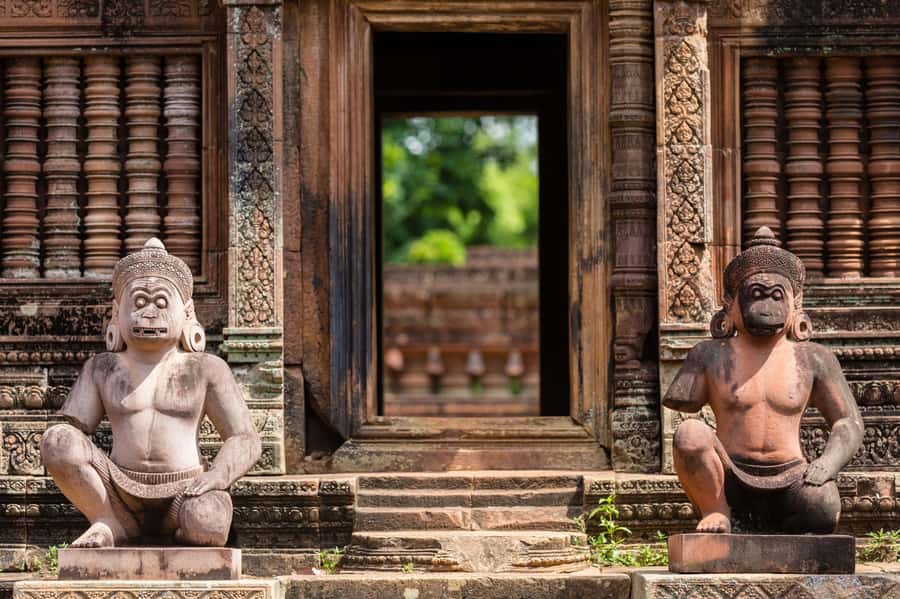
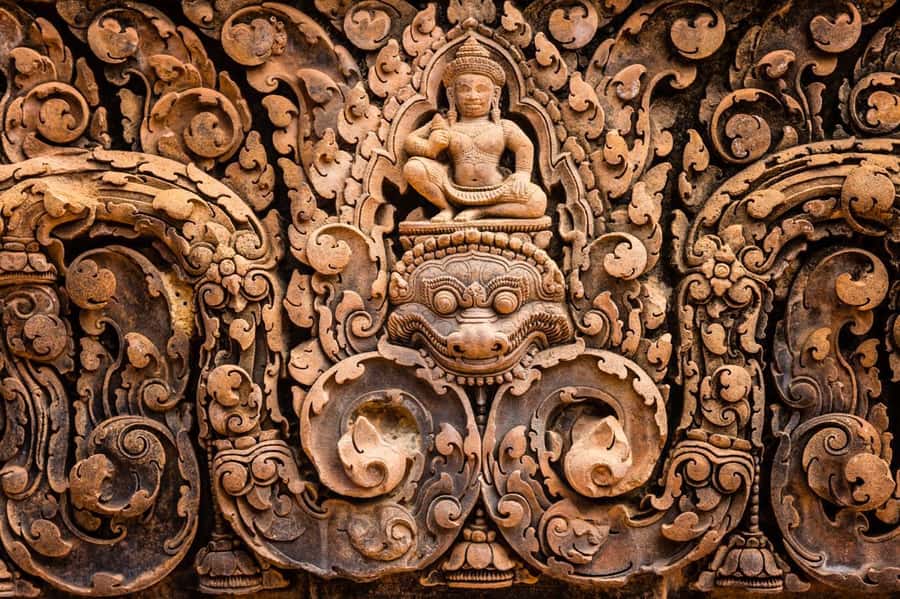
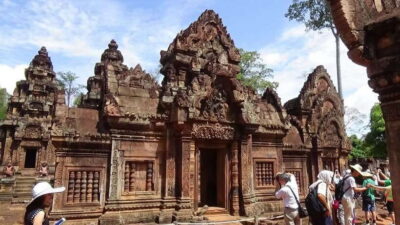
The name means Citadel of Women, and the temple is celebrated for unusually delicate carving. The pink sandstone allows for fine detail, including figures, floral patterns, and scenes linked to Hindu belief. You will not get the same broad, monumental feeling as at Angkor Wat. Instead, you look closely at doorways, lintels, towers, and carved panels.
This is where a good guide earns the fee. Guides such as Ry Cheng, Phyrom, Nara, Narath, and Lok have explained not only what the carvings show, but how Hindu stories and Khmer religious ideas connect across the sites. That context helps you see Banteay Srei as more than a photogenic ruin.
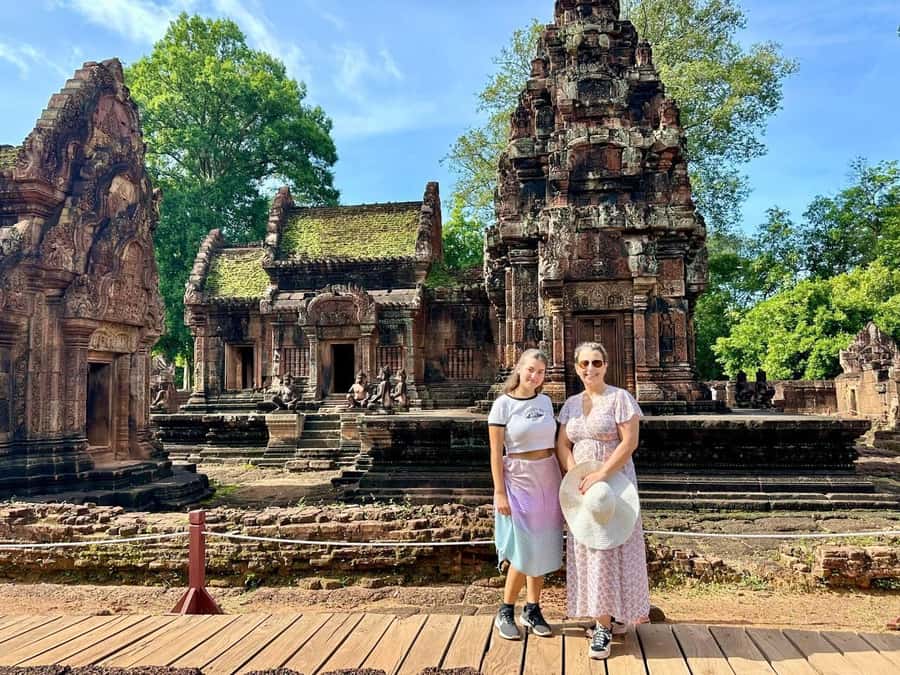
The temple is smaller than many people expect. That is part of its appeal, but it also means the visit can feel busy if several groups arrive together. Give yourself time to study the stonework rather than rushing from one picture stop to the next.
More Banteay Srei visits:
- Full-Day Banteay Srei & 4 Temples – Grand Tours Join-in Tour
5.0 · 1,155 reviews - Siem Reap Tour: Angkor Wat Sunrise, Bayon, Ta Prohm, Banteay Srei
5.0 · 931 reviews - 2-Day Angkor Wat With Small, Big Circuit and Banteay Srei Tour
5.0 · 545 reviews
Pre Rup offers a strong opening
The day begins at Pre Rup, a compact temple built largely of brick and laterite. It is one of the more complete structures in the Angkor area, so its shape is easy to read.
Pre Rup gives you a useful introduction to Khmer temple planning. You can see the upward movement from lower platforms toward the central towers, along with the worn but still visible details that once made the building a place of ceremony.
Starting here also helps you compare materials. Pre Rup’s darker, heavier appearance is quite different from Banteay Srei’s pink sandstone and fine carving. A guide can use that contrast to explain how construction methods and religious symbols changed across the Khmer period.
There are stairs and uneven surfaces, so this first stop is also a practical reminder of the physical demands of the day. Wear shoes with a firm grip. Hiking shoes are recommended, and they make more sense here than sandals with thin soles.
The road to Banteay Srei and Preah Dak Village
The tour is not only about stones. The route from Siem Reap passes through rural areas, and the day includes a stop at Preah Dak Village, where you can observe local life outside the temple zone.
This short break adds useful balance. After studying royal and religious buildings, you see a living community and the ordinary countryside around Angkor. Guides have also shared details about Cambodian daily habits and local customs while driving between sites.
Some departures may include small personal touches. Guides Nara and Dara Try, for example, have been praised for sharing freshly picked mangoes during the journey. That is not something to count on as a formal feature, but it shows how the guide can add local character to what might otherwise be a long transfer.
The road time is part of the day’s design. You are covering a wide area, not simply walking between nearby monuments. An air-conditioned vehicle, bottled water, and cold towels help make those transfers more comfortable.
Lunch is simple, flexible, and extra
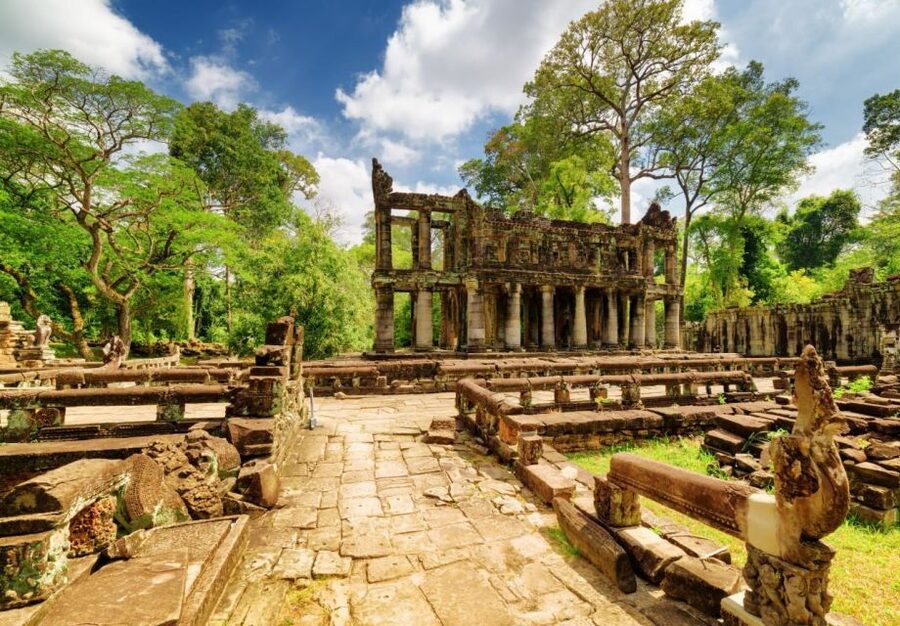
Lunch takes place at a nearby restaurant, with Cambodian dishes such as curries, soups, and stir-fries available. The meal is not included, so bring cash and expect to choose and pay for your own food.
That arrangement keeps the headline price low. At $20 per person, the tour is inexpensive for a full day of transport, guiding, and temple visits, but you should budget separately for lunch and the Angkor Temple Pass.
The restaurant stop also gives you a proper break from the heat. Six temple visits can become tiring if you try to eat quickly in the vehicle, so use lunch to drink water and cool down. Sunscreen and insect repellent belong in your day bag, too.
A different pace for your next Siem Reap morning:
- Angkor Wat Sunrise or Sunset Tour with Guide from Siem Reap
5.0 · 12,109 reviews - Siem Reap: Angkor Wat: Small-Group Sunrise or Sunset Tour
5.0 · 9,444 reviews - From Siem Reap: Kampong Phluk Floating Village Tour by Boat
4.9 · 6,979 reviews - Sunset tour of Kampong Phluk stilts home village on the Tonle Sap
5.0 · 4,865 reviews
East Mebon explains the vanished reservoir
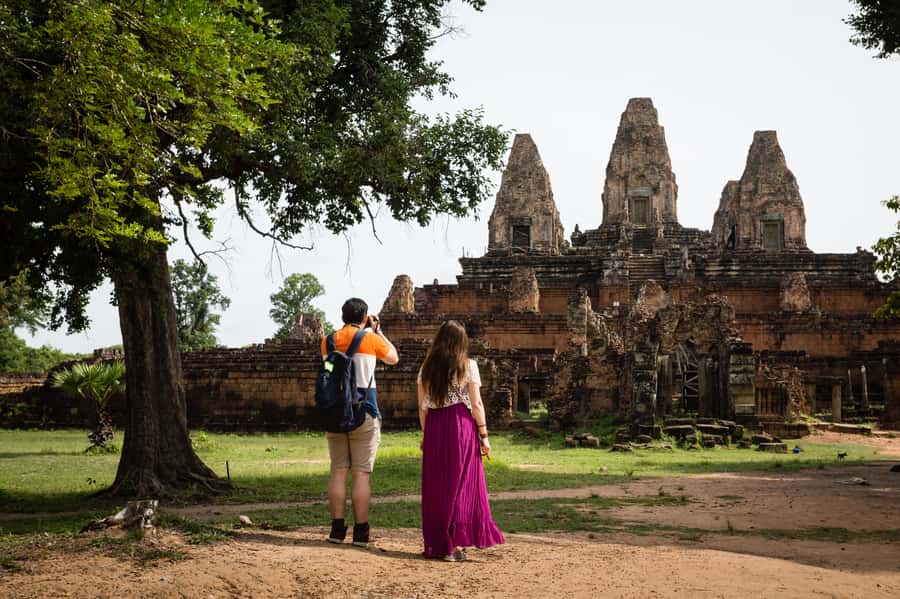
East Mebon once stood on an island in the middle of a large reservoir. The water is gone, but the temple’s original position gives you a glimpse of how Khmer rulers shaped both architecture and water management.
Today, the setting is dry, so the island concept is not immediately obvious. This is another place where explanation matters. The temple was not an isolated building by accident. Its relationship with the reservoir formed part of its purpose and visual setting.
East Mebon has a solid, ordered feel, with brick towers and stone elements that reward a slow look. Compared with Banteay Srei, it is less delicate and more formal. That contrast keeps the day from becoming a blur of similar ruins.
You may notice that the Grand Circuit sites feel quieter and less imposing than Angkor Wat or Bayon. For many people, that is the value of this route. You get room to focus on individual structures instead of spending the entire day trying to absorb one enormous monument.
Neak Poan turns the temple visit into a water story
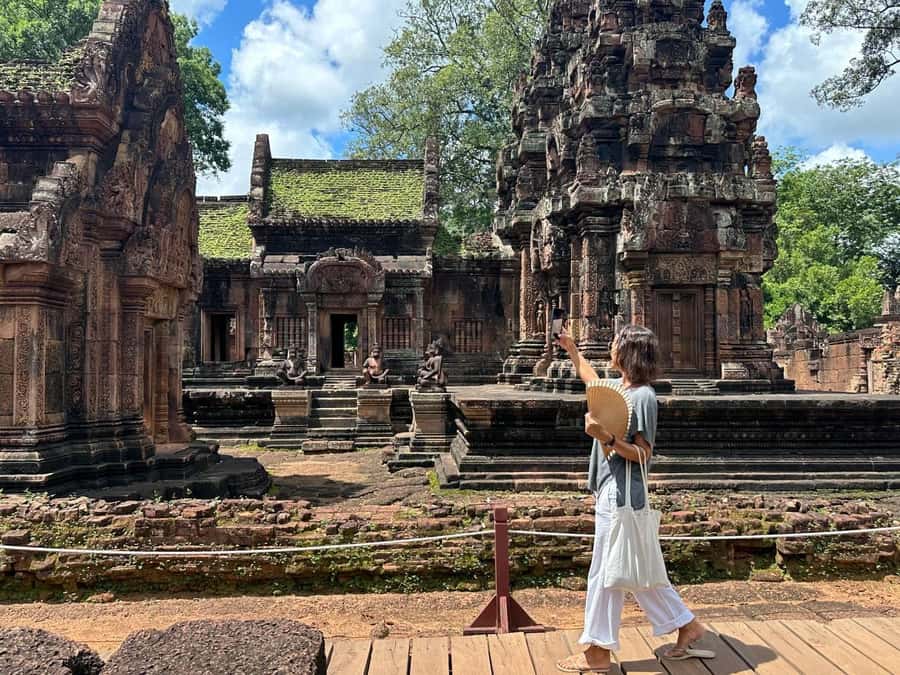
Neak Poan is a small temple on an island in Jayatataka Baray. It is linked to the idea of a mythical Himalayan lake whose waters had healing powers.
The approach and setting make Neak Poan different from the other stops. Rather than climbing through a large enclosure, you head toward a small island structure connected with water and sacred geography. The temple’s size can make it a quick visit, but its meaning is worth hearing.
This stop is especially useful if you want to understand the Khmer relationship between religion, water, and royal power. The guide can explain the symbolism behind the central sanctuary and the surrounding pools, helping you connect the physical layout with Hindu and Buddhist beliefs.
Keep your expectations realistic. Neak Poan is not a vast complex, and the water setting may not look exactly as you imagine from historical descriptions. Its appeal lies in the concept and the unusual approach, not in the number of carvings or towers.
Ta Som has the memorable tree-covered gate
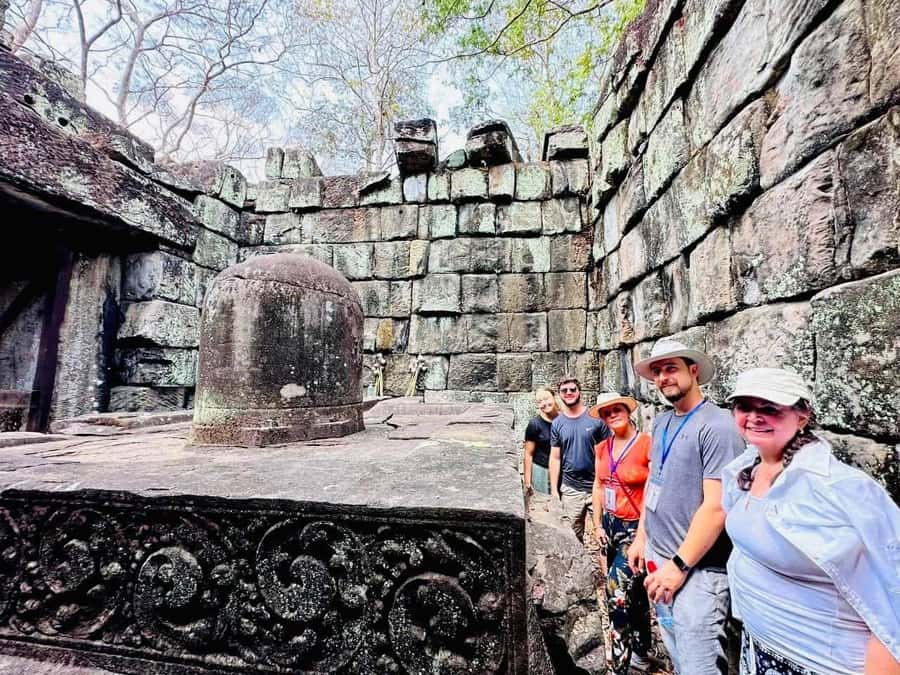
Ta Som is one of the day’s most atmospheric stops. Its stone gate is wrapped in giant tree roots, creating the familiar image of nature pressing into an ancient building.
The roots are the obvious photo subject, but do not stop there. Ta Som is smaller than Preah Khan and easier to take in as a complete site. Walk beyond the famous gate and pay attention to the remaining carvings, doorways, and quiet corners.
A guide can also help you understand the difference between natural growth and temple design. The roots are dramatic, but the site is not simply a backdrop for photographs. It shows the ongoing tension between conservation, jungle growth, and the survival of stone architecture.
Several guides, including Dara Try and Chenda, have been praised for finding good photo angles. That can be helpful in a group tour, where you have limited time and may not want to spend ten minutes searching for the best position.
Preah Khan closes the day on a grand scale
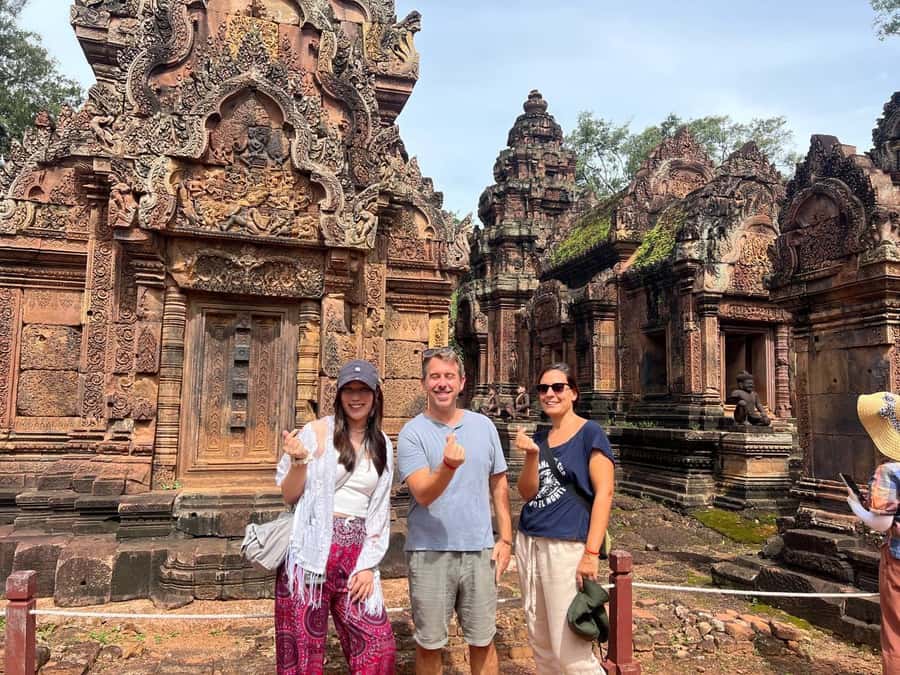
Preah Khan is the largest and most complex stop on this route. It was a major monastic and religious center, with long galleries, carved walls, and many layers of architectural detail.
By the time you arrive, you may be tired. Still, Preah Khan deserves attention because it brings together much of what you have seen during the day: religious imagery, ceremonial planning, carved stone, enclosed courtyards, and the effects of time.
Its size can feel confusing without a guide. Phyrom has used maps and photographs to help explain how the sites fit together, while guides such as Ra, Kim, Tola, and Narath have been praised for giving clear explanations without rushing. That sort of structure keeps Preah Khan from becoming a maze of corridors.
Allow yourself some quiet time here. After the guide’s explanation, walk slowly and notice the changing light, worn carvings, and tree growth around the outer sections. The tour may finish with a sunset view over the lake, depending on the day’s timing and route.
The guides are the real value
The temples are the reason to book, but the guide can determine how much you take away. The strongest feedback has centered on clear English, patience, cultural context, and a good sense of pace.
Names that have received repeated praise include Ry Cheng, Phyrom, Nara, Narath, Tola, Lok, Dara Try, Ra, Kim, Chenda, Pip, and John Long. The exact guide depends on the departure, so you cannot select one of these people as a guaranteed feature from the basic information provided.
What you can reasonably expect is a guide who explains Khmer history, Hindu mythology, Buddhist practice, temple architecture, and everyday Cambodian life. The best guides also answer questions, adjust the pace when possible, and point out details you might walk past.
Photography is another recurring strength. Guides Dara Try, Chenda, Nara, and Phyrom have been praised for taking pictures and finding useful angles. Do not expect a dedicated photographer, but asking your guide for a quick picture is sensible, especially at Ta Som and Banteay Srei.
The shared format means you will be with other people, and the group’s pace affects the day. That keeps the cost down, but it gives you less control than a private outing. A private option is available with a guide add-on, so check the exact package if personal timing matters to you.
What the $20 price really includes
At $20 per person, this is strong value if you want a guided day rather than arranging a vehicle and temple route yourself.
The price includes hotel pickup and drop-off, transport in a high-quality vehicle, an English-speaking guide, local taxes, bottled water, and cold towels. The vehicle has been described as comfortable and air-conditioned, which matters during a long day in the Cambodian sun.
The Angkor Temple Pass is not included. You stop at the Apsara Authority ticket office to buy it, so allow extra money for that official entrance fee. Lunch is also separate.
The low price does come with limits. You share the vehicle, follow a set route, and visit many sites in one day. If you want long photography sessions, a slow architectural study, or a flexible lunch, a private tour may suit you better.
For a first look at the outer Angkor sites, though, the cost is hard to fault. You cover a broad area and receive historical guidance instead of simply being dropped at each ruin.
Heat, clothing, and walking matter
The heat is the biggest practical issue. One visitor described the high temperatures as the only real problem, and there is no tour operator solution for that. Bring sunscreen, insect repellent, cash, and sturdy shoes. The supplied cold towels and water are genuinely useful, especially after walking through exposed temple grounds.
Temple dress rules are strict. Both men and women must cover their shoulders and knees, so avoid shorts and sleeveless tops. Entry may be refused if your clothing does not meet the rules.
The tour runs in all weather conditions. Dress for sun, heat, and rain, and keep valuables in a small day bag. Large bags and luggage are not allowed, and pets and smoking are prohibited.
Pickup is scheduled for 7:50 AM in your hotel lobby. Be ready before then, since shared transfers may first take you to a meeting point before you board the main tour vehicle. One well-organized departure followed this arrangement, with optional tea, coffee, and snacks available at the meeting point.
Who should book this tour?
I would choose this tour if you have already seen, or plan to see, Angkor Wat and Bayon and want the older, quieter, and more varied temple sites around them. It is also a good fit if you want explanations of Hindu and Buddhist symbolism instead of wandering through ruins without context.
You should be comfortable walking for much of the day over uneven ground and handling stairs. The tour is not recommended for people with mobility impairments, and the shared option is not suitable for infants or children under 12.
Solo visitors can benefit from the shared format because it provides company without the cost of a private vehicle. Couples and small groups will also find the $20 rate appealing if they are happy to follow the planned schedule.
You can cancel up to 24 hours before the tour for a full refund, and a reserve-now, pay-later option helps if your Siem Reap plans are still shifting.
Should you book the Banteay Srei Grand Circuit tour?
Book it if you want a full, affordable day that combines Banteay Srei’s fine carvings with five very different temple stops. The route gives you more than a quick highlight reel, especially when the guide explains how Khmer religion, architecture, water, and royal life connect.
Skip it if you dislike shared tours, long road transfers, hot weather, or a fixed schedule. You will get more freedom from a private arrangement, but for $20, with transport, guiding, water, and cold towels included, this is an efficient way to see the outer Angkor sites and understand what you are looking at.
FAQ
Is the Angkor Temple Pass included?
No. The entrance fee is separate. The tour includes a stop at the Apsara Authority Ticket Office so you can purchase your Angkor entrance pass.
Is lunch included?
No. Lunch is at your own expense. The route includes a stop at a nearby restaurant offering Cambodian curries, soups, and stir-fries.
What temples does the tour visit?
The stated route includes Pre Rup, Banteay Srei, East Mebon, Neak Poan, Ta Som, and Preah Khan.
What time is hotel pickup?
You should be ready in your hotel lobby at 7:50 AM for pickup.
What should I wear?
Your knees and shoulders must be covered at temples and museums. Shorts and sleeveless tops are not allowed, and entry may be refused if you do not follow the dress code.
Is the tour suitable for children or people with limited mobility?
The shared tour is not suitable for infants or children under 12. It is also not recommended for people with walking disabilities or wheelchair users.
Fresh reviews from around Siem Reap
- Full-Day Tour Preah Vihea & Koh Ker Temple 3.7 · 3 reviews
- Savor the Countryside: Tours with Authentic Cooking Classes” 5.0 · 3 reviews
- Angkor Grand Circuit Tour & Banteay Srei 5.0 · 3 reviews
- Guided Private Tuk Tuk Tour Angkor Wat and Small Circle and Five Extras 5.0 · 3 reviews
- Angkor Wat Sunrise TukTuk Tour 5.0 · 3 reviews
- Siem Reap Temple Tour 2-Day with Sunrise/Sunset 3.7 · 3 reviews
- Bangkok to Angkor Wat 2 Days 1 Night by Flight 4.5 · 3 reviews
- Kompong Pluk Tour 5.0 · 3 reviews
Banteay Srei Tours, compared.
Full-Day Banteay Srei & 4 Temples – Grand Tours Join-in Tour
Read our review →
2-Day Angkor Wat With Small, Big Circuit and Banteay Srei Tour
Read our review →
3-Days Discovery Of Angkor: Waterfalls,Floating Village and Banteay Srei temple
Read our review →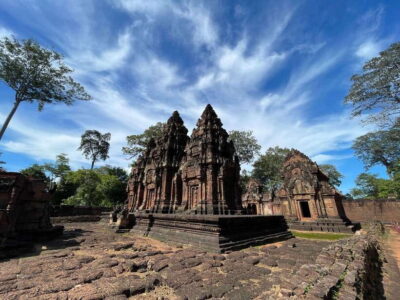
Banteay Srei and Grand Circuit Heritage Tour from Siem Reap
Read our review →Browse the lists this tour appears in