
Reviewed · ANGKOR TEMPLE TOURS
One Day Private Guide Tour of Angkor Thom, Bayon, Ta Phrom & Angkor Wat
Angkor is not one temple. It is an immense former capital filled with monuments from several centuries of Khmer rule. This private day tour gives you the key sequence: the gates and royal terraces of Angkor Thom, the many-faced Bayon, tree-bound Ta Prohm, and a long final visit to Angkor Wat. The personal guide is the real advantage, since these stones make much more sense when someone explains the kings, beliefs, and restoration work behind them.
I especially like two things here. First, the private vehicle lets you move between sites without being tied to a large group. Second, the day is split into a morning circuit and a late afternoon visit to Angkor Wat, a sensible response to Cambodia’s heat. The main drawback is the pace: eight major stops in about nine hours leaves little room for lingering, quiet sketching, or a relaxed lunch.
In This Review
- Key points at a glance
- Why this private Angkor tour works
- 8:00am at Angkor Thom’s South Gate
- Bayon’s 200-plus stone faces
- Baphuon and the Royal Square
- The Elephants Terrace and Leper King Terrace
- Phimeanakas, a smaller but important stop
- Two hours at Ta Prohm
- Lunch is on your own, then Angkor Wat
- Is $146.67 a fair price?
- Who should book this day?
- Final call: book it for structure and insight
- FAQ
- What time does the tour start?
- How long does the experience last?
- Is transportation included?
- Are Angkor temple entrance fees included?
- Is lunch included?
- Is this a private activity?
Key points at a glance
- Angkor Thom’s South Gate starts the day with drama: Huge figures line the approach in a scene based on the churning of the ocean of milk.
- Bayon rewards a guide’s explanation: Its towers carry more than 200 serene faces associated with Avalokitesvara.
- The private format keeps the day flexible: Only your party takes part, with a modern air-conditioned vehicle and an English-speaking guide.
- Ta Prohm gets a full two hours: This is enough time to appreciate its courtyards, gray sandstone, and trees growing through the ruins.
- Angkor Wat is saved for the late afternoon: Three hours lets you see the monument at a slower pace after the morning circuit.
- The $146.67 price includes more than transport: A single-day Angkor Archaeological Park ticket, listed at $37, is included, along with water, taxes, and service charges.
Why this private Angkor tour works
The Khmer Empire controlled much of present-day Cambodia, Laos, Thailand, and Vietnam between the ninth and 12th centuries. The monuments around Siem Reap were not built as isolated attractions. They formed the religious and political heart of a huge kingdom, with temples, reservoirs, royal roads, walls, terraces, and public spaces.
I find a private guide especially useful at Angkor because the site can otherwise feel like a series of impressive stones without a clear story. Your guide can connect Hindu and Buddhist ideas with the ambitions of rulers such as Jayavarman VII and Suryavarman II. The supplied description names a professional licensed English-speaking guide, and one guide mentioned by name in the available feedback is Sim, who is praised for explaining history, daily life, and the temples in fluent English.
That personal format matters. You can ask why a face appears on a tower, how a temple was restored, or why a particular king built a monument. In a larger group, the guide must keep moving. Here, your own group is the only group on the tour.
The vehicle is also practical. You get private transportation in a modern, air-conditioned vehicle, which gives you a cool break between walks. Two bottles of mineral water per person are supplied during sightseeing and transfers. That sounds minor, but after hours on exposed stone paths, it is welcome.
More Angkor temple itineraries:
- Angkor Wat Sunrise or Sunset Tour with Guide from Siem Reap
5.0 · 12,109 reviews - Siem Reap: Angkor Wat: Small-Group Sunrise or Sunset Tour
5.0 · 9,444 reviews - Siem Reap: Angkor Wat 2-Day Tour with Sunrise and Sunset
4.9 · 4,429 reviews
8:00am at Angkor Thom’s South Gate
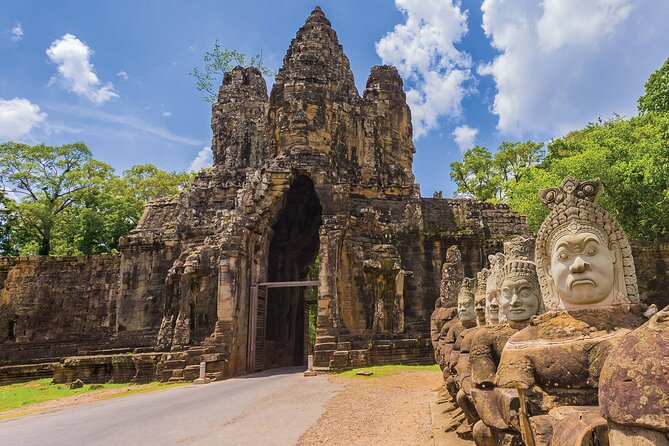
The day begins at 8:00am with Angkor Thom, the 12th-century royal city that became the center of one of the world’s largest urban settlements around 1200. The South Gate is a strong opening because it introduces Khmer sculpture before you even enter the walled city.
The approach presents a long row of enormous figures holding a serpent. The scene refers to the churning of the ocean of milk, a Hindu creation story in which gods and demons pull the serpent to stir the cosmic ocean. The statues give you an immediate sense of scale and also show how Khmer builders used roads, gates, sculpture, and religious symbolism as one carefully planned setting.
Allow about 45 minutes here. That is enough for an explanation, photographs, and a close look at the gate and figures. I would pay attention to the condition of the sculpture. Some pieces are weathered or restored, and your guide can help distinguish the original work from later repairs.
The morning light and earlier start are useful, but 8:00am is not dawn. You should still expect warmth, especially on open stretches. Wear practical walking shoes and clothing that covers shoulders and knees, since these are active religious sites and the day includes extensive walking.
Bayon’s 200-plus stone faces
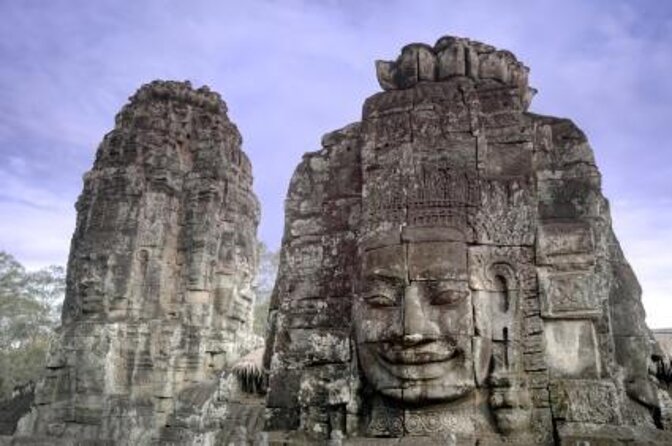
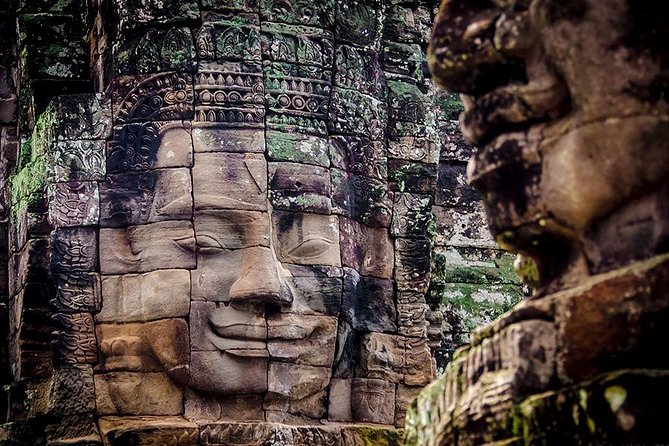
At the center of Angkor Thom sits Bayon, the temple most likely to remain in your mind after the tour. Its towers are covered with large faces, often linked with Avalokitesvara, a compassionate Buddhist figure. More than 200 faces look out from different heights and directions, each with the same calm, closed-mouth smile.
You have about an hour here. That is a useful amount of time because Bayon is confusing at first. Corridors turn sharply, galleries overlap, and the towers rise close together. Without a guide, it is easy to walk through quickly and miss the carvings and the way the faces reveal themselves from changing angles.
I like Bayon for its strange mood. Angkor Wat feels ordered and grand. Bayon feels inward, crowded, and slightly mysterious. The monument was created under Jayavarman VII, a Buddhist king, and its design reflects a different religious and political message from the earlier Hindu temples.
Your guide can also point out how Bayon works as both a temple and a statement of royal power. The king’s association with compassion sits beside the scale of the building and the authority of the surrounding city. Those contrasts are part of what makes the temple more than a photo stop.
Baphuon and the Royal Square
The tour then moves to Baphuon, about 30 minutes. This three-tiered temple mountain was built in the mid-11th century under Udayadityavarman II and dedicated as a state temple. It predates Bayon and gives you a useful comparison between different stages of Khmer temple design.
Baphuon was closed for years during restoration and has reopened. Its long raised walkway and tall central form make it feel different from Bayon’s packed towers. The structure was reconstructed from a huge number of fallen stones, a task that required careful recording and reassembly. Your guide can make that restoration story easier to grasp than a sign alone.
The short stop means you probably will not study every detail. Still, Baphuon earns its place because it shows how Khmer architects used the temple mountain as a symbol of the sacred center of the world. Take your time on the approach and look back toward the entrance. The perspective helps you understand the monument’s original design.
The wider Angkor Thom area also includes the Royal Enclosure and Phimeanakas, though the listed stop times focus on the named monuments. Ask your guide how much time is available for each part on your day. This is one point where a private tour helps, but the full schedule is still busy.
Other Siem Reap experiences to weigh up
- 1-Day Amazing Angkor Wat Tour with Sunset & All Interesting Major Temples
5.0 · 308 reviews - Angkor Wat one Day Private Tour for All Highlight Angkor Temples
5.0 · 199 reviews - 1-Day private Angkor Temple Tour from Siem Reap
4.9 · 178 reviews - 1-Day Angkor Wat Sunrise & All Interesting Temples Private Tour
5.0 · 174 reviews
The Elephants Terrace and Leper King Terrace
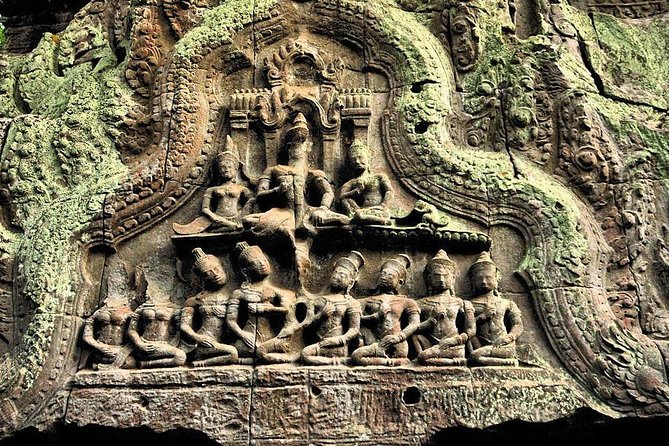
The Elephants Terrace gets around 30 minutes. Jayavarman VII used this long platform to view victorious armies returning to Angkor. Its name comes from the elephant carvings along the face of the terrace, while the broader Royal Square once formed a ceremonial part of the capital.
This is a more open stop than Bayon or Baphuon. I would use it to look closely at the reliefs and picture the terrace as a stage for royal display rather than only as a decorated wall. The scale of the square helps explain how Angkor Thom functioned as a capital, not merely as a collection of temples.
The Terrace of the Leper King follows, also for about 30 minutes. It sits at the northwest corner of Angkor Thom’s Royal Square and was built in the Bayon style under Jayavarman VII. Its modern name comes from a statue and later tradition, not from a simple explanation of the terrace’s original purpose.
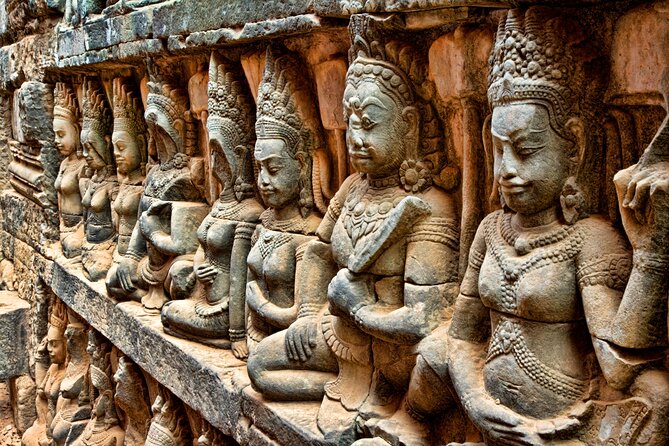
The inner wall is particularly worthwhile because it carries rows of carved figures. A guide can help you see the terrace as a layered structure rather than a single facade. These two terraces are less instantly famous than Angkor Wat, but they add political and ceremonial context to the morning.
Phimeanakas, a smaller but important stop
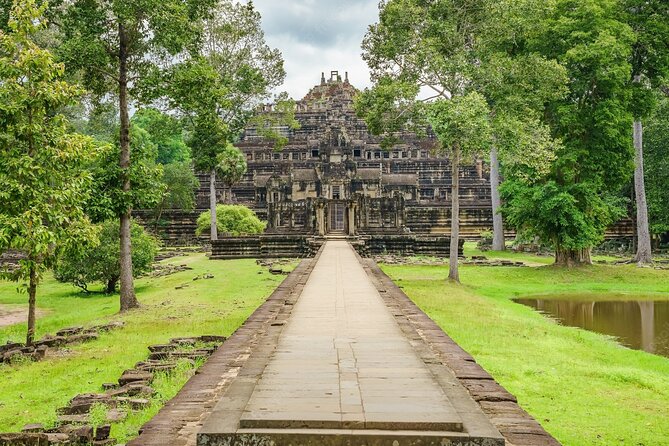
Phimeanakas receives another 30 minutes. This Hindu temple was begun in the late 10th century during the reign of Rajendravarman and completed under Suryavarman I. It follows the Khleang style and takes the form of a three-tiered temple mountain.
After Bayon and Baphuon, Phimeanakas may feel quieter and less visually complete. That is not a reason to skip it. Its value lies in showing an earlier phase of Angkor’s royal building program and in reminding you that the city was rebuilt and expanded by successive rulers.
The stop is brief, so I would let your guide provide the key points rather than trying to inspect every stone. The tour’s strength is the sequence: you see a royal city, a Buddhist state temple, older temple architecture, and ceremonial terraces before reaching the more atmospheric Ta Prohm.
Two hours at Ta Prohm
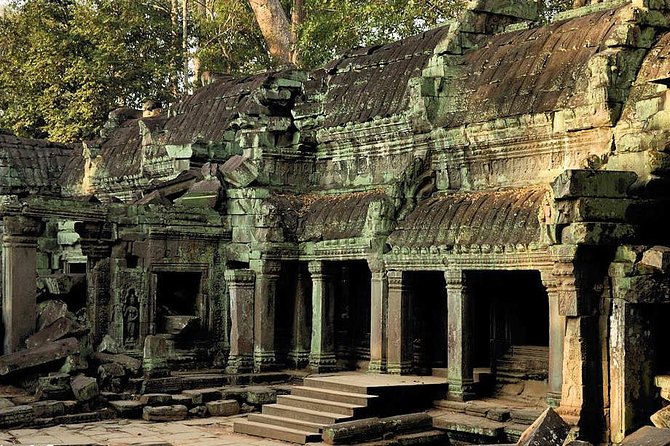
Ta Prohm is given the longest morning visit, about two hours, and that is sensible. Built in 1186 by Jayavarman VII as a monastery dedicated to his mother, it has dark gray sandstone towers, courtyards, galleries, and narrow passages that create a more enclosed mood than the broad spaces of Angkor Wat.
The trees are part of the temple’s modern image, but the stonework deserves equal attention. Roots press through walls and roofs, while carvings survive in shadowed corners. The result is atmospheric, but it is also fragile. You should follow the marked paths and avoid treating the roots or walls as climbing frames.
Two hours lets you slow down. You can look at the layout, listen to the guide’s explanation, and take photographs without racing from entrance to exit. Still, Ta Prohm can feel crowded, and the narrow passages make movement slower than the clock suggests. Your private guide may help choose a practical route and point out places where the carvings are easier to see.
The contrast with Bayon is strong. Bayon centers on faces and visual mystery. Ta Prohm feels like a monastery reclaimed by the surrounding forest. Both were linked to Jayavarman VII, but they express different sides of his building program.
Lunch is on your own, then Angkor Wat
Lunch is not included, and drinks during meals are also at your own expense. The schedule includes a break before the late afternoon visit, but it does not name a restaurant or set meal. I would treat this as useful freedom, while remembering to budget separately.
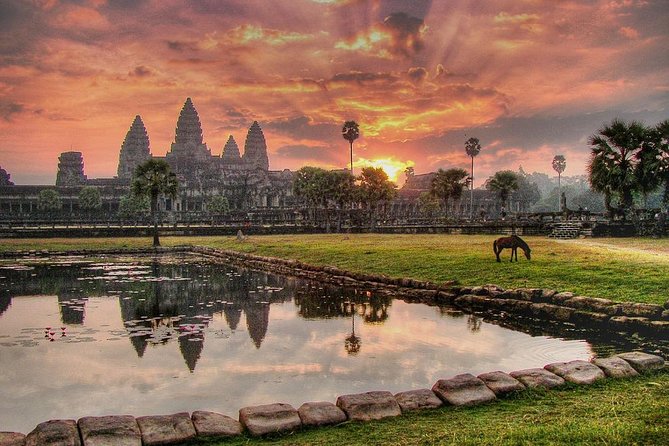
Angkor Wat receives about three hours. Built under Suryavarman II as his funeral temple, it is the largest and most famous monument in the park. Saving it for the late afternoon gives you a chance to approach it after the more enclosed temples of the morning.
Angkor Wat is a temple complex of towers, galleries, courtyards, moats, and long lines of relief sculpture. Its design is highly ordered, with a central sanctuary rising above the surrounding structures. The scale can be hard to absorb from one viewpoint, so listen as your guide explains how the parts fit together.
The reliefs are a major reason to keep moving slowly. They present scenes from Hindu mythology and royal power, with armies, gods, battles, and ceremonial figures carved into the galleries. Three hours gives you enough time for the broad approach, the major galleries, and the central areas open during your visit.
The late afternoon and sunset timing can make the final stop especially appealing, but conditions are not guaranteed. Clouds, heat, crowds, or access rules may affect the experience. I would value the timing for its softer light and cooler feel, while keeping expectations flexible about a perfect sunset.
Is $146.67 a fair price?
At $146.67 per person, this is not the cheapest way to see Angkor. The price makes more sense if you are traveling as a small private party and want a guide, vehicle, and ticket handled together.
The single-day Angkor Archaeological Park admission, listed at $37, is included. So are private air-conditioned transportation, a licensed English-speaking guide, two bottles of water per person, taxes, VAT, and service charges. Lunch, meal drinks, and personal, travel, and health insurance are not included.
The value depends on how many people share the booking. For one or two people, the per-person price is a significant outlay, but you are paying for a private experience rather than a basic transfer. Group discounts are offered, and the cost becomes easier to justify as your own party grows.
I would compare this with the cost of hiring transport and arranging a separate guide, but the most important value is interpretive. Angkor’s size and symbolism reward explanation. The tour also removes the need to negotiate separate transport between eight stops.
Who should book this day?
I would recommend this tour to first-time visitors who want the major Angkor monuments in one organized day. It suits couples, families, and small groups that prefer asking questions privately rather than joining a large party.
It is also a good choice if you value comfort between sites. The air-conditioned vehicle matters after long walks, and the water provision is practical. The split schedule is better than one uninterrupted march through the temples.
I would hesitate if you want a slow archaeological study. The schedule is full, and even two hours at Ta Prohm can pass quickly. Anyone with limited mobility should also consider the amount of walking and uneven temple surfaces, since the available information says most people can participate but does not provide detailed accessibility notes.
Four ratings are recorded at the top score, with the strongest praise focused on the guides, clear planning, courteous driving, English ability, temple history, photography advice, and ways to avoid the thickest crowds. Sim is specifically named for his explanations of history, daily life, and the temples. Those are meaningful strengths, but guide assignments can vary, so you should confirm who will lead your date if a named guide matters to you.
Final call: book it for structure and insight
Book this tour if you want Angkor’s essential monuments, a private vehicle, an English-speaking guide, and the $37 park ticket bundled into one demanding but sensible day. I like the way it begins with the ceremonial South Gate, builds through Angkor Thom, gives Ta Prohm room to breathe, and ends with three hours at Angkor Wat.
Skip it if you prefer setting your own pace or spending an entire day at only one or two temples. For most first-time visitors with limited time in Siem Reap, though, the private format and strong guide focus make the $146.67 price a reasonable investment in understanding what you are seeing.
Free cancellation is available if you cancel at least 24 hours before the 8:00am start time. Changes or cancellations inside that window are not accepted for a refund.
FAQ
What time does the tour start?
The tour starts at 8:00am.
How long does the experience last?
The tour lasts approximately nine hours.
Is transportation included?
Yes. Private transportation in a modern air-conditioned vehicle is included.
Are Angkor temple entrance fees included?
Yes. The single-day Angkor Archaeological Park ticket, listed at $37, is included.
Is lunch included?
No. Lunch is on your own account, and drinks during meals are also not included.
Is this a private activity?
Yes. Only your group participates in the private tour.
Fresh reviews from around Siem Reap
- Full-Day Tour Preah Vihea & Koh Ker Temple 3.7 · 3 reviews
- Savor the Countryside: Tours with Authentic Cooking Classes” 5.0 · 3 reviews
- Angkor Wat Sunrise TukTuk Tour 5.0 · 3 reviews
- Angkor Grand Circuit Tour & Banteay Srei 5.0 · 3 reviews
- Guided Private Tuk Tuk Tour Angkor Wat and Small Circle and Five Extras 5.0 · 3 reviews
- Siem Reap Temple Tour 2-Day with Sunrise/Sunset 3.7 · 3 reviews
- Bangkok to Angkor Wat 2 Days 1 Night by Flight 4.5 · 3 reviews
- Kompong Pluk Tour 5.0 · 3 reviews
Angkor Temple Tours, compared.

Angkor Wat Sunrise or Sunset Tour with Guide from Siem Reap
Read our review →



Angkor Wat Sunrise tour with Small – Group and Guide tours
Read our review →
Angkor Wat Highlights and Sunrise Guided Tour from Siem Reap
Read our review →

Full-Day Angkor Wat Sunrise Private Tour with Guide from Siem Reap
Read our review →Browse the lists this tour appears in