
Reviewed · FLOATING VILLAGE TOURS
Bakong Temples & Floating Village Tour
Bakong gives you a clear look at the idea that later produced Angkor Wat: a stone mountain rising through moats and walls to represent Mount Meru. The afternoon then shifts from royal temples to Kampong Phluk, a working community built around Tonle Sap’s changing water levels.
I like the strong mix of archaeology and present-day life, plus the private tour format, which lets your group set the pace with an English-speaking guide. I also like that pickup, air conditioning, and drinking water are included, useful comforts during a long day.
The main drawback is cost: the $45 tour price does not include the Angkor Pass, listed at $37 per person, and the floating village boat portion also has an admission charge listed separately. Weather may affect the lake visit, too.
In This Review
- Key points at a glance
- Why Bakong makes this more than a standard temple outing
- Lolei sets the clock back to the late ninth century
- Preah Ko connects the early temples
- Two hours at Prasat Bakong is time well spent
- Kampong Phluk shifts the focus from kings to community
- The private format gives the day a personal pace
- What the $45 price really covers
- Who will enjoy this combination most
- Simple ways to get more from the day
- Should you book the Bakong and floating village tour?
- FAQ
- How long does the Bakong Temples and Floating Village Tour last?
- What temples are included?
- How much does the tour cost?
- Is the Angkor Pass included?
- Is transportation provided?
- Is a tour guide included?
- Is the floating village admission included?
- Is this a private tour?
Key points at a glance
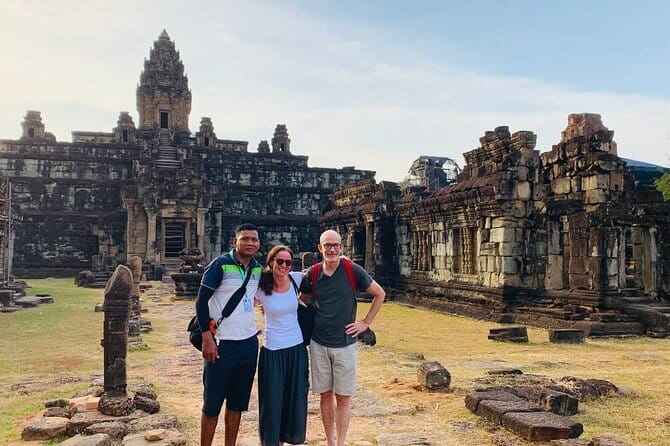
- Bakong is the main event: Built in 881 AD, it was the Khmer Empire’s first sandstone temple-mountain and a model for later monuments.
- The Roluos group comes first: Lolei and Preah Ko provide the setting for understanding Bakong’s early Khmer architecture.
- Kampong Phluk is a real water-based community: Homes, schools, and shops adapt to dramatic seasonal changes in Tonle Sap’s water level.
- Your guide matters: The experience identifies Mr Oun Kosorl and Mr K as guides praised for charm, history, and local explanation.
- The day lasts 6 to 8 hours: This is a substantial outing, not a quick temple stop followed by a short boat ride.
- Budget for extra admission: The $45 price excludes the Angkor Pass, listed at $37, and the Kampong Phluk admission charge.
Why Bakong makes this more than a standard temple outing
Many Siem Reap temple trips focus on the most famous monuments. This one takes you farther back, to the Roluos area and the early form of Khmer temple design.
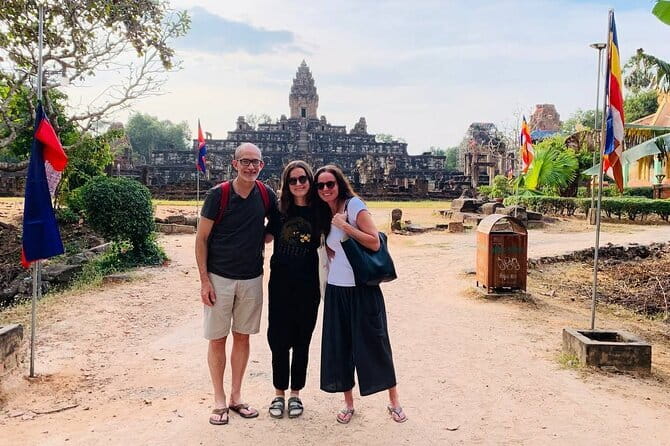
Bakong was built by King Indravarman I in 881 AD. It was the first Khmer temple-mountain made from sandstone, and its design became a prototype for later structures, including Angkor Wat. That connection gives the visit real value. You are not only looking at old stones. You are seeing an early architectural idea that shaped the empire’s best-known temples.
The central pyramid has five levels. It represents Mount Meru, the sacred mountain at the center of the Hindu universe. Moats and enclosing walls reinforce that symbolic design, separating the temple from the ordinary world around it.
Look for the early Naga causeway, one of the oldest known examples in Khmer architecture. The stone guardians also deserve time. Large elephant and lion figures remain on the lower levels, offering a sense of how the temple once marked its boundaries and protected its sacred center.
Bakong is not presented as a quick photo stop. The schedule allows about two hours there, enough time for your guide to explain the layout and for you to inspect the pyramid at a sensible pace. You should still expect stairs, uneven stone, and a hot outdoor setting, since the information provided does not describe indoor shelter or special access arrangements.
More floating village visits:
- From Siem Reap: Kampong Phluk Floating Village Tour by Boat
4.9 · 6,979 reviews - Sunset tour of Kampong Phluk stilts home village on the Tonle Sap
5.0 · 4,865 reviews - Siem Reap: Kampong Phluk Floating Village Tour with Boat
4.9 · 3,843 reviews
Lolei sets the clock back to the late ninth century
The first stop is Lolei, the northernmost temple in the Roluos group. You have about an hour here.
Lolei belongs to a group of three late ninth-century Hindu temples, along with Preah Ko and Bakong. That makes the sequence useful. Instead of seeing Bakong as an isolated monument, you begin with the wider group and move through an early period of Khmer construction.
The supplied details do not give a separate admission price for Lolei, but the itinerary says admission is not included. The general tour information also lists a $37 Angkor Pass as an extra cost. Confirm how the pass applies to your chosen date when booking, since the admission notes are not perfectly clear.
An hour is enough for an introduction, but it may feel long if your main interest is only Bakong. I would treat Lolei as a scene-setting stop. Listen for the links between the three temples, rather than expecting the scale of the later Angkor monuments.
Preah Ko connects the early temples
Preah Ko follows Lolei, with about an hour scheduled. It was the first temple built in Hariharalaya, an ancient city located roughly 15 kilometers southeast of the main Angkor group.
That fact helps explain the importance of the Roluos area. This was an early center of Khmer power, before the better-known monuments farther north became the focus of temple sightseeing.
Preah Ko’s admission is listed as free in the itinerary, though the tour notes still refer to the Angkor Pass as not included. Plan on paying the stated pass cost unless the operator confirms otherwise.
The stop works best as part of the full progression. Lolei introduces the group, Preah Ko shows the early capital setting, and Bakong provides the grand temple-mountain. If you skip the first two, Bakong may still impress you, but you lose some of the architectural story.
Two hours at Prasat Bakong is time well spent
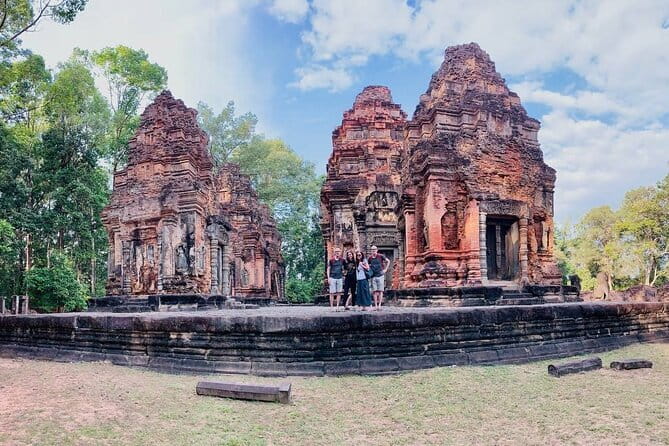
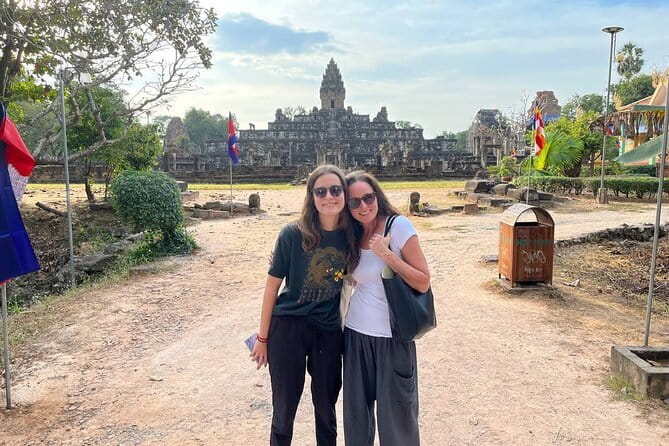
Bakong receives the longest temple visit, and rightly so. You have about two hours to see the pyramid, causeway, guardian statues, moats, and enclosing walls.
The five-tiered sandstone form is the feature you will remember. Its rising levels draw your eye toward the sacred center, while the surrounding water and walls give the whole complex a planned, ordered shape. This is the architectural language later used on a larger scale at Angkor Wat.
Your guide can make the difference here. Mr Oun Kosorl and Mr K are identified with this experience, and the available feedback highlights their charm, clear temple explanations, and ability to connect the sites with the story of Siem Reap. If your guide is Mr K, ask him to point out the earliest Naga causeway and explain how Bakong’s design relates to later temple-mountains.
The temple is also a good place to slow down. A private group does not have to follow a large coach schedule, so you can spend more time on details that interest you. That might mean the elephants at the lower levels, the lions, or the way the pyramid rises through its surrounding walls.
Do not expect every minute to feel equally dramatic. Lolei and Preah Ko are earlier and smaller in scale, and Bakong’s stone surfaces can look weathered. The reward comes from seeing the form as a whole and understanding its place in Khmer architecture.
A different pace for your next Siem Reap morning:
- Angkor Wat Sunrise or Sunset Tour with Guide from Siem Reap
5.0 · 12,109 reviews - Siem Reap: Angkor Wat: Small-Group Sunrise or Sunset Tour
5.0 · 9,444 reviews - Siem Reap: Angkor Wat 2-Day Tour with Sunrise and Sunset
4.9 · 4,429 reviews - Siem Reap: Full-Day Angkor Wat Guided Tour with Sunset
4.9 · 3,803 reviews
Kampong Phluk shifts the focus from kings to community
After the temples, the tour spends about three hours at Kampong Phluk Floating Village. This is a major change in subject and mood.
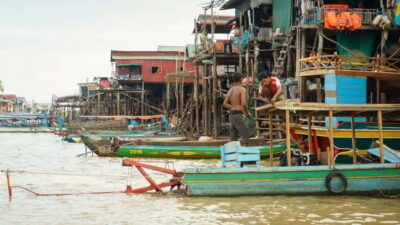
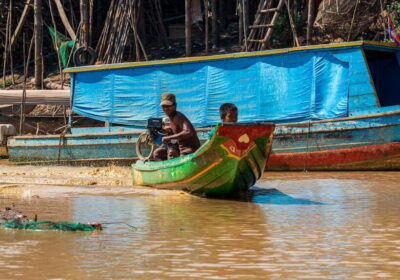
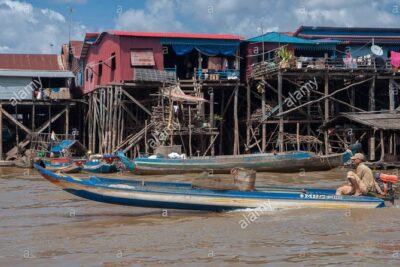
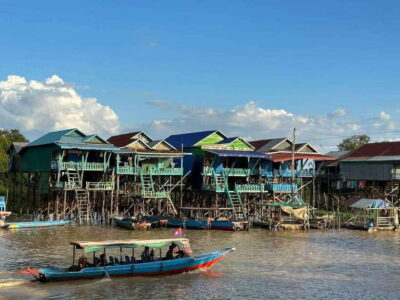
Tonle Sap is the largest lake in Southeast Asia and covers five Cambodian provinces. Its water level changes with the seasons, so the village is built to adapt. Some homes float directly on the water. Others sit on tall stilts, rising high above the ground during the dry season.
That seasonal design is the point of the visit. You are seeing more than houses beside a lake. The community’s infrastructure includes homes, schools, and shops, all arranged around water levels that shift through the year.
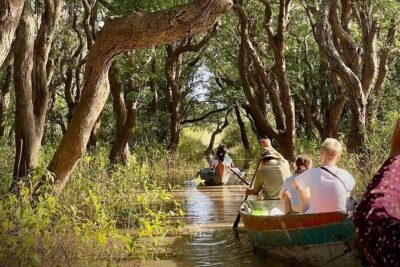
The boat ride takes you along the river toward the village. One available account describes a school visit where primary-age children were learning English. The school detail gives the stop a more personal focus, although the information does not promise that every departure includes the same interaction or school access.
I would approach this part with respect and attention. The setting can be striking, but it also reveals difficult living conditions. One account describes the contrast between those conditions and the apparent happiness of the people living there. That tension is worth acknowledging rather than turning the village into a simple photo background.
Weather can affect the experience. One outing was hampered by poor conditions, so keep your expectations flexible. The lake and river may feel very different under changing skies, and the boat portion is less predictable than a visit to a stone temple.
The private format gives the day a personal pace
This is a private activity, meaning only your group participates. That matters on a 6 to 8-hour day.
You can ask questions as they come up instead of waiting for a whole bus group. You may also find it easier to spend more time at Bakong or ask for extra explanation at the floating village. The actual timing can vary, since each stop has an approximate duration rather than a fixed minute-by-minute schedule.
Pickup and drop-off are included. The vehicle is air-conditioned, and cold drinking water is provided. Those details may sound basic, but they make a difference when you are moving between open temple grounds and a boat route in Cambodia’s heat.
An English-speaking guide is included. The names associated with the experience are Mr Oun Kosorl and Mr K. The available comments place particular value on the guide’s charm, history explanations, and local perspective. If the guide assignment is important to you, ask the operator whether a named guide is available on your date rather than assuming.
What the $45 price really covers
The listed price is $45 per person. That is a reasonable starting price for a full private day with transportation, an English-speaking guide, hotel pickup and drop-off, air conditioning, and water.
The price is not the final amount. The tour information lists the Angkor Pass at $37 per person as an extra charge. Lolei also shows admission as not included, while Preah Ko and Bakong are marked free in the stop details. Kampong Phluk admission is not included either.
In practical terms, you should budget at least $82 per person before the floating village admission charge, assuming the stated Angkor Pass cost applies to you. Confirm the admission arrangement before paying, since the supplied details describe the temple fees in more than one way.
The value improves if you want both the Roluos temples and Tonle Sap in one day. Booking two separate outings could mean more transport time and less flexibility. The value is weaker if you only want the famous Angkor temples, since this tour spends substantial time at earlier sites and the floating village.
Group discounts are offered, which may make the private format more attractive for families or small parties. The experience is also booked around 12 days in advance on average, so leaving it until the last minute may reduce your choice of dates.
Who will enjoy this combination most
I would choose this for someone who wants context, not just the biggest monument. Bakong rewards curiosity about how Khmer temple design developed, while Kampong Phluk adds a look at how people organize daily life around Tonle Sap.
It suits couples, families, and small groups who prefer a private vehicle and guide. It also works well if you have already seen major Angkor sites and want something different from another large temple complex.
The outing may be less suitable if you dislike long days, outdoor heat, boat travel, or uneven temple grounds. It is also not the best pick if your schedule is tight. With 6 to 8 hours required, this needs a full half-day or more.
Most travelers can participate according to the supplied information, but no detailed accessibility information is provided. If stairs, walking surfaces, or boat access are concerns, ask the provider before booking.
Simple ways to get more from the day
Start by treating the first three stops as one story. Lolei and Preah Ko are not merely places to tick off before Bakong. They help you see how the Roluos group developed and why Bakong matters.
At Bakong, give yourself time to look down as well as up. The moats, walls, causeway, and lower-level guardians are part of the design, not background decoration. Ask about the Naga causeway and the temple’s 881 AD construction.
At Kampong Phluk, pay attention to the height and position of the homes. Floating structures and stilted structures solve different problems as water levels change. The schools and shops show that this is a complete community, not simply a line of houses made for sightseeing.
Bring patience for the weather. The lake portion can be affected by conditions, and the experience may feel less polished than an ordinary city attraction. That is also why it can be more revealing.
Should you book the Bakong and floating village tour?
Book it if you want a balanced day that combines early Khmer architecture with present-day life on Tonle Sap. The strongest reasons are Bakong’s importance, the private format, included transport, and guides such as Mr K or Mr Oun Kosorl, whose explanations are central to the experience.
Think twice if you want only the headline Angkor temples, have limited time, or do not want to pay the extra Angkor Pass and floating village admission. Also remember that weather can affect the boat visit.
For the right reader, this is a useful and varied Siem Reap outing. You get the early temple-mountain that helped shape later Khmer monuments, then a close look at a community that changes with the lake. Cancel at least 24 hours before the start time if your plans change, since cancellations within 24 hours are not refunded.
FAQ
How long does the Bakong Temples and Floating Village Tour last?
The tour lasts approximately 6 to 8 hours.
What temples are included?
The route includes Lolei, Preah Ko, and Prasat Bakong.
How much does the tour cost?
The listed price is $45 per person.
Is the Angkor Pass included?
No. The tour information lists an Angkor Pass cost of $37 per person as not included.
Is transportation provided?
Yes. Pickup and drop-off are included, along with an air-conditioned vehicle.
Is a tour guide included?
Yes. An English-speaking tour guide is included. The experience identifies guides including Mr Oun Kosorl and Mr K.
Is the floating village admission included?
No. Admission for Kampong Phluk Floating Village is listed as not included.
Is this a private tour?
Yes. Only your group participates in the activity.
Fresh reviews from around Siem Reap
- Full-Day Tour Preah Vihea & Koh Ker Temple 3.7 · 3 reviews
- Savor the Countryside: Tours with Authentic Cooking Classes” 5.0 · 3 reviews
- Angkor Wat Sunrise TukTuk Tour 5.0 · 3 reviews
- Angkor Grand Circuit Tour & Banteay Srei 5.0 · 3 reviews
- Guided Private Tuk Tuk Tour Angkor Wat and Small Circle and Five Extras 5.0 · 3 reviews
- Siem Reap Temple Tour 2-Day with Sunrise/Sunset 3.7 · 3 reviews
- Bangkok to Angkor Wat 2 Days 1 Night by Flight 4.5 · 3 reviews
- Kompong Pluk Tour 5.0 · 3 reviews
Floating Village Tours, compared.
Sunset tour of Kampong Phluk stilts home village on the Tonle Sap
Read our review →
Siem Reap Floating Village Kampong Phluk Sunset with Boat
Read our review →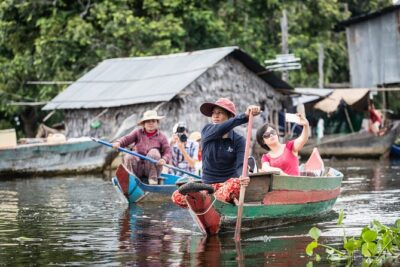
Kompong Phluk Floating Village Half-Day Tour ( Morning / Sunset )
Read our review →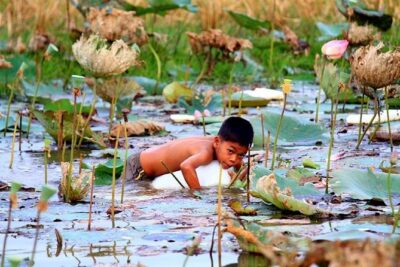
Browse the lists this tour appears in