
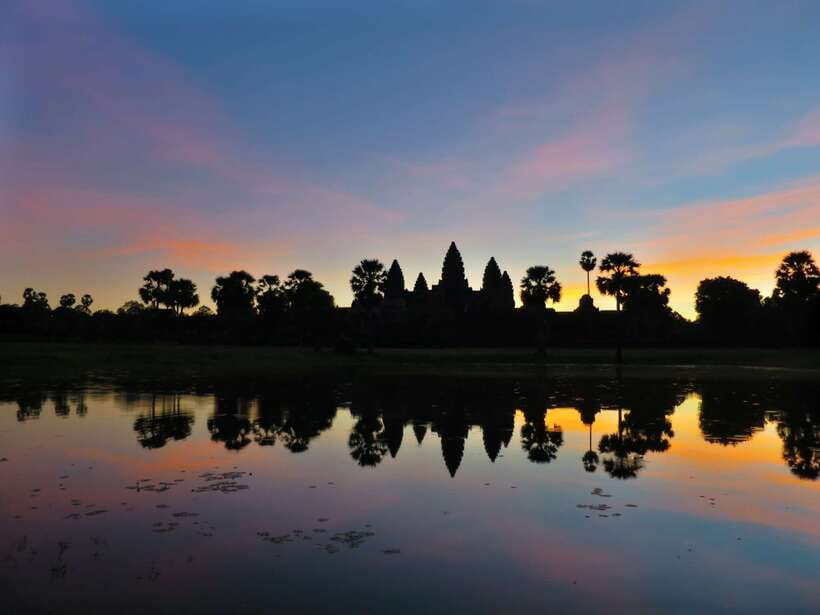
Reviewed · ANGKOR WAT SUNRISE TOURS
Angkor Wat: Sunrise 2.5 Days Temples & Tonle Sap-Small Group
Angkor Wat at sunrise is the headline, but the clever part of this 2.5-day small-group tour is how it spreads the temple circuit over enough time to breathe. You visit Banteay Srei, Preah Khan, Bayon, Ta Prohm, and other major sites, then finish with Tonle Sap’s stilted villages. I like the early access to Angkor Wat’s eastern side, and I like the practical care from guides and drivers such as Pal Saruon, Pireak, Sam, AJ, Keal, and Ro.
The main catch is cost: the advertised $69 does not include the required three-day temple pass, which adds $62 per person. You also need to handle early starts, hot walking, and uneven temple ground. During the dry season, from March 1 through June 30, Tonle Sap is replaced by Cambodia Phare Circus, so check the seasonal plan before booking.
In This Review
- Key points to know before booking
- Why the 2.5-day format works
- Day 1: Pre Rup, Banteay Srei, Neak Pean, and Preah Khan
- Day 2: Angkor Wat before sunrise
- Angkor Thom and the many faces of Bayon
- Day 3: Kampong Phluk and Tonle Sap
- Guides, drivers, and the small-group setup
- What the $69 price really covers
- Who should book this tour
- Should you book it?
- FAQ
- Is the Angkor temple pass included?
- What is included in the $69 tour price?
- Is Tonle Sap visited all year?
- What time does the sunrise day begin?
- How large is the group?
- Is breakfast included?
- What should I wear and bring?
- Is the tour suitable for people with mobility impairments?
Key points to know before booking
- Angkor Wat before dawn: Enter in darkness and walk through the quieter eastern side before the sunrise crowds build.
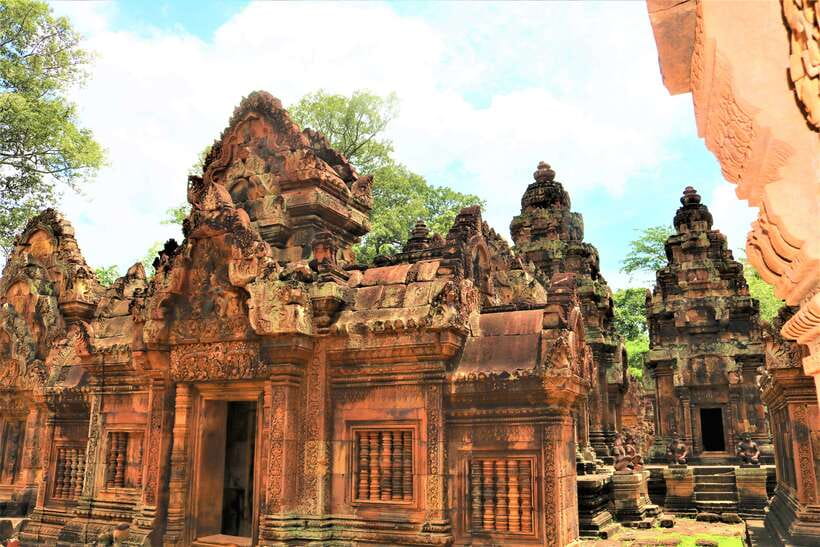
- Banteay Srei’s fine carvings: This smaller temple is a long drive from the central Angkor sites but rewards you with unusually detailed sandstone reliefs.
- A full temple sweep: Pre Rup, Neak Pean, Preah Khan, Angkor Thom, Bayon, Ta Prohm, and Angkor Wat all feature in the plan.
- Tonle Sap or Phare Circus: The lake cruise visits Kampong Phluk in the wetter season, while the circus is the dry-season alternative.
- Small groups and cool-downs: The group is capped at 15, with an air-conditioned vehicle, drinking water, and, according to the tour arrangements, refreshing towels at temple stops.
- Budget beyond the headline price: Allow for the $62 temple pass and your breakfasts, neither of which is included.
Why the 2.5-day format works
Siem Reap’s temple zone is too large for a rushed one-day sweep. A quick circuit can give you photographs of Angkor Wat and Bayon, but it leaves little time for smaller sites, proper explanations, or a break from the heat.
This tour gives the outer temples their own day, the core Angkor circuit another day, and Tonle Sap a final half-day. That division makes practical sense. You can spend time at Banteay Srei without stealing your best hours from Angkor Wat, and you do not have to choose between a temple morning and a lake excursion.
The small-group limit of 15 matters here. Your guide can usually speak to the group rather than shout over a large crowd, and you have a better chance of asking about Khmer beliefs, temple design, or present-day Cambodian life. English is the tour language, and past guides have included Pal Saruon, Pireak, Sam, AJ, and Sokpee Sumsot.
The schedule is active. You walk across temple courtyards, through corridors, and over old stone surfaces. If you dislike early mornings or have mobility limitations, this is not the easy option. The tour is specifically not suitable for people with mobility impairments, and comfortable shoes are essential.
More Tonle Sap lake trips:
- Sunset tour of Kampong Phluk stilts home village on the Tonle Sap
5.0 · 4,865 reviews - Siem Reap: Kulen Mountain, Beng Mealea and Tonle Sap Tour
5.0 · 1,483 reviews - Tonle Sap Lake & Kampong Phluk Village Half-Day Tour
5.0 · 1,045 reviews
Day 1: Pre Rup, Banteay Srei, Neak Pean, and Preah Khan
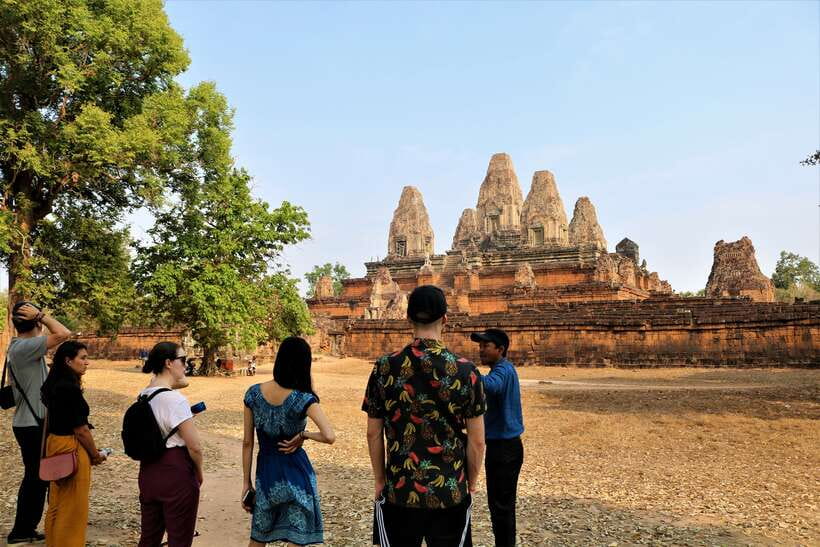
The first temple stop is Pre Rup, a Hindu state temple built from brick, laterite, and sandstone. Its tiered mountain form helps you understand a basic idea behind Khmer temple building: the structure represents a sacred mountain, with the upper levels drawing the eye upward.
Pre Rup is also a useful first stop because it feels different from Angkor Wat. Instead of one immense complex, you get a more compact structure with strong geometric lines and weathered brick. Your guide can help explain how the materials and design fit into the wider Khmer period.
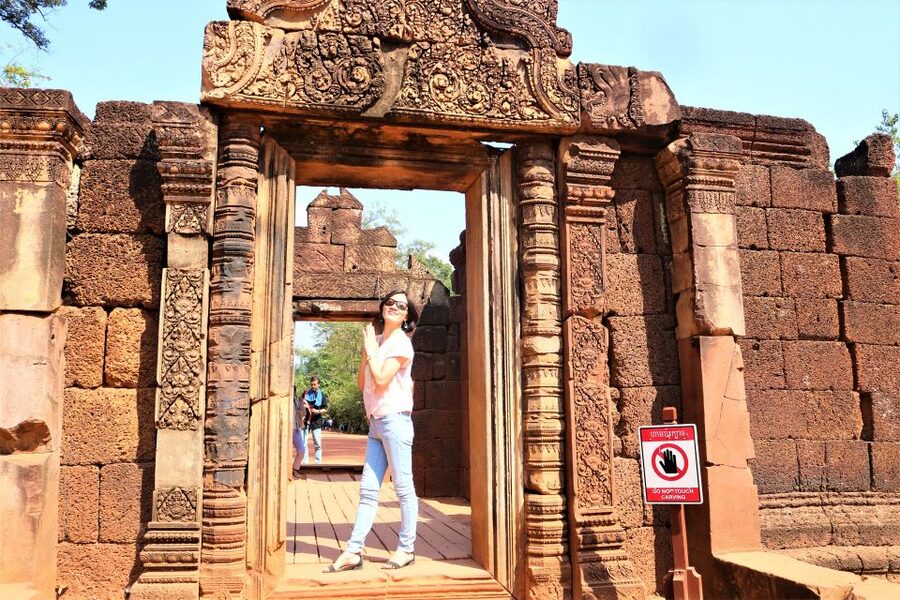
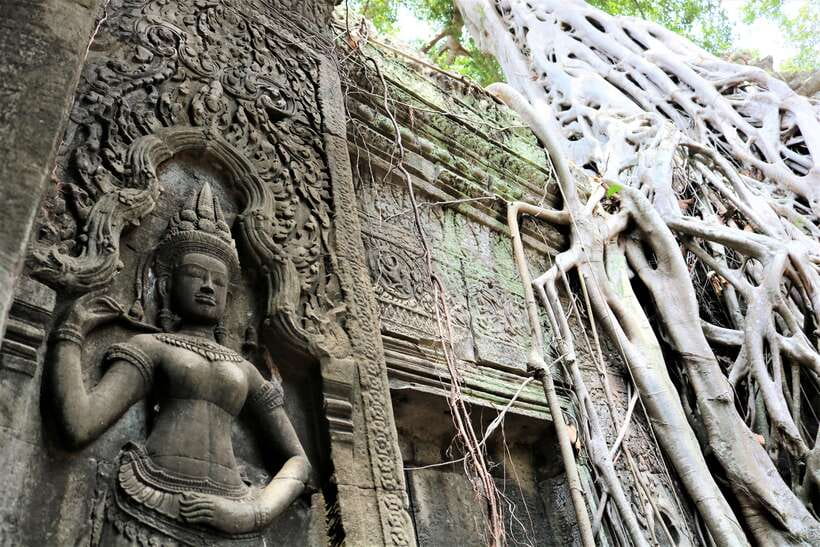
Banteay Srei is the day’s major prize. It is smaller than Angkor Wat, but its sandstone carvings are exceptionally fine. The reliefs cover doorways, pediments, and walls with a level of detail that is easy to miss when you are rushing through larger monuments.
I would give Banteay Srei your full attention rather than treating it as a quick photo stop. Look closely at the carved figures and ornamental patterns. The temple’s distance from the central Angkor area is the trade-off, but the drive is worthwhile if you want craftsmanship as well as scale.
Banteay Srei only became accessible to visitors in the late 1990s, after the Khmer Rouge had left the area. That recent opening adds modern Cambodian context to an ancient site. You are not only looking at old stone, but also at how access and safety have changed in the region.
On the return route, Neak Pean offers a different kind of temple setting. It sits on an artificial island with a Buddhist temple on a circular island, surrounded by water. The design is less about towering buildings and more about a carefully arranged sacred environment.
Water levels and seasonal conditions can affect how the setting looks, so do not expect the same view every month. Still, Neak Pean breaks up the brick-and-stone rhythm of the day and gives your guide a chance to explain Buddhist ideas connected with the site.
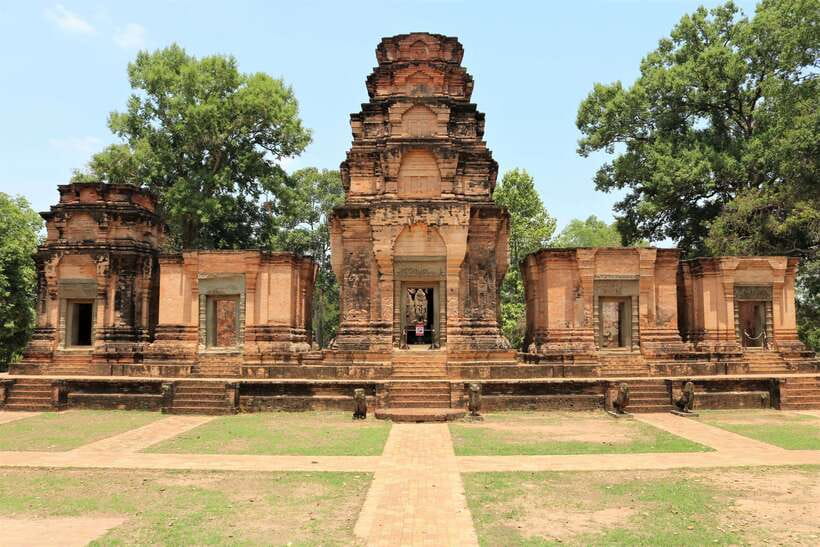
Preah Khan closes the day. This ruined complex has crumbling stone structures, tree roots, corridors, and a wonderfully untidy feel. It is more atmospheric than polished, and I prefer it that way. The mixture of vegetation and masonry shows how time has worked on the Angkor monuments.
The day covers a lot of ground, and Banteay Srei is not close to the other stops. The air-conditioned vehicle is important, especially after walking in the sun. Drivers on this tour have also been noted for waiting near temple exits with cold water and damp towels, a small service that becomes very welcome after several hours outdoors.
Day 2: Angkor Wat before sunrise
The second day begins before dawn with hotel pickup. The aim is to enter Angkor Wat in darkness, carrying a torch, and approach through the eastern side. This is the most distinctive part of the schedule.
Most people think first of the reflecting pool and the famous front view. This route gives you another angle before the sky brightens. Walking through cloistered corridors in the dark changes the mood. You notice the scale gradually, rather than arriving in full daylight and immediately joining the crowd at the best-known viewpoint.
The guide explains the bas-reliefs as you move through the temple. Angkor Wat contains one of the longest continuous stretches of bas-relief carving in the world, with scenes tied to Hindu stories, royal power, and Khmer life. Without help, it is easy to see only rows of figures and miss the story lines.
Guides such as Pal Saruon and Pireak have been praised for clear explanations of temple art, Cambodian culture, and Khmer history. Ask questions as you go. A good explanation turns a wall of carved stone into a sequence of characters, battles, rituals, and beliefs.
Sunrise itself is never guaranteed to be dramatic. Clouds, haze, and crowds are part of the deal. The value of the early start is not just a perfect sky, but the chance to experience the temple before the day becomes hotter and busier.
The morning portion ends with breakfast outside Angkor Wat, followed by a short rest. Breakfast is not included, so plan to buy or bring your own. This break is useful because the next section involves another substantial walk.
Angkor Thom and the many faces of Bayon
After the Angkor Wat morning, the tour continues to Angkor Thom through its southern gate. The entrance is flanked by 54 stone figures representing gods and demons, arranged along the approach.
This gate gives you a strong sense of the fortified city as a planned royal center. It is not simply a decorative entrance. The line of figures, the causeway, and the walls help show how movement into the city was controlled and presented as a sacred passage.
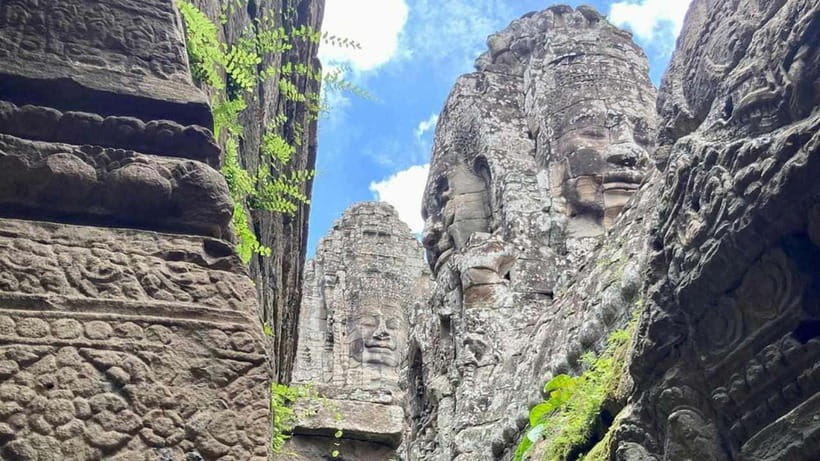
Inside Angkor Thom, Bayon is the essential stop. Its central towers carry more than 200 large carved faces. They appear from different angles as you move around the temple, producing a slightly uncanny experience. The faces are calm rather than theatrical, and their repeated presence makes Bayon unlike any other monument in the circuit.
The stone corridors can be confusing, so this is another place where a guide adds real value. You will want time to look up, around, and into the bas-reliefs rather than simply follow the group from one tower to the next.
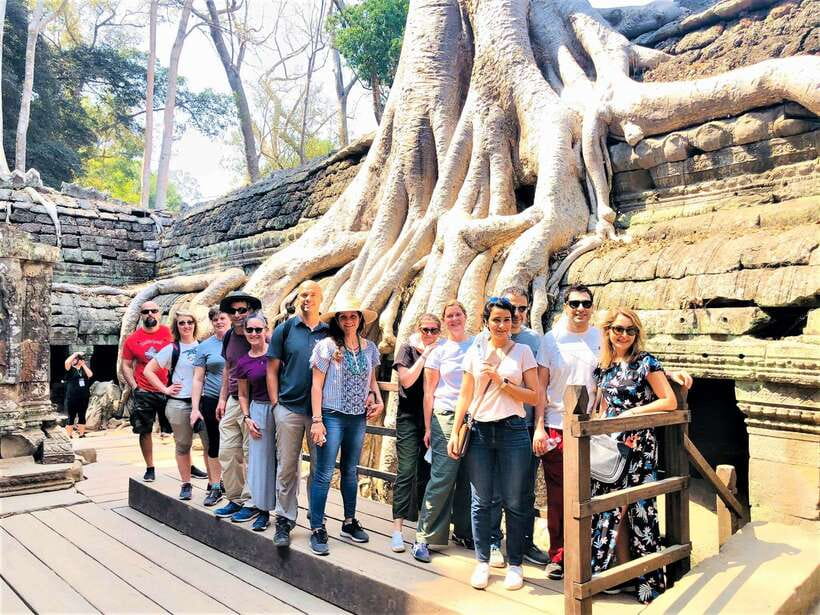
After lunch and a rest break, the itinerary returns to the jungle-enveloped Ta Prohm. Its tree roots and damaged galleries have made it one of Angkor’s most recognizable sites. The appeal is immediate: stone and living growth share the same frame.
Ta Prohm can be crowded, especially around its best-known root-covered sections. The tour does not promise solitude, and you should not expect a quiet personal discovery. What it does offer is a chance to see one of the most atmospheric temples after your guide has already explained the larger Angkor story.
The order of Day 2 is sensible. Angkor Wat gets the coolest and earliest hours, Bayon follows while you are still fresh enough to study its details, and Ta Prohm comes after a proper break. You still need stamina, but the day is less punishing than trying to cover every major temple without pauses.
More sunrise departures to Angkor Wat:
- Angkor Wat Sunrise or Sunset Tour with Guide from Siem Reap
5.0 · 12,109 reviews - Siem Reap: Angkor Wat: Small-Group Sunrise or Sunset Tour
5.0 · 9,444 reviews - Siem Reap: Angkor Wat 2-Day Tour with Sunrise and Sunset
4.9 · 4,429 reviews - Angkor Wat Sunrise tour with Small – Group and Guide tours
5.0 · 3,655 reviews
Day 3: Kampong Phluk and Tonle Sap
The final half-day heads through the countryside to Tonle Sap Lake, one of the world’s largest freshwater lakes. The destination is Kampong Phluk, a group of three fishing villages set among a flooded forest.
The boat cruise is less about grand monuments and more about daily life. You see houses raised on stilts, floating homes, fishing activity, and local work connected with the lake. The height of the houses reflects changing water conditions, which makes the village especially interesting when your guide explains how residents adapt to the lake’s seasonal cycle.
The flooded forest is a key part of the experience. Cruising through it gives you a view of the area that roads cannot provide. Conditions vary with the season, so the amount of water and the character of the boat ride may not look the same throughout the year.
You should approach Kampong Phluk with respect. This is a living community, not a stage set built for sightseeing. Keep your camera use considerate and listen to the guide’s explanation of local routines. AJ, one of the guides associated with this program, has also included a nearby market visit, where you can see local produce and hear about the people who sell it.
The lake visit is replaced by Cambodia Phare Circus during the dry season, listed as March 1 through June 30. That is a major change, not a minor adjustment. If your main reason for booking is the floating village, confirm the date before paying. If you prefer a cultural performance to a boat trip, the alternative may suit you well.
Guides, drivers, and the small-group setup
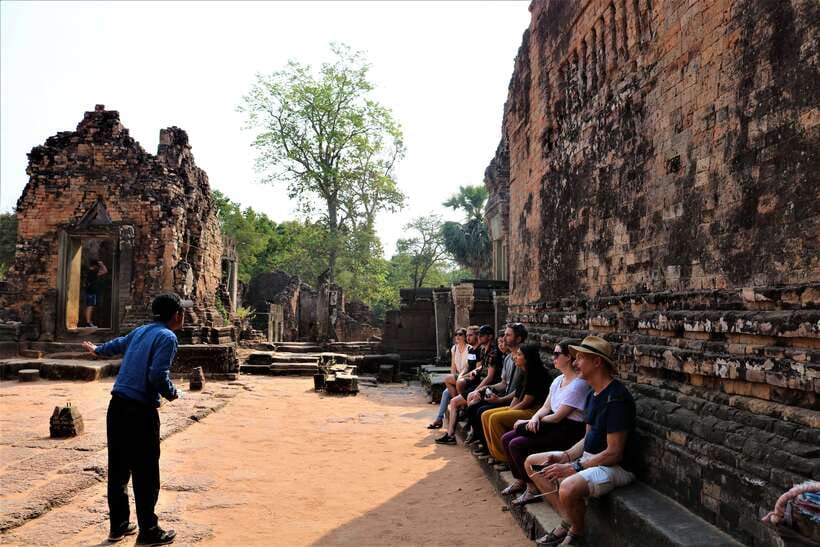
The strongest practical feature is the combination of a local English-speaking guide and a dedicated driver. Names connected with the tour include Pal Saruon, Pireak, Sam, AJ, Sokpee Sumsot, Keal, Ro, and Mao. Assignments can change, but these examples give you an idea of the personal service style to expect.
The guides explain temple design, religious stories, Cambodian culture, and the history of the Khmer people. That broader context matters because Angkor is not just a collection of old buildings. It is a record of royal ambition, religious change, engineering, art, and everyday life.
Drivers handle the long stretches between sites and provide hotel pickup and drop-off in an air-conditioned vehicle. The repeated offering of mineral water and cool wet towels is a detail worth noting. In Cambodia’s heat, a cold drink and a towel after a temple walk can matter more than a polished vehicle.
A group of up to 15 is small enough to feel manageable but not private. You may need to wait for other people at photo stops, and the pace cannot be tailored entirely to you. The upside is a lower price than a private tour and the chance to meet people during a multi-day outing.
What the $69 price really covers
At $69 per person, the tour is an attractive starting price for 2.5 days of transport, guiding, temple visits, and Tonle Sap or Phare Circus. It includes hotel pickup and drop-off, an air-conditioned vehicle, an English-speaking licensed guide, mineral water, the lake entrance and boat cruise or a Category C Phare Circus seat.
The important extra is the Angkor temple pass. You must buy the three-day pass separately for $62 per person. That puts the basic combined cost at $131 before breakfast and any personal spending.
I still consider that fair value if you want all major sites covered with transport and explanations. Hiring separate rides for Banteay Srei, the main Angkor circuit, and Tonle Sap can become awkward, particularly when you add the early sunrise start.
Food is not included, so budget for breakfast and lunch. The sunrise morning specifically ends with breakfast outside Angkor Wat, making it sensible to carry some cash or arrange food with your hotel. The tour provides mineral water, but not meals.
Free cancellation up to 24 hours before departure and reserve-now, pay-later terms give you some planning flexibility. Availability and starting times should be checked for your dates, especially because sunrise pickup and the Tonle Sap or circus substitution affect the schedule.
Who should book this tour
I would choose this experience if you have limited time in Siem Reap and want a broad first visit without arranging several separate day trips. It suits people who want both the famous temples and less polished places such as Preah Khan, along with a look at life around Tonle Sap.
It is also a good fit if you value explanations. Angkor can feel confusing without context, and the guides connected with this program focus on stories, carvings, religion, and Cambodian culture rather than only pointing out photo spots.
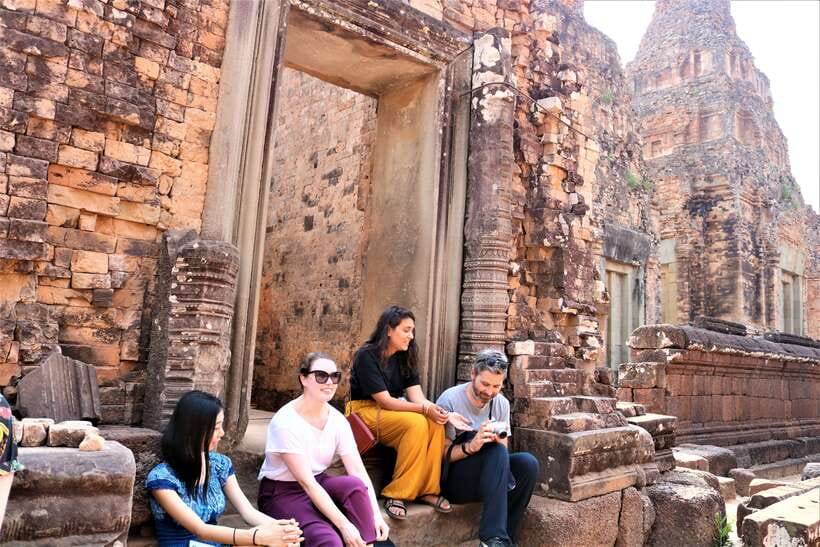
You should think twice if you need a slow pace, private scheduling, or easy access at every site. The tour includes pre-dawn departure, long walks, uneven surfaces, hot weather, and a group schedule. Short skirts are not allowed, so wear respectful clothing that covers your knees and choose sturdy, comfortable shoes.
Should you book it?
Book this tour if you want the main Angkor temples, Banteay Srei, a sunrise start, and Tonle Sap in one organized package. The $69 headline price is good only after you add the $62 temple pass, but the combined cost remains reasonable for the transport, guide, and three-part itinerary.
Before booking, check two things: the season of your visit and your tolerance for early mornings. From March through June, you get Phare Circus instead of the lake, and on Day 2 you will be up well before sunrise. If those details suit you, this is a practical and well-paced introduction to Angkor and the communities around Siem Reap.
FAQ
Is the Angkor temple pass included?
No. The three-day Angkor temple pass costs $62 per person and is not included in the tour price.
What is included in the $69 tour price?
The price includes 2.5 days of touring, a licensed English-speaking guide, hotel pickup and drop-off, an air-conditioned vehicle, mineral water, and either the Tonle Sap entrance fee and boat cruise or a Category C Phare Circus seat.
Is Tonle Sap visited all year?
No. During the dry season, from March 1 through June 30, Tonle Sap is replaced by Cambodia Phare Circus.
What time does the sunrise day begin?
Day 2 starts with a pre-dawn departure from your hotel. The exact pickup time depends on availability and the date of your tour.
How large is the group?
The tour is limited to 15 participants.
Is breakfast included?
No. Breakfast is not included. The sunrise morning ends with breakfast outside Angkor Wat, so you should budget for it.
What should I wear and bring?
Bring comfortable shoes. Short skirts are not allowed, so wear clothing suitable for visits to Cambodia’s temples.
Is the tour suitable for people with mobility impairments?
No. The experience is listed as unsuitable for people with mobility impairments because it involves walking around temple complexes and other active sightseeing conditions.
More Morning in Siem Reap
- Angkor Wat Sunrise & 3 Main Temples with Breakfast – Small Group
5.0 · 2,857 reviews - Siem Reap: Angkor Wat Sunrise and Full-Day Sightseeing Tour
4.9 · 2,828 reviews - Angkor 2-Day Sunset & Sunrise Small-Group Tour
5.0 · 2,567 reviews - Siem Reap: Angkor Wat Sunrise or Sunset Guided Tour
4.9 · 2,123 reviews
More Angkor Temple Itineraries
- Siem Reap: Full-Day Angkor Wat Guided Tour with Sunset
4.9 · 3,803 reviews - Angkor Wat Highlights and Sunrise Guided Tour from Siem Reap
5.0 · 3,213 reviews - Angkor Wat Sunset Small Group Tour with Lunch Included
5.0 · 3,059 reviews - Full-Day Angkor Wat Sunrise Private Tour with Guide from Siem Reap
5.0 · 2,920 reviews
Fresh reviews from around Siem Reap
- Full-Day Tour Preah Vihea & Koh Ker Temple 3.7 · 3 reviews
- Savor the Countryside: Tours with Authentic Cooking Classes” 5.0 · 3 reviews
- Angkor Wat Sunrise TukTuk Tour 5.0 · 3 reviews
- Angkor Grand Circuit Tour & Banteay Srei 5.0 · 3 reviews
- Guided Private Tuk Tuk Tour Angkor Wat and Small Circle and Five Extras 5.0 · 3 reviews
- Siem Reap Temple Tour 2-Day with Sunrise/Sunset 3.7 · 3 reviews
- Bangkok to Angkor Wat 2 Days 1 Night by Flight 4.5 · 3 reviews
- Kompong Pluk Tour 5.0 · 3 reviews
Angkor Wat Sunrise Tours, compared.

Angkor Wat Sunrise or Sunset Tour with Guide from Siem Reap
Read our review →


Angkor Wat Sunrise tour with Small – Group and Guide tours
Read our review →
Angkor Wat Highlights and Sunrise Guided Tour from Siem Reap
Read our review →
Full-Day Angkor Wat Sunrise Private Tour with Guide from Siem Reap
Read our review →
Angkor Wat Sunrise & 3 Main Temples with Breakfast – Small Group
Read our review →
Browse the lists this tour appears in