
Reviewed · ANGKOR TEMPLE TOURS
Angkor Wat Hidden Gems Sunset Symphony In Small Group Shared Tour
Angkor Wat is only part of this full-day circuit. You’ll also see jungle-wrapped Ta Prohm, Bayon’s many stone faces, the elevated views from Baphuon, and sunset from Phnom Bakheng. It is a sensible way to cover the park’s major sights without arranging transport at every turn.
I like the small maximum of 12 people, which should make it easier to hear the guide and ask questions. I also like the practical inclusions: an air-conditioned minivan, hotel pickup and drop-off, cold water, wipes, fuel, parking, and tolls. The main drawback is the long day, especially for anyone who finds temple stairs and hot outdoor walks tiring.
In This Review
- Key points at a glance
- A long day among Angkor’s essential temples
- Ta Prohm and the jungle-wrapped ruins
- Bayon’s smiling stone faces
- Three hours at Angkor Wat
- Baphuon’s climb and open views
- Phnom Bakheng for the final sunset
- What the guide adds to the day
- Minivan comfort and small-group value
- Who should choose this Angkor tour?
- Practical preparation before you book
- Should you book this tour?
- FAQ
- How long does the tour last?
- What time does the tour start?
- Is hotel pickup included?
- How many people can join the group?
- Is the Angkor Park admission fee included?
- Which temples are visited?
- Is food included?
- What clothing is required?
- Can I cancel for a full refund?
Key points at a glance
- Five major Angkor stops: Ta Prohm, Bayon, Angkor Wat, Baphuon, and Phnom Bakheng are packed into one long outing.
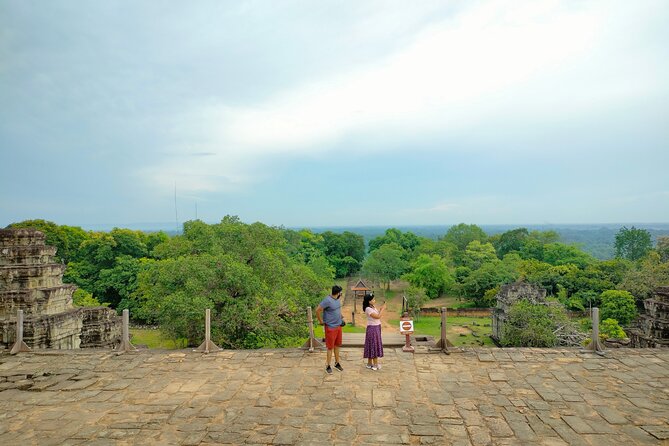
- Sunset from Phnom Bakheng: You finish on a hilltop temple with broad views toward the Angkor complex and Angkor Wat’s towers.
- Small shared group: The vehicle holds no more than 12 people, with a minimum of three people required to book.
- Useful transport included: Hotel pickup and drop-off, an air-conditioned minivan, parking, tolls, gasoline, cold water, and wipes are covered.
- The park pass costs extra: Budget another $37 per person for the Angkor Park admission fee.
- Guides with strong photography skills: The named guides connected with this operator include Theara Kong, Sen Prourng, Narin, Chet, Sam Pho, and Kim.
A long day among Angkor’s essential temples
This tour gives you a broad first look at Angkor in about eight to nine hours. The route mixes famous monuments with different moods: jungle ruins at Ta Prohm, solemn stone faces at Bayon, the scale of Angkor Wat, a climb at Baphuon, and a sunset finish at Phnom Bakheng.
You begin at 8:30 a.m. with hotel pickup in Siem Reap. The exact order can matter at Angkor, but the published route places Ta Prohm first, followed by Bayon, Angkor Wat, Baphuon, and Phnom Bakheng. Since the itinerary lists about seven hours of temple time before transport, you should expect a full day with plenty of walking.
The group is shared rather than private, but the cap of 12 people keeps it smaller than a large coach outing. That matters at temples, where a guide needs to explain carvings and meeting points without shouting across a crowd. It also keeps the price low at $20 per person.
That price is attractive, but it is not the complete cost. The Angkor Park admission fee of $37 per person is not included, and meals and drinks beyond the supplied water are also your responsibility. Once you add the park pass, the outing is no longer a $20 day, but the transport and guiding still make it a useful budget option.
More Angkor temple itineraries:
- Angkor Wat Sunrise or Sunset Tour with Guide from Siem Reap
5.0 · 12,109 reviews - Siem Reap: Angkor Wat: Small-Group Sunrise or Sunset Tour
5.0 · 9,444 reviews - Siem Reap: Angkor Wat 2-Day Tour with Sunrise and Sunset
4.9 · 4,429 reviews
Ta Prohm and the jungle-wrapped ruins
Ta Prohm is the atmospheric opening stop. It is famous for the Tomb Raider connection, but the real appeal is the way trees and stone share the same space. Roots press against walls, doorways frame broken galleries, and the ruin feels less orderly than Angkor Wat.
You have about an hour here. That is enough to see the key sections with a guide, though it leaves little room to wander slowly or wait for a completely empty photograph. You’ll want sturdy footwear and a bit of patience, since the ground around old temple ruins can be uneven.
A guide adds real value at Ta Prohm because it is easy to focus only on the trees. The carvings, layout, and signs of damage help explain why this temple feels different from the more open monuments later in the day. Ask your guide to point out the best photography positions, a skill several of the named guides are noted for.
Bayon’s smiling stone faces
Next comes Bayon, located at the center of Angkor Thom. Its most recognizable feature is the collection of giant carved faces, often described as smiling Buddha faces. The temple contains almost 200 faces, though you won’t see all of them clearly from every angle.
Bayon is not a simple monument to understand at first. Towers, narrow passages, and stacked galleries create a more enclosed visit than Angkor Wat. You’ll get more from the hour here if you stay close enough to hear the explanation of the carvings and the temple’s Buddhist role.
The one-hour stop is efficient, but Bayon rewards careful looking. Take time to compare the faces and examine the lower reliefs if your guide points them out. If photography is important to you, ask for a few minutes to frame the faces after the main explanation rather than rushing straight back to the vehicle.
Three hours at Angkor Wat
Angkor Wat receives the longest visit, about three hours, and that is the right choice. This is the largest and most famous monument on the route, a 12th-century Hindu temple built within the ancient Angkor city.
The scale can be hard to grasp from the entrance. Long galleries, courtyards, towers, and carved walls unfold in stages. You’ll need time simply to walk between the major sections, and the three-hour block lets the guide cover the main design and religious purpose without turning the visit into a sprint.
I like that Angkor Wat is not treated as a quick photo stop. A short visit can leave you with an entrance picture and little sense of the building. Three hours gives you space for the major views, carved details, and the central areas, subject to access and site conditions.
Expect heat, sun, and a lot of standing. The supplied cold water helps, but bring your own meal money because breakfast, lunch, dinner, soft drinks, and alcoholic drinks are not included. There is no food plan built into the tour, so you should ask the guide about the timing if you need a proper meal during the day.
Dress carefully from the start. Shoulders and knees must be covered for both men and women at places of worship and selected museums. No shorts or sleeveless tops are allowed, and the stated dress code uses the word formal. You may be refused entry if your clothing does not meet the requirements, so this is not the day for casual beachwear.
Other Siem Reap experiences to weigh up
- Sunset tour of Kampong Phluk stilts home village on the Tonle Sap
5.0 · 4,865 reviews - Siem Reap: Full-Day Angkor Wat Guided Tour with Sunset
4.9 · 3,803 reviews - Angkor Wat Sunset Small Group Tour with Lunch Included
5.0 · 3,059 reviews - Angkor 2-Day Sunset & Sunrise Small-Group Tour
5.0 · 2,567 reviews
Baphuon’s climb and open views
Baphuon changes the pace. This 11th-century Hindu temple is known for its raised approach and the view gained after climbing toward the top. The description promises a good breeze and scenery, which can be welcome after the enclosed passages at Bayon and the broad walking areas of Angkor Wat.
You have about an hour here. The climb means you need a moderate level of physical fitness, and you should take it slowly if your legs are already tired. This is one of the places where the tour’s schedule may feel demanding, since Baphuon comes after several hours on foot.
The reward is a higher viewpoint and a different way to read the temple plan. From above, the approach and surrounding grounds make more sense than they do at ground level. The stop is also a useful break from the most famous Angkor scenes, with fewer expectations attached to every photograph.
Phnom Bakheng for the final sunset
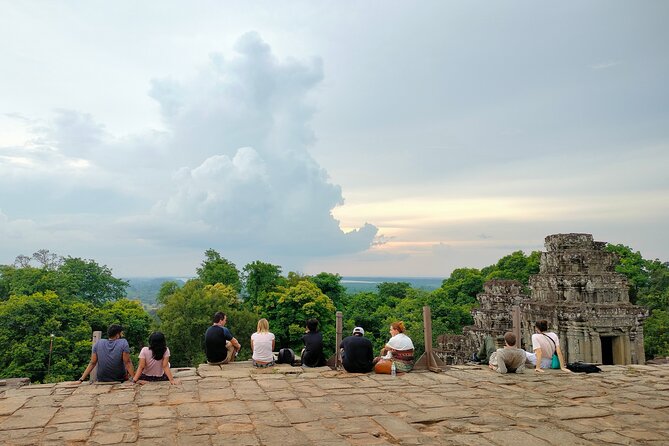
The day ends at Phnom Bakheng, a late-9th-century mountain-style temple used as a sunset viewpoint. From the summit, you can look across the Angkor complex and see Angkor Wat’s towers in the distance.
Sunset is the tour’s most time-sensitive part. The listed start is 8:30 a.m., while the total duration is eight to nine hours, so the actual arrival time and sunset timing may depend on the day’s pace, traffic, temple access, and local conditions. Confirm the final schedule with the operator before booking if sunset is your main reason for choosing this outing.
The summit is reached by an uphill walk and temple steps. It is not a passive viewpoint where you simply step out of the van. Wear shoes with a good grip, carry water, and keep your expectations flexible. Clouds or poor weather can affect the view, and the experience requires good weather to operate.
The position is appealing because you finish by looking back over the area you have just explored. After seeing Angkor Wat at close range, spotting its towers from Phnom Bakheng gives you a sense of how the temples relate to one another across the park.
What the guide adds to the day
The guide is central to the value of this experience. Without one, you can still see the monuments, but the sequence of faces, reliefs, towers, gates, and religious symbols can blur together after several hours.
The named guides associated with this service include Theara Kong, Sen Prourng, Narin, Chet, Sam Pho, and Kim. Theara Kong is described as an English-speaking guide with strong temple and Cambodian history knowledge. Sen Prourng is associated with detailed explanations during an early morning temple outing. Narin and Chet are noted for taking photographs, while Sam Pho is described as having strong knowledge of Angkor Wat and Cambodia. Kim is noted for explaining Cambodian history in German.
Guide assignment is not guaranteed from the information provided, so you should request a preferred guide at booking rather than assume you will receive a particular person. If you want photos, say so early. Several guides connected with the service are praised for finding good picture spots, but your guide needs to know that photography is a priority.
Minivan comfort and small-group value
An air-conditioned minivan is a practical advantage in Siem Reap’s heat. You are moving between large temple sites, and a cool vehicle gives your feet and attention a chance to recover. Hotel pickup and drop-off also remove the need to arrange separate transport to the park.
The vehicle carries up to 12 people. That is small enough for a more personal feel, but it is still a shared outing, not a private tour. You may have to follow the group’s pace and wait for others at meeting points.
Fuel, toll roads, parking, and gasoline are included. These details may sound ordinary, but they prevent small transport charges from appearing during the day. Cold water and wipes are also supplied, which are useful after dusty paths, humid walks, and long periods outside.
The minimum booking requirement is three people. If the minimum is not met, the operator may offer another date or experience, or a full refund. Confirmation is received at booking, and pickup is offered from hotels.
Who should choose this Angkor tour?
I would choose this tour if you want the main Angkor sights in one day and prefer not to arrange a driver, park transfers, and a guide separately. It suits first-time visitors who want a clear route and enough time at Angkor Wat, rather than a short highlights trip.
It also fits solo visitors who want a shared setting and couples who like the value of a group price. The small vehicle and guide-led format give you more support than simply hiring transport, while the $20 fee keeps the guiding and logistics affordable before the park admission fee.
You should think twice if you dislike long days or have difficulty with stairs. Ta Prohm, Bayon, Angkor Wat, Baphuon, and Phnom Bakheng add up to substantial walking, and the final hilltop stop may be tiring after several temple visits.
It is less suited to anyone who wants a slow, private photographic tour. With five major stops and a group schedule, you will have less control over how long you spend at one doorway, gallery, or viewpoint. A private arrangement would be better for that purpose, but it would not offer the same $20 price.
Practical preparation before you book
Buy or budget for the Angkor Park pass separately. The stated admission cost is $37 per person, and it is not covered by the tour price.
Wear clothing that covers your knees and shoulders. This rule applies to men and women, and unsuitable clothing can mean refused entry at worship sites or selected museums.
Bring money for meals and drinks. No breakfast, lunch, dinner, soft drinks, or alcoholic drinks are included, although cold water is supplied.
Plan for moderate physical effort. You’ll walk through several temple compounds, climb at Baphuon, and make an uphill approach to Phnom Bakheng. Comfortable shoes will make the day easier.
Keep your sunset expectations flexible. The tour depends on good weather, and poor weather can lead to a different date or a full refund. You can cancel for a full refund if you do so at least 24 hours before the start time, but cancellations or changes made within 24 hours are not refunded or accepted.
Should you book this tour?
Book it if you want a low-cost, full-day introduction to Angkor with the major temples, air-conditioned transport, a guide, and a sunset viewpoint. The strongest reasons are the five-stop route, the small group cap, and the useful transport inclusions.
Before paying, make sure you are comfortable with the extra $37 park fee, the lack of included meals, the formal clothing rules, and the physical demands of Baphuon and Phnom Bakheng. If those points suit you, this is a practical way to see Angkor’s essential sights without paying for a private vehicle.
FAQ
How long does the tour last?
The tour lasts approximately 8 to 9 hours.
What time does the tour start?
The stated start time is 8:30 a.m.
Is hotel pickup included?
Yes. Hotel pickup and drop-off are included.
How many people can join the group?
The tour has a maximum of 12 people.
Is the Angkor Park admission fee included?
No. The Angkor Park admission fee is listed as $37 per person and must be paid separately.
Which temples are visited?
The route includes Ta Prohm, Bayon, Angkor Wat, Baphuon, and Phnom Bakheng.
Is food included?
No. Breakfast, lunch, dinner, soft drinks, and alcoholic drinks are not included. Cold water and wipes are provided.
What clothing is required?
Knees and shoulders must be covered for both men and women. Shorts and sleeveless tops are not allowed at places of worship and selected museums.
Can I cancel for a full refund?
Yes, if you cancel at least 24 hours before the experience start time. Cancellations made less than 24 hours before the start time are not refunded.
Fresh reviews from around Siem Reap
- Full-Day Tour Preah Vihea & Koh Ker Temple 3.7 · 3 reviews
- Savor the Countryside: Tours with Authentic Cooking Classes” 5.0 · 3 reviews
- Guided Private Tuk Tuk Tour Angkor Wat and Small Circle and Five Extras 5.0 · 3 reviews
- Angkor Wat Sunrise TukTuk Tour 5.0 · 3 reviews
- Angkor Grand Circuit Tour & Banteay Srei 5.0 · 3 reviews
- Siem Reap Temple Tour 2-Day with Sunrise/Sunset 3.7 · 3 reviews
- Bangkok to Angkor Wat 2 Days 1 Night by Flight 4.5 · 3 reviews
- Kompong Pluk Tour 5.0 · 3 reviews
Angkor Temple Tours, compared.

Angkor Wat Sunrise or Sunset Tour with Guide from Siem Reap
Read our review →



Angkor Wat Sunrise tour with Small – Group and Guide tours
Read our review →
Angkor Wat Highlights and Sunrise Guided Tour from Siem Reap
Read our review →

Full-Day Angkor Wat Sunrise Private Tour with Guide from Siem Reap
Read our review →Browse the lists this tour appears in