
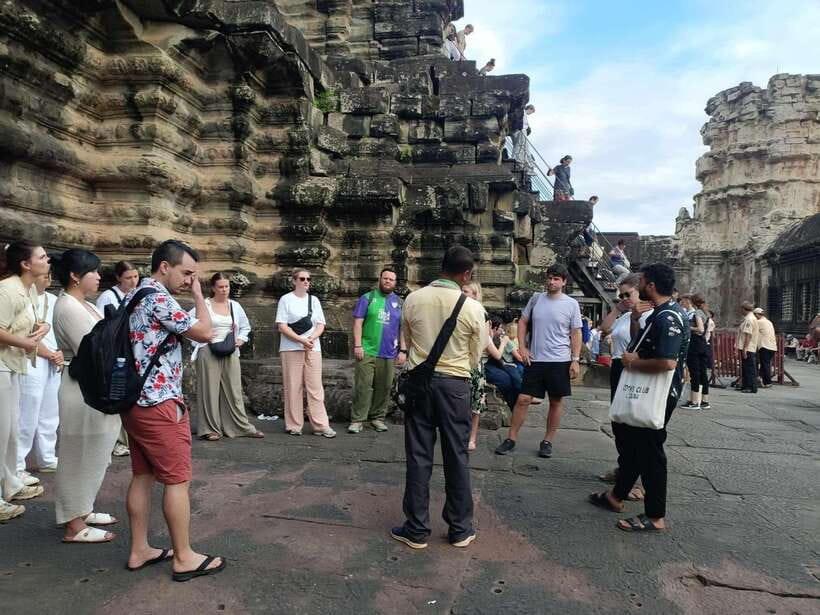
Reviewed · ANGKOR TEMPLE TOURS
Small-Group Full Day Angkor wat Guide tour with Sun set
Angkor Wat is only the opening act here. This full-day route carries you from the great moat and carved galleries to Bayon’s calm stone faces, Ta Prohm’s tree roots, Ta Keo’s unfinished pyramid, and a sunset stop at Phnom Bakheng.
I like two things right away: you get hotel pickup, air-conditioned transport, water, and a guide for just $14, and the route gives you a useful first look at the main Angkor temples. Guides such as Vone, Kosal, Nick, and Mr John are often praised for clear history, humor, patience, and help with photos.
The tradeoff is simple: this is a long, busy day with plenty of walking and limited time at each major site. Add the required $37 one-day Angkor Pass and your real minimum cost is $51 per person, before lunch.
In This Review
- Key points to know before booking
- Why this route works for a first day at Angkor
- Angkor Wat: two hours with the Khmer masterpiece
- Ta Prohm: roots, ruins, and a cooler-feeling path
- Lunch near Banteay Kdei, with your own budget
- Ta Keo: a bold, unfinished pyramid
- Angkor Thom and Bayon: stone faces behind the southern gate
- Phnom Bakheng: a sunset finish with a compromise
- Transport, group size, and the rhythm of the day
- What the $14 price really includes
- What to pack and what to wear
- The guide can shape the whole experience
- Who should book this Angkor day tour?
- Should you book it?
- FAQ
- How long does the Angkor Wat tour last?
- What temples are included?
- Is hotel pickup included?
- Is the Angkor Pass included in the $14 price?
- Is lunch included?
- What language does the guide speak?
- What should I wear at the temples?
- Can I cancel or pay later?
Key points to know before booking
- Six major Angkor sights in one day: Angkor Wat, Angkor Thom, Bayon, Ta Keo, Ta Prohm, and Phnom Bakheng are all part of the route.
- Guiding makes a real difference: Your English-speaking guide explains Hindu and Buddhist symbols, bas-reliefs, dates, and temple design.
- Ta Prohm supplies the most atmospheric walk: Jungle-lined paths lead to stone galleries tangled with large tree roots.
- The $14 price is only the tour cost: Budget another $37 for the one-day temple pass and money for lunch.
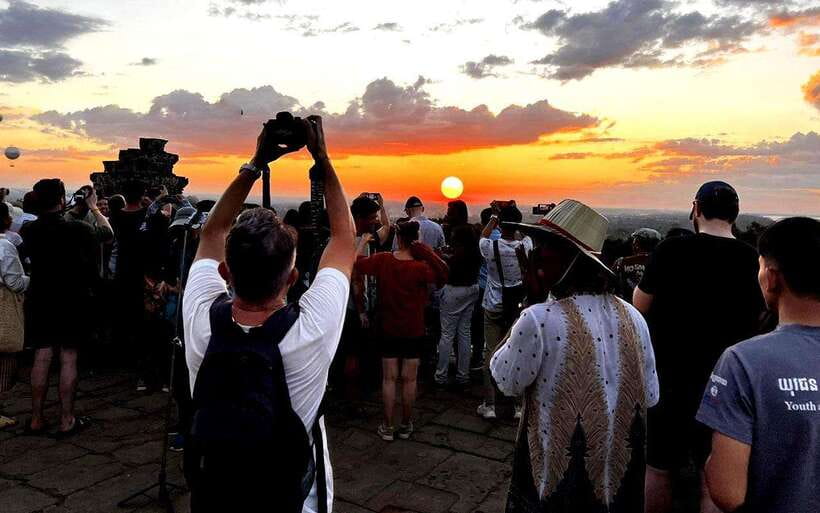
- The day ends above the temple zone: Phnom Bakheng offers a sunset viewpoint and a broad view over Angkor’s site.
- Expect a group pace: Groups can be around 15 people, though some departures are much smaller, including groups of six.
Why this route works for a first day at Angkor
Angkor is too large and too layered to understand from a quick photo stop. A guide gives you a framework: which temples were Hindu or Buddhist, why certain towers face particular directions, and how carvings connect religion with royal power.
That help matters most at Angkor Wat and Bayon, where it is easy to see stone everywhere but miss the story. Guides including Sam Vone, Rith, Sayon, Coco, and Heang have been praised for explaining religious details, answering questions, keeping the group moving, and finding better photo positions.
The route also gives you variety. Angkor Wat feels ordered and monumental. Ta Prohm feels partly reclaimed by the forest. Bayon is puzzling and inward-looking. Ta Keo is stark and massive, while Phnom Bakheng gives the day a quieter finish.
You should expect a full day of heat, steps, uneven ground, and repeated walks between temple areas and the vehicle. Some people prefer this efficient sampler to arranging separate rides and guides. If you already know Angkor well, or want long hours for photography at one temple, the pace may feel tight.
More Angkor temple itineraries:
- Angkor Wat Sunrise or Sunset Tour with Guide from Siem Reap
5.0 · 12,109 reviews - Siem Reap: Angkor Wat: Small-Group Sunrise or Sunset Tour
5.0 · 9,444 reviews - Siem Reap: Angkor Wat 2-Day Tour with Sunrise and Sunset
4.9 · 4,429 reviews
Angkor Wat: two hours with the Khmer masterpiece
After pickup in Krong Siem Reap, the drive to the temple area takes about 45 minutes. The first major stop is Angkor Wat, with roughly 2 hours and 10 minutes for a guided visit.
The approach is part of the experience. You cross the wide moat and pass through the massive outer wall before reaching the long galleries and central towers. This gradual arrival helps you grasp the scale of the complex rather than seeing it as a single isolated building.
Inside, your guide can point out the sandstone bas-reliefs and explain scenes from epic mythology and royal battles. Look closely at the walls instead of rushing straight toward the towers. The carvings are not random decoration. They present gods, armies, rulers, and cosmic order in a language that made sense to the Khmer court.
The temple carries both Hindu and Buddhist associations, so the explanations about changing religious practice are useful. A guide can also answer the small questions that make the visit more personal: what a figure holds, why a doorway is shaped a certain way, or how a particular gallery fits the larger plan.
Two hours sounds generous, but it passes quickly. You will have time to see the main galleries and central areas, yet not enough to linger over every carving. Wear clothing that covers your shoulders and knees, and bring a hat, sunscreen, sunglasses, and water. The supplied water and wet towel are practical comforts once the heat builds.
Ta Prohm: roots, ruins, and a cooler-feeling path
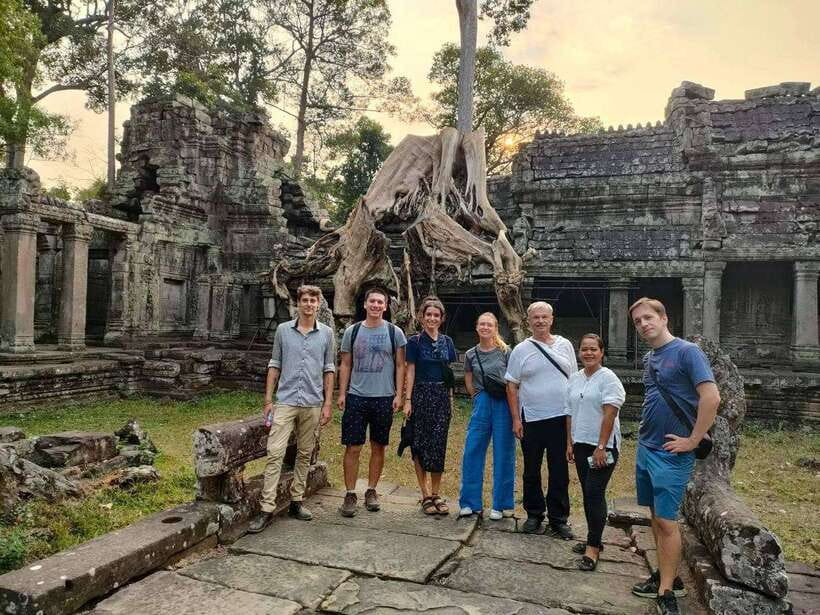
Ta Prohm follows Angkor Wat, with about 1.5 hours for the visit. The route includes a jungle-lined walk before you reach the temple remains, and that change of mood is one of the strongest parts of the day.
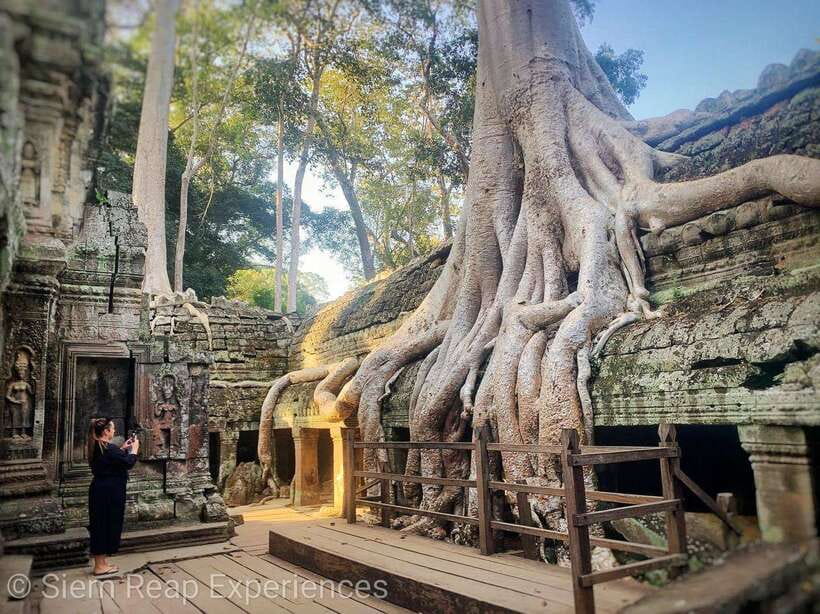
Large roots and branches twist over towers and walls. The trees do not simply decorate the ruins. They create the feeling that the forest and the temple are locked in a slow contest, with neither side fully winning.
Your guide helps you separate fact from movie-style fantasy. Ta Prohm is famous for its tree-covered corridors, but it also has carved doorways, galleries, courtyards, and religious meaning worth noticing. Take time to look beyond the best-known root-covered walls.
This stop can be crowded and visually demanding. Paths may slow down when people pause for photographs, and the group schedule means you may need to move on before you have seen every corner. If photography is your main goal, tell the guide early. Guides such as Vone and Kosal are praised for finding photo spots and helping with pictures, but the whole group still has to keep moving.
Lunch near Banteay Kdei, with your own budget
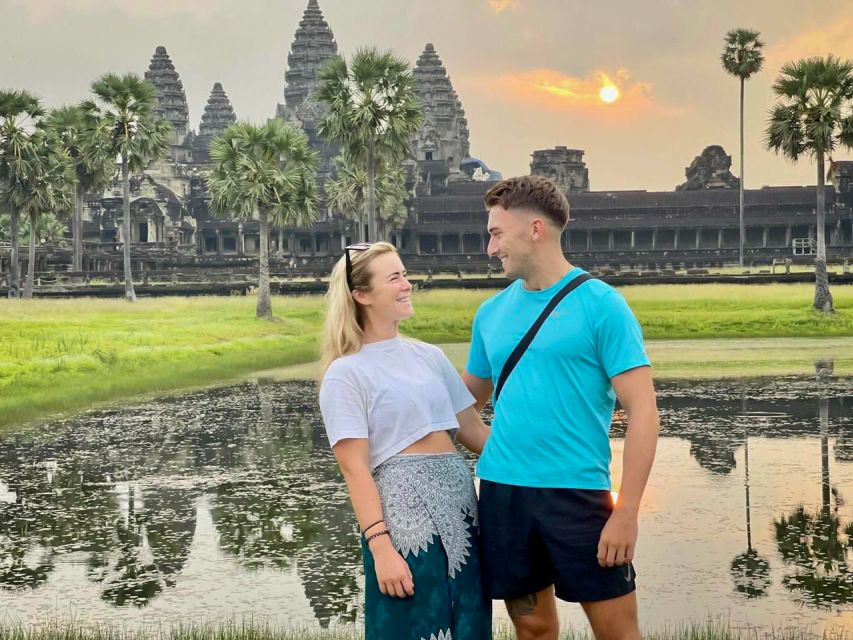
The schedule allows about an hour for lunch after Ta Prohm, at the Banteay Kdei stop. Lunch is not included, so bring cash or plan to pay separately.
This break matters more than it may seem. By this point, you have already walked through Angkor Wat and Ta Prohm, and the afternoon heat can be hard on your legs. Use the hour to eat, refill your energy, and rest rather than treating it as another rushed temple visit.
Banteay Kdei appears in the schedule as the lunch stop, while the six main temple visits are described as Angkor Wat, Angkor Thom, Bayon, Ta Keo, Ta Prohm, and Phnom Bakheng. Confirm the exact lunch arrangement when you book if seeing Banteay Kdei itself matters to you.
Other Siem Reap experiences to weigh up
- Siem Reap: Full-Day Angkor Wat Guided Tour with Sunset
4.9 · 3,803 reviews - Full-Day Angkor Wat Sunrise Private Tour with Guide from Siem Reap
5.0 · 2,920 reviews - Siem Reap: Angkor Wat Sunrise and Full-Day Sightseeing Tour
4.9 · 2,828 reviews - Full-Day Guided Sunset Tour of Angkor Wat
5.0 · 1,507 reviews
Ta Keo: a bold, unfinished pyramid
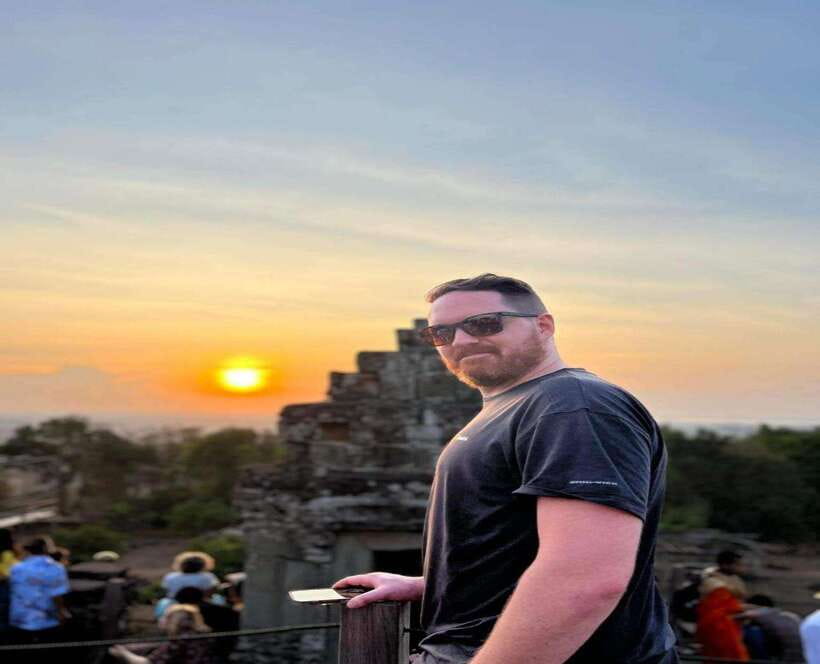
After lunch, the vehicle ride to Ta Keo takes about 30 minutes. You have around an hour here for a guided visit and walk.
Ta Keo is different from Ta Prohm because it is not mainly about forest-covered ruins. Its large sandstone pyramid has a hard, stripped-down appearance, and the unfinished work gives you a glimpse of construction rather than only the final religious setting.
The stop is useful for understanding Khmer temple planning. Massive levels, steep forms, and a strong central axis make the building feel more like a mountain than a conventional hall. The tour description also refers to paths and routes connecting Ta Keo with other temples, which adds a little exploratory flavor to the walk.
The practical issue is footing and effort. This is not a flat museum visit. Comfortable walking shoes are important, and anyone who dislikes uneven temple paths or steep sections should take the pace seriously. The air-conditioned vehicle between stops gives you a needed reset.
Angkor Thom and Bayon: stone faces behind the southern gate
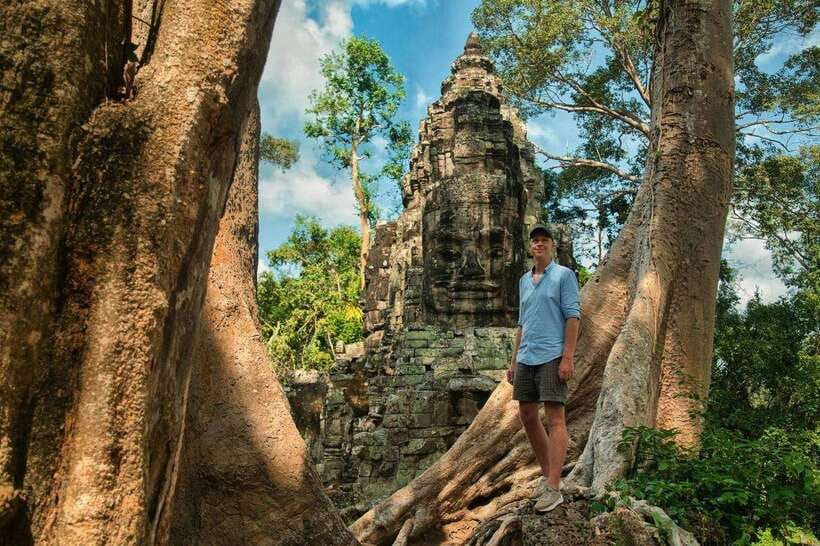
The next drive takes about 25 minutes to the Angkor Thom area, followed by around 1.5 hours at Bayon.
At Angkor Thom’s southern gate, you first meet the famous causeway lined with stone figures. Gods and demons pull at a serpent in a scene tied to Hindu creation mythology. Even before entering the city, the gate presents a carefully staged message about power, order, and the sacred center ahead.
The avenue and gate are easy to photograph, but do not spend all your time there. Inside Angkor Thom, Bayon is the main event. Its towers carry serene stone faces that look outward in several directions, creating an unusual sense that the temple is watching you as much as you are studying it.
Bayon rewards a guide because the plan can feel confusing. Towers, galleries, reliefs, and narrow passages overlap in a way that is hard to read on your own. Your guide can point out scenes of daily life alongside royal and religious images, helping you see more than the famous faces.
You may climb to the upper terrace, depending on current access and conditions. The description of the stop includes the upper level, but temple access rules can change, so follow the guide and on-site instructions. The stone surfaces can be hot, and shade is not guaranteed.
Phnom Bakheng: a sunset finish with a compromise
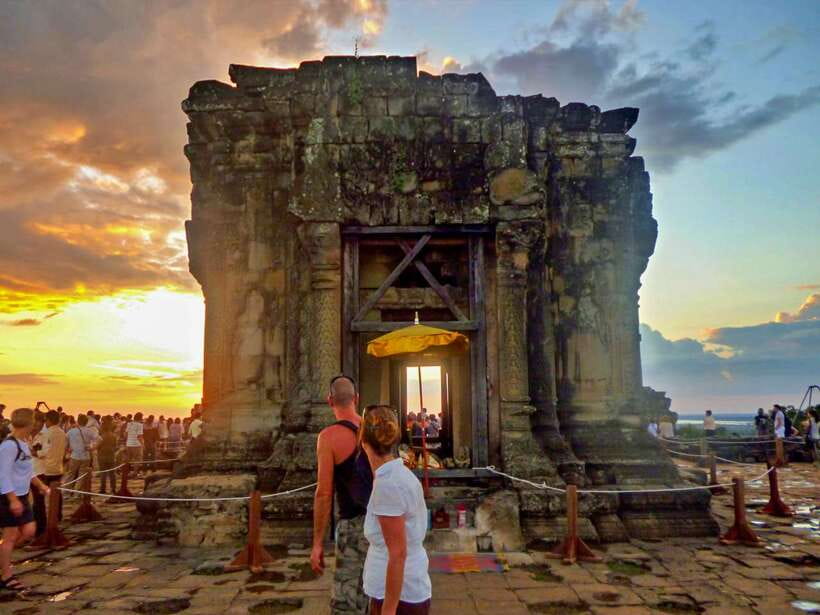
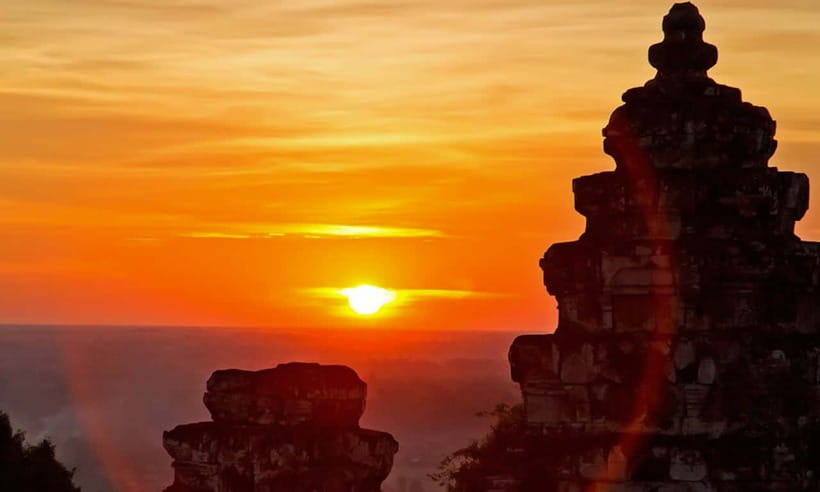
The final temple-area stop is Phnom Bakheng, reached after another drive of about 30 minutes. The visit lasts roughly an hour and ends with a sunset view from the hill.
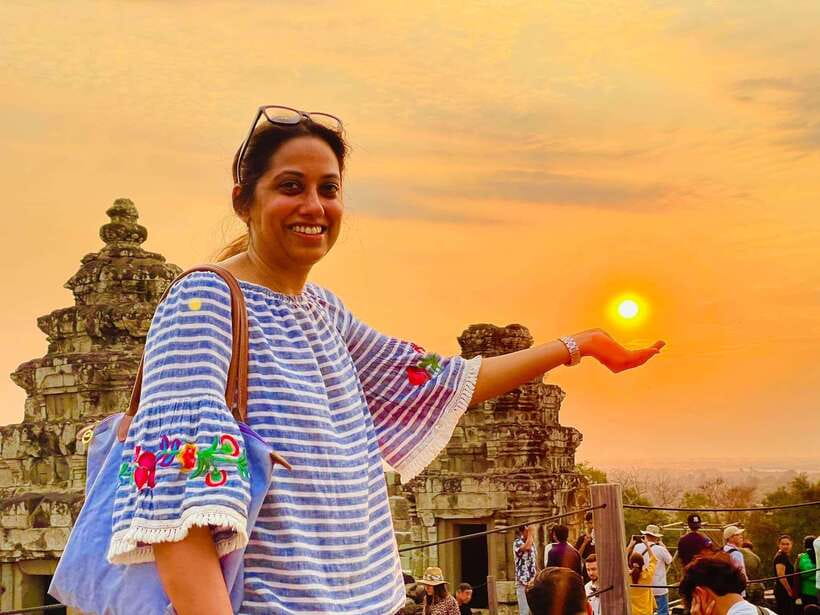
The climb and viewpoint give you a different perspective from the enclosed temples. You can look over the temple zone and watch the light change across the site. After a day spent studying walls and carvings at close range, this wider view helps you understand how much ground the Angkor complex covers.
Sunset is never fully guaranteed. Clouds, haze, crowd levels, and access rules can affect the view, so treat the stop as a scenic ending rather than a promise of perfect colors. You may also find the hill tiring after several hours on your feet.
The timing is one of the smart features of the route. Instead of finishing at the first temple and returning to town, you get one last viewpoint before the drop-off. Guides are also useful here because they can help you judge where to stand and when to begin heading back.
Transport, group size, and the rhythm of the day
Pickup and drop-off are included from your accommodation or listed pickup point in Krong Siem Reap. Be ready about 30 minutes before the scheduled start, since the vehicle may need to collect other people before leaving the city.
Transport is by air-conditioned minivan or coach. Several guides and drivers have been praised for keeping the day organized, supplying water, and making the rides comfortable. In very hot weather, the vehicle becomes more than a convenience. It is where you cool down between long outdoor walks.
Group size varies. One group had about 15 people, while another had only six. A larger group can mean a lower price and a social atmosphere, but you may stand farther from the guide during explanations. A private-group option is available if you want more control over the pace and photo stops.
The day runs for 8 to 10 hours, including drives and temple visits. Expect the actual schedule to shift with traffic, heat, walking speed, and sunset timing. The better guides, including Vone, Nick, Mr John, and Kosal, are noted for balancing explanations with free time, but this remains a packed introduction rather than a slow archaeological study.
What the $14 price really includes
At $14 per person, the tour is unusually inexpensive for a full day of transport, an English-speaking guide, hotel pickup and drop-off, water, a wet towel, and six main temple stops.
The required one-day Angkor Pass costs an additional $37, payable on the day. That brings the basic total to $51 per person before lunch. It is important to calculate the full amount this way, since the low advertised tour price does not cover temple admission.
Even at the higher total, the value is strong if you want to see the major sites without arranging a driver, vehicle, route, and guide separately. You are paying for structure and interpretation, not simply a ride to Angkor Wat.
The price is less compelling if you already have transport or only want to visit one temple slowly. It also does not include food, so budget for lunch and any other personal spending.
What to pack and what to wear
Pack light, but bring the basics:
- Comfortable walking shoes
- Sunscreen and insect repellent
- Sunglasses and a sun hat
- Camera
- Water, even though more is provided
- Clothing covering your shoulders and knees
Alcohol and drugs are not allowed. Non-folding wheelchairs are not suitable for this activity, and the tour is not suitable for babies under one year.
The clothing rule is not a minor detail. Angkor is an active religious site, and bare shoulders or knees can prevent access to some areas. Choose loose, respectful clothing that also works in strong heat.
The guide can shape the whole experience
The biggest variable is the individual guide. The strongest guides on this route are described as funny, patient, well organized, and able to explain religious ideas without making the day feel like a lecture.
Vone is repeatedly singled out for humor, temple knowledge, photography help, and keeping the group on time. Kosal is praised for clear explanations and a pleasant manner. Nick is noted for adjusting the route to quieter moments, while Mr John is described as patient with questions.
Other named guides include Rith, Sayon, Coco, Sary, Heang, Tom, Sam Vone, and Sok Vuthy. The exact person depends on your departure, so you cannot book the tour expecting one particular guide unless the operator confirms it.
English ability can vary by guide. One person found it occasionally difficult to understand Sam Vone but also noted that he repeated explanations patiently. If you miss a detail, ask again. That is exactly what the guide is there for.
Who should book this Angkor day tour?
I would choose this tour for a first day in Siem Reap if you want the major temples explained in a logical order and prefer not to negotiate transport at every stop.
It suits you best if you:
- Have one full day for Angkor
- Want Angkor Wat plus several major temples
- Prefer guided context to wandering alone
- Value air-conditioning between walks
- Want hotel pickup and drop-off
- Like a sunset viewpoint at the end
- Are comfortable walking for most of the day
I would look at the private option if you want longer photo stops, need a slower pace, or dislike following a group schedule. I would also consider buying a three-day Angkor Pass if you have extra time. Use this tour as your first orientation day, then return independently to the temples you liked most and visit additional sites on the other days.
Should you book it?
Book this tour if you want a low-cost, well-organized introduction to Angkor’s headline temples, with a guide who can explain the carvings, religion, and architecture as you go.
Skip it if you want a quiet day, extensive photography time, or a single-temple visit. The day is long and can feel rushed in the heat, but for $14 plus the $37 pass, it gives you an efficient route, comfortable transfers, practical support, and a strong first sense of why Angkor is worth more than a quick look.
FAQ
How long does the Angkor Wat tour last?
The activity lasts approximately 8 to 10 hours, including transportation between Krong Siem Reap and the temple sites.
What temples are included?
The main stops are Angkor Wat, Angkor Thom, Bayon, Ta Keo, Ta Prohm, and Phnom Bakheng. Banteay Kdei is listed as the lunch stop.
Is hotel pickup included?
Yes. Pickup and drop-off are included from your accommodation or the listed pickup point in Krong Siem Reap. You should be ready about 30 minutes before the scheduled start.
Is the Angkor Pass included in the $14 price?
No. The one-day Angkor Pass costs an additional $37 and is payable on the day of the activity.
Is lunch included?
No. Lunch is at your own expense, with a one-hour break scheduled after Ta Prohm near Banteay Kdei.
What language does the guide speak?
The live guide speaks English. Guides named for this experience include Vone, Kosal, Nick, Mr John, Rith, Sayon, Coco, Sary, Heang, Tom, Sam Vone, and Sok Vuthy.
What should I wear at the temples?
Your clothing must cover your shoulders and knees. Comfortable walking shoes are recommended.
Can I cancel or pay later?
You can cancel up to 24 hours in advance for a full refund. Reserve now and pay later is also available, so you do not have to pay at the time of booking.
Fresh reviews from around Siem Reap
- Full-Day Tour Preah Vihea & Koh Ker Temple 3.7 · 3 reviews
- Savor the Countryside: Tours with Authentic Cooking Classes” 5.0 · 3 reviews
- Angkor Wat Sunrise TukTuk Tour 5.0 · 3 reviews
- Angkor Grand Circuit Tour & Banteay Srei 5.0 · 3 reviews
- Guided Private Tuk Tuk Tour Angkor Wat and Small Circle and Five Extras 5.0 · 3 reviews
- Bangkok to Angkor Wat 2 Days 1 Night by Flight 4.5 · 3 reviews
- Siem Reap Temple Tour 2-Day with Sunrise/Sunset 3.7 · 3 reviews
- Kompong Pluk Tour 5.0 · 3 reviews
Angkor Temple Tours, compared.

Angkor Wat Sunrise or Sunset Tour with Guide from Siem Reap
Read our review →



Angkor Wat Sunrise tour with Small – Group and Guide tours
Read our review →
Angkor Wat Highlights and Sunrise Guided Tour from Siem Reap
Read our review →
