
Reviewed · ANGKOR TEMPLE TOURS
Siem Reap: Angkor Wat Tour with Italian-Speaking Guide
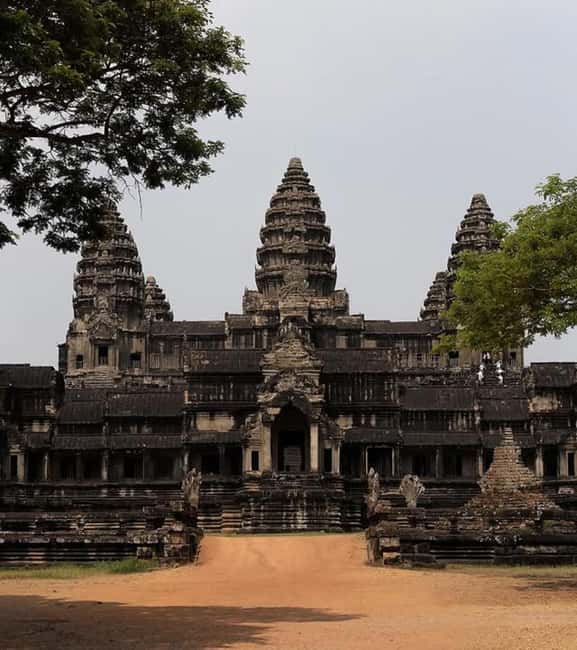
Angkor is far more than one photogenic temple. This private tour links the smiling towers of Bayon, the tree-covered ruins of Ta Prohm, and the vast galleries of Angkor Wat with an Italian-speaking guide who can explain what you are seeing without making you work through a language barrier. Guides such as Matteo, Caro, Chhoure, and Alex have been praised for clear explanations, humor, photos, and adapting the pace to families.
I like two things right away: the private format, which lets you ask questions and adjust the pace, and the careful timing around busy temple areas. Your guide may use less common entrances or routes to find quieter views. The cold water and chilled towels after temple walks are also a small but welcome touch in Cambodia’s heat.
The main consideration is price. At $140 per group of up to two people, the tour is not the cheapest way to see Angkor, especially once you add the temple pass and lunch. It makes better value for couples or small families who want an Italian-speaking guide, hotel transfers, and private attention rather than a large shared group.
In This Review
- Key points to know before you book
- Why an Italian-speaking guide changes the Angkor experience
- Starting at 8:30 AM in Siem Reap
- The one-day route: Angkor’s greatest hits
- South Gate and Victory Gate
- Bayon and the terraces of Angkor Thom
- Ta Prohm and the trees in the ruins
- Lunch near Srah Srang
- Angkor Wat in the afternoon
- The two-day route: more time, less temple fatigue
- Preah Khan and Neak Pean
- Ta Som and East Mebon
- Pre Rup and Banteay Srei
- Price, transport, and what the package really covers
- Clothing, weather, and walking advice
- Should you book this Angkor tour?
- FAQ
- Is the Angkor entrance ticket included?
- How many people can join the private tour?
- What language does the guide speak?
- What transport is used?
- Is lunch included?
- What are the main differences between the one-day and two-day options?
- What should I wear to the temples?
Key points to know before you book
- Two ways to see Angkor: Choose one day for the main temples, or two days for the Grand Circuit and Banteay Srei.
- Italian-speaking guidance: Guides including Matteo, Caro, Chhoure, and Alex explain Khmer art, history, and culture in Italian.
- Private transport: One or two people ride by tuk-tuk on the first day, with a car used on Day 2 of the two-day option. Larger groups use an air-conditioned van or bus.
- Quieter temple timing: The route may be adjusted to use rear entrances or less common paths when practical.
- Useful comfort details: Hotel pickup, cold water, and chilled towels are included.
- Extra costs matter: The Angkor pass costs $37 per person for one day or $62 for two to three days, and lunch is not included.
Why an Italian-speaking guide changes the Angkor experience
Angkor is easy to admire and surprisingly easy to misunderstand. A carved figure, a row of dancers, or a tower with four faces can look beautiful without telling you why it is there. A good guide supplies the missing links between architecture, religion, royal power, and everyday Khmer life.
That help matters even more at a site as large as Angkor Archaeological Park. You are not simply walking into one monument, then moving on. You are crossing an old royal center with temples, terraces, reservoirs, gates, galleries, and long stone approaches spread over a wide area. With a private guide, you can stop to ask why a carving matters or spend less time at a place that does not hold your interest.
The Italian ability of the guide can vary slightly by person. Caro has been described as speaking good Italian, though answers to questions were sometimes brief. Other guides, including Matteo, Chhoure, Alex, and Karo, received especially warm praise for their language skills and explanations. If detailed Italian interpretation is your top priority, it is sensible to confirm the guide arrangement when booking.
You also get a local point of view. One particularly personal experience included an invitation to the guide Chhoure’s family home in the Cambodian countryside. That is not listed as a standard part of the tour, so do not book expecting it, but it shows how a private tour can sometimes become more personal than a standard temple circuit.
More Angkor temple itineraries:
- Angkor Wat Sunrise or Sunset Tour with Guide from Siem Reap
5.0 · 12,109 reviews - Siem Reap: Angkor Wat: Small-Group Sunrise or Sunset Tour
5.0 · 9,444 reviews - Siem Reap: Angkor Wat 2-Day Tour with Sunrise and Sunset
4.9 · 4,429 reviews
Starting at 8:30 AM in Siem Reap
Your guide meets you in your hotel lobby at 8:30 AM for the regular one-day start. You then go together to the Angkor ticket booth, unless you have already purchased your pass online.
The temple pass is separate from the tour fee. Adults pay $37 per person for one day, or $62 per person for two or three days. Children under 12 do not need a ticket if they show a passport as proof of age, and they can join the tour free of charge.
This ticket stop is practical, but it affects your morning. Buying online in advance can save time, especially if you are eager to reach the first temple. The activity advertises a skip-the-ticket-line arrangement, but you still need to have a valid pass before entering the park.
For one or two people, transport is by tuk-tuk on the one-day tour. This is part of the Angkor experience, with open sides, fresh air, and a closer feel to the road. It also means more exposure to heat, dust, and rain than you would get in a car.
On the two-day plan, one or two people use a tuk-tuk on Day 1 and a private car on Day 2. Groups of three or more use an air-conditioned van or bus. After each temple, the driver provides cold water and a chilled towel, a detail that becomes genuinely useful after walking over hot stone.
The one-day route: Angkor’s greatest hits
The one-day plan is designed for the main sights. The schedule can last about eight hours, with the regular version beginning at 8:30 AM and returning to Siem Reap around late afternoon. The listed route also includes several shorter stops around the Angkor Thom area.
South Gate and Victory Gate
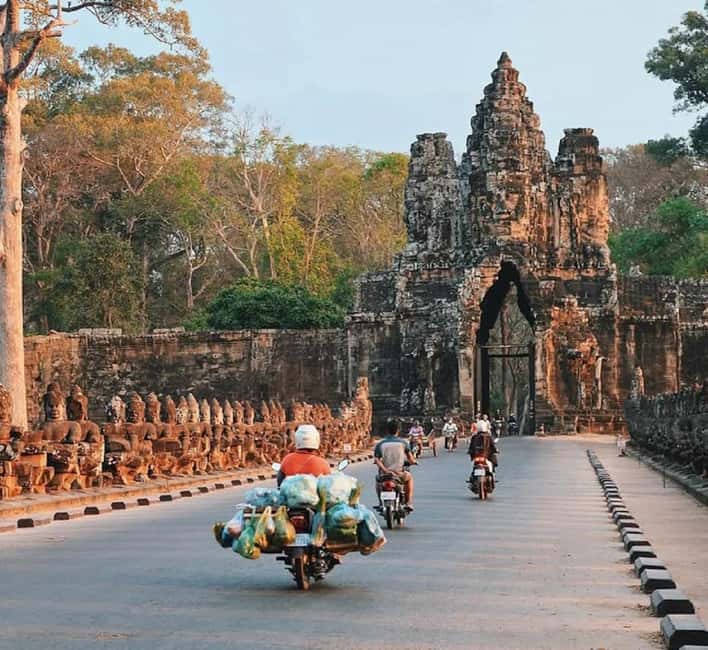
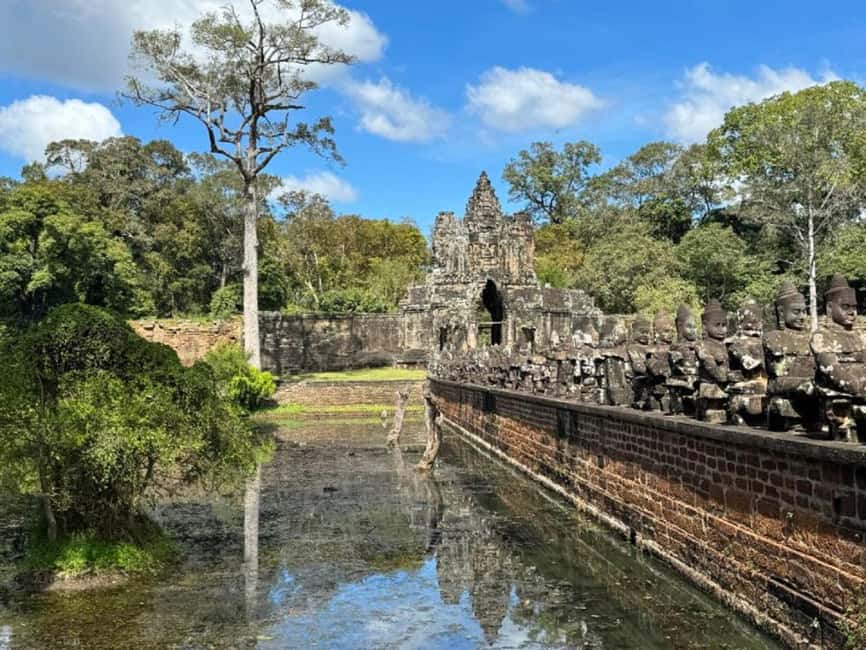
The South Gate of Angkor Thom makes a dramatic first impression. Large stone figures line the approach, while the gate carries the famous serene faces associated with the Bayon style. It is an excellent place to understand the scale of the old city before you begin walking through its temples.
Victory Gate is mainly a photo stop, planned for about 15 minutes. That short pause works well if you want a picture without turning every gate into a full visit. Your guide can also help position you for photographs, a useful service at places where the best angle is not always obvious.
Other Siem Reap experiences to weigh up
- Siem Reap: Full-Day Angkor Wat Guided Tour with Sunset
4.9 · 3,803 reviews - Angkor Wat Sunrise tour with Small – Group and Guide tours
5.0 · 3,655 reviews - Angkor Wat Highlights and Sunrise Guided Tour from Siem Reap
5.0 · 3,213 reviews - Full-Day Angkor Wat Sunrise Private Tour with Guide from Siem Reap
5.0 · 2,920 reviews
Bayon and the terraces of Angkor Thom
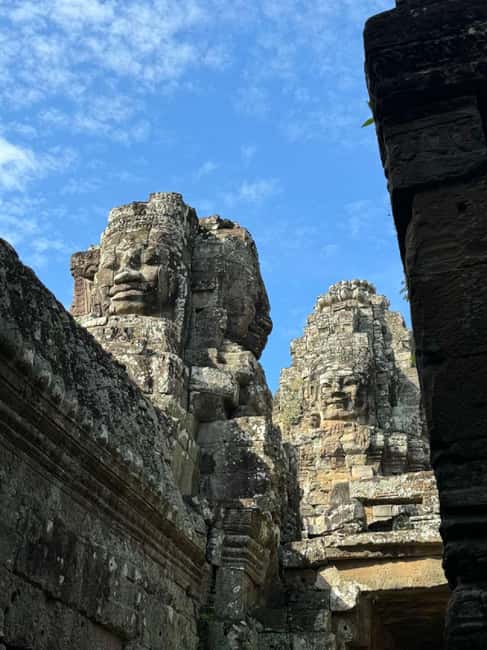
Bayon is one of Angkor’s most distinctive temples. Its towers carry calm faces that seem to watch from every direction, and its tight corridors create a more enclosed visit than the broad approach to Angkor Wat.
The planned visit lasts about 45 minutes. That gives you time to see the principal towers and hear an explanation of the temple’s religious and royal meaning, but it is not enough for a slow study of every carving. If you are deeply interested in reliefs, tell your guide early. A private group gives you at least some room to adjust.
The Terrace of the Elephants is more open and ceremonial. Its long carved wall once formed part of a royal viewing platform. The Terrace of the Leper King is nearby and adds another set of detailed stone carvings. The itinerary allows roughly 20 minutes for the terrace area, so think of it as a focused visit and photo stop rather than a long archaeological walk.
Baphuon adds another layer to Angkor Thom. Its steep pyramid form gives it a different feel from Bayon, and the climb can be tiring in the heat. The planned visit is about 45 minutes. Wear shoes with a firm sole and take care on uneven stone.
Ta Prohm and the trees in the ruins
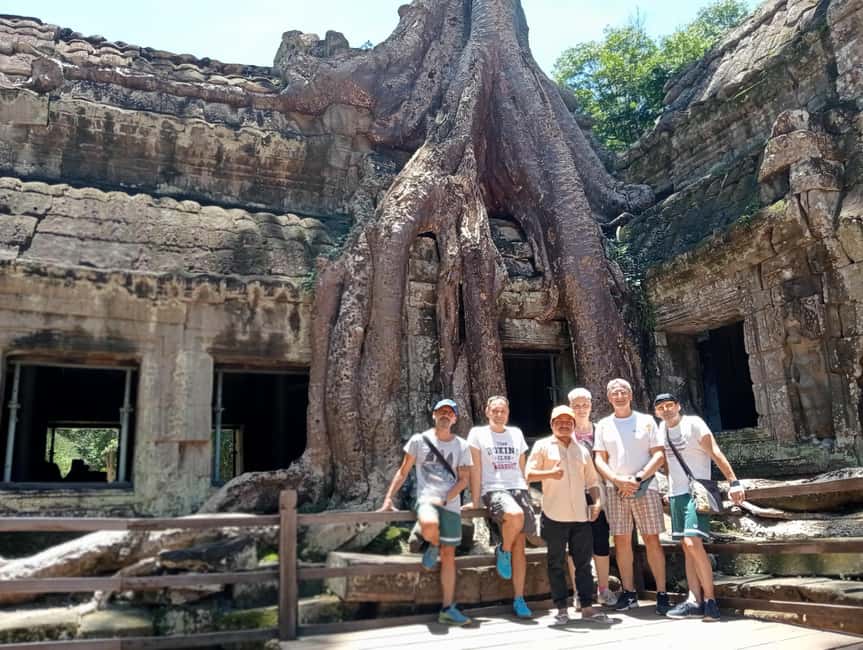
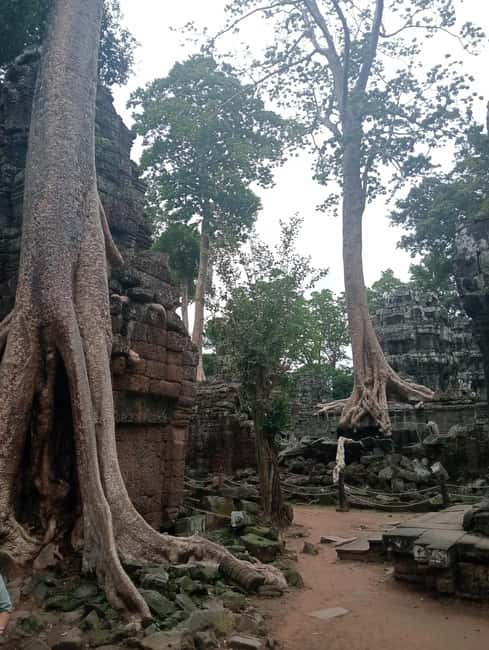
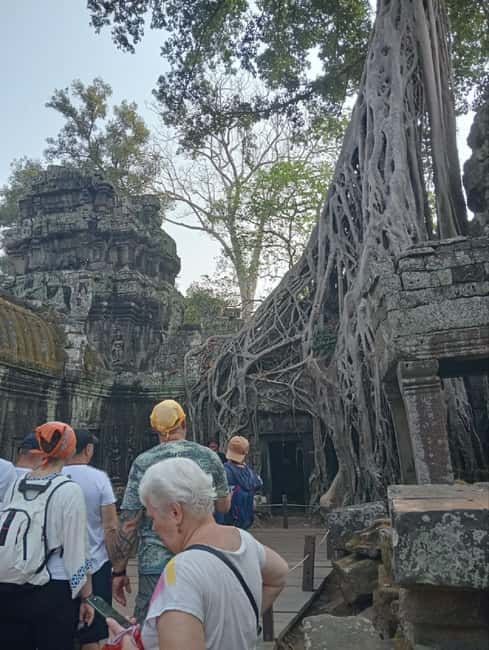
Ta Prohm is the temple most likely to trigger a sense of recognition. Massive roots grow across walls and doorways, giving the ruins a striking, almost theatrical appearance. The trees are not decoration added for visitors. They are part of the long process by which the forest and the stone site have occupied the same space.
The visit lasts about an hour, which is helpful because Ta Prohm has several corridors and memorable corners. It can also be one of the busiest stops, so your guide’s choice of route matters. A less common entrance or a visit timed away from the heaviest crowds can make the temple easier to enjoy.
This is not the easiest temple for a stroller. One family found that the guide helped decide which sites worked better with a stroller and which called for a baby carrier. If you are traveling with very young children, tell the guide what you need before entering each temple.
Lunch near Srah Srang
Lunch is not included, so plan for an additional meal cost. The route lists about an hour for a break and lunch near Srah Srang, a large reservoir with a calmer setting than the main temple compounds.
This is a good point to cool down and eat before Angkor Wat. Cambodian food is available at a nearby restaurant, but the exact restaurant and menu are not specified. Bring water even though the tour supplies cold bottles, and use the lunch break as real rest rather than rushing through a meal.
Angkor Wat in the afternoon
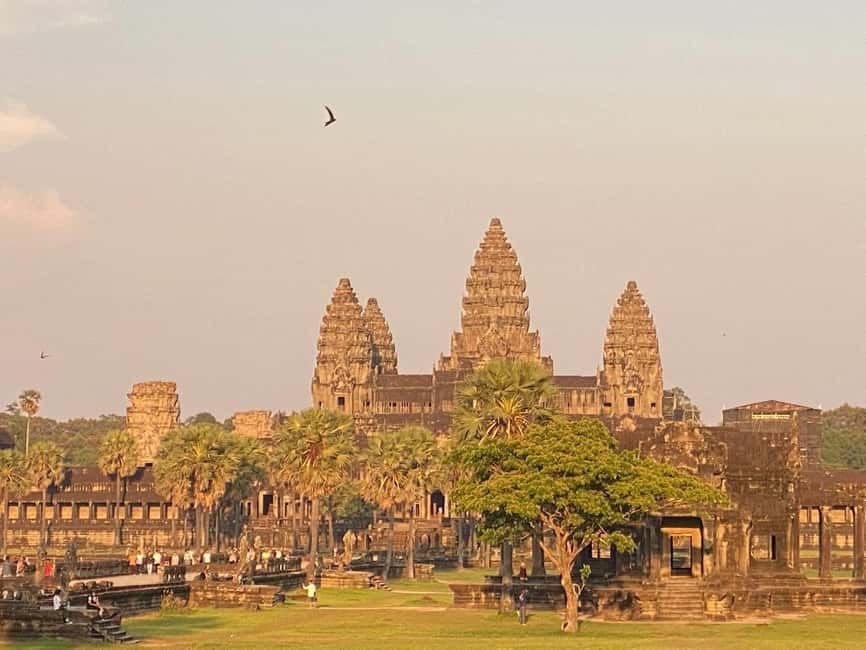
Angkor Wat receives the longest visit, about two hours. That is enough time to approach the monument, cross its galleries, examine its carvings, and discuss the symbolism and history with your guide.
The temple’s scale is the first thing you notice. The long causeway, towers, galleries, and enclosed spaces create a steady sequence of views. It is also the place where dress rules are most important. Wear clothing that covers your shoulders and knees. A scarf may help in some areas, but proper pants or a knee-covering skirt and a shoulder-covering shirt are the safer choice.
The one-day visit finishes around 5:00 PM, though actual timing can shift. One recent outing ended earlier after rain shortened the time outside Angkor Wat. Cambodia’s weather can change quickly, so keep some flexibility in your expectations.
The two-day route: more time, less temple fatigue
If you have the time, I prefer the two-day option for most people. Angkor can become a blur when you try to absorb its biggest monuments in one long day. Splitting the visits lets you spend more attention on the details and gives your feet a better chance to recover.
The second day covers the Grand Circuit and Banteay Srei. With the sunrise option, the morning begins at 5:00 AM and finishes around noon. The standard second day runs until roughly 4:00 PM.
Preah Khan and Neak Pean
Preah Khan is a broad former monastic complex with corridors, carvings, and a strong sense of depth. It rewards a slower walk because the interest is spread through the structure rather than concentrated in one famous facade.
Neak Pean is smaller and more unusual. It sits among pools and is associated with ancient water systems and healing ideas. After the scale of Preah Khan, its compact form provides a useful change of pace.
Ta Som and East Mebon
Ta Som is known for a tree-covered gate, another memorable meeting of stone and roots. It resembles Ta Prohm in mood but is smaller, so you can see its main features without the same amount of walking.
East Mebon once stood on an island in a large reservoir. The water is no longer the central feature it was in the temple’s original setting, but the structure still helps you understand how Khmer builders linked temples with water management and royal planning.
Pre Rup and Banteay Srei
Pre Rup is a mountain-style temple with broad views toward the Cambodian countryside. Its upper levels can be steep, so check your footing and do not feel pressured to climb every section. The open setting makes it a good late-day stop when you want space after several enclosed temples.
Banteay Srei is the prize of the second day for many people. Its pink sandstone carvings are unusually fine, with small details that reward close attention. The name is often translated as Citadel of Women, and the temple is admired for its delicate artistic work rather than its size.
Banteay Srei is farther from the central Angkor group than the main one-day stops, which is one reason it fits better into a separate day. The extra driving is worthwhile if carved detail interests you. If you mainly want the famous postcard views, the one-day route may be enough.
Price, transport, and what the package really covers
The $140 price covers a private group of up to two people. It includes the Italian-speaking guide, hotel pickup and drop-off, transport, the listed transfers, cold water, and chilled towels.
For a couple, the cost can make sense because you are paying for direct attention rather than sharing a vehicle and guide with strangers. It is also useful if you want to ask many questions, need help with photos, or prefer a flexible pace.
The value is less clear if you are a solo visitor focused only on transport. The temple pass costs extra, lunch costs extra, and the one-day itinerary covers sights you could reach with independent transport. The tour earns its price through interpretation, route planning, and convenience.
For three or more people, the air-conditioned vehicle is a practical advantage. Larger groups should also compare the total group price with the cost of arranging separate transport and a guide. Children under 12 join free, which improves the value for families, although the entrance ticket rules still require passport proof for children who are exempt.
Clothing, weather, and walking advice
Do not arrive in shorts, a short skirt, a sleeveless shirt, or a tank top. You need clothing that covers your knees and shoulders at the temples. Choose light, comfortable clothes that meet the rules, and bring sunscreen, sunglasses, a hat, insect repellent, and comfortable shoes.
The stone surfaces can be uneven, and several temples involve steps or sloping paths. Baphuon and Pre Rup may feel demanding in the heat. Rain can also alter the schedule, as happened when time outside Angkor Wat was shortened.
The chilled towels are more than a pleasant extra. They help you reset between temples, particularly during humid weather. Still, pace yourself. A private tour should not become a contest to see how fast you can cross every courtyard.
The experience is not suitable for wheelchair users, and it is not recommended for people over 95. Families with small children can join, but strollers may work at some temples better than others. A baby carrier may be more practical in rougher areas.
Should you book this Angkor tour?
Book it if you want Italian-language guidance, private transport, and a well-planned route without having to organize every temple yourself. The two-day option is the better choice for anyone who wants Banteay Srei, dislikes rushing, or is traveling with children and needs a more adaptable schedule.
Choose the one-day version if your time in Siem Reap is short and you want the essential Angkor sights: Bayon, Ta Prohm, and Angkor Wat, with the terraces and gates added around them. It is a full day, not a relaxed stroll, but it gives you the key monuments in one organized visit.
This tour is less suited to a strict budget or to someone who wants total independence. For everyone else, the strongest reasons to book are the language support, private format, thoughtful timing, hotel transfers, and small comforts that matter after hours in the sun. Confirm the guide’s Italian level if that is central to your decision, then choose two days if your schedule allows.
FAQ
Is the Angkor entrance ticket included?
No. The Angkor pass costs $37 per person for one day and $62 per person for two or three days. Children under 12 do not need a ticket if they show a passport as proof of age.
How many people can join the private tour?
The $140 rate covers a private group of up to two people. Children under 12 can join the tour free of charge.
What language does the guide speak?
The live guide speaks Italian. Guides named Matteo, Caro, Chhoure, Alex, and Karo have led Italian-language visits.
What transport is used?
One or two people travel by tuk-tuk on the one-day tour. On the two-day option, one or two people use a tuk-tuk on Day 1 and a private car on Day 2. Groups of three or more use an air-conditioned van or bus.
Is lunch included?
No. Lunch is not included. The itinerary allows time to eat at a nearby Cambodian restaurant.
What are the main differences between the one-day and two-day options?
The one-day tour focuses on the main temples, including Bayon, Ta Prohm, Angkor Wat, Baphuon, the terraces, and the gates. The two-day option adds the Grand Circuit and Banteay Srei, with a more relaxed schedule.
What should I wear to the temples?
Wear comfortable clothing that covers your shoulders and knees. Shorts, short skirts, sleeveless shirts, tank tops, alcohol, and drugs are not permitted. Bring comfortable shoes, sunglasses, a hat, sunscreen, and insect repellent.
Fresh reviews from around Siem Reap
- Full-Day Tour Preah Vihea & Koh Ker Temple 3.7 · 3 reviews
- Savor the Countryside: Tours with Authentic Cooking Classes” 5.0 · 3 reviews
- Angkor Wat Sunrise TukTuk Tour 5.0 · 3 reviews
- Angkor Grand Circuit Tour & Banteay Srei 5.0 · 3 reviews
- Guided Private Tuk Tuk Tour Angkor Wat and Small Circle and Five Extras 5.0 · 3 reviews
- Siem Reap Temple Tour 2-Day with Sunrise/Sunset 3.7 · 3 reviews
- Bangkok to Angkor Wat 2 Days 1 Night by Flight 4.5 · 3 reviews
- Kompong Pluk Tour 5.0 · 3 reviews
Angkor Temple Tours, compared.

Angkor Wat Sunrise or Sunset Tour with Guide from Siem Reap
Read our review →



Angkor Wat Sunrise tour with Small – Group and Guide tours
Read our review →
Angkor Wat Highlights and Sunrise Guided Tour from Siem Reap
Read our review →
