
Reviewed · ANGKOR TEMPLE TOURS
Siem Reap: Angkor Wat Tour Explore The Most Iconic Temples
Angkor Wat is only the beginning here. This eight-hour private tour strings together the park’s essential temples, from sunrise over Angkor Wat to the giant stone faces of Bayon and the tree-choked ruins of Ta Prohm. You get a driver waiting outside each site, rather than worrying about finding transport in the heat.
I like the small private setup, especially for a long temple day, and I like the practical touches: unlimited bottled water and cool towels. Guides and drivers such as Chamrong, Lay, Ray, Lai, Soka, and Danny have helped make the day easy for past customers. The main consideration is pace. Seven stops in eight hours is a full morning and afternoon of walking, stairs, sun, and temple stones.
In This Review
- Key points to know before booking
- Why this route works for a first day in Angkor
- Sunrise at Angkor Wat, the day’s essential start
- Banteay Kdei, a quieter temple pause
- Ta Prohm and the roots that made it famous
- Ta Keo, the unfinished mountain temple
- Bayon’s 200-plus stone faces
- The South Gate of Angkor Thom
- The transport makes the long day easier
- What the $24 price really covers
- Who should choose this Angkor day
- Should you book this temple tour?
- FAQ
- Is the Angkor Temple Pass included?
- How long does the tour last?
- Is hotel pickup included?
- Is the tour private?
- What temples are included?
- Are food and drinks included?
- What should I wear and bring?
Key points to know before booking
- Sunrise at Angkor Wat: Start early for the reflection of the temple towers in the moat, then continue inside before the main crowds build.
- Seven important stops: The route includes Angkor Wat, Banteay Kdei, Ta Prohm, Ta Keo, Bayon, and the South Gate of Angkor Thom, with sunset at Phnom Bakheng available as a listed option.
- Private transport for $24: The price covers a group of up to two people, making it good value for couples who want their own schedule.
- Driver-led rather than full lecture tour: Your English-speaking driver provides transport and practical help, but the amount of formal temple explanation may vary.
- Water and cool towels included: These small extras matter in Cambodia’s heat, especially after walking across exposed courtyards.
- Temple pass extra: You must buy a valid Angkor Temple Pass separately, and meals are not included.
Why this route works for a first day in Angkor
The Angkor Archaeological Park is not one compact ruin. It is a large area of temples spread across roads and forest, so arranging transport is half the battle. This tour gives you a private vehicle, hotel pickup and return, and a driver who waits while you explore.
The route also has a sensible rhythm. Angkor Wat gives you the grand opening. Banteay Kdei provides a quieter change of mood. Ta Prohm supplies the jungle drama, while Ta Keo and Bayon show very different kinds of Khmer temple design. The South Gate then gives you a final photo stop on the way out.
At $24 per group of up to two, the transport price is attractive. Remember that this is not the complete cost of your temple day because the entrance pass and meals are separate. If you are traveling as two people, the transport works out to $12 each before those extras. Solo visitors pay the same group price, so the value is strongest for couples or friends sharing.
The experience is private, but the service can differ depending on who drives you. English is the stated language, and customer feedback names drivers including Ray, Chamrong, Lay, Lai, Soka, and Danny. Their most useful role is often practical: finding you at the meeting point, waiting outside the temple, offering directions, and helping you manage the heat.
More Angkor temple itineraries:
- Angkor Wat Sunrise or Sunset Tour with Guide from Siem Reap
5.0 · 12,109 reviews - Siem Reap: Angkor Wat: Small-Group Sunrise or Sunset Tour
5.0 · 9,444 reviews - Siem Reap: Angkor Wat 2-Day Tour with Sunrise and Sunset
4.9 · 4,429 reviews
Sunrise at Angkor Wat, the day’s essential start
If you choose the sunrise option, your driver collects you from your Siem Reap hotel before dawn. The exact pickup time depends on availability, but you should expect an early start. The vehicle takes you to the Angkor Archaeological Park, where you buy your temple pass at your own expense.
The tour uses the western entrance for sunrise. From the viewing area, Angkor Wat’s towers appear across the moat as the sky brightens. This is the classic Angkor photograph, but it is more than a picture stop. Arriving before the day heats up gives you a cooler first walk and a chance to see the temple before the busiest period.
Sunrise does require patience. You may spend time waiting for the light and for a clear view, and clouds can affect the result. Still, the early start pays off because you are already at the main temple when the rest of the morning begins.
After sunrise, you go inside Angkor Wat. Built first as a Hindu temple dedicated to Vishnu, it later became a Buddhist site. Its galleries, courtyards, towers, and bas-reliefs can easily fill several hours, but this itinerary asks you to keep moving so the other temples fit into the day.
Look for the long carved scenes along the galleries. They show Hindu stories and figures in carefully arranged panels. The scale can be hard to grasp from a single viewpoint, so take time to look both up at the towers and down at the details under your feet.
Angkor Wat has many steps, broad stone walks, and open areas with little shade. Wear shoes that can handle uneven ground. Cover your shoulders and knees, as required for temple visits, and bring sunscreen and sunglasses.
Banteay Kdei, a quieter temple pause
Banteay Kdei means Citadel of Chambers. Built in the late 12th century as a Buddhist monastery, it has a more enclosed, corridor-like feel than Angkor Wat.
This is one of the most useful stops on the route because it slows the day down. You move through galleries and chambers, passing carvings and sections that remain partly ruined. The incomplete and weathered condition gives Banteay Kdei a calm, slightly mysterious mood without requiring the same scale of movement as Angkor Wat.
Do not expect the monumental towers or famous photo views found at the larger temples. That is the point. Banteay Kdei lets you notice doorways, narrow passages, stone joints, and small carvings that can get lost at Angkor’s grandest sites.
It is also a good place to judge your pace. If you already feel tired here, the afternoon stops will demand careful use of your water and rest periods. Tell your driver if you need a little longer at a shaded spot.
Ta Prohm and the roots that made it famous
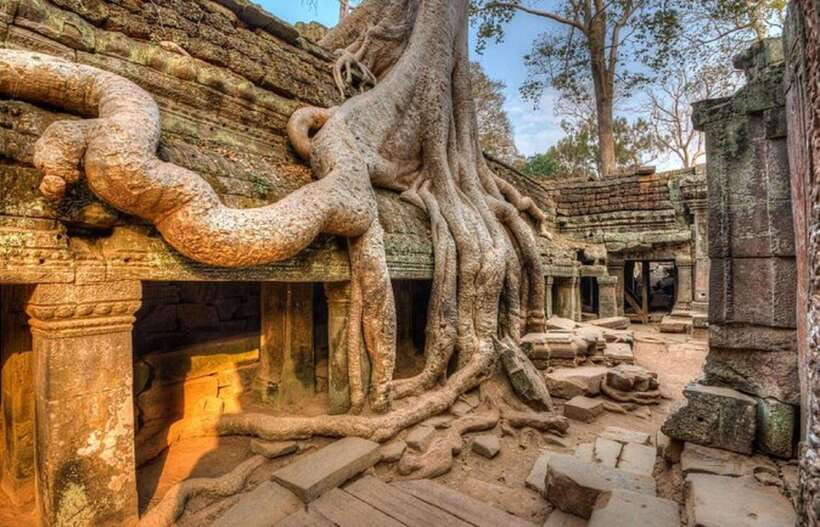
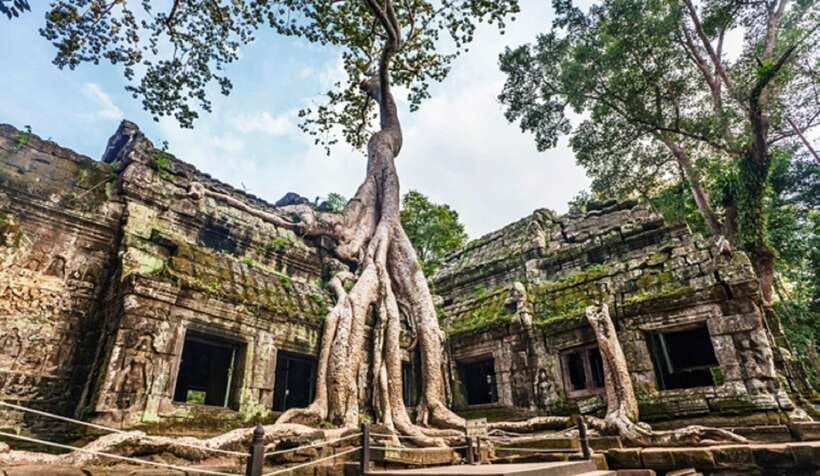
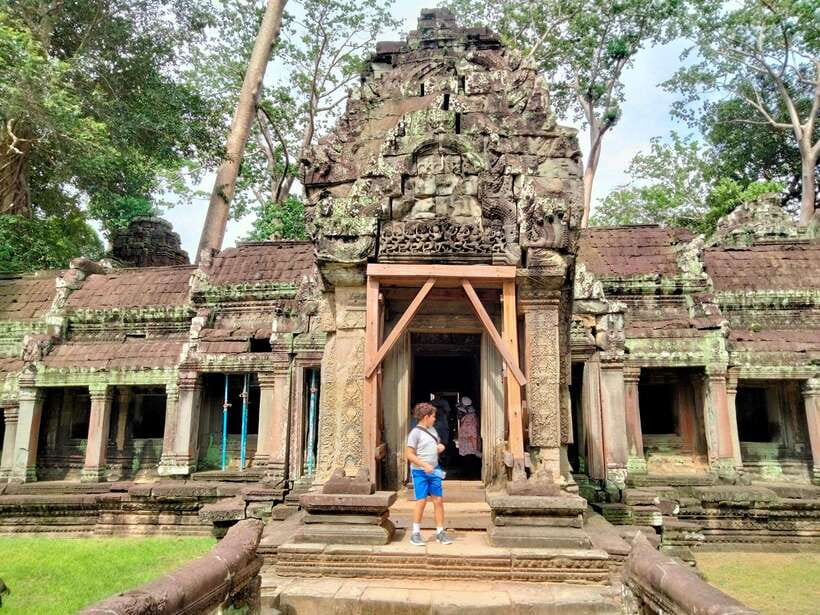
Ta Prohm is the temple most people picture when they think of Angkor swallowed by the jungle. Huge tree roots push over walls and towers, wrapping the stone in a way that makes the ruins feel both fragile and powerful.
The temple was built in the 12th century and has been left largely unrestored. That choice preserves the feeling of a jungle ruin, though it also means uneven paths, collapsed sections, and tight areas where you need to watch your footing.
Ta Prohm became famous through the film Tomb Raider, featuring Angelina Jolie. The film connection may bring you here, but the temple is worth more than its movie reputation. The contrast between carved stone and living roots is unlike anything at Angkor Wat.
This is one of the busiest and most photographed stops on the route. You may need to wait for a clear view at popular sections. Your driver waits outside while you explore, so you are not searching for a ride afterward. That simple arrangement matters when the parking area is busy and you are tired.
A different pace for your next Siem Reap morning:
- From Siem Reap: Kampong Phluk Floating Village Tour by Boat
4.9 · 6,979 reviews - Sunset tour of Kampong Phluk stilts home village on the Tonle Sap
5.0 · 4,865 reviews - Siem Reap: Kampong Phluk Floating Village Tour with Boat
4.9 · 3,843 reviews - Siem Reap: Full-Day Angkor Wat Guided Tour with Sunset
4.9 · 3,803 reviews
Ta Keo, the unfinished mountain temple
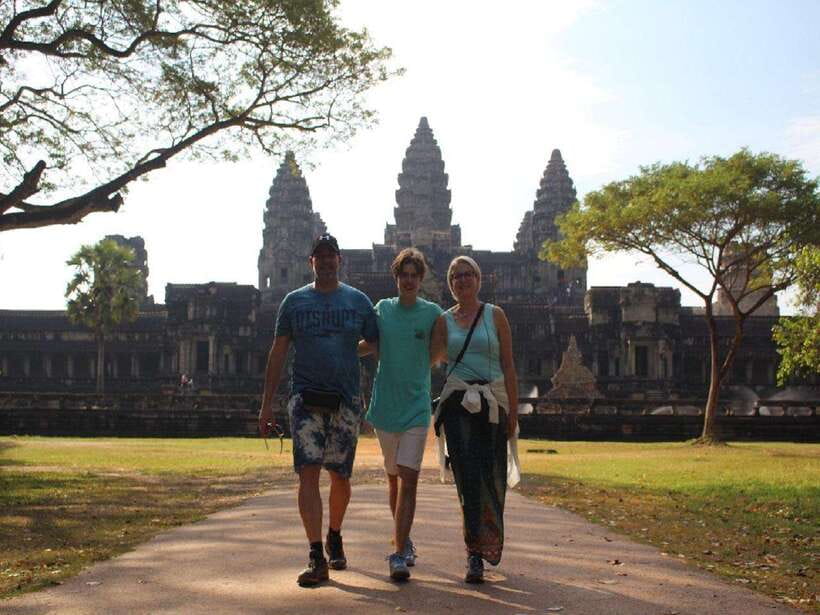
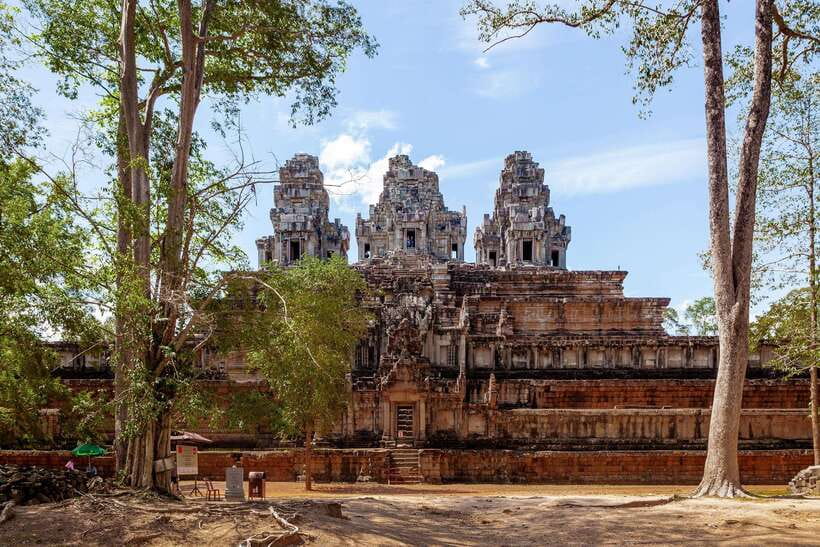
Ta Keo offers a different lesson. Built during the late 10th and early 11th centuries under King Jayavarman V and later rulers, it was never fully completed.
The unfinished state is exactly what makes the visit worthwhile. You can see how much effort went into raising a major temple even before every surface received its final carving. Compared with temples covered in detailed decoration, Ta Keo feels harder, plainer, and more focused on mass and height.
The temple has steep stone stairs and exposed upper levels. You should take care on the climb, particularly after several hours in the sun. Comfortable shoes are important here, and this is not an easy stop for anyone who struggles with uneven terrain or stairs.
Ta Keo may receive less attention than Ta Prohm or Bayon, but it helps you understand that Angkor was not built in one single style. The route works well because it includes this unfinished structure between the more decorated temples.
Bayon’s 200-plus stone faces
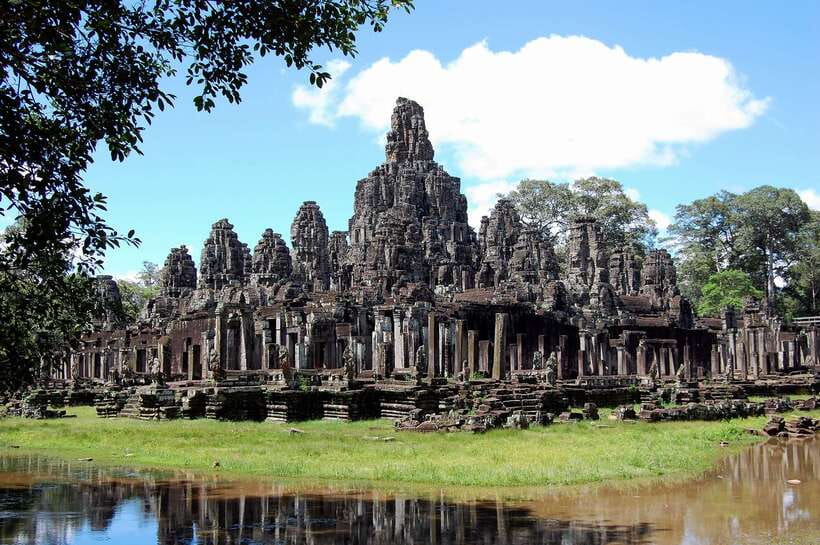
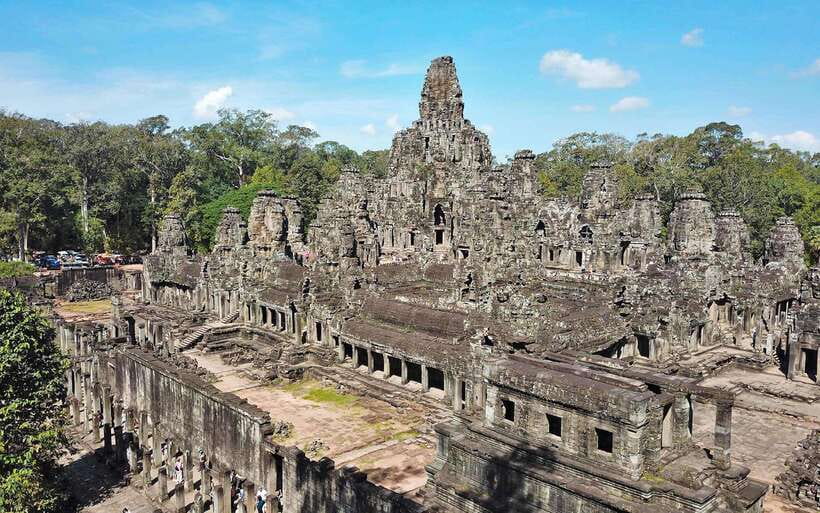
At the center of Angkor Thom, Bayon delivers the most unusual view of the day. Its towers carry large, serene faces, with four faces on many of the 54 towers. Altogether, you may see more than 200 stone faces looking out over the temple.
The faces are the obvious attraction, but do not stop there. The lower galleries contain carvings of battles, processions, and ordinary scenes of daily life. These details bring the old city closer to the ground. You see people, animals, boats, and activity rather than only kings and sacred figures.
Bayon can be confusing to walk through. Towers crowd together, corridors turn sharply, and the faces appear from different angles as you move. That maze-like quality is part of the fun, but it also means you should agree on where your driver will wait before entering.
The temple is not as open and symmetrical as Angkor Wat. It can feel cramped in places, especially when many people gather around the most famous faces. Give yourself time to look up. The best views often come from moving a few steps away from the first obvious photo point.
The South Gate of Angkor Thom
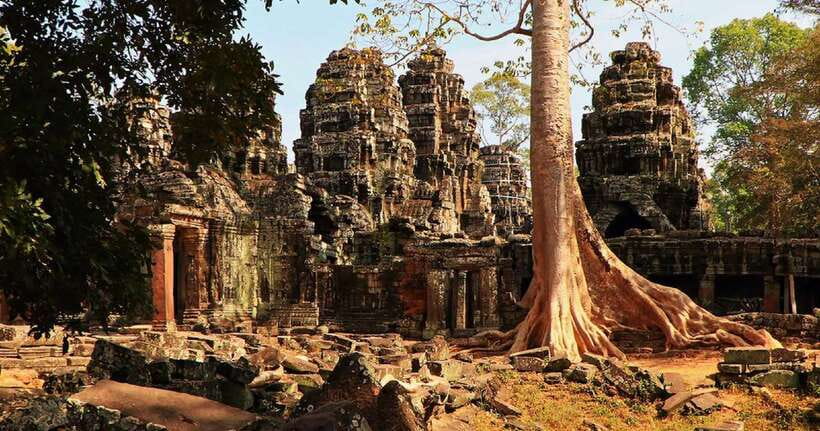
Tonle Om Gate, also called the South Gate of Angkor Thom, is a short stop with a strong visual payoff. A broad causeway leads toward the gate, lined with statues of gods and demons. The gate itself carries four large stone faces similar to those at Bayon.
This is a good final stop because it explains the scale of Angkor Thom from the road. You can photograph the causeway, the statues, and the face-topped gate without another long temple circuit.
Take care near the road and stay aware of traffic and other vehicles. The South Gate is mainly a photo and orientation stop, so it does not add the same walking demand as Angkor Wat or Ta Prohm.
The supplied schedule also names Phnom Bakheng as a sunset point. That does not appear in the main seven-stop route, so confirm at booking whether sunset there is part of your chosen option. Do not assume it is included in the same way as the sunrise program.
The transport makes the long day easier
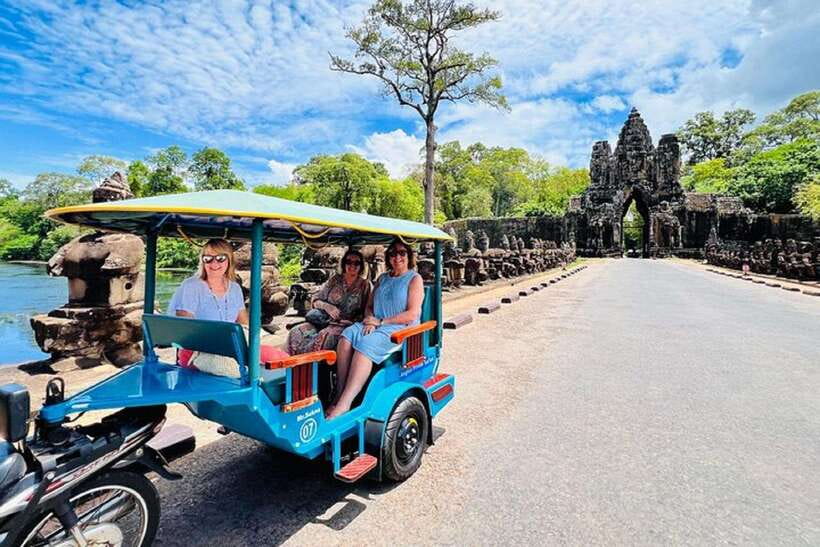
Private round-trip transport is the backbone of this experience. Some customers describe traveling by tuk-tuk, enjoying the breeze between temples. Others simply praise the reliability of their driver. The exact vehicle may depend on the selected arrangement, so check the booking details if vehicle type matters to you.
Your driver picks you up at your hotel or accommodation and returns you there. Pickup is listed as approximately five minutes before departure, with a message sent the day before. Keep your phone available and make sure the operator has the correct accommodation details.
The driver waits outside each temple. That is more useful than it sounds. After walking through vast courtyards, climbing steps, and standing in the heat, you can return to a known vehicle rather than negotiate a new ride.
Cold water is provided without limit, along with cool towels. One customer specifically enjoyed jasmine-scented towels, though that scent should not be treated as guaranteed. These are practical comforts, not decoration. The towel can reset you before the next stop, and the water helps you keep going through the hottest part of the day.
Some drivers also help with directions and local practicalities. Chamrong was praised for stopping at vendors when requested and sharing lunch with customers, while others were valued for being ready outside the temples. The level of historical explanation may vary, so if detailed guiding is your main goal, ask clearly for a driver or guide who provides more commentary.
What the $24 price really covers
The $24 price is for a private group of up to two people. It covers hotel pickup and drop-off, private round-trip transport, bottled water, and cool towels.
It does not cover the Angkor Temple Pass or meals. The pass is compulsory, so budget for it separately before you set out. You also need cash, which is listed among the recommended items.
For two people, the transport cost is a strong deal, particularly when compared with arranging separate rides for each temple. You are paying for a full day of movement and a driver who remains available through the route, not for admission to the monuments or a guaranteed formal lecture at every stop.
The tour has free cancellation up to 24 hours in advance and allows you to reserve now and pay later. Those terms help if your Siem Reap plans are still shifting. The activity is valid for eight hours, with start times subject to availability.
Who should choose this Angkor day
I would choose this tour if you want to see the main Angkor highlights without joining a large group. It suits couples, friends, and solo visitors who value a dedicated vehicle and want the freedom to pause briefly at a temple.
It is also a good fit for first-time visitors who want a clear route. You see the monument everyone expects, the temple made famous by roots, Bayon’s faces, and two less conventional stops in Banteay Kdei and Ta Keo.
I would think twice if you want a full expert-led history lesson at every site. The activity lists an English-speaking driver, and the amount of interpretation depends on the person assigned. It is also a poor match for anyone unable to manage uneven ground, stairs, and extended walking. The site is not wheelchair accessible, and it is not designed for babies under one year or people over 95.
Bring sunglasses, sunscreen, cash, water-friendly patience, and clothing covering your shoulders and knees. Alcohol, drugs, and pets are not allowed.
Should you book this temple tour?
Book it if your priority is efficient private transport, a sunrise start, and the best-known Angkor temples in one eight-hour route. The $24 group price is particularly good for two people, and the water, cool towels, hotel service, and waiting driver remove much of the day’s friction.
Before paying, confirm whether you want sunrise at Angkor Wat or the separate sunset option at Phnom Bakheng. Also decide how much temple explanation you need. If you are happy to explore with practical support and occasional guidance, this is a useful, good-value way to cover Angkor. If you want a specialist lecture at every stop, request that level of service before booking.
FAQ
Is the Angkor Temple Pass included?
No. You must purchase a valid Angkor Temple Pass separately. The tour price does not include temple admission.
How long does the tour last?
The activity is valid for eight hours. Starting times depend on availability, and the sunrise option begins with an early pickup from your Siem Reap accommodation.
Is hotel pickup included?
Yes. Pickup and drop-off at your hotel or accommodation are included. Pickup is listed as approximately five minutes before departure, and a message is sent one day before the tour.
Is the tour private?
Private group service is available. The listed price covers a group of up to two people.
What temples are included?
The route includes Angkor Wat, Banteay Kdei, Ta Prohm, Ta Keo, Bayon Temple, and Tonle Om Gate at the South Gate of Angkor Thom. Sunrise at Angkor Wat is available with the sunrise option.
Are food and drinks included?
Meals are not included. Unlimited bottled water and a cool towel are included.
What should I wear and bring?
Wear clothing that covers your shoulders and knees, along with comfortable walking shoes. Bring sunglasses, sunscreen, and cash. The temple terrain is uneven, and the tour is not wheelchair accessible.
Fresh reviews from around Siem Reap
- Full-Day Tour Preah Vihea & Koh Ker Temple 3.7 · 3 reviews
- Savor the Countryside: Tours with Authentic Cooking Classes” 5.0 · 3 reviews
- Angkor Wat Sunrise TukTuk Tour 5.0 · 3 reviews
- Angkor Grand Circuit Tour & Banteay Srei 5.0 · 3 reviews
- Guided Private Tuk Tuk Tour Angkor Wat and Small Circle and Five Extras 5.0 · 3 reviews
- Siem Reap Temple Tour 2-Day with Sunrise/Sunset 3.7 · 3 reviews
- Bangkok to Angkor Wat 2 Days 1 Night by Flight 4.5 · 3 reviews
- Siem Reap: Prek Toal Tonle Sap Biosphere Reserve Tour 3.1 · 3 reviews
Angkor Temple Tours, compared.

Angkor Wat Sunrise or Sunset Tour with Guide from Siem Reap
Read our review →



Angkor Wat Sunrise tour with Small – Group and Guide tours
Read our review →
Angkor Wat Highlights and Sunrise Guided Tour from Siem Reap
Read our review →
