
Reviewed · ANGKOR TEMPLE TOURS
Preah Khan, Ta Prohm, Bayon Off Beaten Track
The appeal here is simple: you see three of Angkor’s most memorable temples in one private outing, with a guide and driver rather than a large bus group. Preah Khan, Ta Prohm, and Bayon each show a different side of King Jayavarman VII’s building program, from long corridors to tree-covered ruins and giant stone faces.
I like the small private format, limited to your group of up to three, and I like the practical support from Panha and the driver. The guide is praised for clear explanations, local knowledge, airport help, flexible plans, and getting people back on time. The main catch is that the $159 price excludes both the Angkor entrance fee and lunch, so your final cost will be higher.
In This Review
- Key points at a glance
- Three temples, three very different moods
- Preah Khan: long corridors and a royal memorial
- Ta Prohm: the Angkor scene everyone recognizes
- Bayon: faces, reliefs, and a shorter final stop
- What private touring changes
- The $159 question: who gets good value?
- Heat, walking, and how to prepare
- Who will enjoy this Angkor day most?
- My booking advice
- FAQ
- How much does the private tour cost?
- How long does the experience last?
- Which temples are included?
- Is hotel pickup available?
- What is included in the price?
- Can I cancel for a full refund?
Key points at a glance
- Three major Jayavarman VII temples: Preah Khan, Ta Prohm, and Bayon all date mainly from the late 12th or early 13th century.
- Private group of up to three: You avoid a large coach and can discuss the pace or focus with the guide.
- Eight-hour temple day: The planned visits allow roughly two hours at Preah Khan, two at Ta Prohm, and one at Bayon.
- Panha is the named guide: His role includes explaining Cambodian culture, history, and daily life, not just pointing out stones.
- Transport and water are included: Pickup is offered, and the activity ends back at the meeting point.
- Budget for extras: Lunch and temple admission are not included in the $159 group price.
Three temples, three very different moods
I like this route because it avoids treating Angkor as one giant pile of ruins. The three stops have different personalities, and the order gives you time to appreciate those differences.
Preah Khan is broad, layered, and easy to underestimate if you only allow a quick walk. Ta Prohm is the famous tree-and-stone setting, but it has more to offer than a few postcard views. Bayon is more compact, yet its sculpted faces and crowded reliefs demand careful looking.
All three were built during the reign of Jayavarman VII, one of the most important rulers of the Khmer Empire. Preah Khan was built in the 12th century in honor of the king’s father. Ta Prohm, originally called Rajavihara, dates mainly from the late 12th and early 13th centuries. Bayon served as the state temple of the Mahayana Buddhist king.
You are not getting a broad survey of every major Angkor site. You are getting a focused look at three temples connected to one ruler and one period. That focus is useful if you want depth without trying to cram every famous ruin into a single day.
More Angkor temple itineraries:
- Angkor Wat Sunrise or Sunset Tour with Guide from Siem Reap
5.0 · 12,109 reviews - Siem Reap: Angkor Wat: Small-Group Sunrise or Sunset Tour
5.0 · 9,444 reviews - Siem Reap: Angkor Wat 2-Day Tour with Sunrise and Sunset
4.9 · 4,429 reviews
Preah Khan: long corridors and a royal memorial
The first stop allows about two hours, which is a sensible amount of time for Preah Khan. The temple’s name means Royal Sword, and it was built by Jayavarman VII to honor his father.
Preah Khan sits northeast of Angkor Thom and west of the Jayatataka baray, or reservoir. That setting matters because the temple is part of a larger planned religious and water system, rather than an isolated monument dropped into the forest.
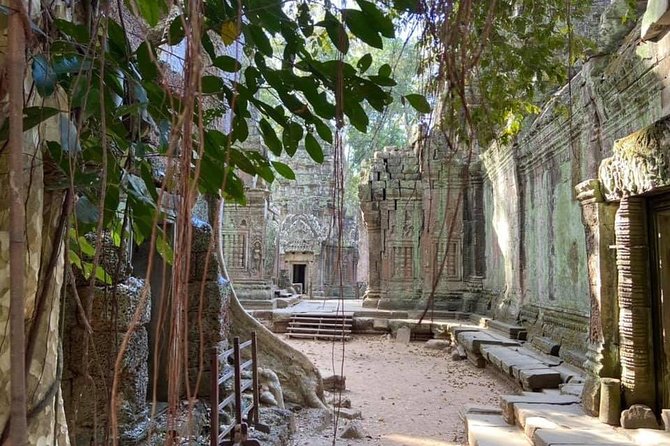
As you move through the site, expect a sequence of courtyards, galleries, doorways, and partially collapsed sections. The pleasure here is not one single dramatic view. It comes from seeing how the temple unfolds, with each passage revealing another angle or carved detail.
I would give this stop your full attention early in the day. Two hours lets you walk at a measured pace and ask questions instead of rushing behind a group. A licensed guide can help you understand the temple’s purpose, the connection to Jayavarman VII, and the details that are easy to miss when you are looking only for a perfect photograph.
The drawback is that Preah Khan can feel sprawling. If you prefer compact monuments with an obvious central viewpoint, you may find the corridors and courtyards less immediately rewarding. That is also why the guide matters here. Without context, some of the temple can blur into repeated stone walls.
Ta Prohm: the Angkor scene everyone recognizes
Ta Prohm receives about two hours, matching Preah Khan and giving you enough time to look beyond the most photographed corners. Its modern name means Ancestor of Brahma, while its original name was Rajavihara.
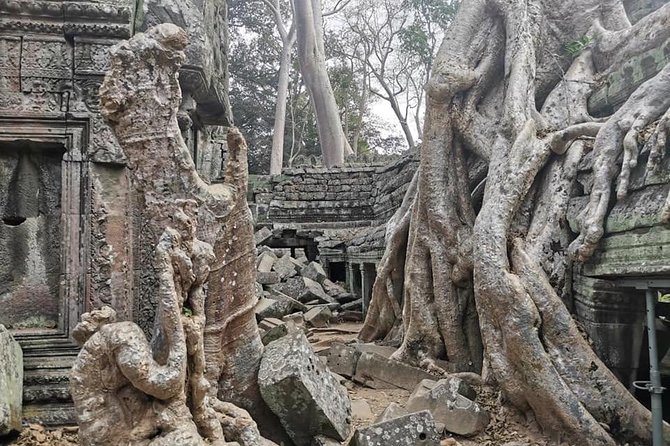
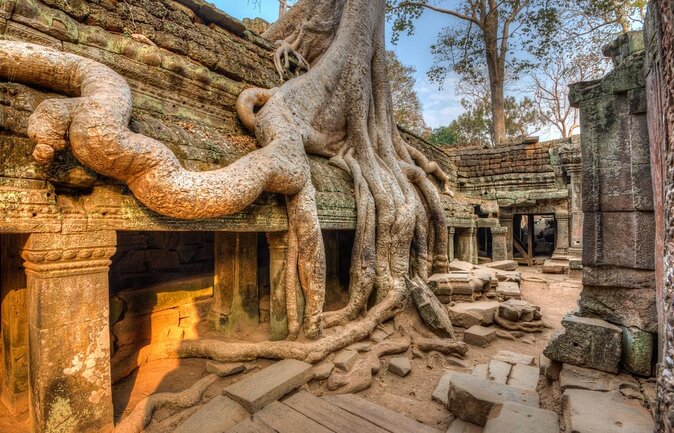
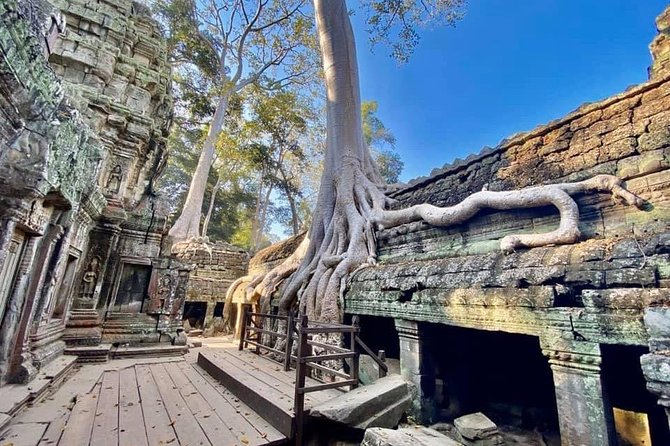
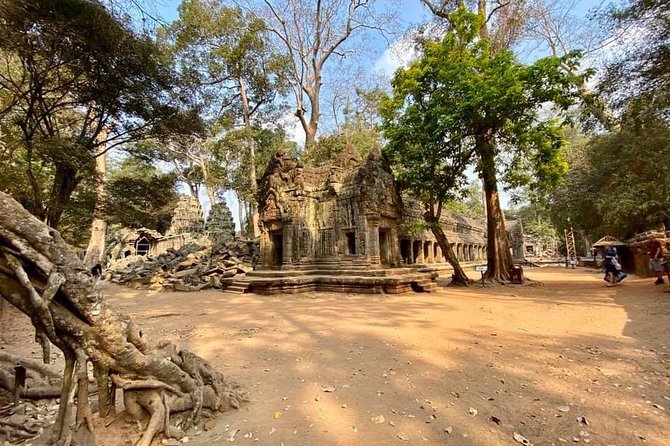
Ta Prohm was built in the Bayon style, mainly in the late 12th and early 13th centuries. It is best known for the way trees grow through and over sections of the temple, creating the famous meeting of roots and masonry.
The setting is visually powerful, but I would not reduce Ta Prohm to a photo stop. Look at the galleries, carved surfaces, doorways, and the way nature has altered the structure. The contrast between careful Khmer design and slow plant growth gives the site its particular character.
A private tour is helpful here because you can spend longer at the parts that interest you and move on when a section feels crowded or repetitive. You also have someone who can explain why Ta Prohm is important within Jayavarman VII’s building period, rather than leaving you with only the familiar tree image.
There is one practical limitation: Ta Prohm is likely to be the most in-demand stop on this route because it is so recognizable. The tour description promises a way to avoid the worst tourist crowds and points to timing as an important part of the experience, but it does not specify a special early opening time for this particular outing. The stated start is 9:00 am, so you should not book this expecting a sunrise departure.
That start time is still useful for people who do not want a pre-dawn morning. It creates a manageable day and may suit you if you value a later beginning over chasing the first light. If avoiding crowds is your top priority, ask the operator before booking how the day’s timing is handled.
Bayon: faces, reliefs, and a shorter final stop
Bayon is scheduled for about one hour. That is the shortest visit of the day, but it can work if your guide keeps the walk focused.
The temple, also called Prasad Bayon, was built in the late 12th or early 13th century as the state temple of Jayavarman VII. It is a richly decorated Khmer temple associated with the king’s Mahayana Buddhist rule.
Bayon is famous for its large carved faces, but the reliefs deserve equal attention. The temple asks you to look up, around, and along the walls. A guide can point out how the sculpted scenes connect religious ideas with everyday life and royal power.
One hour is enough for a strong introduction, especially after two larger stops. It is not generous if you want to study every relief or photograph the temple from many angles. I would treat Bayon as a concentrated finish rather than a complete examination.
The order also has a practical advantage. After Preah Khan and Ta Prohm, Bayon gives you a different visual rhythm: more stone faces and carved surfaces, less emphasis on long open corridors or giant tree roots. It rounds out the day well.
A different pace for your next Siem Reap morning:
- From Siem Reap: Kampong Phluk Floating Village Tour by Boat
4.9 · 6,979 reviews - Sunset tour of Kampong Phluk stilts home village on the Tonle Sap
5.0 · 4,865 reviews - Siem Reap: Kampong Phluk Floating Village Tour with Boat
4.9 · 3,843 reviews - Siem Reap: Full-Day Angkor Wat Guided Tour with Sunset
4.9 · 3,803 reviews
What private touring changes
This is a private activity for your group only, with a maximum of three people. That is a real advantage if you want to ask questions, adjust the pace, or avoid waiting for strangers.
The transport arrangement includes a driver, a licensed tour guide, and bottled water. Pickup is offered, with the listed meeting point at Prince Angkor Hotel & Spa on Sivutha Boulevard in Siem Reap. The activity ends back at that meeting point.
The information does not promise a particular vehicle type for this exact tour. One earlier temple outing connected with Panha used an air-conditioned van, so you can ask about the vehicle when confirming your booking rather than assume. Transport matters in Siem Reap’s heat, especially across an eight-hour temple day.
Panha is the guide associated with the experience. The strongest praise connected with his work centers on punctuality, trust, flexibility, and his ability to explain Cambodian history, culture, and daily life. He has also helped people with airport transfers, restaurant and bar suggestions, and changes to their temple plans.
That wider local knowledge can make the day more useful than a simple monument lecture. You can ask questions about Siem Reap beyond the stones. Still, guide quality depends on the person assigned and your interests, so tell Panha or the operator what you want from the day: architecture, religion, photography, history, or a lighter overview.
The $159 question: who gets good value?
The price is $159 per group, not per person, for up to three people. If three people share the booking, that works out to $53 each before admission and lunch. For two people, it is $79.50 each before those extras. A solo booking pays the full group rate.
That structure favors couples, friends, or a small family group. You are paying for private transport, a driver, a licensed guide, bottled water, and roughly eight hours of attention. Compared with a large shared bus, the value is less about getting the lowest possible price and more about control, comfort, and direct access to your guide.
The price does not include temple admission. You also pay for lunch separately. These are not minor details, since Angkor entry can add a meaningful amount to your daily budget. Check the current admission cost before you commit, because the supplied details do not state the fee.
Lunch is another decision point. The day is long enough that you will need to plan a meal, but no restaurant or lunch stop is specified. Ask how lunch timing works, or set aside time and money for it. Since this is a private outing, you may be able to discuss the timing with the guide.
The free cancellation rule adds some flexibility. You can cancel for a full refund up to 24 hours before the 9:00 am start time. Changes or cancellations made less than 24 hours before the start are not accepted for a refund.
Heat, walking, and how to prepare
The activity recommends a moderate level of physical fitness. That is a useful warning, even though the description does not give a precise distance or number of steps.
You will be walking through temple grounds, corridors, and uneven historic structures over several hours. The schedule gives two hours at each of the first two temples and another hour at Bayon, so comfortable shoes matter more than fashionable ones.
Bottled water is provided, but I would still prepare for a full day outside. Bring sun protection and clothing suitable for visiting religious monuments. The provided information does not spell out a dress code, so ask the operator if you want exact guidance before departure.
The 9:00 am start may be easier on your sleep than a sunrise tour, but it also means the day extends into the warmer part of the morning and afternoon. The private vehicle gives you breaks between sites, yet this is still an active sightseeing day.
If your group includes someone who tires quickly, use the private format to discuss a slower pace. The itinerary is approximate, and the guide’s flexibility is one of the experience’s useful features. Do not mistake flexibility for an automatic guarantee that every timing request can be met. Confirm your preferred plan in advance.
Who will enjoy this Angkor day most?
I would recommend this outing to a small group that wants the major character of Angkor without joining a coach. It suits first-time visitors who want a guide to explain what they are seeing, as well as returning visitors who want to focus on Jayavarman VII’s temples.
It is especially useful for people who care about:
- A private guide rather than a recorded commentary
- A driver handling the movement between temples
- A flexible pace for a group of up to three
- A focused route instead of a long list of unrelated sites
- Local advice about Siem Reap, food, and daily life
I would hesitate if your main goal is the absolute lowest price. A shared outing may cost less, though the supplied information does not provide a comparison. I would also hesitate if you want Angkor Wat itself included, since this route covers Preah Khan, Ta Prohm, and Bayon only.
The tour may not suit you if you want a very slow photographic study of each temple. The total schedule is full, and Bayon receives only one hour. On the other hand, the arrangement is a good match if you want a clear introduction to three major sites and enough time to see each one without spending the entire day on a bus.
My booking advice
I like the shape of this tour. It gives you three strong temples, a private group, a named guide with a record of flexibility, and transport that brings you back to the starting point. The route also has a clear theme: the building program of Jayavarman VII.
Before booking, confirm three things: the vehicle, the plan for lunch, and how the guide intends to handle crowd avoidance with a 9:00 am departure. Also add the temple entrance fee to your budget.
Book it if you are a group of one to three and want personal attention, useful explanations, and a manageable selection of Angkor’s major sites. Skip it if you want a bargain shared trip, a sunrise start, or a full day centered on Angkor Wat. For the right small group, this is a practical way to see three very different temples without turning the day into a race.
FAQ
How much does the private tour cost?
The price is $159 per group of up to three people. Temple admission and lunch are not included.
How long does the experience last?
The tour lasts approximately eight hours. It starts at 9:00 am and ends back at the meeting point.
Which temples are included?
The route includes Preah Khan, Ta Prohm, and Bayon Temple.
Is hotel pickup available?
Pickup is offered. The listed starting point is Prince Angkor Hotel & Spa on Sivutha Boulevard in Siem Reap, and the activity ends back at that meeting point.
What is included in the price?
The price includes bottled water, a private tour, a licensed tour guide, and a driver. Lunch and the entrance fee are excluded.
Can I cancel for a full refund?
Yes. You can cancel at least 24 hours before the experience start time for a full refund. Cancellations or changes made less than 24 hours before the start are not accepted for a refund.
Fresh reviews from around Siem Reap
- Full-Day Tour Preah Vihea & Koh Ker Temple 3.7 · 3 reviews
- Savor the Countryside: Tours with Authentic Cooking Classes” 5.0 · 3 reviews
- Guided Private Tuk Tuk Tour Angkor Wat and Small Circle and Five Extras 5.0 · 3 reviews
- Angkor Wat Sunrise TukTuk Tour 5.0 · 3 reviews
- Angkor Grand Circuit Tour & Banteay Srei 5.0 · 3 reviews
- Siem Reap Temple Tour 2-Day with Sunrise/Sunset 3.7 · 3 reviews
- Bangkok to Angkor Wat 2 Days 1 Night by Flight 4.5 · 3 reviews
- Kompong Pluk Tour 5.0 · 3 reviews
Angkor Temple Tours, compared.

Angkor Wat Sunrise or Sunset Tour with Guide from Siem Reap
Read our review →



Angkor Wat Sunrise tour with Small – Group and Guide tours
Read our review →
Angkor Wat Highlights and Sunrise Guided Tour from Siem Reap
Read our review →
