Reviewed · TOURS
Journey Through Time: Grand Tours with professional photographers
Angkor’s Grand Circuit trades the fame of Angkor Wat for quieter temple paths, tree-covered ruins, and a closer look at the sprawling Khmer complex. You visit six sites in a private car or van, with a guide and photographer to explain what you are seeing and capture photos along the way.
I like the freedom of a private tour, especially when you want to pause at Preah Khan or take your time with Ta Som. I also like the practical extras: hotel pickup, bottled water, fruit, and a photographer who can take pictures and short videos of your group. The main drawback is the schedule. Six temples in five to six hours is brisk, and the route includes Banteay Srei, which sits about 25 kilometers northeast of the main Angkor area.
In This Review
- Key points to know
- What the Grand Circuit adds to your Angkor visit
- Preah Khan, a royal city in ruins
- Neak Pean and the vanished reservoir
- Ta Som, where trees meet the stone
- Pre Rup and the climb to a temple-mountain
- Eastern Mebon and the dry East Baray
- Banteay Srei, the final and most distant stop
- Why private transport changes the day
- What the guides and photographer add
- Dress, heat, and a realistic pace
- Who should book this Angkor tour?
- Should you book the Grand Circuit?
- FAQ
- Where does the tour start and end?
- How long does the experience last?
- Is this a private tour?
- Which temples are included?
- Is Angkor Wat included?
- Is the Angkor temple pass included?
- What is included in the tour price?
- Are meals and drinks included?
- What should I wear?
- Can I cancel for a full refund?
Key points to know
- Six temples in one private outing: Preah Khan, Neak Pean, Ta Som, Pre Rup, Eastern Mebon, and Banteay Srei are all included in the planned route.
- A useful companion to Angkor Wat: The Grand Circuit focuses on different temple styles, smaller ruins, reservoirs, and quieter forest settings.
- Private transport from Siem Reap: Hotel pickup and return are included in a luxury private car or van.
- An English-speaking guide and photographer: Guides associated with the operation include John, Diamond, also known as Pich, and Davann.
- Temple admission costs extra: The one-day Angkor pass is listed at $37 per person and is not included in the $237 tour price.
- Dress carefully: Knees and shoulders must be covered for men and women at places of worship and selected museums.
What the Grand Circuit adds to your Angkor visit
Most first visits to Siem Reap begin with Angkor Wat and the Small Circuit. That is a sensible plan, but the Grand Circuit shows you a different side of Angkor. The temples here are spread through wooded areas and former reservoirs, and several are less restored than the major monuments near Angkor Wat.
You are not simply checking off six ruins. You are following the work of different Khmer kings across several centuries. Jayavarman VII appears repeatedly, with temples built for Buddhist worship and royal remembrance. Rajendravarman’s tenth-century monuments bring a different style, with Hindu symbolism and steep temple-mountains.
The private format matters. You travel only with your own group, so you are not waiting for a large coach party to finish at every doorway. You can ask questions, spend longer at a carved gallery, or move on when your interest fades. That flexibility is especially useful at Preah Khan and Ta Som, where the pleasure comes from wandering rather than standing in one fixed spot.
The listed price is $237 for the experience, but the Angkor pass costs an additional $37 per person. Food, drinks, tips, and a listed $15 sun-light charge are also excluded. The value is strongest for a small group that wants private transport, a guide, and photography in one booking. For a solo visitor, the price may feel high once the temple pass is added.
Travellers planning Siem Reap days often pair this one with:
- Angkor Wat Sunrise or Sunset Tour with Guide from Siem Reap
5.0 · 12,109 reviews - Siem Reap: Angkor Wat: Small-Group Sunrise or Sunset Tour
5.0 · 9,444 reviews - From Siem Reap: Kampong Phluk Floating Village Tour by Boat
4.9 · 6,979 reviews
Preah Khan, a royal city in ruins
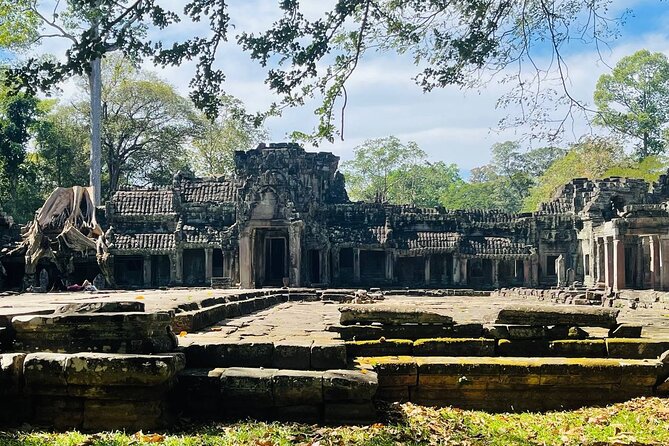
Your first stop is Preah Khan, built by King Jayavarman VII in the early twelfth century in honor of his father. Its name means Royal Sword Temple, and the site once served as far more than a place of worship. It was the center of a large organization said to include nearly 100,000 officials and servants.
Give this stop real attention. The scale can be hard to grasp from the entrance, but the long corridors and layered courtyards show how much activity once took place here. The stonework shifts as you move through the complex, from broad passages to narrower chambers and carved details.
Preah Khan is a good place to use your guide. Without context, it can look like a maze of fallen stones and doorways. With an explanation of the king, the temple’s purpose, and its connection to the surrounding settlement, the site becomes easier to read.
The planned visit is about one hour. That is enough for a useful look, but not enough to inspect every corner. If Preah Khan interests you most, tell your guide early that you would rather have time here than rush through every stop.
Neak Pean and the vanished reservoir
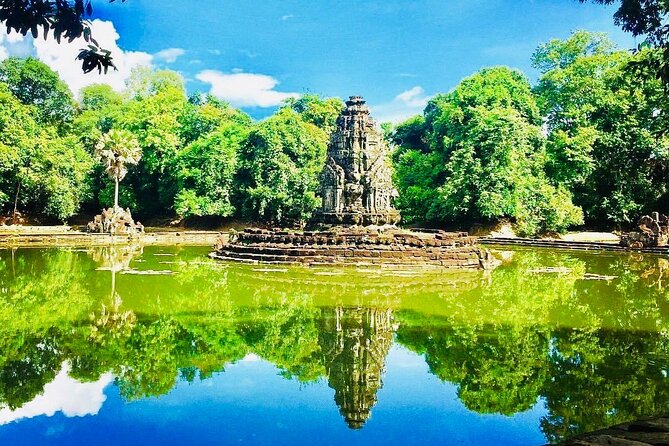
Neak Pean is a sharp change from Preah Khan. Instead of a broad temple complex, you walk toward an artificial island in the former Preah Khan Baray, also called Jayatataka. The central structure was built by Jayavarman VII and is associated with Buddhist worship.
The water setting is the point. Neak Pean was designed as part of a larger hydraulic and religious system, and its island position gives the visit a distinct feel. You are looking at a monument that once related closely to a much larger body of water, even though the reservoir is now gone.
The stop lasts about an hour. Bring patience if the approach feels slower than the temple itself. The route and views are part of the visit, but this is not a monument where you spend the whole hour inside a maze of galleries.
Neak Pean is also a reminder that Angkor was not only a collection of stone towers. Water management, royal power, religion, and daily life were tied together. A good guide can help connect those pieces without turning the visit into a lecture.
Ta Som, where trees meet the stone
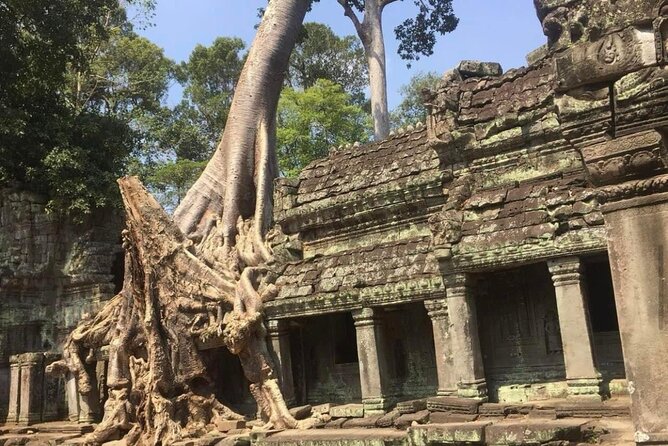
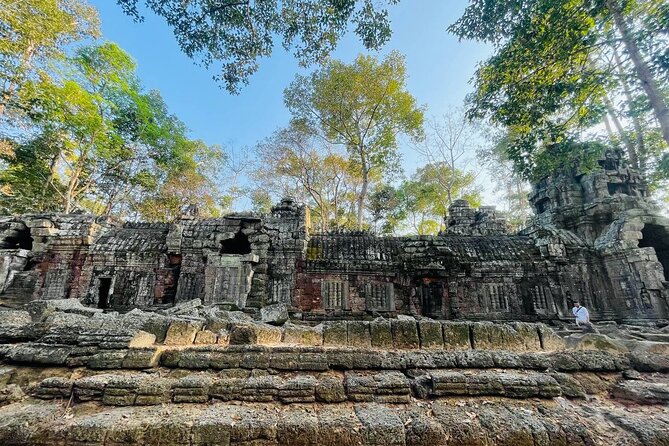
Ta Som was built at the end of the twelfth century by Jayavarman VII in honor of his father. It is often compared with Ta Prohm because nature has been allowed to remain a visible part of the site. Trees and other growth press against the old stonework, giving the temple a less polished appearance.
This is one of the places where a private guide can improve the visit without getting in the way. You can stop for photographs, look closely at the carved doorways, and ask about what has been restored and what has been left largely as found.
Ta Som is scheduled for about one hour. That may be enough for a calm walk, though the total day remains tight because of the number of stops. If taking pictures matters to you, this is one of the temples where you should avoid letting the photographer rush you from one frame to the next.
The operation includes a professional photographer, and previous guide names connected with the team include John, Diamond or Pich, and Davann. The exact guide assignment is not specified, but the guide and photographer combination is useful for couples, families, and groups that want everyone in the picture.
A different pace for your next Siem Reap morning:
- Sunset tour of Kampong Phluk stilts home village on the Tonle Sap
5.0 · 4,865 reviews - Siem Reap: Angkor Wat 2-Day Tour with Sunrise and Sunset
4.9 · 4,429 reviews - Siem Reap: Kampong Phluk Floating Village Tour with Boat
4.9 · 3,843 reviews - Siem Reap: Full-Day Angkor Wat Guided Tour with Sunset
4.9 · 3,803 reviews
Pre Rup and the climb to a temple-mountain
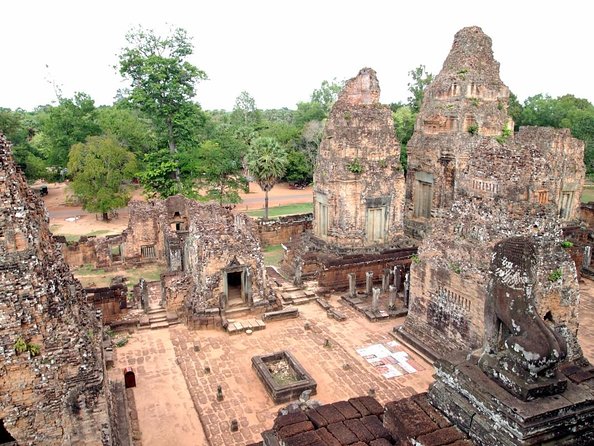
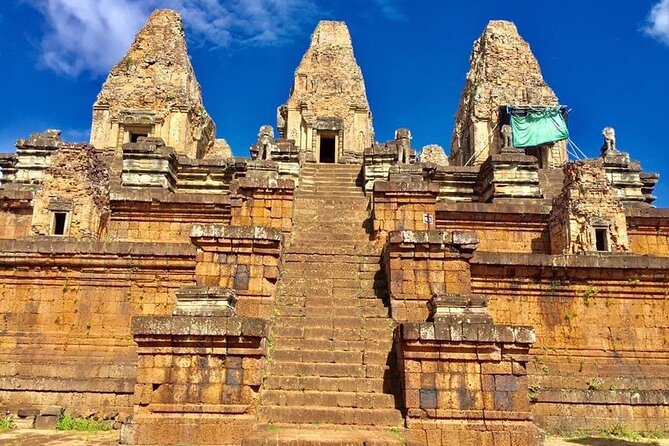
Pre Rup was built by King Rajendravarman in 961 or early 962. It is a Hindu temple-mountain, with strong horizontal levels and a more formal, monumental shape than the overgrown Ta Som.
The modern Khmer meaning of Pre Rup is connected with turning the body. Cambodian belief links the temple with funeral rites, which gives the site a different tone from the Buddhist monuments associated with Jayavarman VII.
You will spend about an hour here. The raised structure gives you a chance to see the temple as a carefully planned mass of sandstone and brick rather than a collection of disconnected ruins. The climb can be a consideration for anyone who is less comfortable with steep temple steps, although the tour information says most people can participate.
Pre Rup is also one of the stops where the guide’s historical explanation matters. The contrast between Rajendravarman’s Hindu temple and Jayavarman VII’s later Buddhist foundations helps you see that Angkor changed with each ruler. You are not looking at one single style frozen in time.
Eastern Mebon and the dry East Baray
Eastern Mebon, also called Mebon in the tour plan, dates from the tenth century. King Rajendravarman built it to honor his parents and dedicate it to the Hindu god Vishnu.
The temple once occupied an artificial island in the center of the East Baray. Today the baray is dry, so the setting no longer matches the original design. That lost water gives the site much of its interest. You are seeing a monument whose position once mattered as much as its stonework.
Allow about an hour. The visit pairs well with Pre Rup because both sites belong to the period of Rajendravarman and reflect Hindu temple planning. Your guide can point out the relationship between the temple, the royal family, and the large waterworks around it.
Eastern Mebon may appeal most to people who enjoy archaeological context. If your priority is dramatic jungle growth or giant gateways, Ta Som and Preah Khan may leave a stronger impression. If you want to understand how the Angkor complex worked as a planned royal center, Mebon earns its place.
Banteay Srei, the final and most distant stop
Banteay Srei is the outlier on this route, about 25 kilometers northeast of the Angkor Archaeological Park. It is smaller than Angkor Wat, but its scale is part of its appeal. The temple is known for detailed Khmer carving and is often described as a jewel of Khmer artistry.
The tour plan places Banteay Srei last and allows about an hour. It is the only listed stop with admission marked as free, but you should still confirm how the Angkor pass applies to your visit, since the general one-day temple pass is listed separately at $37 per person.
The distance is the key practical issue. Including Banteay Srei gives you another major stop, but it also makes the five to six-hour estimate feel ambitious. Road time, temple crowds, walking speed, and photography can all affect how much time remains at each site.
If Banteay Srei is a personal priority, ask the operator about the day’s timing before booking. The published route includes it, but the information does not explain how the drive fits within the stated duration. You may prefer a longer private outing if you want unhurried visits at all six temples.
Why private transport changes the day
Pickup and return to your Siem Reap hotel are included, with the activity beginning and ending in Krong Siem Reap. That removes the need to arrange a separate tuk-tuk or car for a route that covers several widely spaced monuments.
The private car or van is also a useful break from the heat. Mineral water, tissues, and natural fruit are included, but meals and other drinks are not. Bring money for food and personal expenses, since those costs are outside the tour price.
A private vehicle does not make the route short. It simply makes the transitions easier and gives you control over the pace. You are still visiting a large archaeological area, and the schedule includes one hour at each of six stops.
The mobile ticket is a small but helpful detail. Download the e-ticket to your phone so the driver can identify the pickup arrangement. Confirmation is provided when you book, and the tour is offered as a private activity for your group alone.
What the guides and photographer add
The experience includes a professional English-speaking guide and a professional photographer. Those are separate roles with different benefits. The guide helps you understand kings, temple purpose, religion, and construction. The photographer lets you appear in your own holiday pictures instead of relying only on quick phone shots.
The guide names connected with the operation include John, Diamond or Pich, and Davann. John is associated with a friendly style and humor, while Diamond or Pich is associated with explaining kings, Cambodian culture, and temple details. Davann is associated with helping groups avoid queues and showing them good places for pictures.
Those details should shape your expectations, but guide assignment is not guaranteed in the information provided. If a particular guide matters to you, ask before you book rather than assuming a named person will lead your tour.
The photography service is especially useful for couples, families, and groups with an older family member. One group included an 82-year-old grandmother and found the day manageable with the care of the guide. That does not guarantee the same pace or support for every group, but it suggests that you can discuss walking needs in advance.
Dress, heat, and a realistic pace
Temple dress rules are strict. Men and women must cover their knees and shoulders at places of worship and selected museums. Shorts and sleeveless tops can lead to refused entry, so wear light clothing that still covers both areas.
The supplied information lists a $15 per person sun-light charge. The wording is not explained, so ask the operator what this charge covers before payment. Food and drinks are also excluded, although water and natural fruit are supplied during the tour.
Five to six hours is a compact window for six temples. I would treat the schedule as a highlights tour, not a slow archaeological study. You will get a broad look at the Grand Circuit, but you may need to choose between lingering for photographs and seeing every corner.
The private format gives you the best chance of adjusting the pace. Most people can participate, and the tour is near public transportation, but the experience still involves walking around temple grounds and, at Pre Rup, potentially climbing temple steps.
Who should book this Angkor tour?
I would choose this tour if you have already seen, or plan to see separately, Angkor Wat and want a private day focused on other major monuments. It also suits you if you value a guide’s explanation and want someone else to handle the driving.
It is a good fit for couples and families who want photos of the entire group. It can also work well for a small private group with an older relative, provided you discuss walking speed and temple steps before the day begins.
I would hesitate if you want a slow, highly detailed visit to every site. The route is ambitious, and Banteay Srei adds a substantial distance. A shorter route with fewer temples might give you more time at each monument, but that option is not described here.
At $237, the value depends on group size. For several people sharing private transport, a guide, and a photographer, the cost can make sense. For one person, add the $37 temple pass, possible sun-light charge, meals, and tips before deciding if the total fits your budget.
Should you book the Grand Circuit?
Book it if you want a private and varied introduction to Angkor beyond Angkor Wat, with transport, an English-speaking guide, and photographs included. Preah Khan, Ta Som, and Banteay Srei offer especially different settings, while Neak Pean and Eastern Mebon add useful context about Angkor’s former reservoirs.
Before paying, confirm the exact pickup time, the guide assignment, the meaning of the $15 sun-light charge, and how the six stops fit into five to six hours. If you accept a brisk schedule, this is a practical way to cover a lot of Angkor without being tied to a large group. Free cancellation is available up to 24 hours before the start time, which gives you some protection while planning.
FAQ
Where does the tour start and end?
The tour starts in Krong Siem Reap, Cambodia, and ends back at the meeting point. Complimentary round-trip hotel transfer is included.
How long does the experience last?
The tour lasts approximately five to six hours.
Is this a private tour?
Yes. Only your group participates in the activity.
Which temples are included?
The planned route includes Preah Khan, Neak Pean, Ta Som, Pre Rup, Eastern Mebon, and Banteay Srei.
Is Angkor Wat included?
Angkor Wat is not listed as a stop on this Grand Circuit experience. The tour focuses on other temples in the Angkor area.
Is the Angkor temple pass included?
No. The one-day Angkor Temple Pass is listed separately at $37 per person.
What is included in the tour price?
The price includes a luxury private car or van, an English-speaking professional guide, a professional photographer, mineral water, tissues, and natural fruit.
Are meals and drinks included?
Food and drinks are not included. Mineral water and natural fruit are provided during the tour.
What should I wear?
You must cover your knees and shoulders. Shorts and sleeveless tops are not allowed at places of worship and selected museums.
Can I cancel for a full refund?
Yes, if you cancel at least 24 hours before the experience start time. Cancellations or changes made less than 24 hours before the start are not refunded or accepted.
Fresh reviews from around Siem Reap
- Full-Day Tour Preah Vihea & Koh Ker Temple 3.7 · 3 reviews
- Savor the Countryside: Tours with Authentic Cooking Classes” 5.0 · 3 reviews
- Angkor Wat Sunrise TukTuk Tour 5.0 · 3 reviews
- Angkor Grand Circuit Tour & Banteay Srei 5.0 · 3 reviews
- Guided Private Tuk Tuk Tour Angkor Wat and Small Circle and Five Extras 5.0 · 3 reviews
- Siem Reap Temple Tour 2-Day with Sunrise/Sunset 3.7 · 3 reviews
- Bangkok to Angkor Wat 2 Days 1 Night by Flight 4.5 · 3 reviews
- Siem Reap: Prek Toal Tonle Sap Biosphere Reserve Tour 3.1 · 3 reviews
Tours, compared.

Angkor Wat Sunrise or Sunset Tour with Guide from Siem Reap
Read our review →
Sunset tour of Kampong Phluk stilts home village on the Tonle Sap
Read our review →