
Reviewed · BANTEAY SREI TOURS
Grand Circuit with Banteay Srei and Banteay Samre Tour
The most appealing part of this tour is its mix of quiet Grand Circuit temples and Banteay Srei, the small pink sandstone shrine famous for its fine carvings. You get a broad look at Khmer architecture without spending the entire day at the best-known central monuments.
I like the variety, from the long corridors of Preah Khan to the elephant guardians at East Mebon and the tree-framed ruins at Ta Som. I also like that this is a private tour, so your group can move at its own pace and ask questions directly. The main drawback is the price after extras: $59 plus the $37 Angkor Pass, with lunch still on your own account.
In This Review
- Key points to know before booking
- Why this Grand Circuit day works
- Preah Khan gives you room to explore
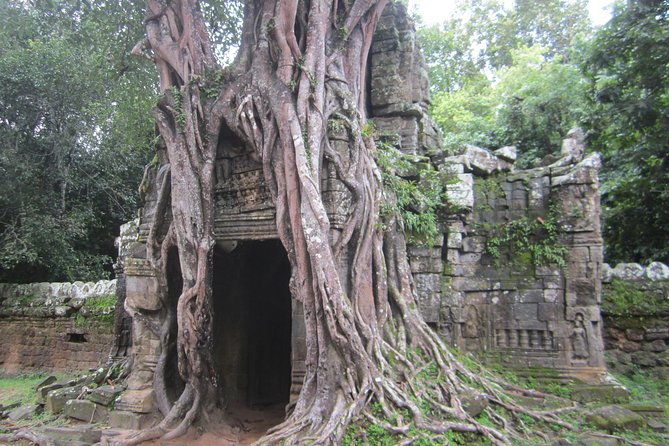
- Ta Som is short, small, and memorable
- Neak Pean offers a different setting
- East Mebon brings out the elephants
- Banteay Srei is the afternoon centerpiece
- Banteay Samre adds another quiet temple
- Pre Rup closes the temple sequence
- What the $59 price really covers
- The private format is useful here
- Who should choose this tour
- Should you book the Grand Circuit tour?
- FAQ
- How long does the tour last?
- What temples are included?
- Is the Angkor Pass included?
- Does the tour include lunch?
- Is transportation included?
- Is hotel pickup offered?
- Is this a private tour?
- Is an English-speaking guide included?
- What should I wear to the temples?
- Can I cancel for a full refund?
Key points to know before booking
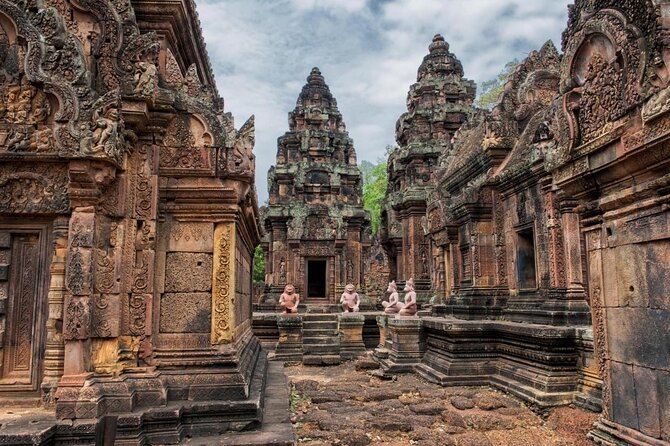
- Banteay Srei is the visual highlight: Its pink sandstone and precise carvings make it unlike the larger temple complexes.
- Seven temples fill the day: You will see Preah Khan, Ta Som, Neak Pean, East Mebon, Banteay Srei, Banteay Samre, and Pre Rup.
- The tour is private: Only your own group participates, with an English-speaking guide and air-conditioned transport.
- The Angkor Pass costs extra: Budget $37 per person for a one-day pass if you do not already have one.
- The schedule mixes long and short visits: Preah Khan and Banteay Srei receive about two hours each, while East Mebon and Ta Som take about 30 minutes.
- Dress matters: Your thighs and shoulders must be covered at the temple complexes, or entrance may be refused.
Why this Grand Circuit day works
This is a good choice if you have already seen the main Angkor temples or if you want a fuller day of Khmer sites beyond the usual first-time route. The stops are spread across different periods and styles, so the day feels less repetitive than a string of similar ruins.
You begin with temples built under several Khmer kings, then head farther out toward Banteay Srei and Banteay Samre. Along the way, the route passes villages, and the schedule allows for a stop to take photos or see more of daily Cambodian life, depending on how the day runs.
The tour lasts about eight to nine hours. That is long enough to cover the sites properly, but you should expect heat, walking, stone steps, and several hours of moving between monuments. Air conditioning in the car or minivan is not a luxury here. It gives you a useful break between visits.
Your English-speaking guide is included, along with transport and bottled drinking water. The operator has used guides including Bunpheng, Pheng, and Chen, with Mai named as a driver on past tours. Since staff assignments can vary, you can ask who will guide your group when you book.
More Banteay Srei visits:
- Full-Day Banteay Srei & 4 Temples – Grand Tours Join-in Tour
5.0 · 1,155 reviews - Siem Reap Tour: Angkor Wat Sunrise, Bayon, Ta Prohm, Banteay Srei
5.0 · 931 reviews - 2-Day Angkor Wat With Small, Big Circuit and Banteay Srei Tour
5.0 · 545 reviews
Preah Khan gives you room to explore
Preah Khan is the largest early stop, with about two hours set aside. Built by King Jayavarman VII in the 12th century, its name means Royal Sword, and it was dedicated to his father.
I like the way Preah Khan rewards a slower walk. Its long passageways, courtyards, carved doorways, and partly ruined walls create a strong sense of movement through an old religious complex. You are not just looking at one central tower. You are following a sequence of spaces.
Two hours is useful here because the temple has enough corners to make a quick visit feel rushed. Your guide can help explain the role of Jayavarman VII and the Buddhist setting, while also pointing out changes made to the site over time.
The drawback is that Preah Khan can be tiring at the start of a long day. You will do a fair amount of walking over uneven ground, and the open areas offer limited relief from the sun. Wear shoes with a firm sole and keep your water close.
Ta Som is short, small, and memorable
Ta Som follows with a visit of roughly 30 minutes. Like Preah Khan, it was built by Jayavarman VII in the 12th century.
This is a compact stop, but it gives the day a change of scale. Instead of another huge complex, you get a smaller ruin with a more intimate feel. Ta Som is also associated with a tree growing around part of the temple, one of those details that makes a brief visit worthwhile.
Thirty minutes will not allow for a long, unhurried study of every carving. Still, the short stop works well in the larger plan. You see another Jayavarman VII temple without spending so much time that the day loses its pace.
Neak Pean offers a different setting
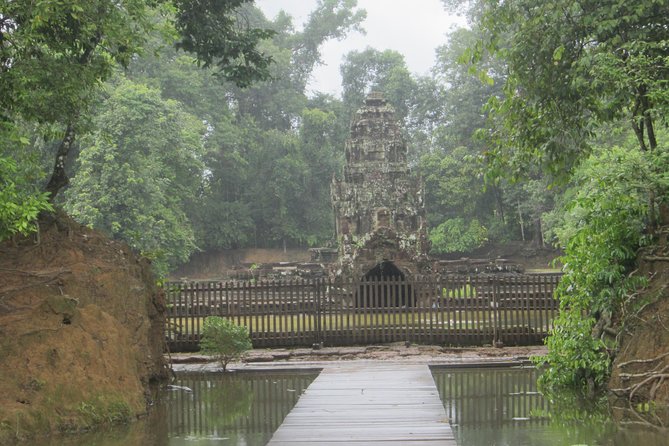
Neak Pean takes about 45 minutes. It is a 12th-century Buddhist temple built on a man-made island, and its name refers to entwined serpents.
The approach is part of the experience. The temple sits in a watery setting rather than being presented as a large stone mass on dry ground. That gives you a useful contrast with Preah Khan and Ta Som.
Your guide can explain the symbolic purpose of the site and its connection to water. The visit is more about the arrangement and setting than about walking through a vast building.
You should keep your expectations sensible. Neak Pean is not a long temple exploration, and the view of the central structure can be more important than the amount of time spent inside. The 45-minute allocation is enough for a look, photographs, and an explanation without overloading the stop.
A different pace for your next Siem Reap morning:
- Angkor Wat Sunrise or Sunset Tour with Guide from Siem Reap
5.0 · 12,109 reviews - Siem Reap: Angkor Wat: Small-Group Sunrise or Sunset Tour
5.0 · 9,444 reviews - From Siem Reap: Kampong Phluk Floating Village Tour by Boat
4.9 · 6,979 reviews - Sunset tour of Kampong Phluk stilts home village on the Tonle Sap
5.0 · 4,865 reviews
East Mebon brings out the elephants
East Mebon takes about 30 minutes and dates from the 10th century. It is a useful example of earlier Khmer architecture, before the later temples associated with Jayavarman VII.
The elephant sculptures are the detail to watch for. They give the monument a more grounded, protective character and provide a welcome visual shift after the Buddhist temples on the morning route.
A half-hour is brief, but it suits the site if you want an overview rather than a long archaeological study. Your guide can place East Mebon in the wider development of Khmer temple design, helping you see why it looks different from Preah Khan or Banteay Srei.
The main limitation is simple: you will not have unlimited time for every corner. If East Mebon is especially important to you, tell your guide early and ask how much flexibility the private schedule allows.
Banteay Srei is the afternoon centerpiece
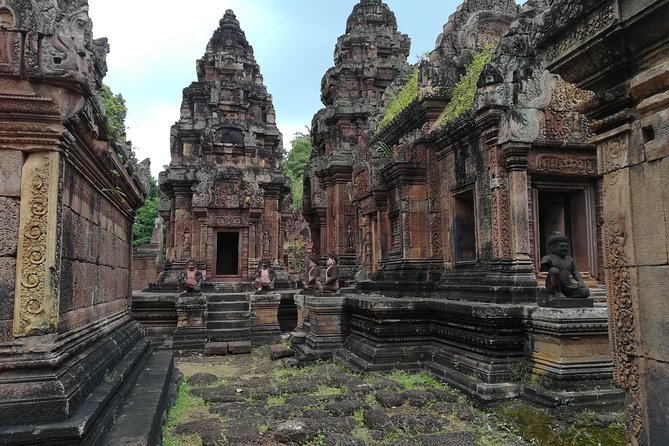
Banteay Srei receives about two hours, and that is the right amount of time for the most detailed stop of the day. Its name is often translated as Citadel of the Women, and it is known for intricate carvings of Hindu gods in pink sandstone.
The stone is smaller in scale and more finely worked than the massive blocks you see at larger Angkor monuments. Look closely at the lintels, pediments, and figures. The craftsmanship is the reason this temple earns such a long visit.
Banteay Srei also changes the rhythm of the tour. After several large or partly ruined sites, you arrive at a temple where the carved surfaces demand close attention. I like that the schedule does not treat it as a quick photo stop.
The drive out also gives you a chance to see villages along the way. You may stop for photographs or to experience a little of rural Cambodian life, though the exact timing depends on the day and the group.
Banteay Srei is outside the central cluster, so the road time adds to the day. That is the tradeoff. You spend more time in the vehicle, but you gain one of the most distinctive temples in the Angkor area.
Banteay Samre adds another quiet temple
On the return from Banteay Srei, the route includes Banteay Samre, with about an hour allocated to the stop. This gives you another chance to see a less crowded temple complex rather than rushing straight back to Siem Reap.
Banteay Samre has a more enclosed, fortress-like arrangement than some of the other sites. The visit also helps break up the journey from Banteay Srei, making the long afternoon return more manageable.
An hour is enough for a guided walk and photographs. If you are already tired by this point, it is still a substantial stop, so save some energy for it. The tour packs a lot into one day, and the final temples can feel harder if you have treated the morning as a race.
Pre Rup closes the temple sequence
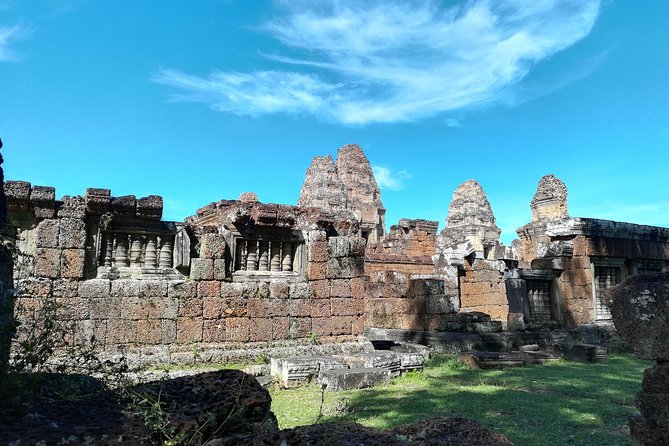
Pre Rup is a Hindu temple built in the late 10th century and dedicated to Shiva. The visit lasts about 40 minutes.
Its position at the end gives you a final look at an earlier Khmer design tradition. By this point, you have seen Buddhist temples from the 12th century, an early Khmer monument, a pink sandstone shrine, and another Hindu temple. That range is one of the strongest reasons to choose this route.
Pre Rup includes steep stone levels, so take care on the steps and do not rush. Forty minutes is enough for an overview, but the stop may feel physically demanding after a full day in the heat.
The original schedule places lunch at your own expense, with a restaurant recommended during the day. That arrangement gives you some practical choice, but it also means the $59 tour price is not your complete spending total.
What the $59 price really covers
At $59 per person, the tour covers the English-speaking guide, air-conditioned transportation, and bottled water. Because the activity is private, the value improves if you are sharing the cost with family or friends, especially if a group discount applies.
You must add the one-day Angkor Pass, listed at $37 per person. Lunch and other drinks are also extra, so your basic day comes to at least $96 per person before food.
That total is fair for a full private day with a guide and transport, but it is not a budget temple shuttle. You are paying for convenience, interpretation, and a route that would be awkward to organize by yourself in one day.
The tour is commonly booked well ahead, with an average booking point of about 50 days in advance. If your dates are fixed, arranging it early is sensible, particularly if you want a specific guide or vehicle type.
The private format is useful here
Only your own group participates. That matters because the day includes seven stops, long transfers, and different levels of walking. You can ask your guide to spend more time at Banteay Srei or Preah Khan, within the limits of the schedule.
The private setup also gives you a better chance to manage the heat. You can ask for a short pause, take photographs without waiting for a large group, and return to the air-conditioned vehicle when a temple visit is complete.
Pickup is offered, and transport may be by an air-conditioned car, minivan, or minibus. The exact vehicle depends on the group. Bottled water is provided, but you should still dress for sun and bring anything else you need for a full day out.
The tour suits most people, but it is not a soft sightseeing ride. You will walk through temple grounds, handle uneven surfaces, and climb steps at some sites. Cover your shoulders and thighs from the start so you are not turned away at a temple entrance.
Who should choose this tour
I would choose this day if you want variety more than a single iconic monument. It is especially well suited to you if the central Angkor temples are already familiar, or if you have enough time in Siem Reap to look beyond the standard highlights.
It also suits people who want historical context. Guides such as Pheng and Chen have been described as fluent in English and able to explain Khmer kings, religion, and Cambodian culture in detail. Bunpheng has also been praised for kindness and for helping visitors understand local life.
Families and small groups may appreciate the private format. You are not tied to strangers, and the vehicle, guide, and water are already arranged.
I would think twice if you dislike long days or want a slow, single-site visit. Seven temples in eight to nine hours is a lot. The route is rewarding because of its range, but you will need to accept a steady pace.
Should you book the Grand Circuit tour?
Book it if you want Banteay Srei, prefer quieter temples, and value having a guide explain what you are seeing. The strongest parts are the range of sites, the two-hour visit at Banteay Srei, the private format, and the chance to see villages beyond the central temple area.
Skip it if your priority is the lowest possible cost, since the Angkor Pass and lunch are not included. You should also choose another plan if you want to linger at each temple or avoid a full day of walking and driving.
For most small groups with one full day available, this is a well-planned way to see the Grand Circuit and the outlying temples. Just budget for the full cost, dress correctly, and save some energy for Pre Rup at the end.
FAQ
How long does the tour last?
The tour lasts approximately eight to nine hours.
What temples are included?
The route includes Preah Khan, Ta Som, Neak Pean, East Mebon, Banteay Srei, Banteay Samre, and Pre Rup.
Is the Angkor Pass included?
No. A one-day Angkor Pass costs $37 per person and is not included in the tour price.
Does the tour include lunch?
No. Lunch and drinks are at your own expense. A restaurant is recommended during the tour.
Is transportation included?
Yes. Transportation is included, using an air-conditioned car, minivan, or minibus.
Is hotel pickup offered?
Yes. Pickup is offered.
Is this a private tour?
Yes. Only your own group participates in the activity.
Is an English-speaking guide included?
Yes. An English-speaking tour guide is included.
What should I wear to the temples?
You must cover your thighs and shoulders when entering the temple complexes. Incorrect clothing may result in refused entrance.
Can I cancel for a full refund?
Yes, if you cancel at least 24 hours before the experience start time. Cancellations or changes made less than 24 hours before the start time are not accepted for a refund.
Fresh reviews from around Siem Reap
- Full-Day Tour Preah Vihea & Koh Ker Temple 3.7 · 3 reviews
- Savor the Countryside: Tours with Authentic Cooking Classes” 5.0 · 3 reviews
- Angkor Wat Sunrise TukTuk Tour 5.0 · 3 reviews
- Angkor Grand Circuit Tour & Banteay Srei 5.0 · 3 reviews
- Guided Private Tuk Tuk Tour Angkor Wat and Small Circle and Five Extras 5.0 · 3 reviews
- Siem Reap Temple Tour 2-Day with Sunrise/Sunset 3.7 · 3 reviews
- Bangkok to Angkor Wat 2 Days 1 Night by Flight 4.5 · 3 reviews
- Kompong Pluk Tour 5.0 · 3 reviews
Banteay Srei Tours, compared.
Full-Day Banteay Srei & 4 Temples – Grand Tours Join-in Tour
Read our review →
2-Day Angkor Wat With Small, Big Circuit and Banteay Srei Tour
Read our review →
3-Days Discovery Of Angkor: Waterfalls,Floating Village and Banteay Srei temple
Read our review →
Browse the lists this tour appears in