Reviewed · FULL-DAY
Full Day Temples Explorer – Small Group
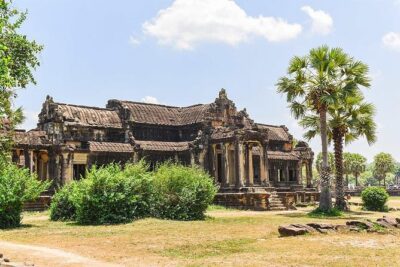
Angkor’s biggest sights fit into one well-planned day here, with Angkor Wat, Bayon, and Ta Prohm forming the main arc. You also pause at Angkor Thom’s South Gate, the Terrace of the Leper King, the Terrace of the Elephants, and Srah Srang.
I like the small-group format and the practical hotel pickup. I also like the guides’ focus on more than stonework: Noy explains Cambodia’s culture and past, while Sok is praised for bringing the temple stories to life. The main catch is that the $19 fare does not include the $37 temple pass, and the lunch details need clarification before booking.
In This Review
- Quick points to know
- Why this one-day Angkor route works
- Angkor Wat gets the opening three hours
- Angkor Thom begins at the South Gate
- Bayon and its enormous stone faces
- Srah Srang and the midday pause
- Ta Prohm closes the day among trees and stone
- The small-group setup and vehicle
- What the $19 price really buys you
- Guide quality can shape the whole day
- Who should book this Angkor day?
- Should you book Full Day Temples Explorer?
- FAQ
- What temples does the tour visit?
- How long does the tour last?
- What time does the tour start?
- Is hotel pickup included?
- Is transportation air-conditioned?
- Is the English-speaking guide included?
- How much does the tour cost?
- Is the temple pass included?
- Is lunch included?
- Can children under five join?
Quick points to know
- Three major temples in one day: Angkor Wat, Bayon, and Ta Prohm give you the classic Angkor experience without adding a second full day.
- A compact group: The tour is described as a maximum of 10 people, though the additional information lists up to 15.
- Hotel pickup in Siem Reap: You start at about 8:00 am in an air-conditioned vehicle and return to your hotel.
- Strong guide element: Guides including Noy and Sok explain temple design, Cambodian culture, and local history in English.
- Budget price, extra admission: The tour costs $19 per person, but you must buy the $37 temple pass directly at the site.
- Lunch is unclear: The schedule says lunch is included at a Khmer local restaurant, while the exclusions say lunch is available at your own choice and not included.
Why this one-day Angkor route works
I see this as a practical first day for you in Siem Reap. It covers the three temples most people hope to see, then adds the grand entrance to Angkor Thom and two smaller stopping points. You get a broad look at the complex without spending several days moving between ruins.
The route also has a sensible rhythm. Angkor Wat receives the longest visit, Bayon gets enough time for its unusual face towers, and Ta Prohm comes after lunch when its tree-covered corridors provide a change of mood. That variety matters. A full day of similar temple courtyards can blur together, but these places feel quite different from one another.
The tour begins at 8:00 am, with pickup from your Siem Reap hotel. The vehicle is air-conditioned, and mineral water is provided. That is more than a small comfort in Cambodia, where a day outside among exposed stone galleries can become tiring.
You should still set your expectations correctly. This is a highlights tour, not a slow archaeological study. The schedule allows about three hours at Angkor Wat, one and a half hours at Bayon, and one and a half hours at Ta Prohm, with shorter stops around them. If you want to inspect every carving or sit quietly at each shrine, you will feel rushed.
Other Siem Reap experiences to weigh up
- Siem Reap: Full-Day Angkor Wat Guided Tour with Sunset
4.9 · 3,803 reviews - Full-Day Angkor Wat Sunrise Private Tour with Guide from Siem Reap
5.0 · 2,920 reviews - Siem Reap: Angkor Wat Sunrise and Full-Day Sightseeing Tour
4.9 · 2,828 reviews
Angkor Wat gets the opening three hours
Angkor Wat is the centerpiece, and the schedule gives it roughly three hours. That is the right call. This is not a temple you can sensibly reduce to a quick photo stop.
Your guide introduces Angkor Wat as the world’s largest religious monument and helps you make sense of its scale. The site can feel confusing at first, with galleries, towers, courtyards, and long approach paths competing for attention. A clear explanation gives each part a place in the larger plan.
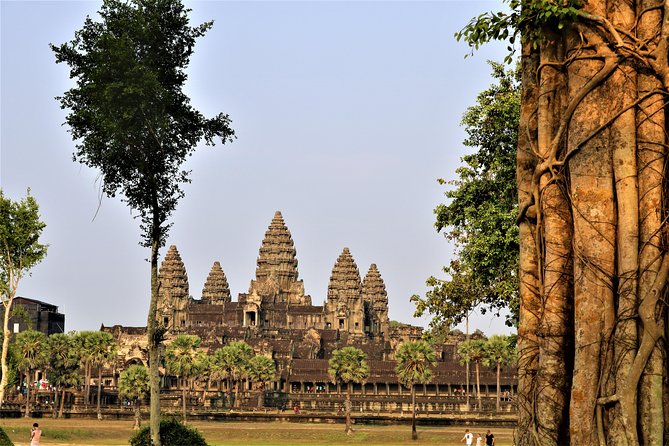
I like starting here because it gives you the grandest architectural statement first. The long approach, the broad water defenses, the galleries, and the central towers show the ambition of the Khmer builders. You can take in the exterior and then spend time inside rather than racing through the complex.
Three hours is useful, but it is not unlimited. You may need to choose between lingering over carved walls, exploring every passage, and pausing for photographs. Listen to your guide’s introduction, then keep an eye on the meeting time so you do not shorten the later temple visits.
The temple pass is not included. You pay $37 per person directly to the site, so the advertised $19 cost is only the tour service. Your practical day cost begins at $56 before lunch, assuming the pass price supplied here remains current. That is still a fair price for transport, a guide, water, and a full day, but it is not a $19 all-in temple visit.
Angkor Thom begins at the South Gate
The South Gate takes about 30 minutes. It is a brief stop, but it gives you one of the most memorable approaches in the Angkor complex.
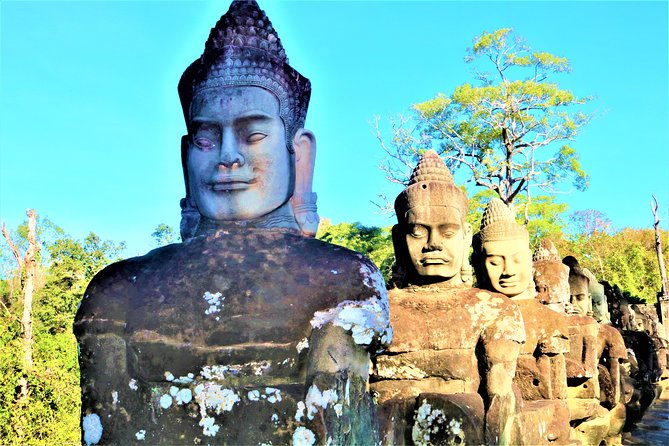
A row of 54 stone figures lines each side of the causeway. Gods stand on the left and demons on the right, creating a dramatic entrance into the fortified city of Angkor Thom. The arrangement is easy to miss if you only stop for a quick picture, so this is a place where your guide’s explanation adds real value.
I would treat the South Gate as a visual introduction rather than a full sightseeing session. You get time to look at the figures and understand the entrance, then continue toward the city’s main monument. If you prefer long, unhurried stops, 30 minutes may feel short. For a one-day route, it keeps the program moving.
The schedule also passes by the Terrace of the Leper King and the Terrace of the Elephants. These are not listed as extended visits, so you should think of them as added context along the way rather than separate attractions with dedicated exploration time.
Bayon and its enormous stone faces
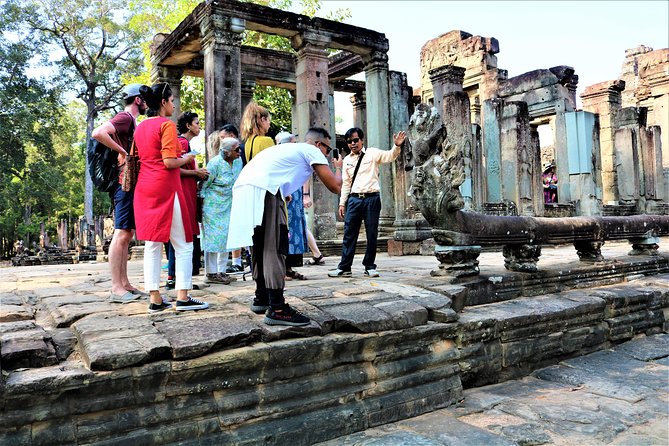
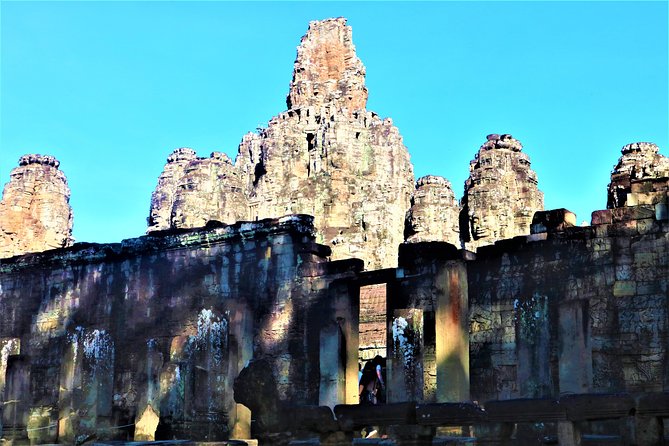
Bayon receives about an hour and a half. For many people, this is the most striking stop after Angkor Wat.
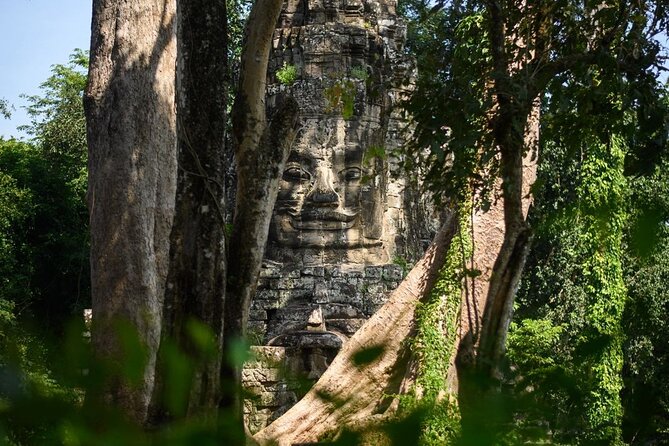
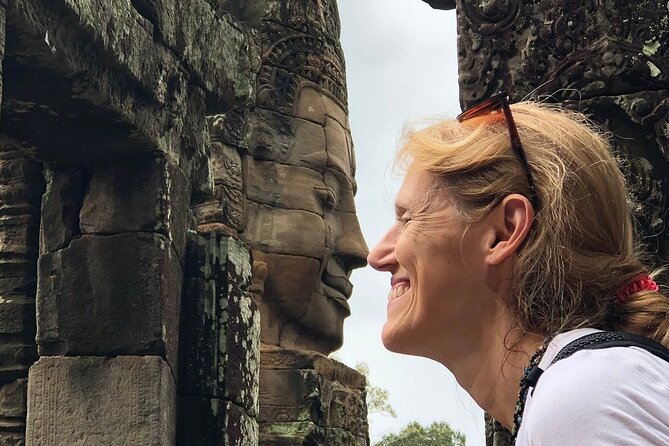
The temple is known for its central towers covered with more than 200 enormous faces. As you move through the interior, faces appear from different angles, sometimes close and sometimes partly hidden by the surrounding stonework. The effect is personal and slightly uncanny, especially compared with Angkor Wat’s more ordered design.
Your guide can help you understand Bayon’s place in Angkor Thom, once the capital of the Khmer Empire. That context keeps the visit from becoming a hunt for the best face photograph. Look closely at how the towers are arranged and how the narrow interior spaces open into larger views.
The one-and-a-half-hour visit is a good middle ground. You have time to see the main structure and hear an explanation, though not enough to inspect every carved surface. If you want a quieter experience, move away from the first obvious viewing points when possible, but follow the guide’s timing carefully.
The strongest part of this experience is the human explanation around the stones. Noy is described as covering both the temples and Cambodia’s wider culture and past. Sok is praised for a strong command of the Angkor sites and for explaining the story throughout the visits. Guide quality can vary on any group tour, but the named guides associated with this experience suggest that interpretation is meant to be central, not an afterthought.
A different pace for your next Siem Reap morning:
- Angkor Wat Sunrise or Sunset Tour with Guide from Siem Reap
5.0 · 12,109 reviews - Siem Reap: Angkor Wat: Small-Group Sunrise or Sunset Tour
5.0 · 9,444 reviews - From Siem Reap: Kampong Phluk Floating Village Tour by Boat
4.9 · 6,979 reviews - Sunset tour of Kampong Phluk stilts home village on the Tonle Sap
5.0 · 4,865 reviews
Srah Srang and the midday pause
The lunch break takes about an hour at Srah Srang, with a Khmer local restaurant named in the schedule. This pause is placed between Bayon and Ta Prohm, which makes sense for your energy and attention.
The supplied details conflict on one important point. The itinerary says lunch is included, while the exclusions say lunch meals are not included and are available at your own choice. I would confirm this with Tourme ANGKOR before you pay. Do not assume the $19 fare covers the meal.
Srah Srang itself is associated with a reservoir setting and provides a natural point to stop after the morning temples. The schedule gives you an hour, enough for a meal and a rest before returning to the ruins. Since the tour provides mineral water, you have at least one basic refreshment covered during the day.
I like the placement of the break because Ta Prohm is best approached with some energy left. Still, an hour is not a long lunch if service is slow or you want time to look around. Keep the group’s departure time in mind.
Ta Prohm closes the day among trees and stone
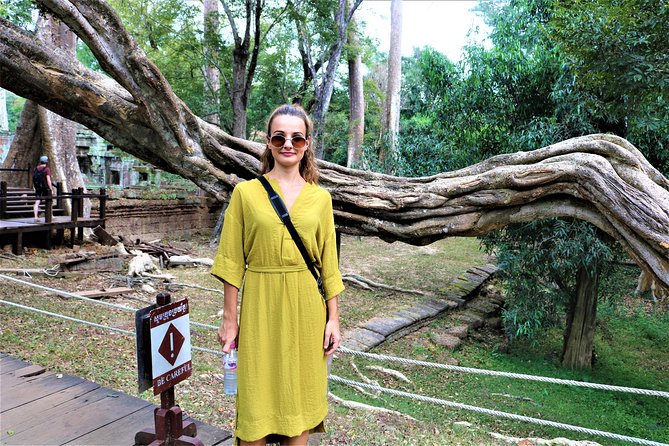
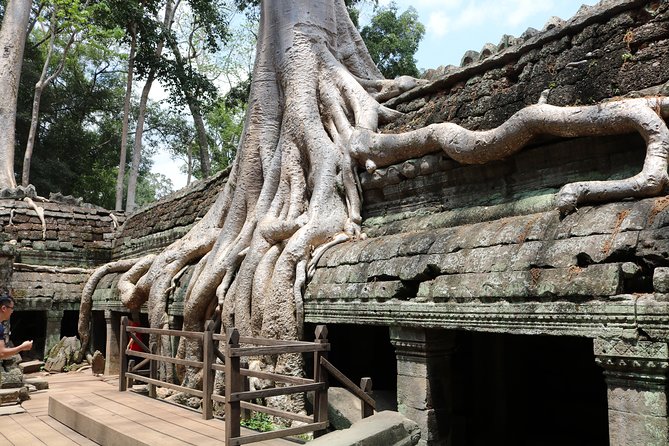
Ta Prohm receives about one and a half hours and provides the most atmospheric finish. The temple is enveloped by jungle, with trees growing around and over sections of the ruins. It feels very different from Angkor Wat’s open formality and Bayon’s crowded stone faces.
Ta Prohm was once home to 2,740 monks. That fact gives the site a human scale, even when the fallen walls and roots make it feel wild. Your guide can help you picture the temple as a working religious center rather than only a dramatic ruin.
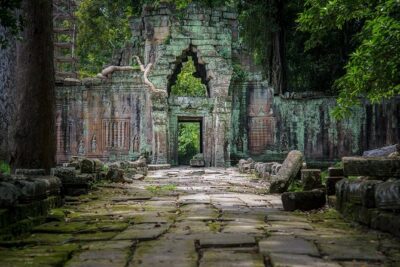
The attraction here is the tension between nature and architecture. Tree roots press against walls, doorways frame broken stone, and narrow passages make the temple feel maze-like. You will want to stop often, but the route still follows a schedule.
One and a half hours is enough to experience the main paths and hear the important explanation. It is not enough for every corner. The afternoon timing may also mean more heat, so use the provided water and pace yourself. Ta Prohm is a strong final stop because its mood stays with you after the grander monuments have begun to blend together.
The small-group setup and vehicle
The tour is marketed as a small group with a maximum of 10 people, while the additional information allows up to 15 travelers. That difference is worth asking about before booking. Ten people would feel more personal and make it easier to hear the guide. Fifteen is still a manageable vehicle group, but it gives you less room to ask questions or linger.
The air-conditioned minivan is an important part of the value. You are not only paying for a ride between temples. You are getting a cool place to recover between long walks and a guide who can explain what you are seeing while the group moves through the complex.
Pickup and drop-off are offered from hotels in Siem Reap City. The start time is 8:00 am. Since the tour lasts about eight hours, plan for most of your day to be committed to the route.
The experience is suitable for most people, but children under five are not allowed on this small-group tour. The provided information does not give a detailed mobility assessment, so you should ask the operator directly if you have concerns about walking or temple access.
What the $19 price really buys you
At $19 per person, the tour service is inexpensive for an eight-hour outing. You receive hotel transport, an English-speaking licensed guide, an air-conditioned vehicle, mineral water, and local tax.
The temple pass changes the calculation. At $37, it costs more than the tour itself. Add the two together and you are looking at $56 per person before any lunch charge. That is still good value if you want a guided route and do not want to arrange transport between widely separated temples, but you should compare the full cost, not the headline fare.
I especially like the value for first-time visitors. A guide helps you understand why the South Gate matters, how Bayon differs from Angkor Wat, and why Ta Prohm has such a distinctive look. You also avoid spending time arranging separate rides between each stop.
You pay for convenience rather than luxury. This is a shared outing on a fixed schedule, not a private tour with flexible stops. If you already know Angkor well and want to set your own pace, a private driver may suit you better. If you want the key temples explained and organized in one day, this price is attractive.
Guide quality can shape the whole day
The strongest praise attached to this experience centers on the guides. One guide is described as bringing insight and wisdom, not just facts. Another, Noy, explains temple details while also discussing Cambodia’s culture and past. Sok is singled out for a strong command of Angkor and for sharing that understanding throughout the route.
That matters because Angkor rewards explanation. Without context, you may see a row of gods and demons, a face tower, or tree roots around a wall. With a good guide, you can connect those details to the religious and political purpose of the sites.
The operator also identifies an experienced, licensed English-speaking guide as part of the tour. Individual guide assignments can change, so I would not book on the assumption that you will receive a particular person. Still, the available names give you useful points of reference if you want to ask who is leading your departure.
The tour works best if you take part. Ask questions, point out details, and tell the guide what interests you. The small-group design is specifically valuable because it gives you more chance to engage than a large coach tour.
Who should book this Angkor day?
I would choose this tour if you have one full day in Siem Reap and want the major Angkor sights handled in a sensible order. It suits first-time visitors, couples, solo visitors who want company, and anyone who values an English explanation of Cambodian culture alongside the temples.
It also fits a budget-conscious plan. The $19 service price is low, and the air-conditioned transport plus guide removes several planning chores. Just budget separately for the $37 temple pass and clarify lunch.
I would hesitate if you dislike fixed schedules or want to photograph each temple at your own pace. Angkor Wat gets three hours, but the South Gate is brief and the later stops follow a set timetable. The group-size discrepancy also means you should confirm how many people will actually be in your vehicle.
Free cancellation is available if you cancel at least 24 hours before the start time. Changes or cancellations inside that window are not accepted for a refund.
Should you book Full Day Temples Explorer?
Book it if you want a focused first look at Angkor with the main temples, hotel pickup, cooling transport, and a guide who explains more than dates and names. The route is well chosen, and the guides’ cultural explanations can make the temples easier to understand.
Skip it if you need a private pace, dislike group timing, or want a longer lunch and more time at the smaller terraces. Before booking, confirm the final group size and whether lunch is included. Once you add the $37 temple pass, the value remains good, but the real cost is higher than the advertised tour price.
FAQ
What temples does the tour visit?
The tour visits Angkor Wat, Angkor Thom’s South Gate, Bayon Temple, and Ta Prohm Temple. It also passes the Terrace of the Leper King and the Terrace of the Elephants.
How long does the tour last?
The experience lasts about eight hours.
What time does the tour start?
Pickup and the tour start at approximately 8:00 am.
Is hotel pickup included?
Yes. Pickup and drop-off from hotels in Siem Reap City are included.
Is transportation air-conditioned?
Yes. Transport is provided in an air-conditioned vehicle.
Is the English-speaking guide included?
Yes. An experienced, licensed English-speaking tour guide is included.
How much does the tour cost?
The listed tour price is $19 per person.
Is the temple pass included?
No. The Angkor temple pass must be paid directly to the site and costs $37 per person.
Is lunch included?
The supplied information is inconsistent. The schedule says lunch is included at a Khmer local restaurant, while the exclusions say lunch is not included. Confirm this point with Tourme ANGKOR before booking.
Can children under five join?
No. Children under five are not allowed on this small-group tour.
Fresh reviews from around Siem Reap
- Full-Day Tour Preah Vihea & Koh Ker Temple 3.7 · 3 reviews
- Savor the Countryside: Tours with Authentic Cooking Classes” 5.0 · 3 reviews
- Angkor Wat Sunrise TukTuk Tour 5.0 · 3 reviews
- Angkor Grand Circuit Tour & Banteay Srei 5.0 · 3 reviews
- Guided Private Tuk Tuk Tour Angkor Wat and Small Circle and Five Extras 5.0 · 3 reviews
- Siem Reap Temple Tour 2-Day with Sunrise/Sunset 3.7 · 3 reviews
- Bangkok to Angkor Wat 2 Days 1 Night by Flight 4.5 · 3 reviews
- Siem Reap: Prek Toal Tonle Sap Biosphere Reserve Tour 3.1 · 3 reviews
Full-Day, compared.


Full-Day Angkor Wat Sunrise Private Tour with Guide from Siem Reap
Read our review →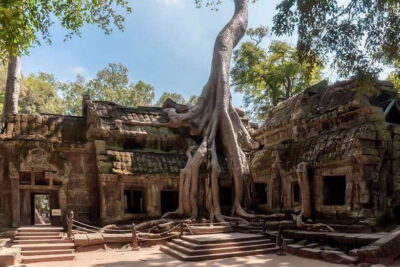
Angkor Wat full Day ‘Small Group with sunset & Tour Guide
Read our review →
Full-Day Banteay Srei & 4 Temples – Grand Tours Join-in Tour
Read our review →