Reviewed · CITY TOURS
Full-Day private Tour with Sun Rise in Lost City & Angkor Wat from Siem Reap
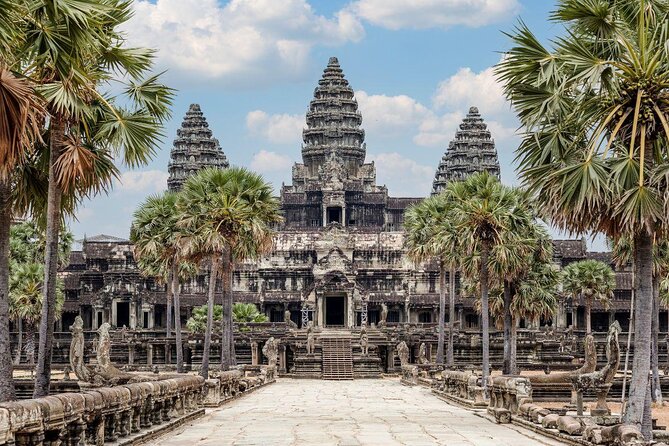
Angkor Wat at sunrise is the hook, but the clever part is entering through the eastern gate in darkness and walking toward the north pool before the crowds gather. You know the temple is ahead, but the trees and early light keep it hidden for a while. I like the quiet approach and the chance to see the towers reflect in the water before the heat takes over.
I also like the private format. Guides such as Rith, Sim, and Sen have been praised for clear English, strong temple knowledge, helpful photography, and an easy manner. The other big plus is the route: after Angkor Wat, you continue through Angkor Thom and finish at atmospheric Ta Prohm instead of treating the sunrise as the whole day.
The main drawback is the early start and the extra cost of admission. The tour is listed at $36 per person, but the Angkor temple pass costs another $37, making the basic total $73 per person before food. You will also walk for much of the morning, so this is not a lazy sightseeing day.
In This Review
- Key points at a glance
- Before dawn at Angkor Wat
- Breakfast near the temple
- Angkor Thom’s South Gate
- Bayon and its stone faces
- Baphuon and the former royal center
- Phimeanakas inside the royal enclosure
- The Leper King and Elephant terraces
- The tour’s flexible side stops
- Ta Prohm’s jungle atmosphere
- Guides who shape the day
- What the $36 price really covers
- Who should book this Angkor day
- Is this private sunrise tour worth booking?
- FAQ
- What is included in the tour price?
- Is the Angkor temple admission fee included?
- How long does the tour last?
- Is hotel pickup available?
- Is this a private tour?
- Which temples and sites are visited?
- What should I wear and bring?
- Can I cancel for a full refund?
Key points at a glance
- Sunrise from Angkor Wat’s north pool: Enter before dawn and wait for the first light over Cambodia’s most famous temple.
- Private guide and vehicle: Your schedule can be adjusted, and only your own party joins the tour.
- Strong guide team: Rith, Sim, and Sen are noted for clear explanations, local stories, photo help, and thoughtful timing.
- A full Angkor circuit in eight hours: See Angkor Wat, Bayon, Baphuon, Phimeanakas, both royal terraces, and Ta Prohm.
- Crowd and heat strategy: The early departure puts the most popular temple first, before the day grows hot.
- Bring or arrange breakfast: A boxed meal from your hotel works well, with time to eat at a local cafe near Angkor Wat.
Before dawn at Angkor Wat
You leave your Siem Reap hotel before sunrise in a private vehicle. The exact pickup time is arranged around sunrise, but expect a very early morning. That is the price of the best light and cooler walking conditions.
At Angkor Wat, the group enters through the eastern gate in darkness. The usual postcard view is from the west, but this approach gives the morning a little drama. You walk along a jungle path toward the north pool, where the temple slowly comes into view as the sky brightens.
Sunrise here is not guaranteed to produce a perfect reflection or a cloudless sky. That is worth knowing before you book. Still, the changing light, the scale of the towers, and the silence before the site fills up make this a strong start to an Angkor day.
Your guide can help you find a useful viewing place, explain the layout, and point out details that are easy to miss in the dark. Sen has been singled out for knowing a good sunrise position, while Rith has been praised for getting groups out early and away from the thickest crowds.
After sunrise, you continue inside the temple. Angkor Wat is not just a facade beside a pond. It is a huge 12th-century religious complex with galleries, courtyards, towers, bas-reliefs, and upper terraces. You will walk through its central chambers and climb to higher levels where access permits.
The site requires patience. The distance between the outer areas and the central sanctuary is considerable, and the stone surfaces can be uneven. Wear flat shoes with a good grip. Clothing should cover your shoulders and knees at temples where that rule applies.
More Angkor temple itineraries:
- Angkor Wat Sunrise or Sunset Tour with Guide from Siem Reap
5.0 · 12,109 reviews - Siem Reap: Angkor Wat: Small-Group Sunrise or Sunset Tour
5.0 · 9,444 reviews - Siem Reap: Angkor Wat 2-Day Tour with Sunrise and Sunset
4.9 · 4,429 reviews
Breakfast near the temple
The tour information recommends taking a boxed breakfast from your hotel. That is practical. You can eat at a local cafe near Angkor Wat rather than lose time returning to Siem Reap.
The morning meal is not included, and the description allows for breakfast or lunch with cold drinks at a local restaurant. Ask your guide how the timing will work on your date. A private tour gives you more control here than a fixed group departure.
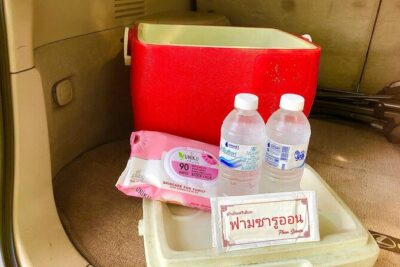
A cafe stop also gives you a short break before the next cluster of temples. This matters because the day combines early rising, heat, stairs, and long walks. Carry the bottled water supplied with the tour, and bring additional water if you know you drink often in hot weather.
Angkor Thom’s South Gate
The next major stop is the South Gate of Angkor Thom, the former capital enclosed by thick walls. The approach crosses a bridge lined with stone figures, with 54 figures on each side according to the tour description.
This is a quick stop, listed at about 30 minutes, but it is a useful introduction to Angkor Thom. Your guide can explain the gate’s defensive role and the symbolism of the figures. It is also one of the better places for a wide photograph of the entrance.
Because this is a road-access stop, you may see vehicles and other groups moving through. The private format helps your guide choose a sensible time for photos rather than keeping you there longer than necessary.
Bayon and its stone faces
Inside Angkor Thom, Bayon receives about an hour. This 13th-century temple served as the state temple of King Jayavarman VII and sits at the center of his capital.
Bayon is famous for its enormous carved faces, which appear from different angles as you move through the towers. The effect is more intimate than Angkor Wat. Angkor Wat impresses with symmetry and scale; Bayon rewards close looking.
Ask your guide to explain the bas-reliefs as well as the faces. The carvings show scenes of warfare, court life, markets, and ordinary activity. Without help, it can be easy to walk past these panels and focus only on the towers.
The interior paths can feel tight, especially when several groups arrive together. This is one place where an early start and a flexible guide help. You should also watch your footing, since old stone steps and raised surfaces are part of the experience.
Other Siem Reap experiences to weigh up
- Siem Reap: Full-Day Angkor Wat Guided Tour with Sunset
4.9 · 3,803 reviews - Full-Day Angkor Wat Sunrise Private Tour with Guide from Siem Reap
5.0 · 2,920 reviews - Siem Reap: Angkor Wat Sunrise and Full-Day Sightseeing Tour
4.9 · 2,828 reviews - Full-Day Guided Sunset Tour of Angkor Wat
5.0 · 1,507 reviews
Baphuon and the former royal center
Baphuon follows with roughly 40 minutes. The supplied description mistakenly repeats the Bayon text for this stop, so you should rely on your guide for the site-specific explanation on the day.
Baphuon is part of the Angkor Thom complex and has a long raised approach that gives the temple a strong sense of procession. You will notice a different scale and design from Bayon. The temple feels more open, with broad stone areas and a structure that rewards views from several directions.
This is another walking stop, not a quick photo pull-over. The heat can build by late morning, so use the shaded moments and drink water before moving on.
Phimeanakas inside the royal enclosure
Phimeanakas, also called Vimeanakas, sits within the walled area of the former royal palace. The temple began near the end of the 10th century under Rajendravarman and was completed under Suryavarman I.
The name is often translated as celestial temple. Its three-tier pyramid form gives you a sense of how the royal center once worked, even though the palace buildings themselves were largely made from perishable materials and are not preserved in the same way as the stone temples.
The stop is listed at about one hour, which allows time to see the temple and the surrounding royal enclosure. The area can feel quieter than Bayon, and it helps connect the grand temples with the administration and daily life of the Khmer court.
You may find this stop less immediately dramatic than Angkor Wat or Ta Prohm. Its value is context. Your guide can help you picture the larger royal complex rather than treating Phimeanakas as an isolated ruin.
The Leper King and Elephant terraces
The Terrace of the Leper King receives about 30 minutes. This U-shaped structure dates to the 13th century and is associated with King Jayavarman VII. Its modern name comes from a statue, though the terrace is also linked by some interpretations to royal cremation practices.
Look closely at the carved inner walls. The terrace is not only a platform viewed from the road. Its enclosed passages contain detailed figures that become clearer when your guide points them out.
Nearby, the Terrace of the Elephants stretches for about 350 meters. It served as a reviewing stand for ceremonies and as a base for the king’s public audiences. The long wall of carved elephants gives the terrace its name and makes the scale of the former capital easier to grasp.
These two terraces are useful stops for understanding power and ceremony. They are not the most secluded parts of Angkor Thom, but they do not require the same time commitment as the major temples. Together, they give the middle of the tour variety.
The tour’s flexible side stops
The schedule includes two brief stops described as special or secret places within Angkor Thom, each about 10 minutes. The exact locations are not specified, which means you should ask your guide what is planned on the day.
This is one of the more appealing features of a private tour. If your guide knows a quieter corner, a useful viewpoint, or a detail that fits your interests, there is room to pause without waiting for a bus full of people.
At the same time, do not book this expecting a long visit to an undisclosed major monument. These are short additions to the route, not separate headline attractions. Their value depends on the guide and on conditions at the site.
Ta Prohm’s jungle atmosphere
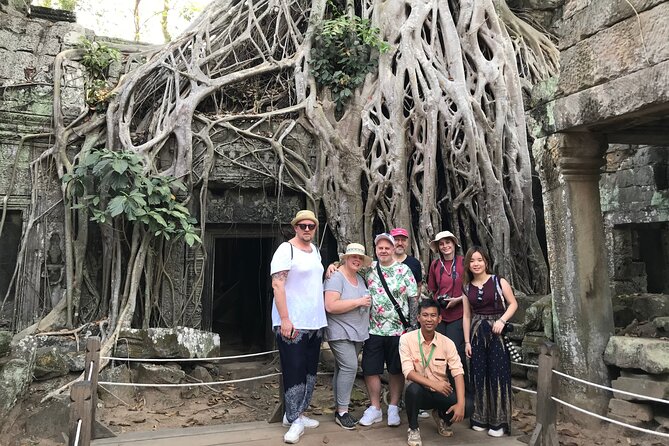
Ta Prohm is the final major stop and receives about an hour. Built in the 13th century, it is best known for trees growing over walls and for its appearance in the film Tomb Raider.
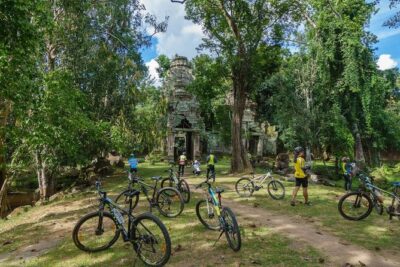
Ta Prohm feels different from Angkor Wat and Bayon. Its appeal comes from the mix of carved stone, collapsed galleries, roots, shade, and narrow passages. The vegetation has become part of the visual identity of the temple, although the site is still an important historic monument rather than a movie set.
The popular scenes can be crowded. Your guide can help you move through the temple in a sensible order and point out less obvious carvings. Do not rush only to the tree-covered sections. The remaining galleries and reliefs are worth attention too.
By this point, you may be tired. That is the honest tradeoff of fitting the major highlights into one eight-hour day. Ta Prohm rewards patience, but you will enjoy it more if you manage your pace earlier at Angkor Wat.
Guides who shape the day
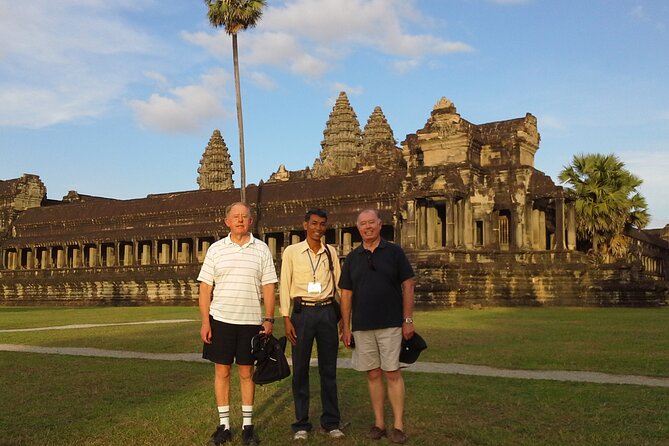
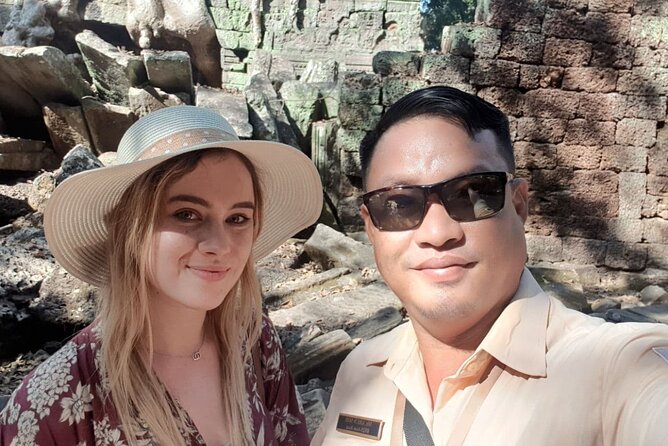
The guide is central to the value of this experience. Rith, also identified as Phorn Bunnarith, has been praised for excellent English, personal stories, answers to questions, photo help, and an ability to keep groups clear of the busiest areas.
Sim has been described as careful about checking pickup details before the morning and making the day run smoothly. Sen has received praise for sunrise positioning, helpful service, and an attentive driver. The tour provider is Journey2 Angkor, and guide assignment can vary, so you should not assume a particular name unless it is confirmed for your booking.
The strongest praise centers on three things: clear explanations, early timing, and a friendly manner. Those qualities matter more here than a memorized list of dates. Angkor is easier to understand when someone connects the temples to kings, religious change, public ceremonies, and Cambodian life.
The private setup also lets you ask for more or less detail. If you want to focus on sculpture, architecture, photography, or Cambodia’s modern story, say so early. The tour is described as flexible to your needs, but flexibility works best when you tell the guide what you want.
What the $36 price really covers
The advertised price is $36 per person. That includes an English-speaking guide, private comfortable vehicle, hotel pickup and drop-off, and bottled water.
The Angkor admission fee is not included. The stated price is $37 per person, so plan on $73 per person for the tour and temple entry. Food and drinks beyond the supplied water are also extra.
That is still a useful package for a private full-day visit. You are paying for transport, a dedicated guide, and a carefully arranged route rather than simply buying entry to the temples. For two or more people, the private vehicle and guide can offer solid value, especially if group discounts apply to your booking.
The value is weaker if you only want a short sunrise visit or prefer to explore without explanation. It becomes stronger if you want the main temples covered in one day, hotel pickup, help with timing, and the freedom to adjust the pace.
Who should book this Angkor day
I would choose this for a first visit to Siem Reap when you have one main temple day and want the major sights in a logical order. It suits couples, families, and small groups who value personal attention and do not want to coordinate tuk-tuks, temple routes, entry procedures, and sunrise timing alone.
It is also a good fit for anyone who wants help with photographs or with the meaning behind the carvings. The guide can make Bayon’s faces, the royal terraces, and Ta Prohm’s galleries more readable.
You should think twice if you dislike early mornings, have trouble with long walks, or want a slow, single-temple visit. The eight-hour plan covers a lot. It is efficient, but not leisurely.
Confirmation is provided when you book, and the guide sends a link for the temple entrance e-ticket several days ahead. Most people can take part, but comfortable shoes, covered shoulders and knees where required, and a plan for breakfast are important.
Free cancellation is available up to 24 hours before the start time for a full refund. Changes or cancellations inside that window are not accepted for a refund.
Is this private sunrise tour worth booking?
Book it if you want to see Angkor Wat at first light and use one well-organized day to cover Angkor Thom and Ta Prohm. The early start, private car, flexible pacing, and strong guide support make the $36 service fee reasonable once you understand that the $37 temple pass is extra.
I would not book it for a relaxed temple day. For that, a shorter private visit may suit you better. But if you have limited time in Siem Reap, this tour gives you the essential Angkor experience, useful cultural context, and a better chance of avoiding the worst heat and crowds.
FAQ
What is included in the tour price?
The price includes an English-speaking tour guide, private vehicle, hotel pickup and drop-off, and bottled water.
Is the Angkor temple admission fee included?
No. The stated admission fee is $37 per person, paid separately from the $36 tour price.
How long does the tour last?
The experience lasts about eight hours.
Is hotel pickup available?
Yes. Hotel pickup and drop-off are included.
Is this a private tour?
Yes. Only your own group participates in the activity.
Which temples and sites are visited?
The route includes Angkor Wat, Angkor Thom’s South Gate, Bayon, Baphuon, Phimeanakas, the Terrace of the Leper King, the Terrace of the Elephants, and Ta Prohm. It also includes two brief special stops within Angkor Thom.
What should I wear and bring?
Wear flat, comfortable walking shoes and clothing that covers your shoulders and knees where temple rules require it. A boxed breakfast from your hotel is recommended.
Can I cancel for a full refund?
Yes, if you cancel at least 24 hours before the experience start time. Cancellations or changes made less than 24 hours in advance are not eligible for a refund.
Fresh reviews from around Siem Reap
- Full-Day Tour Preah Vihea & Koh Ker Temple 3.7 · 3 reviews
- Savor the Countryside: Tours with Authentic Cooking Classes” 5.0 · 3 reviews
- Angkor Wat Sunrise TukTuk Tour 5.0 · 3 reviews
- Angkor Grand Circuit Tour & Banteay Srei 5.0 · 3 reviews
- Guided Private Tuk Tuk Tour Angkor Wat and Small Circle and Five Extras 5.0 · 3 reviews
- Bangkok to Angkor Wat 2 Days 1 Night by Flight 4.5 · 3 reviews
- Siem Reap Temple Tour 2-Day with Sunrise/Sunset 3.7 · 3 reviews
- Kompong Pluk Tour 5.0 · 3 reviews