
Reviewed · SIEM REAP
Discover Cambodia 8 Days from Siem Reap to Koh Trong -Phnom Penh
Angkor Wat is only the opening act here. Over eight days, you move from the great temple cities of Siem Reap to a car-free Mekong island, then on to Phnom Penh’s royal sights and sobering genocide museums. I like that this private Cambodia tour shows far more than the famous temples.
I also like the comfortable pace created by breaking up long drives with villages, markets, pagodas, and river stops. Guides such as Sara, Sarat, Pysedh, Tokk, and Leap have been praised for clear English, historical insight, flexibility, and warm care, though your assigned guide may be different. The main drawback is the amount of road travel, especially on the transfer from Siem Reap to Kratie.
In This Review
- Key points to know before booking
- What the $1,223.10 price really covers
- Day 1: A soft landing in Siem Reap
- Day 2: Angkor Thom, Ta Prohm, and Angkor Wat
- Day 3: Floating villages and Siem Reap’s living culture
- Day 4: From Siem Reap to the Mekong at Kratie
- Day 5: Bicycle paths, markets, and Mekong dolphins
- Day 6: Villages, pagodas, and Skun’s unusual market
- Day 7: Phnom Penh’s palace and painful modern history
- Day 8: A simple departure from Phnom Penh
- Guides, vehicles, and the pace of the route
- Who should book this Cambodia tour?
- FAQ
- Where does the tour begin?
- Where does the tour finish?
- How long is the experience?
- Is this a private tour?
- Is an English-speaking guide included?
- What accommodation is included?
- Are meals included?
- How physically active is the tour?
Key points to know before booking
- Angkor in one packed day: Angkor Thom, Bayon, Ta Prohm, and Angkor Wat receive the main focus on Day 2.
- A quiet Mekong pause: Koh Trong is car-free, about 7 kilometers long, and explored by bicycle.
- Private transport matters: Your group has its own air-conditioned vehicle, driver, and English-speaking guide.
- History beyond temples: Phnom Penh includes the Royal Palace, Silver Pagoda, Tuol Sleng, and Choeung Ek.
- Good hotel coverage: The price includes double, twin, or triple-share accommodation, usually in 4-star hotels.
- A demanding middle section: The journey through Kampong Thom, rubber country, Kratie, and Kampong Cham involves long road days.
What the $1,223.10 price really covers
At $1,223.10 per person, this is not a budget bus trip. It is priced as an eight-day private journey with hotel accommodation, seven breakfasts, entrance fees, an English-speaking guide, and private air-conditioned transport. That bundle can be good value if you want a smooth route without arranging separate transfers, temple tickets, and local guides.
The private format is especially useful in Cambodia. You can ask questions, adjust the pace, and spend more time at a temple or market if your guide agrees. One guide, Pysedh, was praised for adding time for a last-minute elephant sanctuary visit, which gives you an idea of the flexibility possible on a private booking.
The accommodation is based on double, twin, or triple sharing. Two nights are described as being in a traditional Khmer house on Koh Trong, although the named hotel for those nights is Mekong Dolphin Hotel or a similar property. Ask the operator to confirm the exact room and island arrangement before paying, particularly if you are traveling alone or want a private room.
Tips for the guide and driver are not included. You should also budget for personal meals beyond the included breakfasts and any optional spending. The tour provides a strong sightseeing framework, but it is not an all-inclusive holiday.
Travellers planning Siem Reap days often pair this one with:
- Angkor Wat Sunrise or Sunset Tour with Guide from Siem Reap
5.0 · 12,109 reviews - Siem Reap: Angkor Wat: Small-Group Sunrise or Sunset Tour
5.0 · 9,444 reviews - From Siem Reap: Kampong Phluk Floating Village Tour by Boat
4.9 · 6,979 reviews
Day 1: A soft landing in Siem Reap
Your guide and driver meet you at Siem Reap Angkor International Airport and take you to a city-center hotel. The transfer is listed at about two hours, including an introduction to Siem Reap and Cambodia from your guide.
That first conversation matters. Cambodia can feel easier to understand when someone explains the country’s temples, modern government, recent past, and daily life before you begin sightseeing. You stay at the Regency Angkor Hotel or a similar 4-star property.
There is no major sightseeing stop on arrival day, which is sensible after a flight. Use the evening to rest rather than trying to force in another attraction. You will need energy for Day 2, the heaviest temple day of the tour.
Day 2: Angkor Thom, Ta Prohm, and Angkor Wat
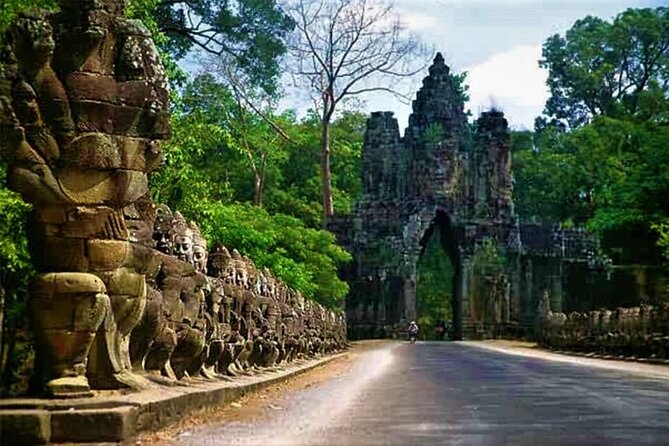
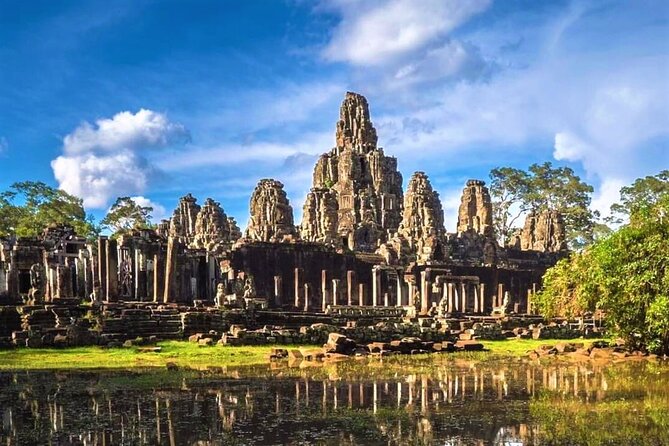
Day 2 is the visual center of the trip. After breakfast, you enter Angkor Thom through the South Gate, a restored entrance lined with monumental figures. The gate is a quick stop, but it prepares you for the scale of the old royal city.
The Bayon receives about 90 minutes. Its towers, carved with enormous serene faces, are the temple’s great reward. Unlike Angkor Wat, which is carefully balanced and highly ordered, Bayon feels more crowded, mysterious, and difficult to read. A good guide can help you understand how it fitted into Jayavarman VII’s royal city.
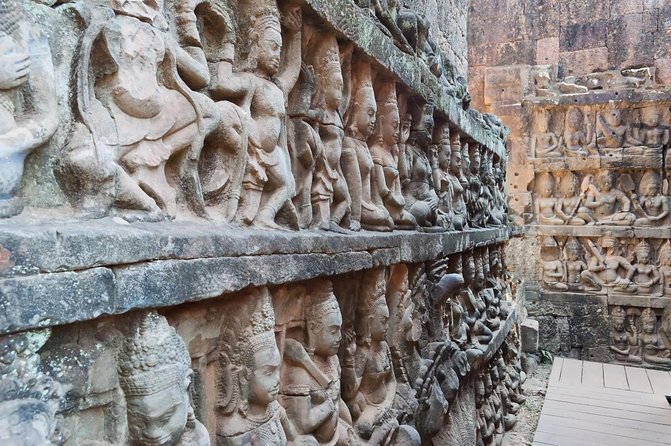
You then spend about an hour exploring Angkor Thom itself, followed by Baphuon, Phimeanakas, the Terrace of the Elephants, and the Terrace of the Leper King. These stops show that Angkor is not just a collection of isolated temples. It was a planned capital with ceremonial spaces, royal enclosures, processional routes, and layers of religious change.
Baphuon has a long raised approach and several levels, while Phimeanakas sits near the center of the former royal palace area. The two terraces are less instantly famous than Bayon, but they help fill in the city’s story. The carved galleries of the Terrace of the Leper King deserve close attention, especially if your guide points out the reliefs tucked inside the walls.
Ta Nei is a quieter stop deep in the forest. Its small scale and relative obscurity offer a welcome change after the larger monuments. The path and site conditions may be less polished than at the major temples, so wear shoes suitable for uneven ground.
Ta Prohm gets 90 minutes and is one of the most atmospheric stops. Trees grow through the stonework, and the temple has been cleared only enough to allow access and prevent further structural damage. The setting is memorable, but it can also be crowded and slow to navigate.
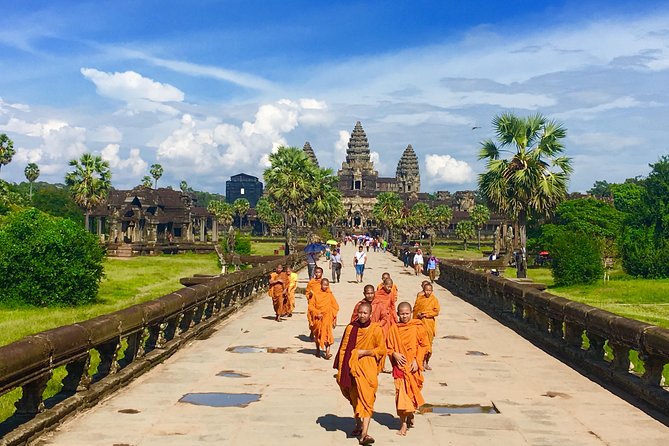
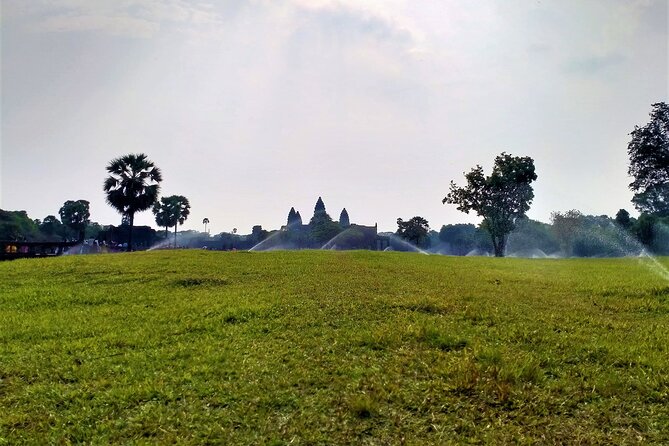
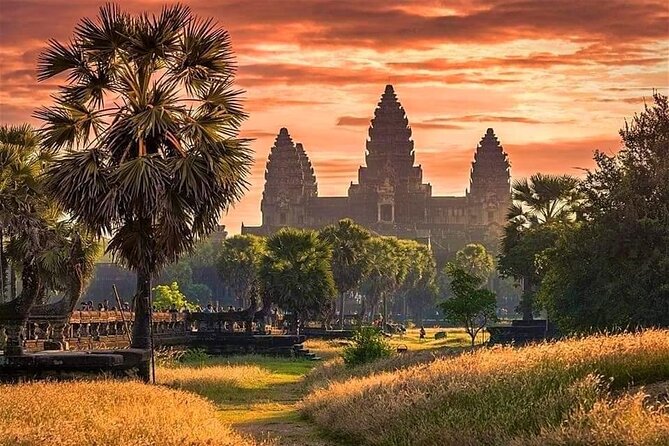
Angkor Wat receives about two hours. You will see why it is Cambodia’s signature monument: the composition, proportions, carved galleries, and preserved structure are exceptional. Two hours is enough for a first visit, but not enough to study every relief or explore every corner. That is the trade-off of placing so many major sites into one day.
This is a long day with considerable walking, steps, heat, and sun. The supplied guidance calls for moderate physical fitness. Bring water, cover your shoulders and knees at temple sites, and listen to your guide about where the route can be shortened.
Day 3: Floating villages and Siem Reap’s living culture
Day 3 shifts from stone to water and craft. Tonle Sap is Southeast Asia’s largest freshwater lake, and its size changes sharply between the dry and monsoon seasons. That seasonal rhythm shapes the surrounding communities and makes the lake more than a scenic boat ride.
At Kampong Phluk, you take a traditional wooden boat through a floating village about 35 kilometers southeast of Siem Reap. The village is home to more than 3,000 people, and houses are built to cope with changing water levels. Conditions can vary by season, so the exact appearance of the village and boat route may not be the same throughout the year.
Wat Preah Prom Rath offers a short stop beside the river. Its colorful wall paintings and modern religious statues provide a look at living Cambodian Buddhism, not just ancient ruins. I like this kind of pause because it keeps the tour from turning Cambodia into an archaeological display.
At Artisans Angkor, you see a social business that creates rural jobs while reviving Khmer crafts. The visit adds an economic angle to the trip, though you may feel pressure to browse or buy. Treat it as a chance to learn about craft training rather than assuming every item is a must-have.
The West Baray, a huge man-made reservoir surrounded by an earthen embankment, rounds out the day. It is a quieter historical site and a useful reminder of the engineering behind Angkor’s success.
You return to the Regency Angkor Hotel or a similar property. Compared with Day 2, this day has a more varied rhythm, though the boat ride and village visit depend on water conditions.
A different pace for your next Siem Reap morning:
- Sunset tour of Kampong Phluk stilts home village on the Tonle Sap
5.0 · 4,865 reviews - Siem Reap: Angkor Wat 2-Day Tour with Sunrise and Sunset
4.9 · 4,429 reviews - Siem Reap: Kampong Phluk Floating Village Tour with Boat
4.9 · 3,843 reviews - Siem Reap: Full-Day Angkor Wat Guided Tour with Sunset
4.9 · 3,803 reviews
Day 4: From Siem Reap to the Mekong at Kratie
Day 4 is the tour’s biggest travel transition. You leave Siem Reap for Koh Trong Island near Kratie, with stops that break up the drive.
Spean Praptos, also known as the Naga Bridge, is an old Angkor-period bridge. It is a brief stop, but it makes the road itself part of the sightseeing. In Kampong Thom, you pass through the city and visit a stone-cutting village, where large sandstone statues are made.
The route continues through a rubber plantation near Stueng Trang, described as Cambodia’s largest rubber-growing area. This is an agricultural view of the country, far removed from temple corridors. The plantation stop lasts about an hour, and the drive then heads toward the Mekong and Kratie.
In Kratie, you cross the river by boat to Koh Trong and walk along the Mekong riverside. The crossing is short, but it changes the mood at once. You are no longer in a major sightseeing center. You are on an island where daily life moves at a slower pace.
Overnight accommodation is listed as Mekong Dolphin Hotel or a similar property. Confirm whether your room is on Koh Trong itself and clarify the traditional-house setup, since the accommodation description uses both terms.
Day 5: Bicycle paths, markets, and Mekong dolphins
Koh Trong is designed for a slower morning. The island has no cars, is about 7 kilometers long and 1 kilometer wide, and is home to roughly 500 families. You explore by bicycle for about three hours, passing through a rural setting at a much gentler speed than the temple circuits.
The cycling is one of the most distinctive parts of the tour. It gives you time to notice homes, small farms, and river life without viewing everything through a vehicle window. The tour does require moderate fitness, and you should be comfortable riding for several hours.
Back in Kratie, Samaki Market offers a practical look at provincial life. Local products fill the stalls, and colonial buildings surround the market area. It is a useful stop for seeing what people buy and sell, rather than simply visiting another monument.
Phnom Sambok Pagoda is a cultural site and tourist area with a hilltop setting. The 100-Column Pagoda, about 36 kilometers north of Kratie, adds another religious and architectural stop. Both sites are best approached with your guide’s explanation, since the buildings can otherwise blur together after several days of temples and pagodas.
The day’s most fragile attraction is the Mekong dolphin area. You take a boat into a conservation zone to look for critically endangered freshwater dolphins. The two-hour boat outing supports a meaningful conservation story, but wildlife is never guaranteed. Keep expectations realistic and treat the river setting as part of the experience, not just a search for animals.
You spend another night at Mekong Dolphin Hotel or a similar property. This is the tour’s best chance to slow down before the road journey resumes.
Day 6: Villages, pagodas, and Skun’s unusual market
You leave the Mekong region for Phnom Penh, with stops around Kampong Cham. The city is Cambodia’s third largest, but the route also passes through rural areas, giving you a mix of town and countryside.
Dei Doh Pagoda is a short religious stop with a pair of well-preserved sandstone lions. The site has been built over in places, so it is not as visually complete as the major Angkor monuments. Its value lies in seeing how older stonework fits into an active modern temple setting.
Cheung Kok Village is supported by the French NGO Amica, which works with residents toward a more sustainable rural economy. Villagers grow rice, but the area can harvest only one crop a year. That detail gives the stop real context: rural Cambodia is shaped by water, soil, markets, and seasonal limits, not just postcard scenery.
The final unusual stop is Skun, known for its spider market. It is an optional-feeling spectacle even though it is built into the route. If you are curious about Cambodian food culture, it is a memorable look at a local market specialty. If the sight of fried spiders is not for you, you can focus on the rest of the market rather than treating the stop as a test of courage.
You spend the night at the Sun & Moon Urban Hotel or a similar 4-star property in Phnom Penh. This is another substantial road day, so do not plan a demanding evening activity unless your arrival time allows it.
Day 7: Phnom Penh’s palace and painful modern history
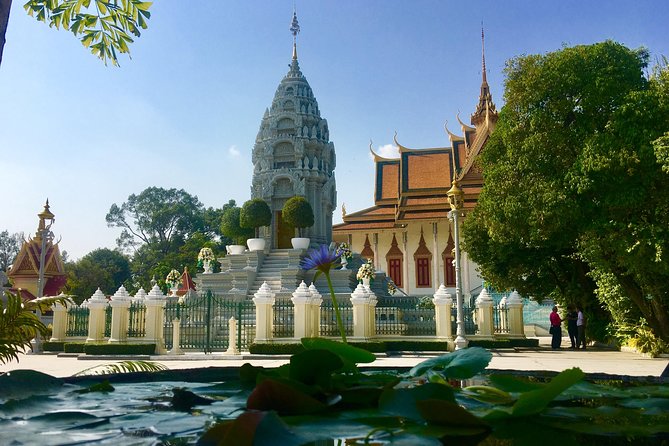
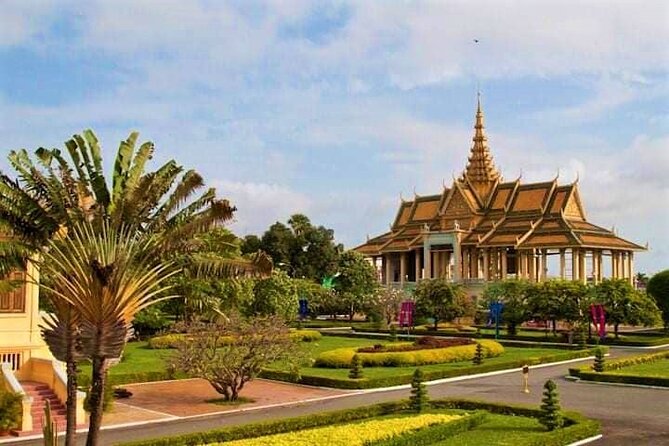
Day 7 gives Phnom Penh its full due. The Royal Palace was begun in 1886 after King Norodom moved the royal capital to the city. The complex remains one of the capital’s central landmarks, with ornate buildings and formal grounds.
Next door, the Silver Pagoda is known for its polished silver floor and important Buddhist objects. The gardens offer a calm break from city traffic. Allow about 90 minutes for the palace and another hour for the pagoda, and dress respectfully for both.
Wat Phnom sits on the city’s only hill, a tree-covered knoll about 27 meters high. According to local legend, the first pagoda here was built in 1373 to house four Buddha statues found by a woman named Penh. It is a compact visit, but the site gives Phnom Penh its name and offers a different scale from the palace.
The Independence Monument and the statue of King Father Norodom Sihanouk are brief but useful city stops. Wat Ounalom, one of Phnom Penh’s five original monasteries, sits near the river and was once home to the Institute Bouddhique and its library.
The emotional center of the day is Tuol Sleng Genocide Museum, the former Security Prison 21. You then continue to Choeung Ek, a former orchard and mass burial site about 17 kilometers south of the capital. These places document the Khmer Rouge period from 1975 to 1979. They are essential for understanding Cambodia, but they are not light sightseeing. Give yourself quiet time afterward.
Central Market closes the day with a more ordinary side of Phnom Penh. Its 1937 domed building contains long corridors of stalls selling food, clothing, and goods. After the palace and memorial sites, the market brings you back to the city’s present-day rhythm.
The route is full. If you need more time at Tuol Sleng or Choeung Ek, tell your guide early. A private vehicle makes that conversation easier than it would be on a fixed group bus.
Day 8: A simple departure from Phnom Penh
After breakfast, you have free time until your driver meets you in the hotel lobby. The transfer to Techo International Airport is provided without a guide and is listed at about three hours.
The long transfer estimate gives you a useful safety margin, but check your departure details with the operator. The tour ends at the airport, with no sightseeing planned on the final day.
Guides, vehicles, and the pace of the route
The strongest part of this experience is the combination of a private driver and a guide who can explain what you are seeing. Named guides praised for their service include Mr. Sara, Mr. Tokk, Pysedh, Leap, and Sarat. Their reported strengths include clear English, friendliness, safety, flexibility, and the ability to bring Cambodia’s past to life through stories.
Your guide and driver will not necessarily be one of those people, so treat the names as examples rather than a promise. The vehicle is air-conditioned, and several accounts specifically praised safe driving, cold water, and cold towels after temple visits.
The route is not physically extreme, but it is active. Expect walking at Angkor, temple steps, boat rides, bicycle riding on Koh Trong, and long hours in the car. The private format helps, yet it cannot remove Cambodia’s heat or road distances.
Who should book this Cambodia tour?
I would choose this trip if you want Angkor Wat but also want to see Cambodia outside Siem Reap and Phnom Penh. It suits first-time visitors who prefer a ready-made route, couples or families sharing a private vehicle, and solo visitors who value personal guidance and a sense of security.
It is less suitable if you want a slow beach holiday, dislike long drives, or prefer to spend several days exploring one city. The itinerary is ambitious, and Day 2 and Days 4 to 6 can feel long.
Book it for the range: ancient capitals, living temples, floating homes, a car-free Mekong island, endangered dolphins, rural villages, royal Phnom Penh, and the country’s painful recent past. At this price, the value comes from the private logistics and included admissions, not from luxury. Confirm the exact hotels, island accommodation, room supplement if needed, and guide arrangements before booking.
FAQ
Where does the tour begin?
The tour begins with pickup at Siem Reap Angkor International Airport in Siem Reap, Cambodia.
Where does the tour finish?
The tour finishes with a transfer to Techo International Airport in Phnom Penh on Day 8.
How long is the experience?
The tour lasts approximately eight days.
Is this a private tour?
Yes. Only your own group participates, with private transfers in an air-conditioned vehicle.
Is an English-speaking guide included?
Yes. An English-speaking tour guide is included for the sightseeing portions of the trip. The final airport transfer is provided without a guide.
What accommodation is included?
Accommodation is based on double, twin, or triple sharing. The tour lists 4-star hotels or similar properties, including the Regency Angkor Hotel and Sun & Moon Urban Hotel, plus two nights connected with traditional Khmer-house accommodation on Koh Trong.
Are meals included?
Seven breakfasts are included. Tips for the guide and driver are not included.
How physically active is the tour?
You should have a moderate level of physical fitness. The itinerary includes walking at Angkor and Phnom Penh, temple steps, boat trips, and about three hours of bicycling on Koh Trong Island.
Fresh reviews from around Siem Reap
- Full-Day Tour Preah Vihea & Koh Ker Temple 3.7 · 3 reviews
- Savor the Countryside: Tours with Authentic Cooking Classes” 5.0 · 3 reviews
- Angkor Wat Sunrise TukTuk Tour 5.0 · 3 reviews
- Angkor Grand Circuit Tour & Banteay Srei 5.0 · 3 reviews
- Guided Private Tuk Tuk Tour Angkor Wat and Small Circle and Five Extras 5.0 · 3 reviews
- Siem Reap Temple Tour 2-Day with Sunrise/Sunset 3.7 · 3 reviews
- Bangkok to Angkor Wat 2 Days 1 Night by Flight 4.5 · 3 reviews
- Kompong Pluk Tour 5.0 · 3 reviews