Reviewed · TOURS
Cambodia 7 Days Tour from Siem Reap to Battambang and Phnom Penh
Angkor Wat is only the beginning here. This seven-day route links Cambodia’s grandest temples with floating villages, rural roads, Battambang’s old streets, a bamboo train, and Phnom Penh’s royal and sobering historic sites. I like that you get both headline sights and less-visited places such as Banteay Chhmar, although this itinerary does not actually list Banteay Chhmar as a scheduled stop, so you should confirm that point before booking.
I especially like the private transport and the steady help of an English-speaking guide. Past trips have been led by guides including Sara, Vany, Chany, and Meng, with driver Art praised for careful driving. The main drawback is the pace: several days are packed from morning to evening, and the Phnom Penh day asks you to take in both genocide sites and major city sights in one long stretch.
In This Review
- Key points at a glance
- What the seven-day route does well
- Day 1: A gentle arrival in Siem Reap
- Day 2: Angkor Thom, Ta Prohm, and Angkor Wat
- Day 3: Tonle Sap and Siem Reap’s local side
- Day 4: Battambang by bamboo train and mountain road
- Day 5: From Battambang to Oudong
- Day 6: Phnom Penh’s palace and painful past
- Transport, meals, and what you pay for
- Should you book this Cambodia route?
- FAQ
- How long is the Cambodia tour?
- Where does the tour begin?
- Where does the tour end?
- Is this a private tour?
- What is included in the price?
- Are meals other than breakfast included?
- Is there an extra charge for a single room?
- Are guide and driver tips included?
Key points at a glance
- Angkor in one powerful day: Bayon, Ta Prohm, Angkor Wat, and Phnom Bakheng are joined by the royal monuments of Angkor Thom.
- A private seven-day road journey: Your own group travels with a driver and English-speaking guide, rather than following a large shared coach.
- Tonle Sap beyond the shoreline: Kampong Phluk adds a look at floating village life and a mangrove setting.
- Battambang brings variety: Ride the bamboo train, explore old pagodas, visit Phnom Sampeau, and watch millions of bats leave the cave at sunset.
- Cambodia’s recent past is treated seriously: Tuol Sleng and Choeung Ek give the Phnom Penh portion emotional weight.
- The price covers the useful basics: Six hotel breakfasts, accommodation, water, transport, guide service, and entrance fees are included.
What the seven-day route does well
At $1,025.05 per person, this is not a shoestring Cambodia trip. It is a private, organized journey with six nights of accommodation, transport between cities, a guide, water, breakfasts, and admission fees included. That matters because the route covers Siem Reap, Battambang, and Phnom Penh, with several out-of-town stops that would be awkward to arrange one by one.
The real value is time saved. You do not need to find separate drivers for Angkor, Tonle Sap, Battambang, Oudong, and Phnom Penh. You also avoid piecing together hotels and entrance arrangements while moving every day or two. Group discounts may be available, so the per-person cost can look better for families or friends booking together.
Hotels are offered at three levels. In Siem Reap, the choices range from Royal Crown Hotel & Spa to Regency Angkor Hotel and Angkor Paradise Hotel. In Battambang, the options include Classy Hotel & Spa, Cambana La Riviere Hotel, and Maisons Wat Kor. Phnom Penh choices range from Mahasakor Inn to Sun & Moon Urban Hotel and Sun & Moon Riverside.
Because the wording says or similar, you should confirm the exact hotel before paying. The supplied information indicates central, clean hotels were part of some past stays, but the precise property and room category can vary. Twin or double accommodation is included. A single room costs an extra 40 percent of the total tour price per person, a significant supplement for solo visitors.
Travellers planning Siem Reap days often pair this one with:
- Angkor Wat Sunrise or Sunset Tour with Guide from Siem Reap
5.0 · 12,109 reviews - Siem Reap: Angkor Wat: Small-Group Sunrise or Sunset Tour
5.0 · 9,444 reviews - From Siem Reap: Kampong Phluk Floating Village Tour by Boat
4.9 · 6,979 reviews
Day 1: A gentle arrival in Siem Reap
Your guide and driver meet you at Siem Reap Angkor International Airport and take you into Siem Reap City. The airport transfer is listed at about two hours, though that figure likely includes orientation and city transfer time rather than two hours of driving alone.
This is a sensible first day. You arrive, learn about the city, and settle into your hotel instead of being pushed straight into temple ruins. Siem Reap is the base for the Angkor Archaeological Park, so the location gives you an easy start for the following morning.
The guide is an important part of this trip. The strongest feedback centers on friendly service, clear explanations, patience, and the ability to adjust the day. Names that have received special praise include Sara, Vany, Chany, and Meng. Your assigned guide may be someone else, but you can reasonably expect English-language guiding as part of the package.
Day 2: Angkor Thom, Ta Prohm, and Angkor Wat
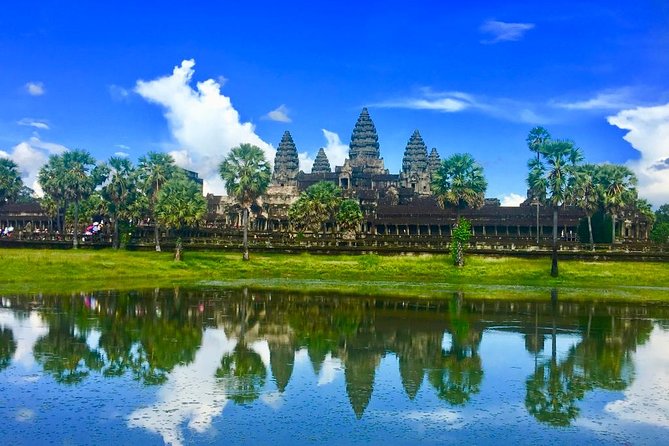
Day two is the tour’s big temple day, and it is full. You begin at the South Gate of Angkor Thom, where monumental faces and guardian figures introduce the scale of the old Khmer capital.
The Bayon gets about an hour and ten minutes. Its towers, carved faces, and enclosed galleries reward a guide who can explain what you are seeing without turning every stone into a lecture. Baphuon follows, with about 45 minutes to explore its tall sandstone base and long approach.
Phimeanakas, the Terrace of the Elephants, and the Terrace of the Leper King fill out the royal center of Angkor Thom. These stops are shorter, but together they help you understand that Angkor was not just a collection of temples. It was a royal city with ceremonial spaces, walls, roads, reservoirs, and working communities.
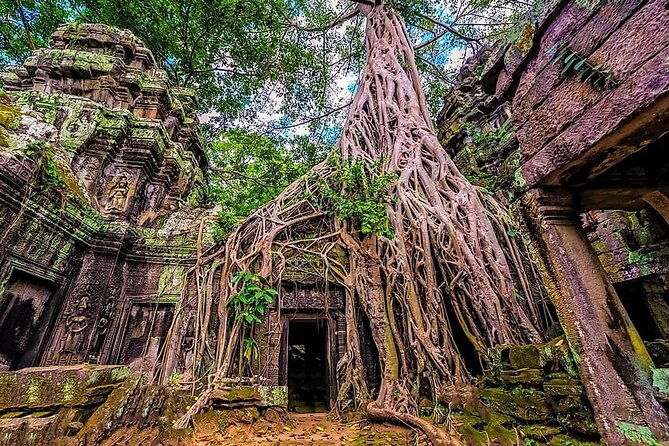
Ta Prohm receives two hours, which is welcome. Its towers and galleries are tangled with large tree roots, and it has the atmospheric quality many people hope to find at Angkor. The site can feel crowded, so the time is best used with patience rather than trying to rush from one famous view to the next.
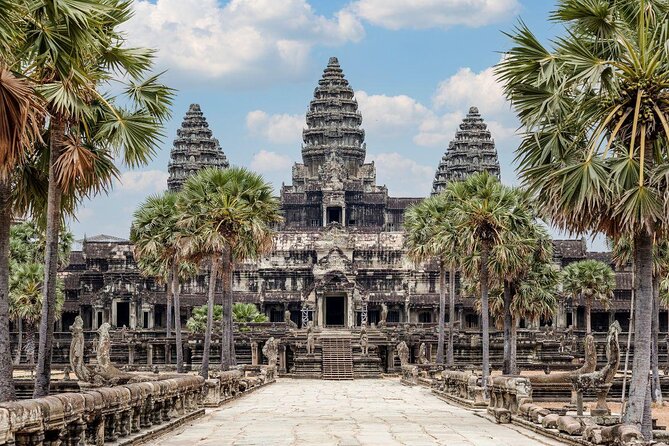
You then get about two hours at Angkor Wat. That is enough for a meaningful visit, but the temple is so large that you will not see every corner. Look for the long bas-reliefs, the balanced towers, the courtyards, and the scale of the outer galleries. The guide can help you read the building as a religious and political statement instead of a series of photo stops.
Phnom Bakheng closes the day with a hilltop temple and wide views. The schedule gives it about an hour. If the timing brings you there near sunset, expect this to be a popular point. The day is physically demanding, with heat, steps, uneven ground, and a lot of walking. Carry water, use sun protection, and wear shoes that grip.
The order and timing may change. Ask your guide early in the day how the stops will be handled, especially if you care about avoiding the busiest periods. The admission fees are included, which simplifies this major sightseeing day.
Day 3: Tonle Sap and Siem Reap’s local side
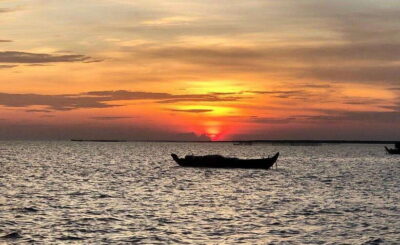
The third day shifts from stone temples to water and living culture. Tonle Sap is Southeast Asia’s largest freshwater lake and supports fishing communities, including floating villages inhabited largely by ethnic Cambodian residents.
Kampong Phluk is given about three hours, plus two hours for Tonle Sap itself. The village is known for homes and structures adapted to changing water levels, as well as a mangrove forest. Water conditions and seasonal changes affect how the village looks, so the experience is not a fixed outdoor display. Your guide can help explain how lake life fits into the wider economy.
This is one of the route’s more useful contrasts. After the formal grandeur of Angkor, you see a place shaped by water, fishing, transport, and local routines. Keep your expectations realistic: it is a sightseeing visit, not a homestay or a hands-on village program.
Back in Siem Reap, Artisans Angkor introduces traditional Khmer crafts and a social business that creates rural jobs while reviving local skills. The one-hour stop has practical value if you want to understand how Cambodian crafts are taught and sold. It also gives you a chance to buy something made locally, though the price and shipping arrangements for large objects need care.
One past issue involved mailing a one-meter Cambodian traditional guitar to Europe. A large purchase may not fit in checked or carry-on luggage, so ask about packing and postage before you buy. That is a small point, but it can save you an expensive surprise.
Wat Bo is one of Siem Reap’s older pagodas, with 19th-century wall paintings. The Royal Residence follows, with about 30 minutes. The residence is the King of Cambodia’s official home when he visits Siem Reap, so access and viewing may be limited. Treat this as a brief exterior or grounds visit rather than a full palace tour.
A different pace for your next Siem Reap morning:
- Sunset tour of Kampong Phluk stilts home village on the Tonle Sap
5.0 · 4,865 reviews - Siem Reap: Angkor Wat 2-Day Tour with Sunrise and Sunset
4.9 · 4,429 reviews - Siem Reap: Kampong Phluk Floating Village Tour with Boat
4.9 · 3,843 reviews - Siem Reap: Full-Day Angkor Wat Guided Tour with Sunset
4.9 · 3,803 reviews
Day 4: Battambang by bamboo train and mountain road
The road to Battambang changes the mood again. Battambang is Cambodia’s second-largest city, known for colonial buildings and traditional wooden houses, some more than a century old. The city portion is less monumental than Angkor and more about streets, markets, pagodas, and everyday life.
The bamboo train gets about two hours. A norry is a simple platform placed on railway wheels, and the ride is remembered for its novelty and directness. It is not a polished museum attraction. That is part of the appeal, though you should expect a basic experience rather than luxury transport.
The itinerary also includes Battambang Central Market, listed with an unusually long duration of one day and 21 hours. That is clearly not a realistic market visit. Read it as a market stop within the Battambang day, and confirm the actual timing with the operator.
Wat Tahm-rai-saw, also called the White Elephant Pagoda, offers a look at local religious architecture. The Cambodia Peace Gallery then adds a modern focus on peace, recovery, and Cambodian participation in peace efforts around the world. This is an important balance to the later genocide museums. Cambodia’s past cannot be reduced to war alone.
Ek Phnom Pagoda is an atmospheric, partly collapsed 11th-century temple about 11 kilometers north of Battambang. Its laterite walls and old reservoir remains add a quieter archaeological stop, though the ruin is less complete than Angkor Wat or Bayon.
Phnom Sampeau is a roughly 100-meter-high mountain shaped, according to its name, like a ship. The visit lasts about two hours and is followed by the bat caves. Near sunset, millions of bats stream into the sky from the caves. It is a striking natural event, but timing matters. You will want to arrive before the flight begins, and your guide will need to manage the schedule carefully.
The Ta Dumbong Kro Aung statue closes the day. The figure is linked to Battambang’s name and a local legend about a cow herder, a magic black stick, and the overthrow of a king. It is a quick stop, but legends like this give the city a local voice beyond its colonial facades.
Day 5: From Battambang to Oudong
Day five is primarily a transfer day from Battambang toward Phnom Penh. That means you should expect road time, not a full day of sightseeing. The route stops at Pursat and Oudong Mountain before reaching the capital.
Udong served as Cambodia’s royal capital from the 17th to the 19th centuries. Its two hilltop mounds are connected by a ridge, and the visit gives you a different view of royal Cambodia than Phnom Penh’s palace. The one-hour stop may involve slopes and steps, so pace yourself in the heat.
Another stop is identified by map coordinates rather than a clear attraction name. The description points to a meditation center where you may walk through the gardens and enter the main temple. The center teaches Vipassana meditation, but the tour does not promise a meditation session. Consider this a quiet cultural pause, not a formal retreat.
Your Phnom Penh hotel is one of the Mahasakor Inn, Sun & Moon Urban Hotel, or Sun & Moon Riverside, or a similar property. Since you have already spent several days on the road, a central hotel is useful for an evening walk or meal, though no evening program is specified.
Day 6: Phnom Penh’s palace and painful past
The final full day is ambitious. It begins with Cambodia’s Khmer Rouge history and continues through royal Phnom Penh, old pagodas, monuments, and Central Market.
Tuol Sleng Genocide Museum occupies the former Security Prison 21, a secondary school converted into a prison during the Khmer Rouge regime. The displays are difficult, direct, and necessary. Allow yourself emotional space. This is not a light sightseeing stop.
Choeung Ek, also called the Killing Field, lies about 17 kilometers south of Phnom Penh. The former orchard and mass graves are treated as a historical site, and the visit adds context to what you saw at Tuol Sleng. Together, the two places explain the machinery and human cost of the 1975 to 1979 genocide.
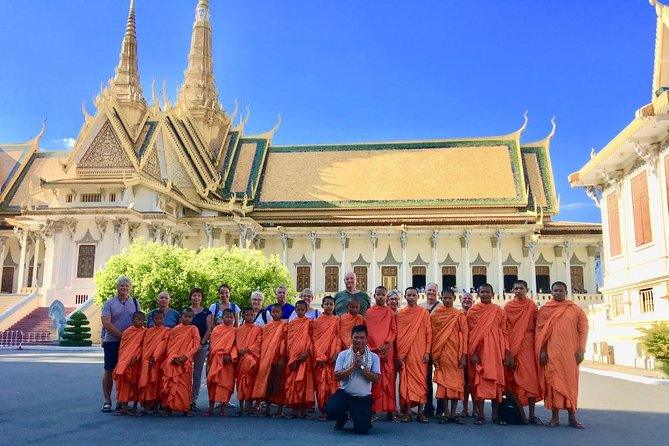
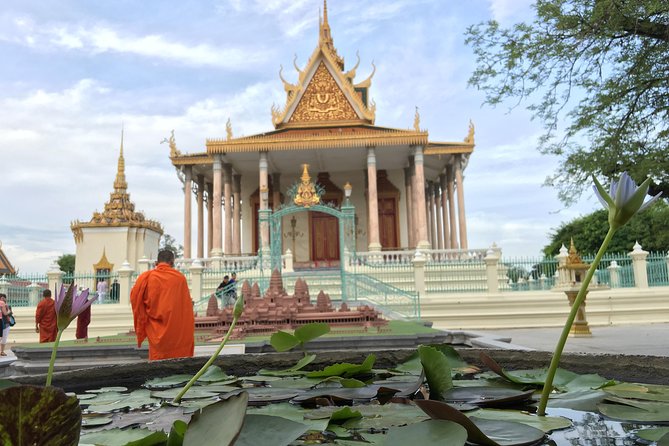
The schedule then moves to the Royal Palace and Silver Pagoda. The palace began construction in 1886 after King Norodom moved the royal capital to Phnom Penh. The Silver Pagoda, set in gardens beside the palace, is known for its decorative interior and religious objects.
Wat Phnom sits on a 27-meter hill and is tied to the story of four Buddha statues found by a woman named Penh. It is a compact stop with a strong connection to the city’s name and founding legend.
The Independence Monument commemorates independence from France in 1953. Nearby, the statue of King Father Norodom Sihanouk offers a more recent national memorial. Wat Ounalom, one of Phnom Penh’s five original monasteries, sits near the riverfront and adds another layer of Buddhist life.
Central Market finishes the day with a large domed building from 1937 and rows of stalls. It is useful for browsing food, clothing, small goods, and souvenirs after the more formal monuments. The day is long, and the pairing of genocide sites with palace visits can feel emotionally uneven. Still, it gives you a broad picture of Phnom Penh in a limited amount of time.
Transport, meals, and what you pay for
This is a private tour, so only your group participates. That is a major advantage for families and friends. You can ask for a slower temple visit, a short break, or more explanation at a place that matters to you. The actual flexibility depends on the guide and the day’s road conditions, but private transport is more adaptable than a fixed bus.
The package includes double or twin accommodation, six breakfasts, an English-speaking guide, driver, transport, entrance fees, and drinking water. Lunches and dinners are not listed, so budget separately for those. Tips for the guide and driver are also excluded.
The price makes the most sense if you value convenience and a single point of coordination. It is less attractive if you prefer independent travel, simple guesthouses, and plenty of unplanned time. A single room adds 40 percent, so solo visitors should compare the total with booking hotels and drivers separately.
The tour is generally suitable for most people, but the itinerary includes temple steps, uneven surfaces, heat, long road transfers, and full sightseeing days. The company says most people can participate, but specific mobility needs should be discussed before booking.
Cancellation is generous if you act early: cancel at least six full days before the start for a full refund. Two to six full days before departure brings a 50 percent refund, while cancellations less than two full days ahead are nonrefundable.
Should you book this Cambodia route?
Book it if you want Cambodia’s major sights arranged in one private trip, with Angkor, Tonle Sap, Battambang, Oudong, and Phnom Penh all included. It suits first-time visitors, families, and anyone who prefers a guide to handle long transfers and admission details.
Think twice if you want slow mornings, independent food stops, or several days in one place. Before booking, confirm the exact hotels, the promised Banteay Chhmar visit, the real Central Market duration, airport arrangements, and which guide will lead your group. If you accept the brisk pace, the route offers an unusually broad first look at Cambodia for seven days.
FAQ
How long is the Cambodia tour?
The tour lasts approximately seven days and includes six nights of accommodation. It begins in Siem Reap and ends in Phnom Penh.
Where does the tour begin?
Pickup begins at Siem Reap Angkor International Airport in Siem Reap, Cambodia.
Where does the tour end?
The final airport transfer is to Techo International Airport, listed as KTI. The transfer is without a guide.
Is this a private tour?
Yes. Only your group participates in the private tour or activity.
What is included in the price?
The price includes double or twin accommodation, transport, an English-speaking tour guide, entrance fees, drinking water, and six breakfasts.
Are meals other than breakfast included?
No. Only six breakfasts are specifically included. Lunches and dinners are not listed as included.
Is there an extra charge for a single room?
Yes. A single-room stay adds a 40 percent charge to the total tour price per person.
Are guide and driver tips included?
No. Tipping for the guide and driver is not included.
Fresh reviews from around Siem Reap
- Full-Day Tour Preah Vihea & Koh Ker Temple 3.7 · 3 reviews
- Savor the Countryside: Tours with Authentic Cooking Classes” 5.0 · 3 reviews
- Angkor Wat Sunrise TukTuk Tour 5.0 · 3 reviews
- Angkor Grand Circuit Tour & Banteay Srei 5.0 · 3 reviews
- Guided Private Tuk Tuk Tour Angkor Wat and Small Circle and Five Extras 5.0 · 3 reviews
- Siem Reap Temple Tour 2-Day with Sunrise/Sunset 3.7 · 3 reviews
- Bangkok to Angkor Wat 2 Days 1 Night by Flight 4.5 · 3 reviews
- Siem Reap: Prek Toal Tonle Sap Biosphere Reserve Tour 3.1 · 3 reviews
Tours, compared.

Angkor Wat Sunrise or Sunset Tour with Guide from Siem Reap
Read our review →
Sunset tour of Kampong Phluk stilts home village on the Tonle Sap
Read our review →