Reviewed · TUK-TUKS
Angkor Wat Private Tour in a Tuk Tuk
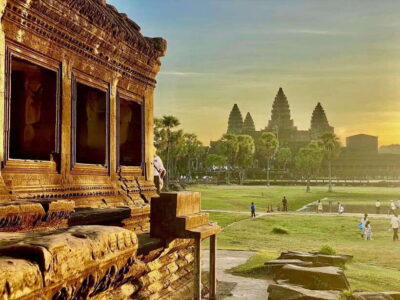
Angkor Wat is only one part of this six-to-seven-hour outing. The real payoff is the route through the old Khmer capital, where enormous stone faces at Bayon, royal viewing terraces, tree-covered Ta Prohm, and the great temple itself form one connected story. A private tuk-tuk keeps the day flexible and handles the long rides between sites.
I especially like the included hotel pickup and bottled water, plus the way a local guide can bring meaning to carvings that might otherwise look like a wall of stone. I also like the personal format: guides such as Soydy, Phy, Nak, Long, and Voath Vinh have been praised for clear English, strong temple knowledge, and careful help with limited mobility. The main consideration is the extra $37 park ticket, which brings the basic $45 tour cost to $82 per person before food and drinks.
In This Review
- Key points at a glance
- Why a tuk-tuk is a smart way to see Angkor
- Angkor Thom: entering the Khmer capital
- Bayon Temple and its stone faces
- The Elephant and Leper King terraces
- Ta Prohm: beauty in a state of ruin
- Angkor Wat: two hours for the main event
- The guide makes the difference
- What the $45 price really covers
- Who should book this temple circuit
- Cancellation and practical planning
- Is this Angkor Wat tuk-tuk tour worth booking?
- FAQ
- How long does the Angkor Wat private tuk-tuk tour last?
- Which temples and sites are included?
- Is hotel pickup included?
- Is the Angkor park admission ticket included?
- How much does the tour cost?
- Is the tour private?
- Does the tour include a guide?
- What happens if I need to cancel?
Key points at a glance
- Private route by tuk-tuk: Only your group takes part, making the ride more personal than a large coach outing.
- Six major sights in one day: The route covers Angkor Thom, Bayon, both royal terraces, Ta Prohm, and Angkor Wat.
- Guides add the meaning: Expect explanations of Khmer history, Hindu stories, Buddhist worship, inscriptions, and temple decoration.
- The listed price is not the final price: Add the $37 Angkor National Park admission fee to the $45 tour cost.
- Good help for slower walkers: The tuk-tuk can take you close to monuments, reducing some unnecessary walking.
- A long but worthwhile morning and afternoon: The schedule begins with an 8 a.m. pickup and allows two hours at Angkor Wat alone.
Why a tuk-tuk is a smart way to see Angkor
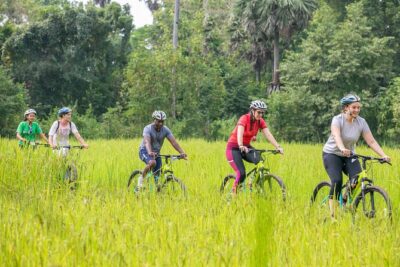
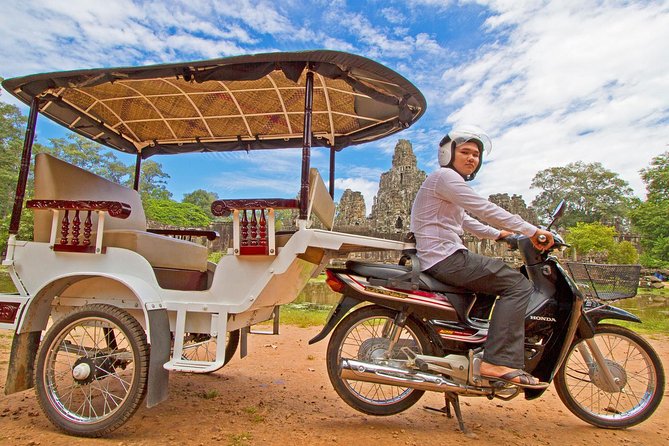
The Angkor Archaeological Park is spread across a large area. Walking from temple to temple is not realistic for this route, and a private car would lose some of the fun of moving through the park in the open air. The tuk-tuk gives you shade, a breeze, and easy access along smaller roads and passageways.
You also avoid the fixed rhythm of a bus group. If a carving catches your eye, you can ask about it. If the heat begins to wear you down, you can pause at the vehicle. The driver and guide work as a pair, with the guide handling the explanations and the driver handling the route.
The tour begins with pickup at your Siem Reap hotel at 8 a.m. Airport pickup and drop-off are also listed as included, which can be useful if your schedule lines up with the tour time. The day lasts about six to seven hours, though the total depends on driving time and how long you spend looking at each site.
Your group is the only group on the activity. That matters at Angkor, where a large tour can make a temple feel like a procession. Private touring does not remove crowds at the famous monuments, but it gives you more control over your own time.
More Angkor temple itineraries:
- Angkor Wat Sunrise or Sunset Tour with Guide from Siem Reap
5.0 · 12,109 reviews - Siem Reap: Angkor Wat: Small-Group Sunrise or Sunset Tour
5.0 · 9,444 reviews - Siem Reap: Angkor Wat 2-Day Tour with Sunrise and Sunset
4.9 · 4,429 reviews
Angkor Thom: entering the Khmer capital
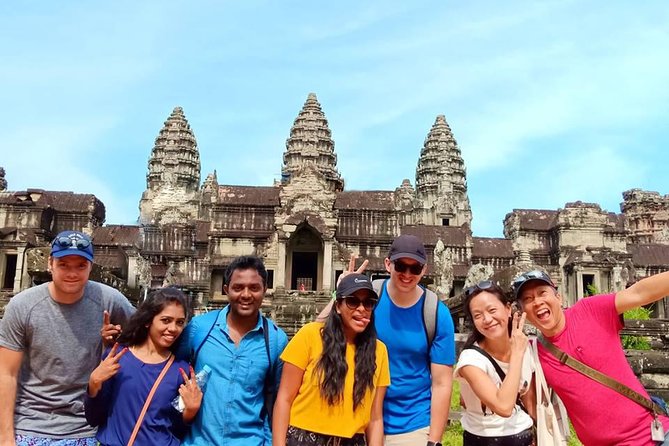
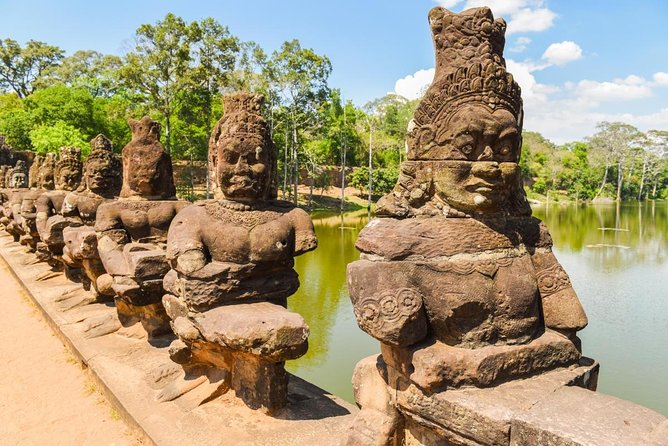
The first substantial stop is Angkor Thom, the capital city built near the end of the 12th century under King Jayavarman VII. Allow about 40 minutes here. This is not simply a gateway on the way to other temples. It introduces the scale and ambition of the Khmer kingdom.
Your guide can explain how Angkor Thom functioned as a capital and help you read the symbols around its entrances and structures. The city was built during the reign of a ruler associated with Mahayana Buddhism, a useful detail because the next stop, Bayon, sits at the heart of this great walled city.
The 40-minute visit is enough for an introduction and key views, but not enough for every corner. That is one reason the guide matters. You will need help deciding which details deserve your attention instead of trying to inspect every stone surface.
Admission is not included at this stop or any of the temples. The single Angkor National Park ticket is listed separately at $37 per person.
Bayon Temple and its stone faces
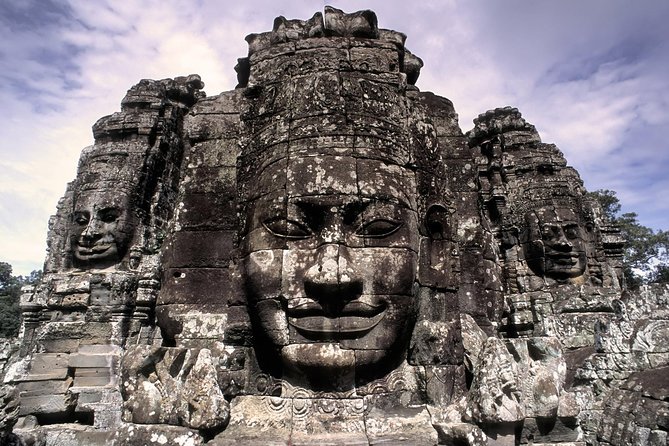
Bayon receives another 40 minutes. Built in the late 12th or early 13th century as the state temple of Jayavarman VII, it is famous for its towers carved with large faces. From a distance, the temple can look confusing, almost like a pile of weathered stone. Inside, the passageways and towers begin to make more sense when someone explains the plan and religious purpose.
This is a good place to use the guide actively. Ask about the faces, the Buddhist setting, and the carved scenes. One guide, Nak, is noted for explaining small details such as inscriptions and decoration, which is exactly the sort of help Bayon rewards.
The paths, steps, and uneven stone can make the stop tiring. You do not need to rush. A private tour lets you spend your energy where it counts, and your tuk-tuk remains available when it is time to move on.
The Elephant and Leper King terraces
The tour then gives about 30 minutes to the Terrace of the Elephants and the Terrace of the Leper King. The Elephant Terrace served as a platform from which the king watched victorious armies return. Its name comes from the elephant carvings along the structure, while the nearby Terrace of the Leper King has detailed sculptural work of its own.
This stop is shorter than the others, so expect a focused visit rather than a long exploration. The guide can point out the royal purpose of the terraces and explain how the carvings fit the power and ceremony of the Khmer court.
For you, the value is contrast. Angkor is not only a collection of isolated temples. These terraces show how architecture was tied to government, public display, and the daily business of a capital city.
Other Siem Reap experiences to weigh up
- Siem Reap: Angkor Wat Private Tuk-Tuk Tour
4.9 · 2,222 reviews - Siem Reap Countryside Bike Tour / E-Bike or Tuk Tuk
5.0 · 935 reviews - Angkor Sunrise Bike Tour / E-Bike or Tuk Tuk
5.0 · 615 reviews - Angkor Wat Private Tuk-Tuk Tour (sunrise Option) & more
5.0 · 439 reviews
Ta Prohm: beauty in a state of ruin
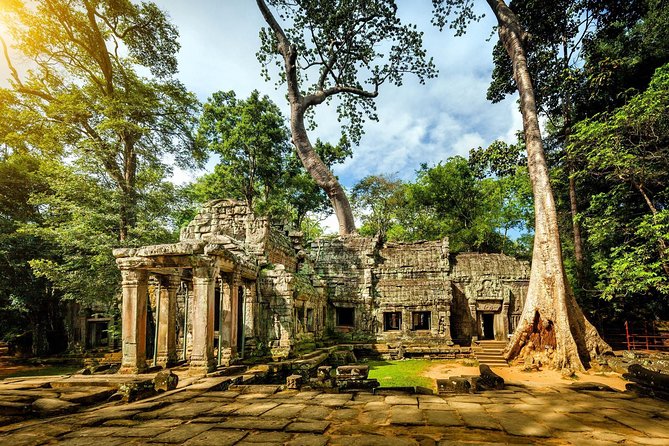
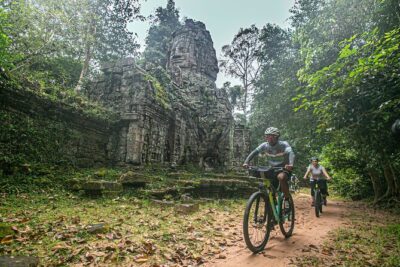
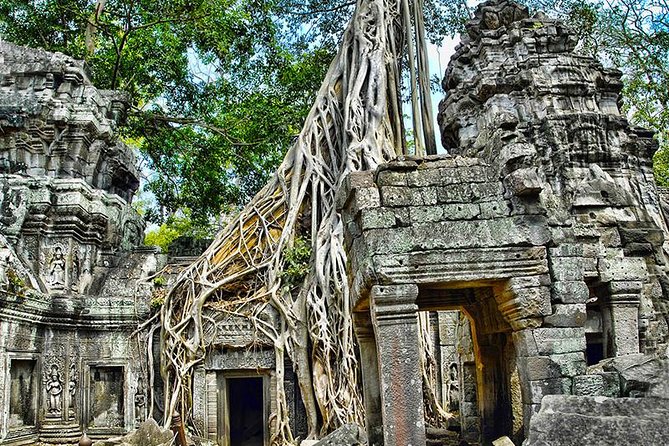
Ta Prohm gets a full hour, and that is sensible. Built between the mid-12th and early 13th centuries under Jayavarman VII, the temple was dedicated to the king’s mother. Its partially ruined condition, stone corridors, and trees growing around the structure give it a very different mood from Angkor Wat.
The trees and fallen stone are the draw, but do not let the famous photographs become the whole point. Ta Prohm also has carvings, courtyards, and architectural details worth studying. A good guide will help you look past the most photographed spots and understand how the temple was designed.
The ruin also means uneven ground and some restricted areas. If you use a walking pole or need to limit steps, tell the guide early. The private format helps here, since the pace can be adjusted for your group. A past guest with limited mobility received help getting close to the monuments, reducing the amount of walking required.
Ta Prohm can be hot and tiring by the time you reach it. The provided mineral water is a small inclusion, but a useful one. Food and other drinks are not included, so you should plan your own meals and refreshments.
Angkor Wat: two hours for the main event
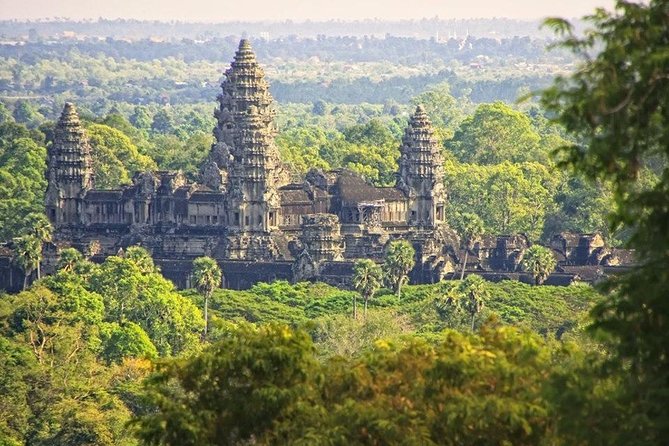
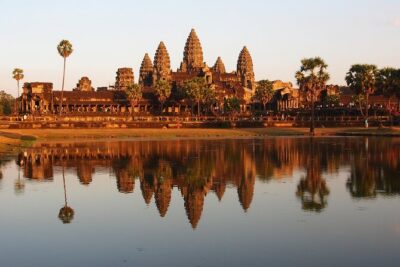
The final major stop is Angkor Wat, with about two hours set aside. Built in the early 12th century for King Suryavarman II as his state temple and capital, it was dedicated to the Hindu god Vishnu. Later use as a Buddhist site adds another layer to its story.
Angkor Wat is the best-preserved temple in the park and the only one with a national flag on the Cambodian flag itself. Its galleries, towers, courtyards, and carved scenes can fill far more than two hours, but the allotted time gives you a proper visit rather than a quick photo stop.
This is where explanations of Hindu legends become especially useful. The carvings are not random decoration. They express religious stories, royal ideals, and the temple’s role as a symbolic universe. Your guide can connect those stories to what you are seeing instead of leaving you to guess at the figures and scenes.
Two hours still requires choices. You may spend much of it in the galleries and central areas, or focus on the exterior views and major carvings. Tell your guide what interests you. Some guides, including Phy and Nak, are praised for explaining temple details clearly, while Soydy and Long are noted for combining strong English with an approachable manner.
Angkor Wat is also the point when fatigue can catch up with you. The tour covers several sites before arriving here, and the stone surfaces can be demanding. Take your time. A private tuk-tuk means you are not being pushed through the temple on a strict bus schedule.
The guide makes the difference
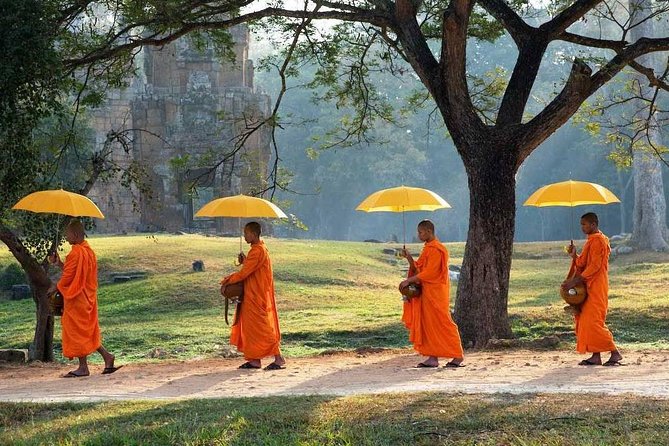
The temples are impressive without a guide, but the experience changes when someone can explain why a structure was built and what its carvings mean. This tour includes a local, live English-speaking guide. Guide assignments can vary, with names connected to this experience including Soydy, Vantha, Phy, Long, Voath Vinh, Phuy Phy, and Nak.
The strongest praise is consistent in a few areas. Guides are described as punctual, helpful, easy to understand in English, and well informed about Khmer history. Nak is associated with close attention to inscriptions and decoration. Phy is praised for explaining a large amount of material during a long day. Long is described as warm and enthusiastic about his work.
That range is useful to know because the guide is not a minor extra here. You are paying for interpretation, transport, and coordination. If you want only a driver and a quick circuit, you may not use the full value of the tour. If you want to understand the temples, ask questions throughout the day.
The guide and driver also work together. That team approach can make the day easier for anyone who walks slowly or needs the tuk-tuk to stop close to each monument.
What the $45 price really covers
The advertised price is $45 per person. It includes the full-day tuk-tuk, local English-speaking guide, hotel or airport pickup and drop-off, and bottled water.
The important addition is the $37 Angkor National Park admission fee. That makes the listed tour and ticket total $82 per person, before food, drinks, travel insurance, or any other personal costs. The ticket is not a hidden charge, since it is clearly excluded, but you should include it when comparing this tour with alternatives.
For a private experience, the value is solid if you are traveling with a small group and want transport plus interpretation in one package. The group discount feature may improve the per-person price for larger parties, though the exact discount is not specified.
The cost is less attractive if you already have transport and only need a guide. In that case, you would be paying for services you do not need. For most first visits, though, the park’s size and the number of stops make the combined transport and guide service practical.
Who should book this temple circuit
I would point this tour toward first-time visitors to Angkor who want the major sights in one day without joining a large group. It also suits families, couples, friends, and anyone who prefers to ask questions without strangers listening.
The route is a good fit if you want a broad introduction: capital city, state temple, royal terraces, ruined monastery, and the great Hindu temple. It is less suitable if you want a slow photographic study of one or two temples, since six sites and the transport between them create a full schedule.
The tour can work for people with limited mobility, but do not read that as full accessibility. The monuments have uneven surfaces and may involve steps. The useful point is that the guide and driver can bring the tuk-tuk close to the sites and help reduce walking when possible.
You should also be prepared for a long day. The early start helps, but the heat and stone paths still demand sensible pacing. Wear practical shoes, carry sun protection, and use the included water. Those are simple choices, but they make the difference between a rewarding temple day and an exhausting one.
Cancellation and practical planning
You can cancel for a full refund up to 24 hours before the local start time. Cancellations or changes made within 24 hours are not refunded or accepted.
Confirmation is provided when you book. The activity is private, and most people can participate, although the site itself may still be difficult for anyone who cannot manage uneven temple ground.
Food and drinks are not included. Plan for that separately, since the schedule runs through much of the day. The tour provider is Green Era Travel.
Is this Angkor Wat tuk-tuk tour worth booking?
I would book it if you want the main Angkor temples explained in plain English, with private transport and hotel pickup handled for you. The strongest reasons are the guide access, the flexible tuk-tuk format, the sensible major-temple route, and the help available for visitors who cannot walk long distances quickly.
I would hesitate only if you want a very slow visit, already have a tuk-tuk and guide, or dislike full sightseeing days. Remember to budget $37 for the park ticket, and expect the six-to-seven-hour schedule to feel substantial.
For a first look at Angkor, this is a practical, personal way to cover the essentials. Ask questions, pace yourself, and give Angkor Wat its full two hours. That is when the tour earns its keep.
FAQ
How long does the Angkor Wat private tuk-tuk tour last?
The tour lasts approximately six to seven hours. Pickup begins at 8 a.m. from your hotel in Siem Reap.
Which temples and sites are included?
The route includes Angkor Thom, Bayon Temple, the Terrace of the Elephants, the Terrace of the Leper King, Ta Prohm Temple, and Angkor Wat.
Is hotel pickup included?
Yes. Hotel pickup and drop-off in Siem Reap are included. Airport pickup and drop-off are also listed as included.
Is the Angkor park admission ticket included?
No. The Angkor National Park ticket costs $37 per person and is not included in the $45 tour price.
How much does the tour cost?
The listed tour price is $45 per person. With the separate $37 park admission fee, the combined cost is $82 per person before food, drinks, insurance, or other personal expenses.
Is the tour private?
Yes. Only your own group participates in the activity.
Does the tour include a guide?
Yes. A local live English-speaking guide is included, along with the tuk-tuk and driver.
What happens if I need to cancel?
You can receive a full refund if you cancel at least 24 hours before the experience start time. Cancellations or changes made less than 24 hours before the start time are not refunded or accepted.
Fresh reviews from around Siem Reap
- Full-Day Tour Preah Vihea & Koh Ker Temple 3.7 · 3 reviews
- Savor the Countryside: Tours with Authentic Cooking Classes” 5.0 · 3 reviews
- Angkor Wat Sunrise TukTuk Tour 5.0 · 3 reviews
- Angkor Grand Circuit Tour & Banteay Srei 5.0 · 3 reviews
- Guided Private Tuk Tuk Tour Angkor Wat and Small Circle and Five Extras 5.0 · 3 reviews
- Siem Reap Temple Tour 2-Day with Sunrise/Sunset 3.7 · 3 reviews
- Bangkok to Angkor Wat 2 Days 1 Night by Flight 4.5 · 3 reviews
- Kompong Pluk Tour 5.0 · 3 reviews