
Reviewed · ANGKOR TEMPLE TOURS
Angkor Wat & Bayon: the Smiling Temple
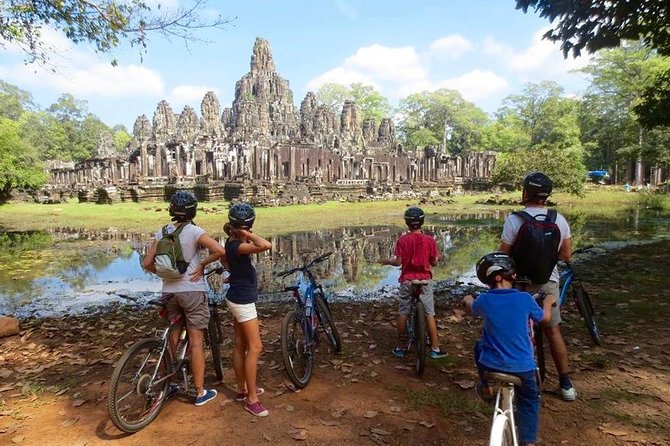
Angkor Wat and Bayon are far more rewarding when you have time to notice the trees, butterflies, flowers, and old walls between the monuments. This five-hour bike tour keeps the pace easy, uses a small group of no more than 10 people, and takes you beyond the usual temple-road routine.
I like the quiet trails and the chance to reach Prasat Chrung on Angkor Thom’s protective wall. I also like that the package includes a good Trek mountain bike, helmet, lunch, coconut water, and drinking water.
The main catch is practical: the $37 Angkor temple pass is not included, and hotel pickup is not provided. Heat can also change the day’s plan, especially for children or anyone unused to cycling in Cambodia.
In This Review
- Key points to know before booking
- Why cycling makes Angkor feel different
- Starting in Siem Reap at 7:30 am
- Angkor Wat, the day’s first major reward
- Angkor Thom’s south gate and defensive wall
- Prasat Chrung and the view from the wall
- The west gate, left unrestored
- Bayon and its famous smiling faces
- Lunch, coconut water, and keeping your energy up
- Is the $50 price good value?
- Who should book this ride?
- Booking, clothing, and cancellation details
- Should you book Angkor Cycling Tour?
- FAQ
- How long does the Angkor cycling tour last?
- What time does the tour start?
- Where does the tour begin and end?
- Is the Angkor temple pass included?
- What is included in the $50 tour price?
- Is hotel pickup included?
- How many people can join the tour?
- Can I cancel for a full refund?
Key points to know before booking
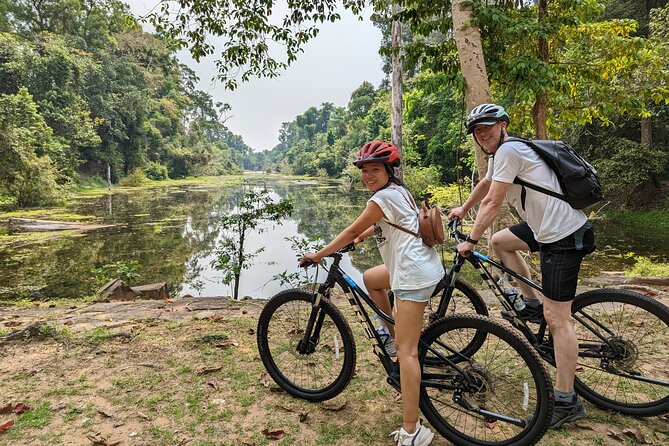
- A relaxed ride, not an athletic challenge: The route is intended for ordinary riders, with some off-road cycling but no racing or adventure-tour pace.
- Two great temples plus quieter corners: You see Angkor Wat and Bayon, with Angkor Thom’s gates, wall, and Prasat Chrung added to the route.
- Small groups matter here: The maximum is 10 people, giving you more room to hear the guide and keep the ride together.
- Most practical costs are covered: Bike rental, helmet, guide, lunch, coconut water, and drinking water are included.
- Budget for the temple pass: A one-day Angkor pass costs $37 and must be bought separately from the $50 tour.
- Plan for heat and respectful clothing: Bring sunscreen, sunglasses, and a camera, and wear clothing that covers your shoulders and knees at sacred sites.
Why cycling makes Angkor feel different
Angkor is a huge complex. You can move from one monument to another by car or tuk-tuk, but a bicycle gives you a slower view of the old capital. You hear birds and tires on the path rather than spending each short stretch inside a vehicle.
That slower pace is the best reason to book this experience. The ride is described as leisurely and suitable for all fitness levels, not as a demanding mountain-bike outing. You still need enough energy to pedal for several hours, but the point is to look around, not set a personal record.
The route includes less direct trails where you might see butterflies and flowers. These stretches help break up the large stone monuments and give the day a more natural feel. You are not simply checking off Angkor Wat and Bayon. You are also seeing the spaces between them.
The group limit of 10 is another real advantage. A large cycling group can become a noisy line of riders, with people spread too far apart to hear the guide. A group this size should make it easier to ask questions, stay together, and pause without turning every stop into a production.
More Angkor temple itineraries:
- Angkor Wat Sunrise or Sunset Tour with Guide from Siem Reap
5.0 · 12,109 reviews - Siem Reap: Angkor Wat: Small-Group Sunrise or Sunset Tour
5.0 · 9,444 reviews - Siem Reap: Angkor Wat 2-Day Tour with Sunrise and Sunset
4.9 · 4,429 reviews
Starting in Siem Reap at 7:30 am
You meet Angkor Cycling Tour on Taphul Road in Siem Reap at 7:30 am. The tour ends back at the same meeting point after about five hours.
There is no hotel pickup or drop-off, so you need to arrange your own way to Taphul Road. That is a small but important detail when you are comparing this tour with packages that include transport. The early start also means you should plan your morning carefully, especially if you are staying outside central Siem Reap.
At the meeting point, the included Trek mountain bike and helmet are provided. The use of a named bike brand is reassuring, but the available information does not specify frame sizes, child bikes, or electric bicycles. If you have a particular bike requirement, ask before booking rather than assuming it will be available.
The tour includes pure drinking water, which is welcome in Cambodia’s heat. You should still bring sunscreen and sunglasses. A camera is also recommended, though you will want to keep it secure during the off-road portions.
Angkor Wat, the day’s first major reward
Angkor Wat is the largest and most famous stop. It is often described as one of the seven wonders of the ancient world, and its scale explains why it can feel overwhelming when you first arrive.
Approaching by bicycle gives you a little more time to take in the setting. You are not rushed directly from a vehicle into the monument. The ride forms part of the experience, and the guide provides historical background as you go.
The tour does not include the Angkor entry ticket. The stated price for a one-day temple pass is $37, so your basic cost becomes $87 per person before you arrange transport to the meeting point. That is still a fair price for a small-group outing that includes equipment, food, drinks, and guiding, but it is not a $50 all-in temple visit.
You should dress for both cycling and worship. Bare shoulders and shorts or skirts above the knees are prohibited in sacred palaces, and respectful clothing is strongly encouraged throughout Angkor. Lightweight clothing that covers your shoulders and knees will save you from having to rethink your outfit at the entrance.
Angkor Thom’s south gate and defensive wall
After Angkor Wat, the route continues toward Angkor Thom, the larger walled city that contains Bayon. The south gate is presented as one of the most appealing entrances to Angkor Thom, and it gives the ride an excellent change of mood after the broad scale of Angkor Wat.
The gate is part of a defensive system, so this stop is not just about taking a photograph. The walls, entrance, and surrounding approach help you understand how the old capital was protected and organized. Your guide’s explanations are especially useful here because the stones can otherwise look like a series of impressive but disconnected structures.
Cycling also helps you appreciate the distances involved. Angkor is not one compact temple with a few nearby ruins. The old city extends across a large area, and the bicycle ride shows that scale in a direct way.
The surface is not guaranteed to be smooth throughout. One important point for you to remember is that the route includes some off-road biking. This is still described as an easy, non-professional outing, but easy does not mean paved from start to finish.
A different pace for your next Siem Reap morning:
- From Siem Reap: Kampong Phluk Floating Village Tour by Boat
4.9 · 6,979 reviews - Sunset tour of Kampong Phluk stilts home village on the Tonle Sap
5.0 · 4,865 reviews - Siem Reap: Kampong Phluk Floating Village Tour with Boat
4.9 · 3,843 reviews - Siem Reap: Full-Day Angkor Wat Guided Tour with Sunset
4.9 · 3,803 reviews
Prasat Chrung and the view from the wall
One of the more unusual parts of the route is the climb onto Angkor Thom’s protective wall to reach Prasat Chrung. This is where the ride becomes more than a standard temple circuit.
The stop offers a broad view from the wall and a quieter setting than the headline monuments. It also adds a physical sense of the city’s defenses. You are not only looking at a temple facade. You are seeing how the walls shaped movement around Angkor Thom.
The word climb matters here. The tour remains leisurely, but this part may require more effort than the flat sections. If you are traveling with young children or anyone who tires quickly, ask the guide how the group handles the approach.
This is also the type of stop that benefits from a small group. The guide can keep an eye on the pace and give context without shouting across a crowd. Bring your camera, but keep your hands free when riding and use care on uneven ground.
The west gate, left unrestored
The west gate of Angkor Thom is included as a contrast to the more polished or familiar parts of the complex. It is described as the never-restored gate, giving you a chance to see a less finished and less managed part of the ancient city.
That makes it useful for understanding the range of Angkor’s condition. Some monuments are carefully maintained and heavily visited. Others feel more exposed to time and the elements. The west gate offers a reminder that Angkor is not a single perfectly preserved showpiece.
For many people, this may be a more memorable stop than another formal temple interior. The bicycle route lets you reach it without treating the day as a quick series of photo stops. You have time to notice the old stonework and the surrounding setting.
Still, the tour’s main focus is Angkor Wat and Bayon. If you want a long visit at every smaller gate and ruin, five hours may feel short. The schedule is best for someone who wants a broad introduction rather than an exhaustive study of Angkor Thom.
Bayon and its famous smiling faces
Bayon is the second major temple of the tour and one of Angkor’s most distinctive sights. Its 54 towers and 216 smiling faces give it a character very different from Angkor Wat.
The faces appear from different angles as you move through the temple. That makes Bayon especially well suited to a bicycle day, since the route has already given you a sense of movement and changing viewpoints. You can look closely at the towers, then step back and see how the faces shape the whole structure.
Your guide’s history talk is valuable here. Bayon can be visually confusing, with towers, galleries, and carved faces layered close together. A good explanation helps you understand what you are seeing rather than treating the temple as a backdrop for photographs.
The schedule allows you to see Bayon as a major stop, but the total experience lasts only about five hours. The tour is not designed for an unhurried, full-day examination of every chamber. If Bayon is your personal priority, tell the guide early so you can manage your time at the other sites.
Lunch, coconut water, and keeping your energy up
Lunch, refreshing coconut water, and drinking water are included. These details may sound minor, but they matter on a hot cycling route. You do not need to spend the morning wondering where your next drink will come from or pause the tour to find a meal.
You should give the company any dietary requirements when booking. No specific menu is provided, so do not assume a particular dish or special diet will be available without advance notice.
The coconut water is a pleasant local touch and a practical break from plain water. Even with refreshments supplied, bring sensible sun protection and pace yourself. The itinerary is easy rather than strenuous, but a hot day can make several hours outdoors feel much longer.
The heat is the biggest variable in this experience. One family had children who could not manage the ride back from the temples, and the tour leader arranged a tuk-tuk home. On another very hot day, the group did not finish the planned route and the company sent a car to collect the riders.
Those examples make the tour operator’s flexibility a positive point, but they also give you a clear warning. Families with small children should not assume every rider will complete the full return cycle. Ask about a backup plan before setting out, particularly if your children are new to longer bike rides.
Is the $50 price good value?
At $50 per person, this tour is reasonably priced for what is included. You receive a premium Trek mountain bike, helmet, English-speaking guide, lunch, coconut water, and drinking water. The maximum group size is 10, which is more personal than a large coach-style visit.
The temple pass changes the calculation. Add the $37 one-day Angkor entry fee and the base cost reaches $87 per person. You also pay for your own transport to and from Taphul Road.
I would compare this with what you value most. If you want a guide, a bike, food, and a small group, the price makes sense. If you already have transport, a temple pass, and a strong preference for exploring alone, the package may offer less value.
The tour has a 4.9 rating from 47 reviews, with 100 percent recommended. Those numbers suggest a strong level of satisfaction, but the practical caveats remain important: off-road riding, hot weather, no hotel transport, and an extra entry fee.
Who should book this ride?
I would choose this for an active family with older children, couples, solo visitors who like small groups, and anyone who wants a calmer way to see Angkor. You do not need to be a serious cyclist. The route is specifically presented as non-adventurous and suitable for ordinary riders.
It is also a good choice if you want some historical explanation without spending a full day in a vehicle. The guide connects the gates, wall, temples, and old capital, while the bicycle keeps the transfers from feeling like dead time.
I would be more cautious if you dislike heat, have trouble cycling on uneven paths, or need a guaranteed hotel transfer. Families with very young children should ask how a shorter ride or a tuk-tuk backup would work.
You also need to be comfortable with a five-hour outline rather than a slow, detailed study of every temple. Angkor Wat and Bayon receive the main attention, while the other stops add context and variety.
Booking, clothing, and cancellation details
Confirmation is provided when you book, and the activity is available with a mobile ticket. Free cancellation is allowed up to 24 hours before the local start time for a full refund. Changes or cancellations made within 24 hours are not accepted for a refund.
Wear clothing that respects Angkor’s religious role. Shoulders should be covered, and shorts or skirts above the knees are prohibited in sacred palaces. Sunscreen, sunglasses, a camera, and suitable shoes for cycling are sensible choices.
The tour begins at 7:30 am and returns to the meeting point. Since the provider does not include hotel pickup or drop-off, leave enough time to reach Taphul Road before the start.
Should you book Angkor Cycling Tour?
Book it if you want Angkor Wat and Bayon with a guide, a manageable bicycle route, and a small group rather than a rushed vehicle circuit. The quiet trails, Prasat Chrung viewpoint, unrestored west gate, and Bayon’s many faces give the morning more variety than a simple two-temple transfer.
Think twice if you need hotel transport, want a fully paved route, or are booking for young children who may struggle in strong heat. The best approach is to treat this as a flexible half-day ride, bring respectful clothing and sun protection, and budget another $37 for the temple pass. For the right rider, it offers a practical and pleasantly unhurried introduction to Angkor.
FAQ
How long does the Angkor cycling tour last?
The tour lasts approximately five hours.
What time does the tour start?
The tour starts at 7:30 am.
Where does the tour begin and end?
It begins at Angkor Cycling Tour on Taphul Road in Krong Siem Reap and ends back at the same meeting point.
Is the Angkor temple pass included?
No. The one-day Angkor entry pass costs $37 and is not included in the tour price.
What is included in the $50 tour price?
The price includes an English-speaking guide, a premium Trek mountain bike, helmet, lunch, coconut water, and pure drinking water.
Is hotel pickup included?
No. Hotel pickup and drop-off are not included.
How many people can join the tour?
The maximum group size is 10 people.
Can I cancel for a full refund?
Yes. You can cancel at least 24 hours before the experience start time for a full refund. Cancellations or changes made less than 24 hours before the start time are not refunded.
Fresh reviews from around Siem Reap
- Full-Day Tour Preah Vihea & Koh Ker Temple 3.7 · 3 reviews
- Savor the Countryside: Tours with Authentic Cooking Classes” 5.0 · 3 reviews
- Angkor Grand Circuit Tour & Banteay Srei 5.0 · 3 reviews
- Guided Private Tuk Tuk Tour Angkor Wat and Small Circle and Five Extras 5.0 · 3 reviews
- Angkor Wat Sunrise TukTuk Tour 5.0 · 3 reviews
- Siem Reap Temple Tour 2-Day with Sunrise/Sunset 3.7 · 3 reviews
- Bangkok to Angkor Wat 2 Days 1 Night by Flight 4.5 · 3 reviews
- Kompong Pluk Tour 5.0 · 3 reviews
Angkor Temple Tours, compared.

Angkor Wat Sunrise or Sunset Tour with Guide from Siem Reap
Read our review →



Angkor Wat Sunrise tour with Small – Group and Guide tours
Read our review →
Angkor Wat Highlights and Sunrise Guided Tour from Siem Reap
Read our review →
