
Reviewed · ANGKOR TEMPLE TOURS
Angkor Wat & Banteay Srey Tour
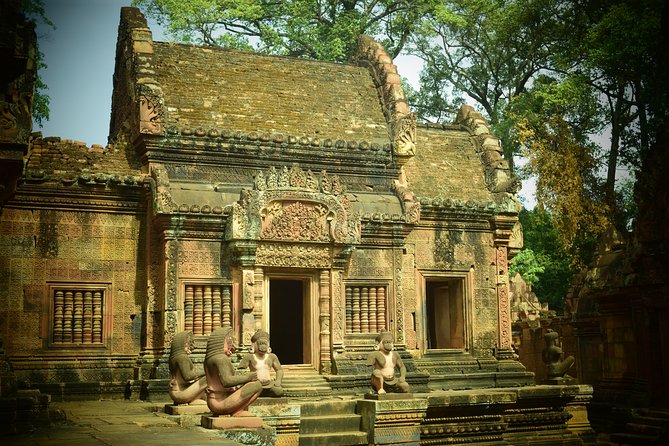
Angkor Wat may be the main event, but Banteay Srei’s pink sandstone carvings give this long day a finer, more intimate finish. You’ll also see the huge faces of Bayon, the tree-covered ruins of Ta Prohm, and the quieter Banteay Samre.
I like the private format, since you can move at your own pace and ask questions without joining a large group. I also like the practical touches, including hotel pickup, air-conditioning, cool towels, and drinking water. The drawback is the pace: five temple stops, long drives, and up to 10 hours can leave you tired, especially in Cambodia’s heat.
In This Review
- Key points
- Five temples, five different moods
- Starting with Angkor Wat’s grand scale
- Reading the smiling faces at Bayon
- Ta Prohm and the power of nature
- The long road to Banteay Srei
- Banteay Samre, a quieter final temple
- What the $50 price really covers
- Guides who add a personal touch
- Timing, comfort, and the physical effort
- Who should book this Angkor day?
- Should you book it?
- FAQ
- What is included in the $50 tour price?
- Are temple entrance fees included?
- Which temples are visited?
- How long does the tour last?
- Is this a private tour?
- Is hotel pickup available?
- Is sunrise included?
- Can I cancel for a full refund?
Key points
- Five major temples in one day: Angkor Wat, Bayon, Ta Prohm, Banteay Srei, and Banteay Samre.
- Private transportation: Only your own group participates, with hotel pickup and an air-conditioned vehicle.
- A guide-led experience: Guides including Kosorl Oun, Bros, and Sinann are associated with warm, personal explanations of temple history and Cambodian life.
- Banteay Srei adds variety: Its pink sandstone and delicate carvings feel very different from Angkor Wat’s grand scale.
- Admission is extra: The $50 price covers transport, guide, water, and cool towels, but not the Angkor temple pass.
- A full-day commitment: The scheduled temple visits total about 10 hours before allowing for driving, ticket purchase, and breaks.
Five temples, five different moods
This tour is built for someone who wants a broad first look at the Angkor complex rather than a slow study of two or three monuments. The route combines the sites most people hope to see with two temples that add detail and variety.
Angkor Wat gives you scale and symbolism. Bayon brings you face to face with the mysterious smiling towers. Ta Prohm supplies the memorable jungle setting. Banteay Srei rewards close looking, while Banteay Samre offers a quieter Hindu temple in the Angkor Wat style.
That variety is the tour’s main strength. You are not looking at five versions of the same ruin. Each stop changes the mood, the architecture, and the kind of questions you can ask your guide.
The tradeoff is time. The planned visits total about 10 hours: three hours at Angkor Wat, two hours each at Bayon, Ta Prohm, and Banteay Srei, and one hour at Banteay Samre. The advertised overall duration is 7 to 10 hours, so the actual day may depend on driving time, ticket arrangements, and how closely the schedule is followed.
More Angkor temple itineraries:
- Angkor Wat Sunrise or Sunset Tour with Guide from Siem Reap
5.0 · 12,109 reviews - Siem Reap: Angkor Wat: Small-Group Sunrise or Sunset Tour
5.0 · 9,444 reviews - Siem Reap: Angkor Wat 2-Day Tour with Sunrise and Sunset
4.9 · 4,429 reviews
Starting with Angkor Wat’s grand scale
Your guide or driver collects you from your hotel at the time selected during booking. You meet in the hotel lobby, then head to the ticket office to buy your temple pass. The admission fee is not part of the $50 tour price, so plan for that additional cost before you begin exploring.
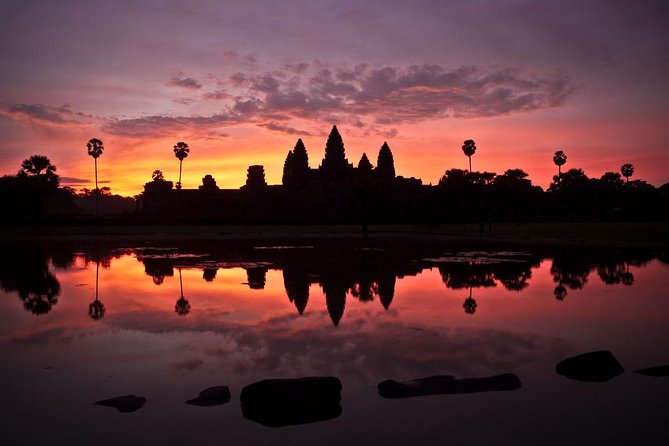
Angkor Wat deserves the longest stop. Built between 1113 and 1150 during the reign of Suryavarman II, it is the largest and most famous Khmer temple. Its central structure rises 65 meters, and a broad moat surrounds the complex.
The first impression is one of size. The approach across the water and toward the temple gives you time to see the building as a whole before you begin looking at individual carvings. Once inside, the walls and galleries reveal another side of the monument, with extensive base-reliefs covering both exterior and interior areas.
I would use the first part of this visit to understand the plan of the temple. Then let your guide point out the stories and symbols in the reliefs. Without help, it is easy to admire the stonework but miss how much information is packed into it.
Three hours is a useful amount of time here, though it will not feel leisurely if you stop often for photographs. Wear clothing that covers your shoulders and knees, and choose shoes that can handle uneven stone surfaces. The supplied water and cool towels become especially welcome as the morning goes on.
Reading the smiling faces at Bayon
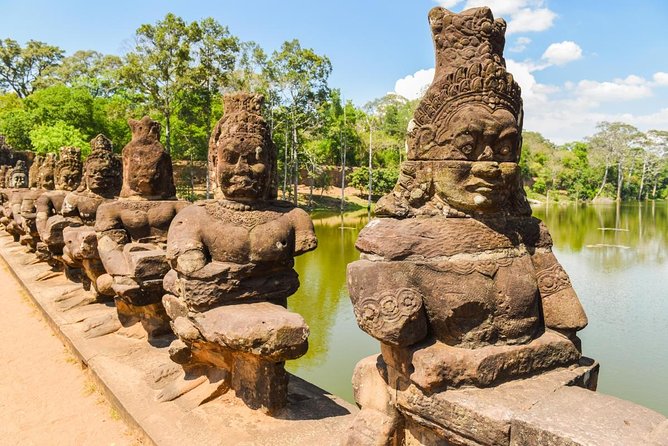
Bayon is part of Angkor Thom, the great capital associated with Jayavarman VII. It was built in the late 12th or early 13th century in a Buddhist style and is known for its towers carved with more than 200 smiling faces.
The temple is less immediately orderly than Angkor Wat. Towers crowd around one another, corridors turn unexpectedly, and the faces appear from different angles as you walk. This makes Bayon a good place to stay close to your guide. A clear explanation helps you understand how the temple worked as part of a royal capital, rather than seeing it as a collection of beautiful stones.
The temple is described as having 54 towers representing the provinces before and during the Khmer Empire. The site was later damaged in 1811 by Cham invaders. Those details give the monument a long, complicated life, not a frozen moment from the 12th century.
Two hours is enough for a focused visit, but the uneven passages and stone steps require care. If you have knee trouble or find steep temple steps difficult, tell your guide at the start of the day. One guide associated with the company, Kosorl Oun, has been praised for helping people manage difficult climbs and adjusting his assistance to their needs. That does not remove the physical challenge, but it can make the visit more manageable.
Ta Prohm and the power of nature
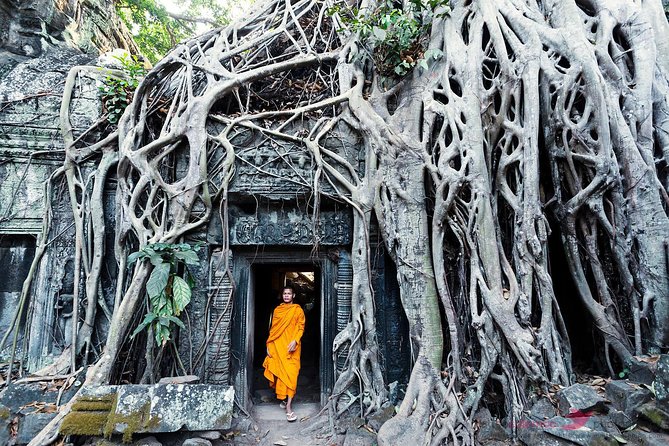
Ta Prohm is the temple most likely to trigger instant recognition. Built in the late 12th century by Jayavarman VII and dedicated in 1186 to his mother, it is famous for the Spung trees that grow up through and over the sandstone walls.
The roots are the visual hook, but do not let them become the whole visit. The galleries, courtyards, and damaged sections show how the temple has changed over time. Ta Prohm began with a Buddhist purpose and was later converted to Hindu worship. Some Buddhist galleries were destroyed and replaced with Hindu symbols, including Yoni and Lingam.
The two-hour stop gives you room to look beyond the best-known tree formations. Ask your guide to explain where the Buddhist and Hindu elements appear, and how the trees affect the stonework. This is one of the places where an informed local guide can turn a quick photo stop into a more meaningful visit.
Ta Prohm is about 1.5 kilometers from Bayon through the Victory Gate. Even with vehicle transport between the temples, the site involves walking over rough ground and through constricted spaces. Give yourself time to look up, look down, and watch your footing.
A different pace for your next Siem Reap morning:
- From Siem Reap: Kampong Phluk Floating Village Tour by Boat
4.9 · 6,979 reviews - Sunset tour of Kampong Phluk stilts home village on the Tonle Sap
5.0 · 4,865 reviews - Siem Reap: Kampong Phluk Floating Village Tour with Boat
4.9 · 3,843 reviews - Siem Reap: Full-Day Angkor Wat Guided Tour with Sunset
4.9 · 3,803 reviews
The long road to Banteay Srei
Banteay Srei is about 35 kilometers from the main Grand Circuit area, so this stop adds real driving time. It is also the reason the day feels more ambitious than a standard Angkor highlights tour.
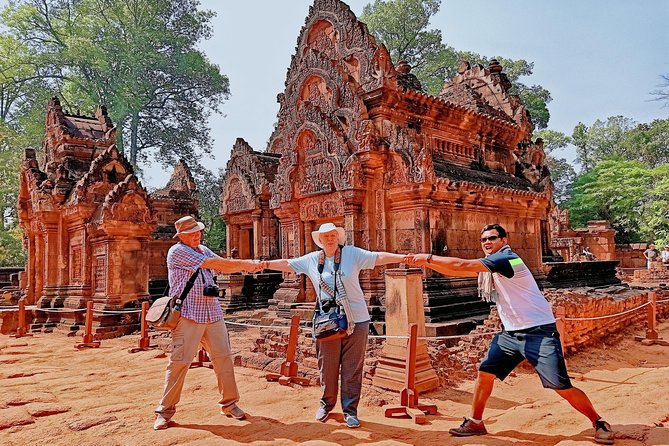
The temple is built from pink sandstone, and its detailed carvings are unusually fine. The name Lady Temple is linked to the delicacy of the carving. Compared with Angkor Wat’s imposing galleries and Bayon’s giant faces, Banteay Srei feels smaller and more precise.
This is the place to slow down visually. Look at the borders around doorways, the small figures, and the carefully worked sandstone surfaces. The detail is best appreciated at close range, where you can see how much attention went into areas that might be missed in a larger monument.
The route may include a stop to watch local people making natural sugar products from sugar palm. That short visit adds a useful connection between the temple area and present-day Cambodian life. It is not the same as visiting another monument, so you should view it as a possible cultural pause rather than a guaranteed formal demonstration.
Banteay Srei is scheduled for two hours. Combined with the drive, this makes the middle or later part of the day less rushed at the temple itself, but more tiring overall. If you prefer a deep, unhurried visit to one site, you might want a separate Banteay Srei outing. If you want variety on a first visit, the extra distance is worthwhile.
Banteay Samre, a quieter final temple
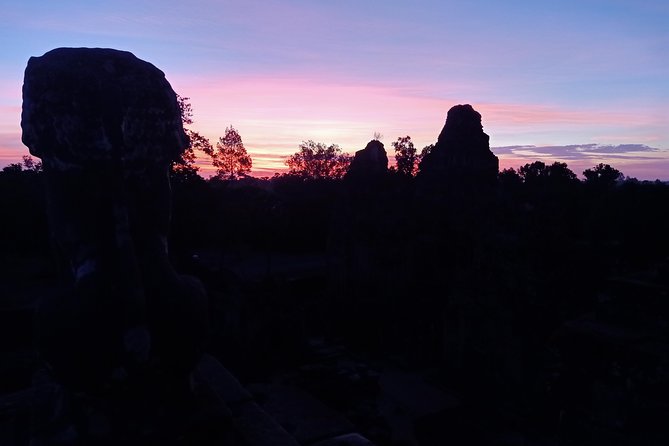
Banteay Samre is often a good way to finish because it does not repeat the scale of Angkor Wat or the famous tree roots of Ta Prohm. Located about 400 meters east of the East Baray, it was built during the reigns of Suryavarman II and Yasovarman II in the early 12th century.
This is a Hindu temple in the Angkor Wat style. Its architecture lets you compare it with the morning’s main monument, while the smaller scale makes the comparison easier. You can pay attention to the layout, towers, entrance structures, and carved details without trying to absorb an enormous complex all at once.
The planned visit lasts one hour. That is enough for a clear look, though your energy may be the bigger issue by this point. The advantage of including Banteay Samre is that you get one more architectural stop without needing to commit to a second full day.
What the $50 price really covers
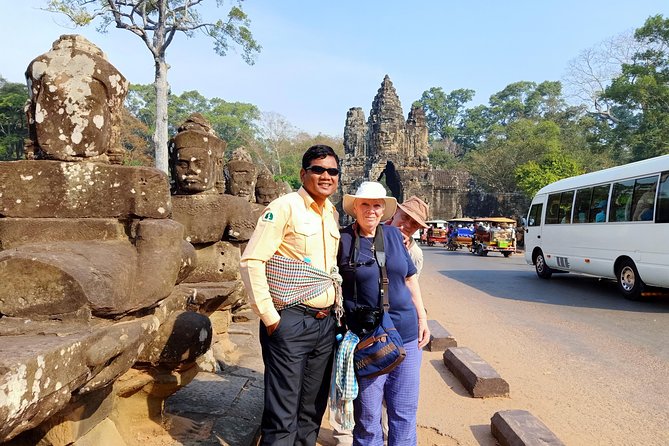
At $50 per person, the tour includes air-conditioned transportation, a speaking guide and driver, cool drinking water, and cool towels. Hotel pickup is offered, and the activity is private, meaning only your group participates.
The private arrangement matters more than it might first appear. You can ask for more explanation at Bayon, spend longer at Banteay Srei, or let the guide know when you need a short pause. The exact flexibility depends on the day’s timing, but you are not tied to the rhythm of a large coach group.
The biggest extra cost is the entrance fee. You buy the temple pass at the ticket office after pickup, and that fee is not included. Meals, personal expenses, travel insurance, and any sunrise extra charge are also excluded.
That makes the tour a reasonable value if you want transport and guiding organized for you. It is less attractive if you only want a basic ride to the temples and plan to explore independently. The guide is an important part of the price, especially at Bayon and Ta Prohm, where the stories and religious changes are not obvious from the stonework alone.
Guides who add a personal touch
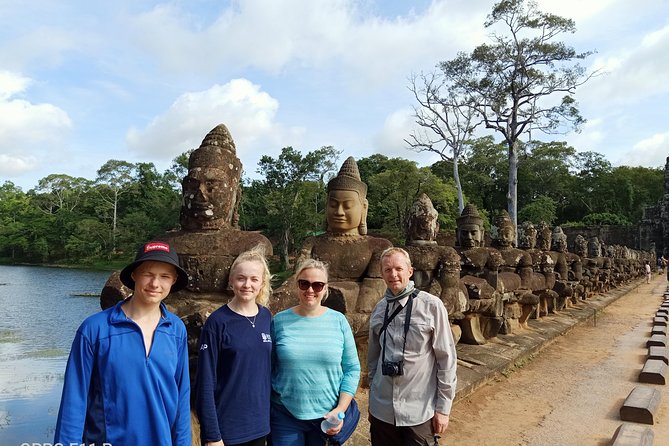
The company is associated with guides including Kosorl Oun, Bros, and Sinann. Kosorl is also identified as the founder of Easy Angkor Trip. The guide assigned to your booking may vary, so you should not assume a particular person unless that is confirmed directly.
The strongest pattern in the guide feedback is personal attention. Kosorl is described as friendly, enthusiastic, and well informed about Cambodian history, present-day communities, and the temples. He is also noted for creative photography, which may appeal to you if you want help taking group or couple photographs during the day.
Bros is described as sharing temple history as well as information about Cambodia’s Khmer Rouge period. That broader context can be valuable, since the monuments are not separate from the country’s modern story.
Sinann is noted for stepping in when another guide became ill and for being polite and helpful during a full temple day. The practical point is simple: a good guide can make a hot, demanding schedule feel more personal and organized.
Do not expect every guide to deliver the same style. Some people want a detailed history lesson, while others prefer short explanations and more time for photographs. Tell your guide what works for you at the beginning.
Timing, comfort, and the physical effort
The tour lasts about 7 to 10 hours, and the schedule is full. You will spend much of the day walking around stone monuments, crossing open courtyards, and negotiating uneven surfaces. Bayon and Ta Prohm can be awkward underfoot, and temple stairs may be steep.
Most people can participate, but the experience is not a sit-down sightseeing tour. If you have arthritis, knee pain, or trouble with stairs, discuss it with your guide before setting off. The air-conditioned vehicle provides relief between stops, and the cool towels and water are useful practical benefits, but they do not change the amount of walking.
A sunrise visit is not part of the standard price. If you want to add sunrise, expect an extra charge. The normal plan begins with pickup at the time you select during booking, so check that your chosen time gives you enough daylight for all five sites.
The tour does not include meals. Bring money for food and other personal expenses, and remember that the long distance to Banteay Srei can make the day feel longer than the temple hours suggest.
Who should book this Angkor day?
I would recommend this tour to a first-time visitor with one full day for Angkor and a strong wish list. You see the famous monuments, add Banteay Srei’s fine carving, and finish with Banteay Samre rather than spending the entire day at only the central sites.
It also suits couples, families, and small private groups who want a guide without joining strangers. The photography help associated with Kosorl may be a nice bonus for couples or groups who want more than quick phone snapshots.
I would hesitate to recommend it to someone who dislikes early starts, long drives, or packed sightseeing days. You may also prefer a shorter plan if your main goal is careful architectural study. Angkor Wat, Bayon, and Ta Prohm alone can fill a demanding day.
You can cancel for a full refund if you do so at least 24 hours before the start time. Changes or cancellations within 24 hours are not accepted for a refund, and the cut-off follows local time.
Should you book it?
Book this tour if you want private transport, a guide, and a wide Angkor sampler in one day. The strongest reasons are the mix of grand, intimate, jungle-covered, and quieter temples, along with the personal help offered by guides such as Kosorl Oun, Bros, and Sinann.
Skip it if you want a slow visit with long breaks or if Banteay Srei’s 35-kilometer drive feels like too much for one day. Before booking, confirm the pickup time, the guide language, the temple admission cost, and whether sunrise is part of your plan. For an energetic first look at Siem Reap’s major temples, the $50 tour offers a useful amount of structure and support, as long as you budget separately for admission, food, and personal expenses.
FAQ
What is included in the $50 tour price?
The price includes air-conditioned transportation, hotel pickup, a speaking guide and driver, cool drinking water, and cool towels.
Are temple entrance fees included?
No. Entrance fees are excluded. You travel to the ticket office after hotel pickup to buy your temple pass.
Which temples are visited?
The tour visits Angkor Wat, Bayon Temple, Ta Prohm Temple, Banteay Srei, and Banteay Samre.
How long does the tour last?
The experience lasts approximately 7 to 10 hours. The scheduled temple visits total about 10 hours, although the actual duration can vary.
Is this a private tour?
Yes. Only your own group participates in the activity.
Is hotel pickup available?
Yes. Your guide or driver meets you in your hotel lobby and picks you up at the time selected during booking.
Is sunrise included?
No. Sunrise requires an additional charge.
Can I cancel for a full refund?
Yes, if you cancel at least 24 hours before the experience start time. Cancellations within 24 hours and changes made within 24 hours are not refunded.
Fresh reviews from around Siem Reap
- Savor the Countryside: Tours with Authentic Cooking Classes” 5.0 · 3 reviews
- Full-Day Tour Preah Vihea & Koh Ker Temple 3.7 · 3 reviews
- Angkor Wat Sunrise TukTuk Tour 5.0 · 3 reviews
- Angkor Grand Circuit Tour & Banteay Srei 5.0 · 3 reviews
- Guided Private Tuk Tuk Tour Angkor Wat and Small Circle and Five Extras 5.0 · 3 reviews
- Siem Reap Temple Tour 2-Day with Sunrise/Sunset 3.7 · 3 reviews
- Bangkok to Angkor Wat 2 Days 1 Night by Flight 4.5 · 3 reviews
- Kompong Pluk Tour 5.0 · 3 reviews
Angkor Temple Tours, compared.

Angkor Wat Sunrise or Sunset Tour with Guide from Siem Reap
Read our review →



Angkor Wat Sunrise tour with Small – Group and Guide tours
Read our review →
Angkor Wat Highlights and Sunrise Guided Tour from Siem Reap
Read our review →
